

死者の霊 — Shisha no Rei
Mission: Examine apparitions, revenants, death omens, and spirits connected with burial, grief, and the unsettled dead.


Mission: Examine apparitions, revenants, death omens, and spirits connected with burial, grief, and the unsettled dead.

The Corpse-Thief of the Funeral Road
| Japanese Name | 火車 |
| Romanization | Kasha |
| Classification | Corpse-Stealing Spirit |
| Expedition | Expedition X — Spirits of Death |
| Threat Level | ■■■■□ (Level IV – Severe) |
| First Recorded | Kii Zōdan-shū — 17th Century CE |
Some spirits wait in forests.
Others come for the dead.
The Kasha is a yōkai associated with funerals, corpses, fire, and the terrifying possibility that even death does not guarantee rest. Across Japanese folklore, it is often described as a supernatural being that descends during a funeral or burial to seize the body of the deceased and carry it away.
Its name means “fire cart,” reflecting an older image of a burning vehicle connected with the punishment of sinners and their passage toward Buddhist hell. Over time, this idea became intertwined with stories of supernatural cats and corpse-stealing creatures, eventually producing the feline Kasha familiar from later yōkai imagery. By the Edo period, artists such as Toriyama Sekien depicted the Kasha in catlike form, helping establish the image that survives today.
The arrival of a Kasha is rarely quiet.
Stories describe sudden thunder, violent winds, dark clouds, or a disturbance around the coffin. In some accounts, the body disappears without warning. In others, the coffin becomes strangely light, as though whatever it contained has already been taken.
Cats themselves had long been surrounded by beliefs concerning death. Folkloric warnings cautioned against allowing a cat near a corpse or letting one leap across a coffin, actions sometimes feared to cause supernatural consequences. These traditions helped connect the mysterious behaviour of cats with anxieties surrounding funerals and the vulnerable boundary between the living and the dead.
Within Sacred Forests, the Kasha occupies a darker threshold.
The forest is usually a place the traveller enters.
The Kasha reverses that relationship.
It arrives when the journey appears to be over.
Its presence suggests that boundaries remain unstable even after death. The funeral procession, the grave, and the rituals intended to guide the deceased safely onward may all be interrupted by something older, wilder, and beyond human control.
Unlike spirits that deceive travellers or inhabit ancient trees, the Kasha is drawn toward the moment when a human body has become strangely undefended.
The person is gone.
The rituals have begun.
And something is still hungry.
Perhaps the thunder above the procession is only weather.
Perhaps the sudden wind means nothing.
Perhaps the shape moving beyond the trees is only a cat.
But when the coffin feels lighter than it did a moment before, the living may already be too late.

The Mother Who Could Not Let Go
| Japanese Name | 産女 |
| Romanization | Ubume |
| Classification | Maternal Ghost |
| Expedition | Expedition X — Spirits of Death |
| Threat Level | ■■□□□ (Level II – Caution) |
| First Recorded | Konjaku Monogatari-shū — c. 1120 CE |
Some spirits linger because they cannot leave a place.
Others remain because they cannot leave someone behind.
The Ubume is one of the most sorrowful figures in Japanese supernatural tradition, commonly described as the ghost of a woman who died during pregnancy or childbirth. Rather than appearing as a distant or abstract spirit, she is often encountered still carrying a child, bound to the responsibility that death interrupted.
Stories of the Ubume vary widely, but a familiar pattern begins with a lone woman appearing at night and approaching a passerby. She asks them to hold her baby for only a moment.
Then she disappears.
At first the bundle seems ordinary. But as the traveller continues holding it, the child becomes heavier and heavier, until its weight is almost impossible to bear. In some versions, the bundle is eventually revealed to contain a stone or an image of Jizō rather than a living infant.
Other traditions are gentler and more tragic. Tales describe a dead mother continuing to care for a child after her own death, sometimes returning to purchase sweets or nourishment before vanishing again into the night. These stories transform the Ubume from a frightening apparition into something more complicated: a spirit whose attachment survives even when the body does not.
Her appearance reflects that tension. She may resemble an ordinary woman carrying an infant, or appear bloodied and visibly marked by childbirth. Edo-period imagery often emphasizes this unsettling combination of motherhood, death, and physical vulnerability.
Within Sacred Forests, the Ubume introduces a different kind of haunting.
She is not simply a creature of wilderness. She belongs to roads, graves, temple grounds, lonely crossings, and the uncertain spaces where travellers encounter those who should no longer be walking.
Her presence also changes the meaning of danger.
The first instinct is not necessarily to flee.
It is to help.
That is what makes the encounter so powerful. The traveller is confronted not with claws or teeth, but with a request that feels deeply human.
Hold this child.
Just for a moment.
The forest has already taught us that appearances can deceive, that trees can remember, and that voices may answer from places we cannot see.
The Ubume adds another lesson.
Not every spirit remains because of anger.
Some remain because love itself has become unfinished.
And somewhere along a dark path, a woman may still be waiting for someone willing to carry what she no longer can.
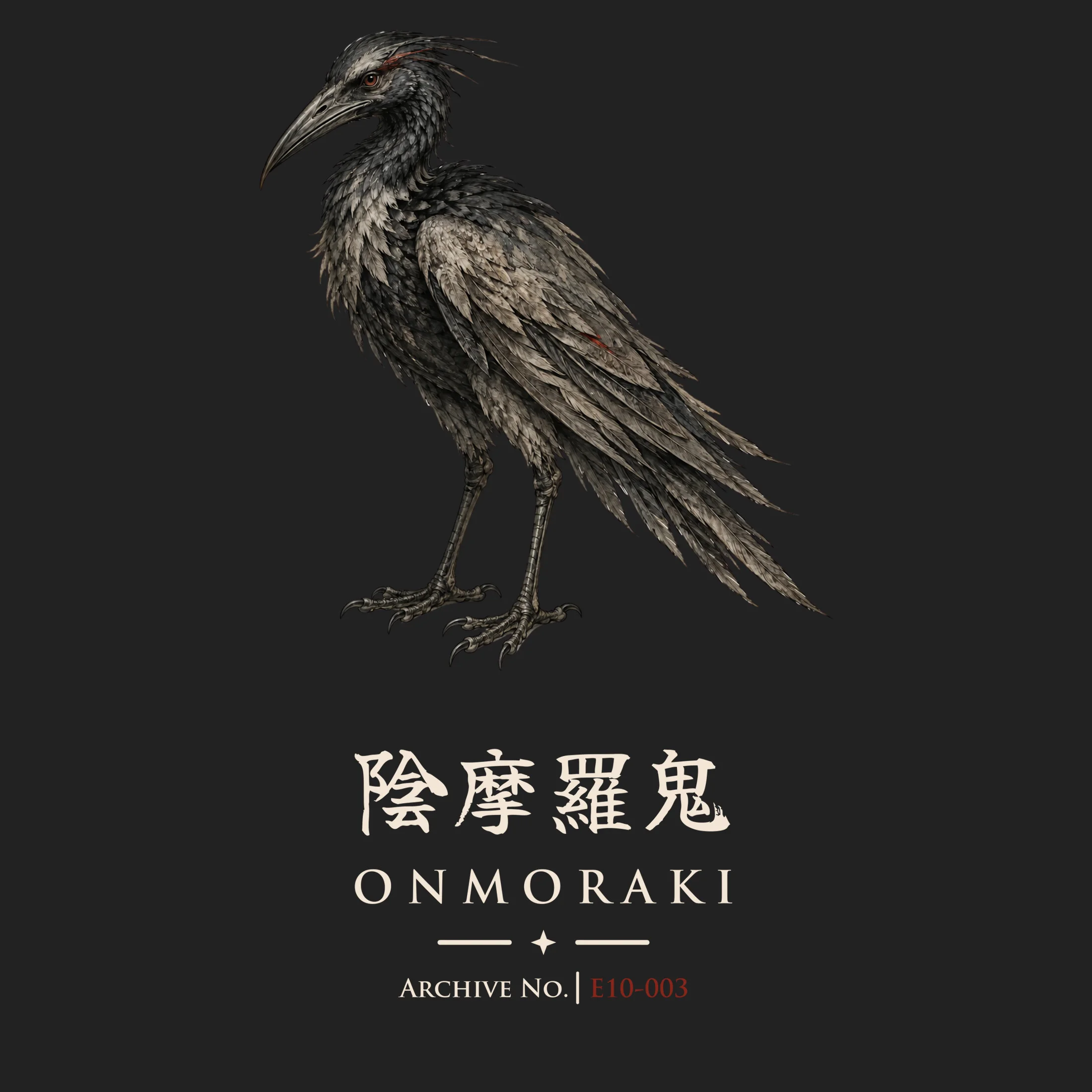
The Bird That Rises from the Unburied Dead
| Japanese Name | 陰摩羅鬼 |
| Romanization | Onmoraki |
| Classification | Corpse-Born Spirit |
| Expedition | Expedition X — Spirits of Death |
| Threat Level | ■■■□□ (Level III – Dangerous) |
| First Recorded | Taihe Hyakumonogatari — 1732 CE |
Some things emerge from the forest.
Others emerge from what humans fail to bury properly.
The Onmoraki is a strange and unsettling yōkai associated with death, neglected corpses, and the boundary between proper ritual and spiritual disorder. It is commonly described as a monstrous bird with a dark body and a disturbing humanlike face, appearing near the dead when funerary rites have been ignored or left incomplete.
Unlike spirits born from mountains, trees, or animals, the Onmoraki is closely tied to the treatment of the human body after death.
In Buddhist-influenced accounts, a corpse that has not received the proper prayers or memorial rites may become vulnerable to supernatural transformation. From that neglect, the Onmoraki is said to appear.
Its form reflects the unease of that origin.
A bird is a creature of movement, able to rise above the earth and cross distances that humans cannot. But the Onmoraki remains connected to a body that should already have been laid to rest. It is neither fully corpse nor fully animal, neither properly dead nor truly alive.
That incompleteness is what gives it its power.
Stories describe the creature appearing near temples, graveyards, or places where the dead have been forgotten. Its cry may disturb the night, and its presence becomes a warning that something essential has been left unresolved.
The fear surrounding the Onmoraki is therefore not simply fear of death.
It is fear of improper passage.
Many Japanese traditions place great importance on rituals that guide, honour, and remember the dead. When those rituals fail, the boundary between the living and the deceased becomes unstable. The Onmoraki embodies the consequences of that instability.
Within Sacred Forests, it represents a different kind of contamination.
The wilderness itself has not become hostile.
Human neglect has created the disturbance.
Where the Jubokko grows from violence absorbed into the soil, the Onmoraki emerges from a death that has not been given the care required to become final. Both suggest that the past does not simply disappear when humans turn away from it.
Something remains.
Something changes.
Something may return.
The Onmoraki also adds a new dimension to the expedition: the supernatural does not always wait patiently in ancient places. Sometimes it is created by failure, by omission, by rituals left undone.
The traveller may hear wings overhead and assume that a bird has been disturbed among the trees.
Perhaps it has.
But if the shape above carries a human face, the more important question is not what it is.
It is what happened here before you arrived.
And why no one finished what they began.

The Dead Who Would Not Be Ignored
| Japanese Name | 御霊 |
| Romanization | Goryō |
| Classification | Vengeful Spirit |
| Expedition | Expedition X — Spirits of Death |
| Threat Level | ■■■■□ (Level IV – Severe) |
| First Recorded | Heian Period — 9th Century CE |
Some spirits are born from the wilderness.
Others are created by injustice.
The Goryō are powerful vengeful spirits associated with people who died in anger, disgrace, exile, betrayal, or political conflict. In Japanese belief, especially during the Heian period, sudden disasters such as epidemics, fires, storms, and social unrest could be interpreted as signs that the dead had not accepted what happened to them.
A wronged person might die.
But the grievance could remain.
The fear surrounding Goryō was therefore not simply fear of ghosts. It was fear that unresolved human conflict could continue beyond death and return with enough force to affect entire communities.
These spirits were often associated with individuals of status or influence whose deaths were considered unjust or politically charged. If misfortune followed, people might suspect that the deceased had become a Goryō and was taking revenge upon the living.
The response was not always confrontation.
Sometimes it was reverence.
One of the most striking aspects of Goryō belief is the idea that a dangerous spirit could be pacified through ritual, worship, offerings, and the granting of divine status. Shrines were established for certain feared dead, transforming resentment into protection.
A spirit that threatened the community could, if properly honoured, become its guardian.
This creates a very different relationship between humans and the supernatural.
The Goryō is not evil by nature.
It is wronged.
Its violence grows from memory, humiliation, and unfinished grievance.
Within Sacred Forests, the Goryō introduces the idea that a haunting may belong not to the land itself, but to the history carried through it.
A quiet grove may once have witnessed exile.
A path may cross the place where someone was betrayed.
A shrine hidden among the trees may not exist because the place was always sacred.
It may exist because something dangerous needed to be remembered.
The Goryō shows how memory can reshape a landscape. Human conflict becomes ritual. Fear becomes devotion. A place associated with death becomes a place of worship.
And over time, the boundary between vengeance and protection begins to blur.
The traveller may see only an old shrine beneath the trees.
A few weathered offerings.
A name almost forgotten.
But the shrine may be there for a reason.
Some spirits are worshipped because they are benevolent.
Others are worshipped because people remember what happened when they were ignored.

The Spirit That Remains After Death
| Japanese Name | 死霊 |
| Romanization | Shiryō |
| Classification | Restless Spirit |
| Expedition | Expedition X — Spirits of Death |
| Threat Level | ■■■□□ (Level III – Variable) |
| First Recorded | Early 9th Century CE — Nihon Ryōiki |
Not every ghost is driven by revenge.
Some simply remain.
The Shiryō is a spirit of the dead, a broad term for the presence of someone who has died but has not fully departed from the world of the living. Unlike the Goryō, whose haunting is often shaped by injustice and vengeance, a Shiryō may linger for many reasons: attachment, grief, confusion, unfinished duty, or a bond too strong to disappear with death.
Its presence is often quiet.
A familiar voice heard where no one stands.
A figure glimpsed at the edge of a path.
A room that suddenly feels occupied.
The sense that someone who should be gone is still near.
In Japanese spiritual traditions, the relationship between the living and the dead is shaped by remembrance, ritual, and care. Ancestors may be honoured and welcomed through established customs, while the spirits of those who die suddenly, violently, or without proper rites may be treated with greater unease.
The Shiryō exists somewhere within that uncertainty.
It is not necessarily monstrous. It does not need to attack, deceive, or even reveal itself clearly. What makes it unsettling is the possibility that death has not created as complete a separation as the living would like to believe.
The boundary remains open.
Stories of the dead returning often reflect deeply human concerns. A spirit may appear because it cannot abandon a loved one. It may return to complete a promise, seek recognition, or simply repeat the habits of a life it no longer possesses.
Sometimes the haunting is frightening.
Sometimes it is almost tender.
That ambiguity distinguishes the Shiryō from more visibly threatening yōkai. The spirit itself may not understand that its presence causes fear. It may be less an intruder than someone who has failed to realize that they no longer belong.
Within Sacred Forests, the Shiryō brings death into the landscape without spectacle.
There is no monstrous tree, falling head, or burning apparition.
Only absence behaving like presence.
A forest path is especially suited to such encounters. Mist obscures distance. Trees interrupt the line of sight. Footsteps sound different when there is no one else nearby. The mind begins to fill the spaces between what is seen and what is remembered.
Perhaps the figure ahead is another traveller.
Perhaps the voice belongs to someone waiting beyond the trees.
Or perhaps the forest has given the dead one more place to walk.
The Shiryō asks a simple question that is difficult to answer:
When someone dies, what exactly leaves?
And what, if anything, stays behind?

The Spirit That Leaves the Living Body
| Japanese Name | 生霊 |
| Romanization | Ikiryō |
| Classification | Living Spirit |
| Expedition | Expedition X — Spirits of Death |
| Threat Level | ■■■□□ (Level III – Dangerous) |
| First Recorded | Genji Monogatari — c. 1001–1014 CE |
Not every ghost belongs to the dead.
Some are created by the living.
The Ikiryō is a spirit believed to separate from a person who is still alive, often under the force of intense emotion. Jealousy, grief, hatred, obsession, or resentment may become so powerful that part of the self is thought to leave the body and act independently.
Unlike a Shiryō, the spirit of someone already dead, the Ikiryō is tied to a living source.
That makes it especially unsettling.
The person responsible may not know what is happening.
In traditional stories, an Ikiryō may appear near the object of its emotion, causing illness, nightmares, exhaustion, fear, or other unexplained disturbances. Sometimes it resembles the person from whom it came. In other accounts, its presence is sensed rather than clearly seen.
The haunting can begin before anyone understands that a haunting exists.
One of the most famous expressions of this idea appears in The Tale of Genji, where overwhelming jealousy is associated with a living spirit that torments another woman. The episode captures a central fear surrounding the Ikiryō: emotion itself can become powerful enough to cross the boundary of the body.
No death is required.
No deliberate ritual is necessary.
The spirit emerges because feeling has become impossible to contain.
This separates the Ikiryō from many supernatural beings whose origins lie in remote landscapes, ancient objects, or forgotten graves. Its source is immediate and human.
The danger is already among the living.
Stories of Ikiryō also blur the line between intention and responsibility. If a person unconsciously sends out a spirit, are they guilty of what it does? Can resentment harm someone even when the person carrying it never chooses to act?
The Ikiryō gives supernatural form to that uncomfortable possibility.
Emotion leaves a trace.
Thought acquires presence.
What is hidden inside one person begins to affect another.
Within Hyakki, the Ikiryō represents a haunting without a corpse and a ghost without death. It suggests that the boundary between body and spirit is less secure than it appears.
A person may be standing miles away.
They may be asleep.
They may insist they have done nothing.
And perhaps they are telling the truth.
But somewhere else, a familiar figure may already be standing beside the bed.
Watching.
Breathing.
Carrying every feeling its owner tried to keep inside.
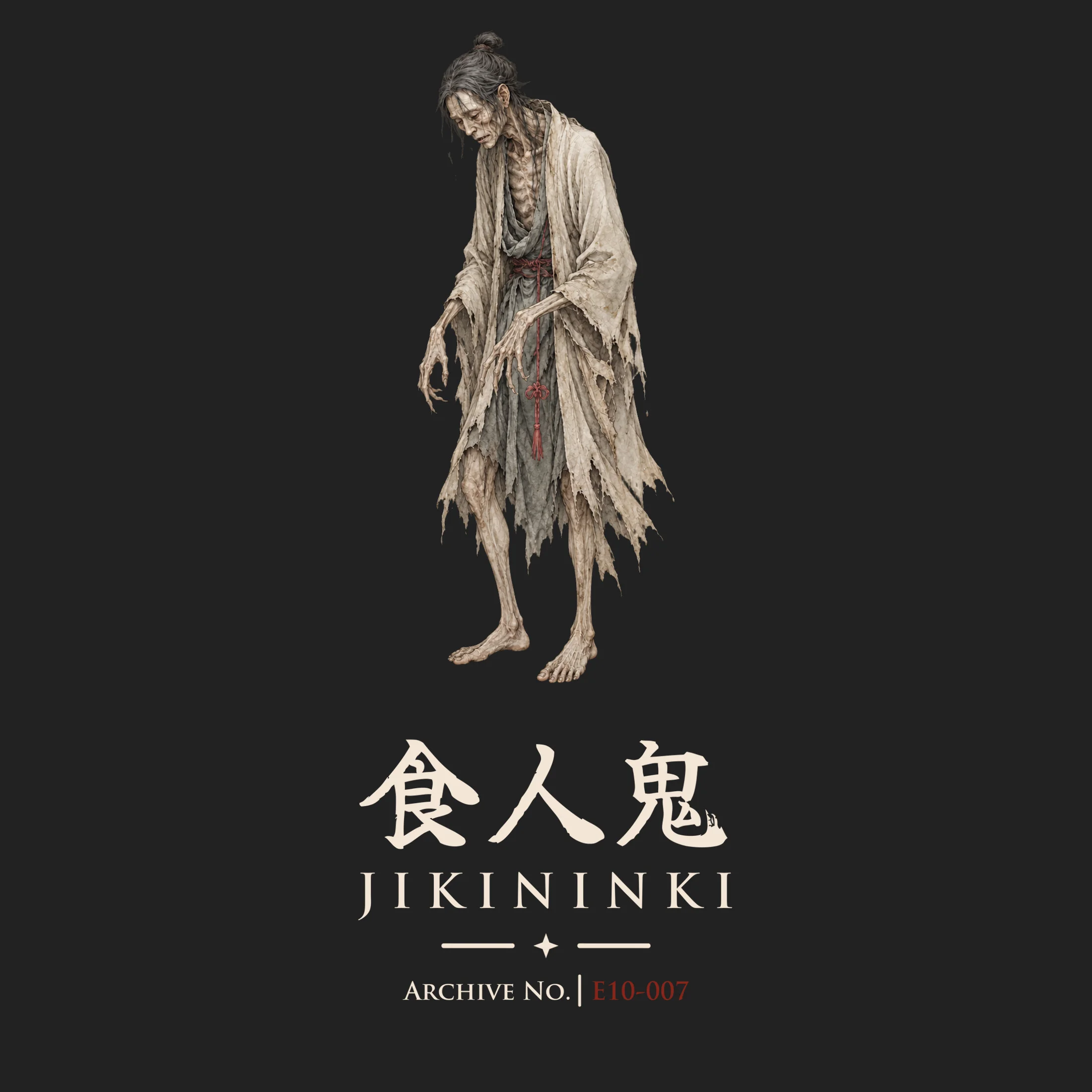
The Corpse-Eater Condemned by Hunger
| Japanese Name | 食人鬼 |
| Romanization | Jikininki |
| Classification | Corpse-Eating Spirit |
| Expedition | Expedition X — Spirits of Death |
| Threat Level | ■■■■□ (Level IV – Severe) |
| First Recorded | Kwaidan — 1904 CE |
Some spirits return because they cannot let go.
Others return because they are condemned to hunger.
The Jikininki is a cursed being from Japanese Buddhist folklore, often described as the restless spirit of a person whose greed, selfishness, or corruption in life has followed them beyond death. Their punishment is brutal and fitting: they are forced to consume the corpses of the newly dead.
The horror of the Jikininki lies not only in what it does, but in what it remembers.
Unlike a mindless monster, the Jikininki is often portrayed as retaining some awareness of its former humanity. It knows what it has become. It may feel shame, grief, or disgust, yet remain unable to resist the hunger that defines its existence.
In some stories, the Jikininki was once a monk who neglected spiritual duties for wealth or personal gain. After death, that failure becomes physical. A person who should have protected the dignity of the dead is transformed into a creature that violates it.
The sacred role is reversed.
Ritual becomes desecration.
Compassion becomes appetite.
Jikininki are commonly associated with graveyards, remote temples, isolated villages, and places where corpses are left unattended. Their presence transforms the stillness surrounding death into something far more threatening.
A body at rest is no longer safe.
Night itself becomes a period of vulnerability.
The Jikininki also reflects a broader Buddhist idea that desire can become its own punishment. Greed does not simply disappear when life ends. It may continue, stripped of pleasure and transformed into endless need.
What was once chosen becomes compulsory.
What once seemed valuable becomes a curse.
Within Hyakki, the Jikininki stands at the intersection of death, morality, and transformation. It is not born from the forest or created by a violent landscape. Its origin lies in human failure.
That makes it deeply uncomfortable.
The monster was once a person.
Perhaps a respected one.
Perhaps someone trusted with sacred responsibility.
Now all that remains is hunger.
And the worst part may be that somewhere inside the creature, the person is still present.
Still aware.
Still ashamed.
Still waiting for the next body to be left alone.

The Presence That Calls Toward Death
| Japanese Name | 死神 |
| Romanization | Shinigami |
| Classification | Death-Associated Spirit |
| Expedition | Expedition X — Spirits of Death |
| Threat Level | ■■■□□ (Level III – Dangerous) |
| First Recorded | 1709 CE — Chikamatsu Monzaemon |
Some dangers announce themselves from the road ahead.
Others wait above it.
The Tsurube-otoshi is a yōkai associated with remote forests and mountain paths, often described as a giant disembodied head that drops suddenly from the branches of tall trees onto unsuspecting travellers below.
Its name evokes the image of a tsurube, the bucket traditionally lowered into a well. Like that bucket, the creature descends vertically and without warning. One moment the path is empty. The next, something enormous falls from the darkness overhead.
Accounts vary in appearance and behaviour. In some stories, the Tsurube-otoshi resembles the gigantic head of a human or monk. In others, it is more monstrous, its face distorted by hunger or amusement. Some traditions describe it crushing victims beneath its weight. Others portray it as frightening travellers simply for the pleasure of watching them panic.
What remains consistent is the direction of the threat.
The traveller looks forward.
The Tsurube-otoshi waits above.
That simple reversal makes it particularly effective as a creature of the forest. Dense woodland naturally limits visibility. Branches overlap. The canopy conceals movement. At dusk, the space overhead becomes a continuous field of shadow, close enough to feel protective and dark enough to hide almost anything.
The Tsurube-otoshi turns that shelter into uncertainty.
A tree is no longer simply something beside the path. Its branches become a possible hiding place. A rustle above may be a bird, a falling branch, or the first warning that something much heavier is about to descend.
Within Sacred Forests, the Tsurube-otoshi introduces another dimension to the landscape.
The traveller has already learned to mistrust paths, voices, trees, and distant lights.
Now even the direction of danger can no longer be assumed.
The forest surrounds the body completely. Roots lie beneath the feet. Trunks close around the path. Branches meet overhead. There is no single direction from which the supernatural must approach.
And unlike spirits that guard sacred places or punish deliberate disrespect, the Tsurube-otoshi can feel almost arbitrary.
You do not need to disturb a shrine.
You do not need to cut down a sacred tree.
Sometimes it is enough simply to pass beneath the wrong branches at the wrong moment.
So the traveller learns another rule.
Watch the path.
Watch the trees.
And occasionally, look up.

The Dead Who Return
| Japanese Name | 幽霊 |
| Romanization | Yūrei |
| Classification | Ghost of the Dead |
| Expedition | Expedition X — Spirits of Death |
| Threat Level | ■■■□□ (Level III – Variable) |
| First Recorded | 1089 CE — Chūyūki |
Some spirits return with purpose.
Others return because something remains unfinished.
The Yūrei is one of the most recognizable forms of ghost in Japanese tradition, the lingering spirit of a dead person who has not fully passed on. It may remain because of grief, love, betrayal, anger, duty, or a death so sudden that separation from the living world never feels complete.
Unlike more specialized spirits, the Yūrei is a broad category.
It is not defined by one motive.
A Yūrei may seek revenge, mourn someone left behind, guard a place, repeat an old habit, or simply appear without revealing why.
Its presence is often tied to attachment.
Something in the living world still matters.
Something has not been released.
Traditional depictions of Yūrei became especially recognizable during the Edo period. They are often shown with pale faces, long dark hair, white burial garments, and hands hanging loosely before the body. Their lower form may fade away rather than end in visible feet, giving the impression that the spirit is no longer fully bound to the physical world.
This appearance became deeply influential, but the image should not be mistaken for a single fixed rule. Yūrei stories vary widely, and many spirits appear almost exactly as they did in life.
What matters is the disturbance they create.
A room feels occupied when it should be empty.
A figure stands where no one could have entered.
A familiar voice is heard after the person who owned it has died.
The Yūrei turns absence into presence.
Within Japanese traditions surrounding death, proper funerary and memorial rites help maintain the relationship between the living and the dead. A spirit that remains outside that order can become unsettling precisely because it suggests that the expected passage has failed.
The dead have not gone where they were supposed to go.
Within Hyakki, the Yūrei stands at the heart of the boundary between life and death.
Unlike the Ikiryō, its body is already gone. Unlike the Goryō, it does not require vengeance. Unlike the Shinigami, it does not wait for death to arrive.
It is what may remain afterward.
That makes the Yūrei frightening, but also deeply human.
A haunting may begin with hatred.
It may also begin with love.
With longing.
With a promise.
With someone who simply could not leave.
The figure at the end of the corridor may not want to harm you.
It may only want to be seen.
And sometimes, that is enough.

The Four-Eyed Exorcist Who Drove Out the Dead
| Japanese Name | 方相氏 |
| Romanization | Hōsōshi |
| Classification | Ritual Exorcistic Figure |
| Expedition | Expedition X — Spirits of Death |
| Threat Level | ■□□□□ (Level I – Protective) |
| First Recorded | 706 CE — Shoku Nihongi |
Not every supernatural figure is something to fear.
Some were created to confront fear itself.
The Hōsōshi is a ritual exorcistic figure associated with driving away evil spirits, disease, and dangerous supernatural influences. Rather than belonging purely to folklore, the Hōsōshi emerged from formal ceremonial tradition, entering Japan through practices adapted from ancient China and becoming part of court rituals concerned with purification and protection.
Its appearance was deliberately imposing.
Traditional descriptions place the Hōsōshi behind a four-eyed mask, dressed in dark clothing with red garments and carrying a spear or halberd together with a large shield. The four eyes allowed the figure to symbolically watch in every direction, searching out harmful spirits wherever they attempted to hide.
The Hōsōshi played an important role in tsuina, a courtly exorcism ritual intended to expel pestilence and malevolent forces. Moving through the palace and toward its gates, the figure drove unwanted spirits outward, transforming ritual movement into a deliberate cleansing of space.
Its role also extended into funerary practice. Related traditions placed the Hōsōshi at the front of funeral processions, where its purpose was to protect the dead from harmful beings and clear the path toward burial.
This makes the Hōsōshi difficult to classify beside ordinary yōkai.
It is not simply a monster.
It is a human ritual role made deliberately supernatural.
The mask, weapon, costume, and ceremonial authority transform the performer into something capable of confronting forces invisible to everyone else.
There is also an intriguing reversal within its later history. The frightening appearance originally used to drive demons away gradually became visually associated with the very beings it was meant to oppose. The boundary between demon and demon-hunter began to blur.
Within Hyakki, the Hōsōshi represents something different from the spirits that precede it.
The Shiryō remains.
The Goryō returns.
The Shinigami waits.
But the Hōsōshi goes looking for what should not be there.
It enters the contaminated space deliberately.
Four eyes searching every direction.
Shield raised.
Weapon ready.
Its purpose is not to escape the supernatural.
It is to force the supernatural to retreat.
And perhaps that is what makes the figure so striking.
Behind the terrifying face is not a monster approaching the living.
It is someone standing between the living and whatever is approaching them.