The Design
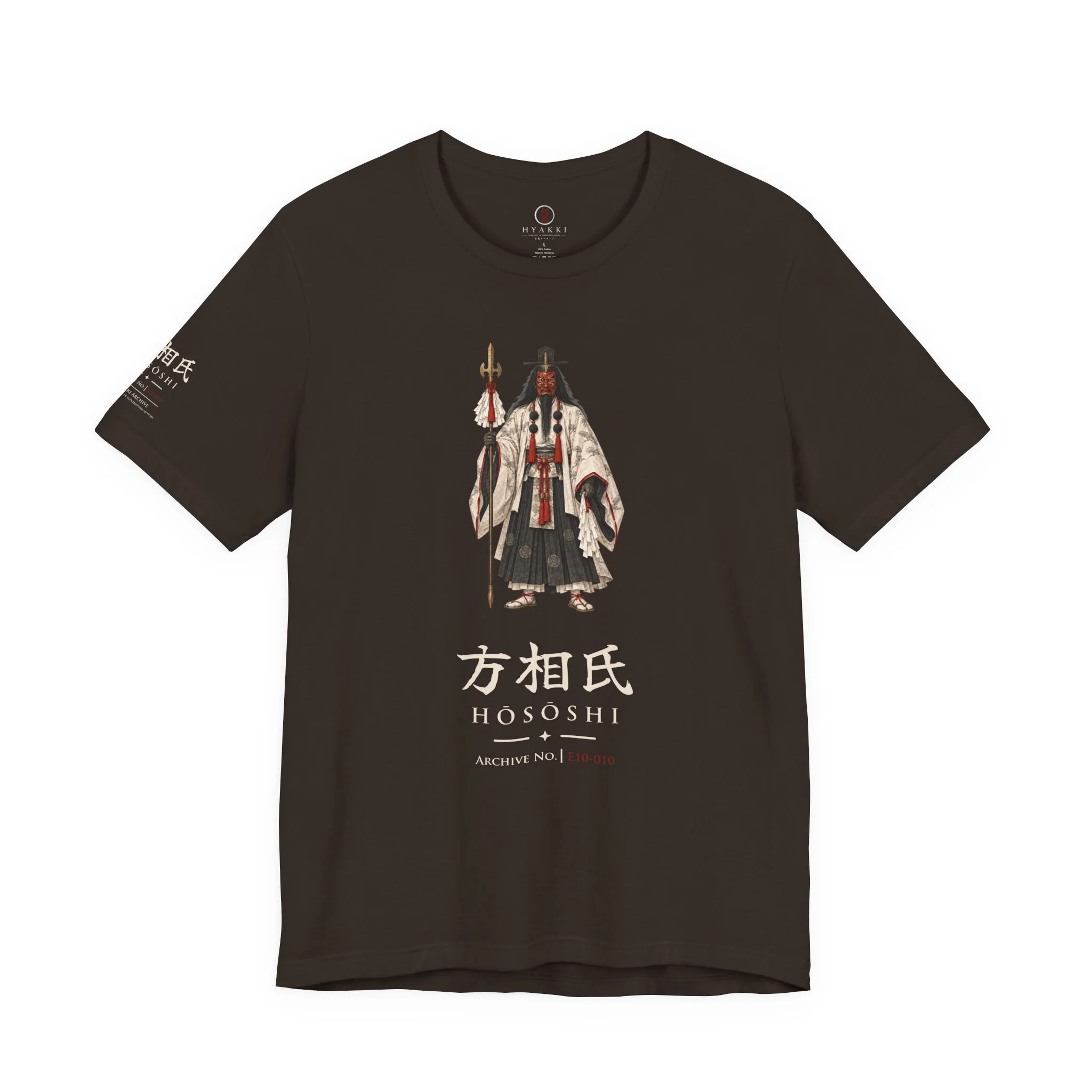
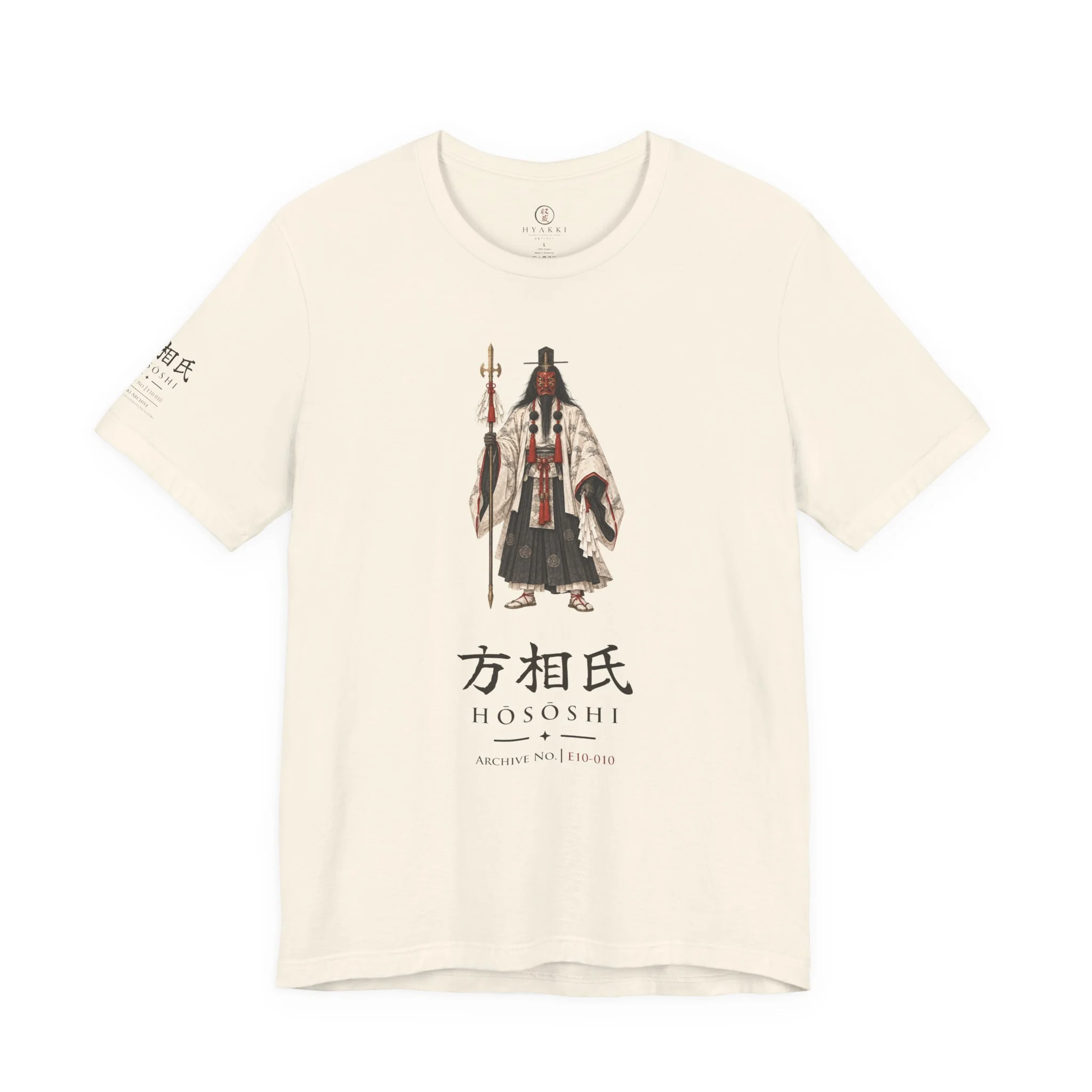
The E10-010 Hōsōshi design presents the figure as a commanding ritual exorcist rather than as a monster.
At the center stands a full-body ceremonial figure wearing layered white and black robes with restrained floral patterning, red cords, large black beads, and a formal black headpiece. The defining feature is the red four-eyed mask, immediately separating the figure from an ordinary court attendant and giving the design its ritual authority.
In one hand, the Hōsōshi carries a tall ceremonial staff with a metal spear-like head, red knotwork, and folded white paper streamers. The other hand holds additional ritual paper.
The overall silhouette is upright, symmetrical, and imposing.
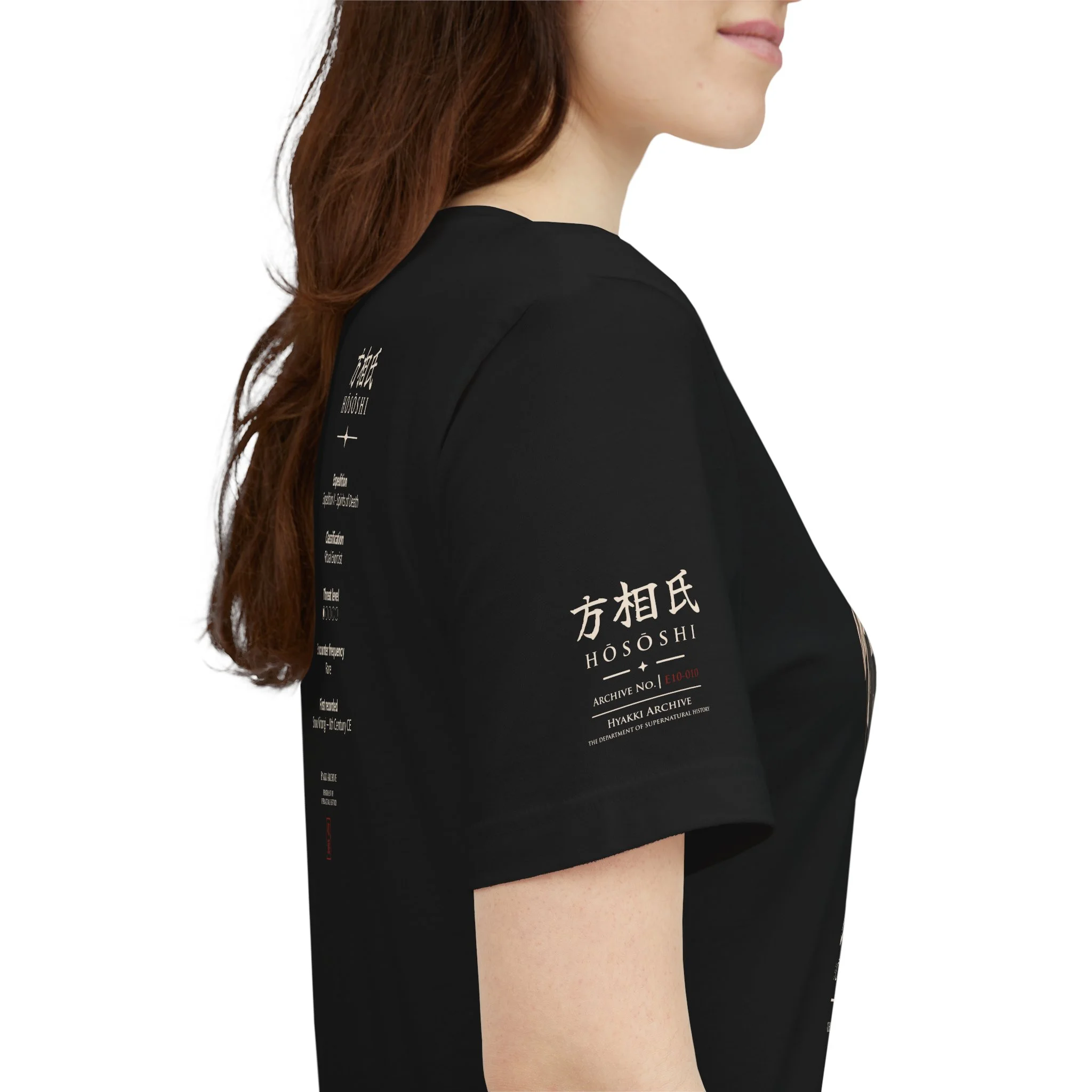
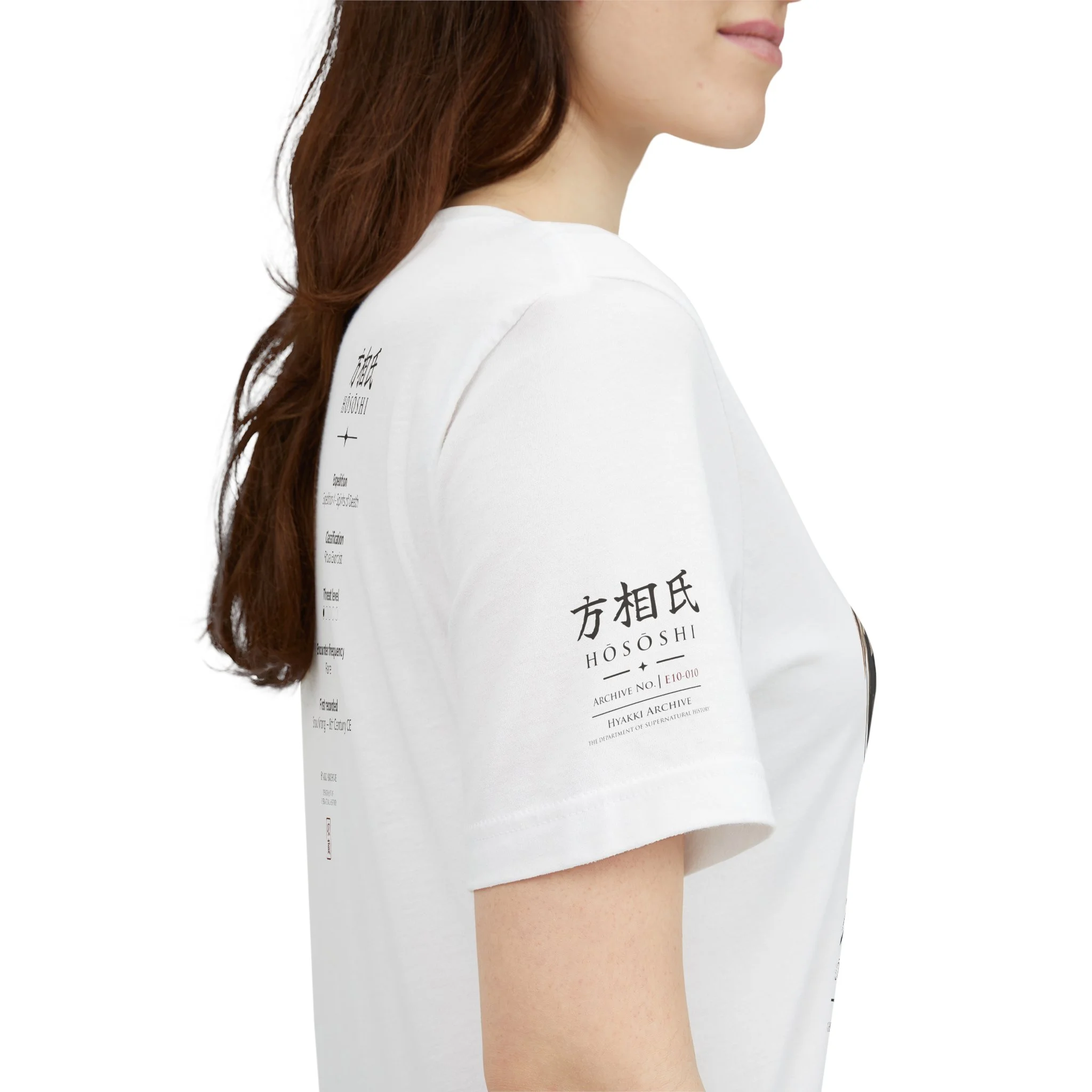
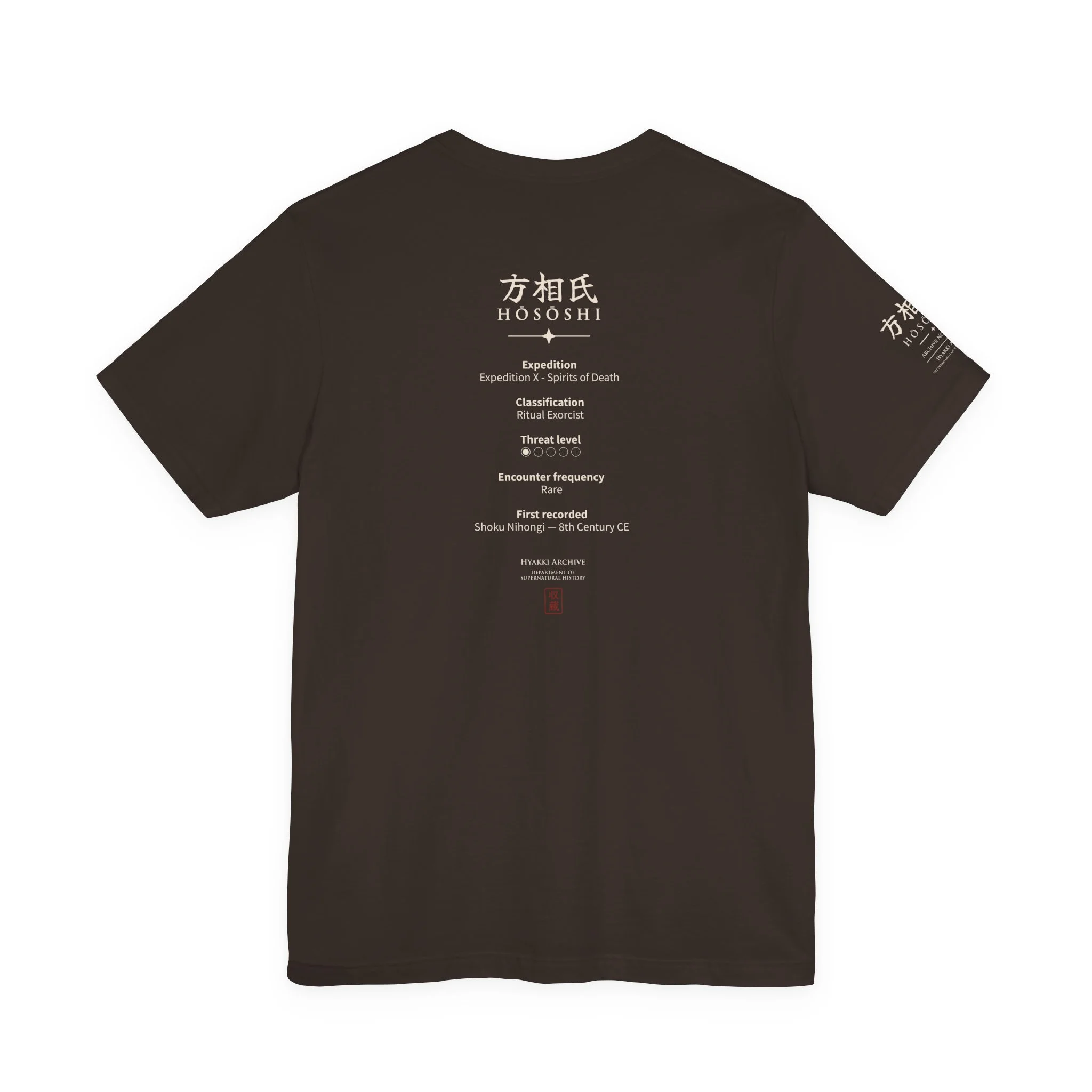
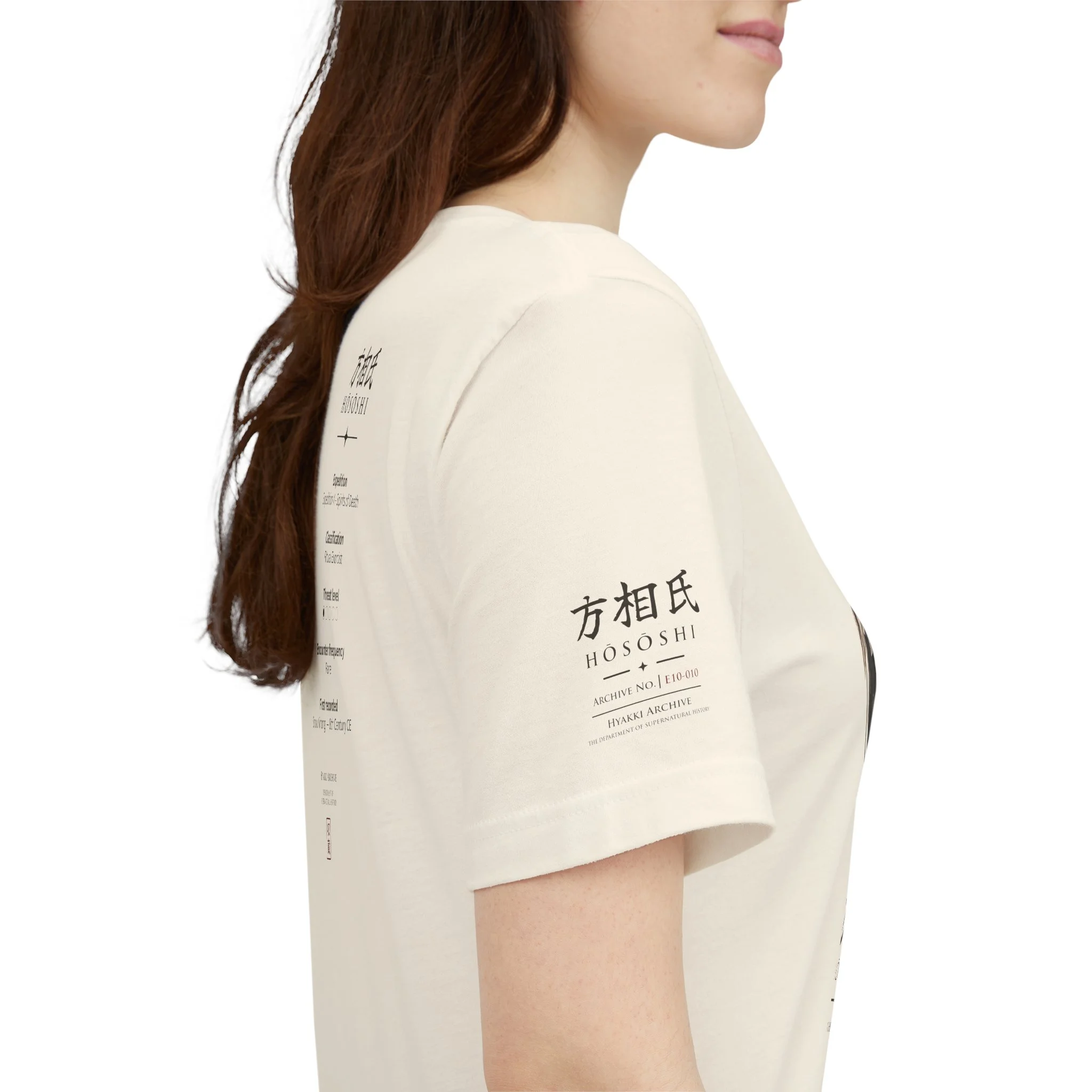
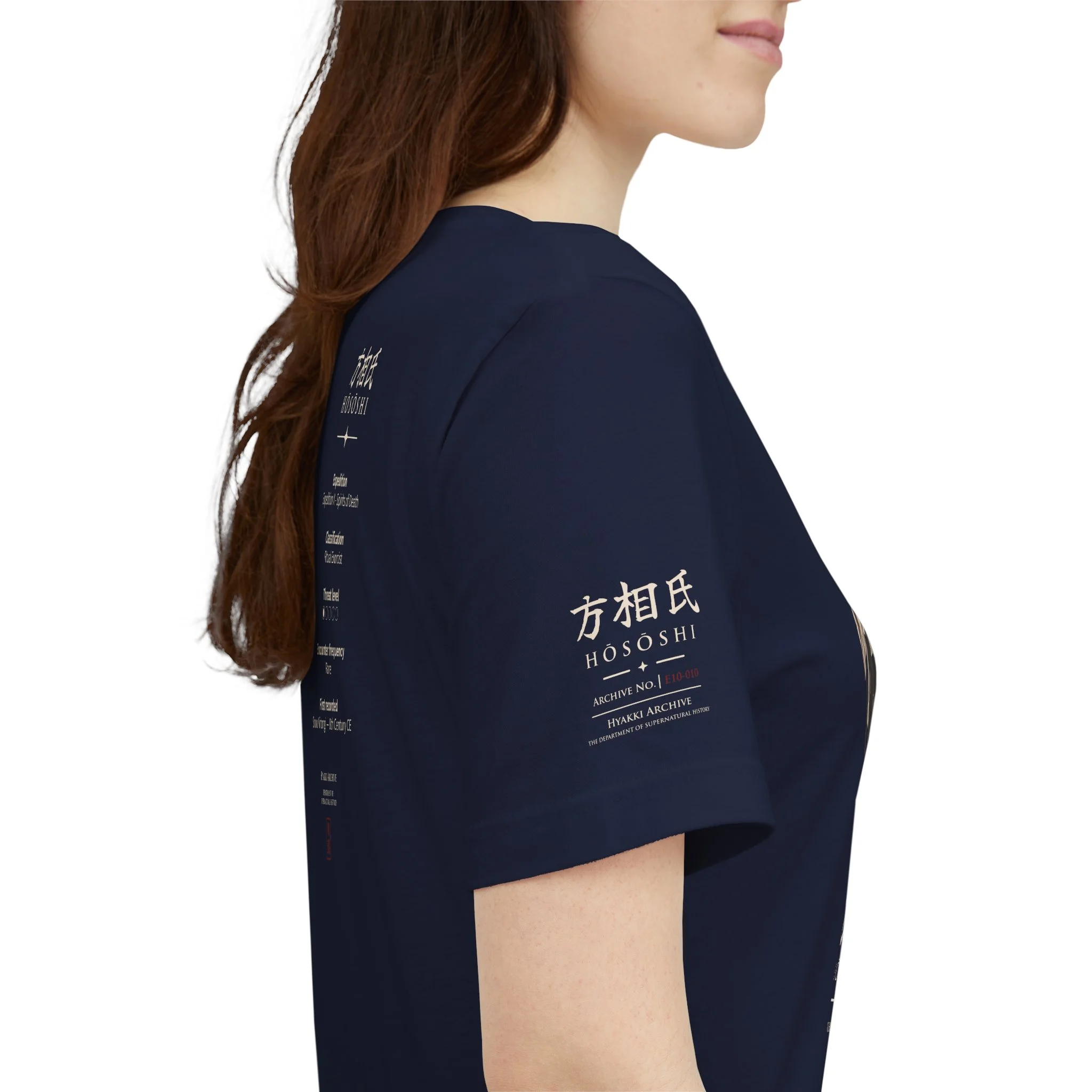
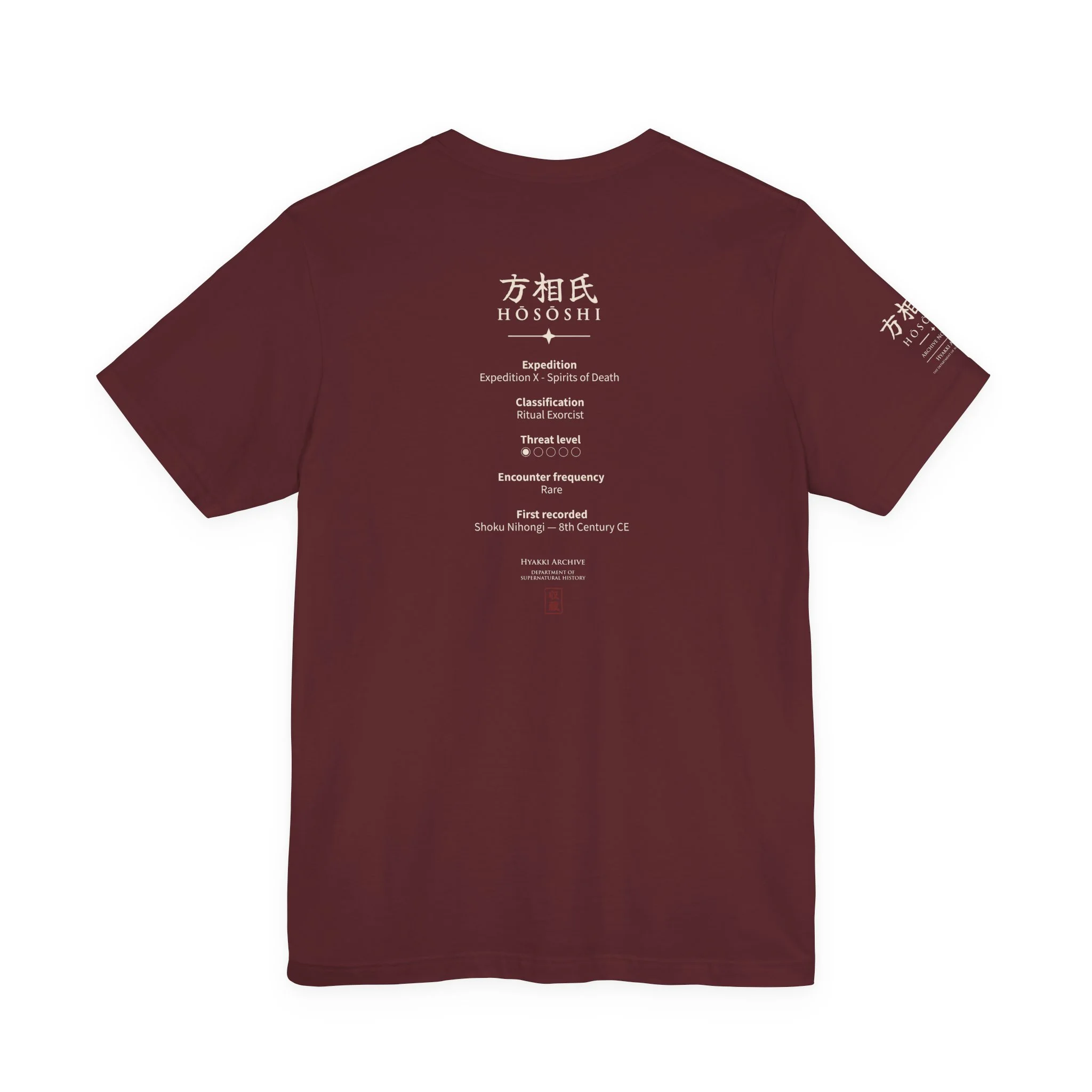
Beneath the illustration, 方相氏, HŌSŌSHI, and Archive No. E10-010 continue the established Hyakki archive format.
Unlike many entries in Spirits of Death, this figure is not presented as something stalking the living.
It is dressed to confront what does.
The Entity Behind the Design
Hōsōshi was historically a ritual exorcistic figure associated with tsuina, a ceremony used to expel harmful spirits, pestilence, and dangerous unseen influences.
The tradition ultimately came to Japan from China, where the related fangxiangshi occupied a comparable exorcistic role.
In early Japanese court ritual, the Hōsōshi was not the demon.
It was the one pursuing the demons.
That distinction is essential, because the figure’s frightening appearance can easily lead to the opposite impression. The extraordinary mask, ceremonial weaponry, and imposing costume were part of a ritual role designed to confront forces associated with disease, impurity, and supernatural danger.
The Hōsōshi therefore sits at an unusual boundary within the Hyakki Archive:
human in role, monstrous in appearance, protective in purpose.
Known For
Hōsōshi is best known for its role in tsuina, the ancient court ceremony of ritual expulsion.
During the rite, dangerous unseen influences were driven from the ceremonial space through movement, shouting, weapons, noise, and coordinated ritual action.
The most distinctive visual feature of the Hōsōshi is the four-eyed face or mask. The extra eyes were connected with the figure’s ability to perceive what ordinary people could not: the invisible beings it was expected to pursue.
Over time, however, the tradition changed.
As the Hōsōshi’s appearance became increasingly frightening and demon-like, later forms of the ceremony sometimes treated the Hōsōshi itself as the visible oni being driven away.
That reversal is one of the most fascinating parts of the tradition.
The exorcist became visually indistinguishable from the thing being expelled.
From Folklore to Design
This design leans directly into the ritual authority of the Hōsōshi.
The four-eyed red mask is the strongest historical anchor and immediately gives the figure its identity. Rather than making the face demonic for spectacle alone, the design uses the four eyes to suggest perception beyond ordinary human sight.
The ceremonial staff reinforces the figure’s active role. It does not appear decorative. Combined with the paper streamers and rigid upright posture, it makes the Hōsōshi look prepared to move into ritual space and confront something unseen.
The white outer robes prevent the figure from becoming visually indistinguishable from a conventional oni, while the black lower garments and red accents give the design enough severity to retain its intimidating presence.
Most importantly, the artwork does not depict the Hōsōshi as a supernatural beast.
It depicts a human figure transformed by costume, mask, and ritual office into something capable of facing supernatural danger.
From the Hyakki Archive
Archive File E10-010 closes Expedition X — Spirits of Death with the expedition’s clearest reversal.
Most of the archive has followed the dead.
The corpse that is stolen.
The mother who returns.
The spirit that refuses to leave.
The apparition that rises beside the body.
The presence that draws the living toward death.
Hōsōshi stands on the other side of that boundary.
It does not wait for the dead to return.
It goes looking for what should be driven out.
Four eyes face the unseen.
The staff is raised.
The ritual begins.
And for once, the thing wearing the most frightening face is there to protect the living.
収蔵
Research Post — E10-010 Hōsōshi
| Temperament |
Protective • Commanding • Ritualized |
| Activity |
Seasonal Exorcistic Ceremony |
| Encounter Frequency |
Restricted to Ritual Context |
| Habitat |
Imperial Court • Ceremonial Grounds • Later Temple and Festival Contexts |
| Known Variants |
Chinese Fangxiangshi • Japanese Court Hōsōshi • Later Oni-Like Ritual Forms |
01 · What Is It?
Hōsōshi is best understood as a ritual office or ceremonial figure, not as a supernatural species.
In ancient Japanese court ritual, the Hōsōshi took part in tsuina, an exorcistic ceremony intended to remove disease-bearing spirits, malign influences, and other dangerous presences at the transition into a new year.
The role had been transmitted from China, where related fangxiangshi figures already belonged to traditions of ritual exorcism. In Japan, the Hōsōshi became the central pursuer in the court ceremony, driving unseen demons away rather than embodying them. Rekihaku Archive
This distinction is essential for Hyakki.
Hōsōshi may look supernatural in later depictions, especially because of the elaborate mask and imposing costume, but historically it began as the one confronting the supernatural threat.
02 · Historical Record
The Japanese tsuina ceremony is documented by 706 CE, during the reign of Emperor Monmu. The Shoku Nihongi records the performance of the rite to expel epidemic-causing influences. The National Diet Library identifies this as one of the earliest documentary anchors for the Japanese tradition. 国立国会図書館
The rite had Chinese origins and became an established court ceremony in ancient and Heian-period Japan. The Hōsōshi served as the figure responsible for pursuing the invisible eki-ki, or pestilential demons, from the ceremonial space. レファレンス協同データベース
Later court manuals continued to describe tsuina as part of the annual ceremonial calendar. Works concerned with court ritual preserve it among the important observances conducted in the twelfth lunar month. D Museum
The tradition therefore has an unusually firm historical basis.
Hōsōshi is not a modern reconstruction of an imagined ancient exorcist.
It belonged to an actual ritual institution.
03 · Appearance
Hōsōshi was deliberately made to look extraordinary.
The traditional figure is especially associated with a four-eyed mask or face, an attribute inherited from the older Chinese exorcistic tradition. The unusual eyes expressed the Hōsōshi's ability to perceive threats that ordinary people could not see.
Historical descriptions also associate the role with striking ceremonial clothing and equipment intended to make the figure imposing while it pursued demons through the ritual space.
This appearance should not be mistaken for evidence that Hōsōshi was believed to be a biological monster.
The terrifying appearance was part of the office.
Its purpose was functional.
The figure had to confront beings associated with disease, impurity, and supernatural danger, so it was visually transformed into something capable of meeting them on their own terms.
For Hyakki, the four-eyed ceremonial face is therefore one of the most historically meaningful visual elements available.
04 · Behaviour & Encounters
The Hōsōshi did not wait passively for supernatural beings to appear.
Its role was to pursue them.
During tsuina, the ritual figure moved through the ceremonial space while participants used noise, weapons, and ritual actions to force dangerous unseen beings away. Sources describe shouting, drums or other loud sounds, and the use of bows and arrows in the broader ceremony. 国立国会図書館
The Hōsōshi therefore belongs to a very different encounter pattern from most entities in Spirits of Death.
A Yūrei returns.
A Goryō causes calamity.
A Kasha approaches the corpse.
The Hōsōshi goes toward the danger.
Its existence is defined by confrontation and expulsion rather than haunting.
This makes the figure one of the few entries in the expedition whose historical function was fundamentally protective.
05 · Belief, Ritual & Meaning
Tsuina was performed to remove harmful influences at a dangerous moment of transition.
The end of the year was understood as a time when accumulated impurity, illness, and supernatural danger needed to be expelled before the new cycle began. The Japanese court adopted the rite from China, and the Hōsōshi became its most visually distinctive participant. 国立国会図書館
The ritual was closely connected with fears of epidemic and unseen pestilential beings.
That makes the Hōsōshi particularly appropriate for Spirits of Death. It does not personify death itself. Instead, it stands on the side of the living, confronting forces thought capable of bringing disease and death into the community.
The figure also reveals an important feature of historical ritual:
sometimes the person responsible for confronting the monstrous must temporarily look monstrous themselves.
The frightening appearance is not proof of corruption.
It is ritual authority made visible.
06 · Variations & Later Development
The most fascinating part of the Hōsōshi tradition is that its role eventually reversed.
In the older ceremony, the Hōsōshi expelled invisible demons.
By the late Heian period and into the Kamakura and Muromachi periods, the strange appearance of the Hōsōshi increasingly caused the figure itself to be treated as the visible oni. Participants then symbolically drove the Hōsōshi away. レファレンス協同データベース
This is an extraordinary transformation.
The exorcist became the demon.
At the same time, tsuina traditions gradually interacted with the customs surrounding Setsubun. The National Diet Library notes that the older court rite and later bean-throwing traditions were originally distinct, although they eventually became closely associated in popular practice. 国立国会図書館
Modern oni-expulsion customs therefore preserve traces of a much older ritual history, even though the original Hōsōshi role is no longer obvious to most participants.
07 · What We Actually Know
| Hōsōshi was a ritual participant in the Japanese tsuina ceremony |
DOCUMENTED |
| Tsuina was introduced to Japan from China |
DOCUMENTED |
| The ceremony is documented in Japan by 706 CE |
DOCUMENTED |
| The original Hōsōshi role was to drive away pestilential and dangerous spirits |
DOCUMENTED |
| The four-eyed appearance belongs to the traditional exorcistic iconography |
DOCUMENTED |
| Hōsōshi was originally a supernatural demon being hunted by humans |
INCORRECT |
| Later tradition sometimes reversed the role and treated the Hōsōshi itself as the oni being expelled |
DOCUMENTED |
| Modern Setsubun demon-expulsion customs developed partly from the older tsuina tradition |
DOCUMENTED |
















Reviews
There are no reviews yet.