The Design
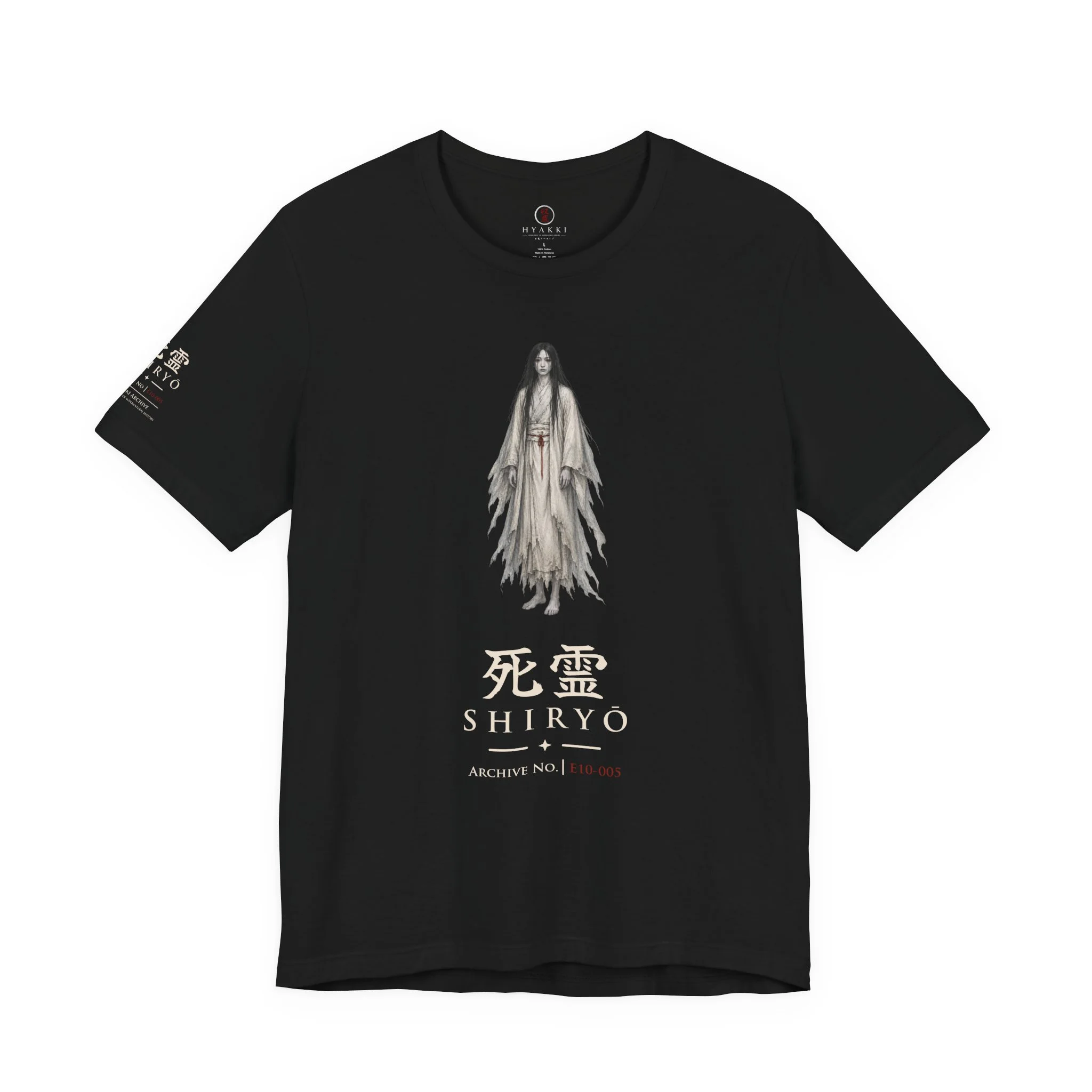
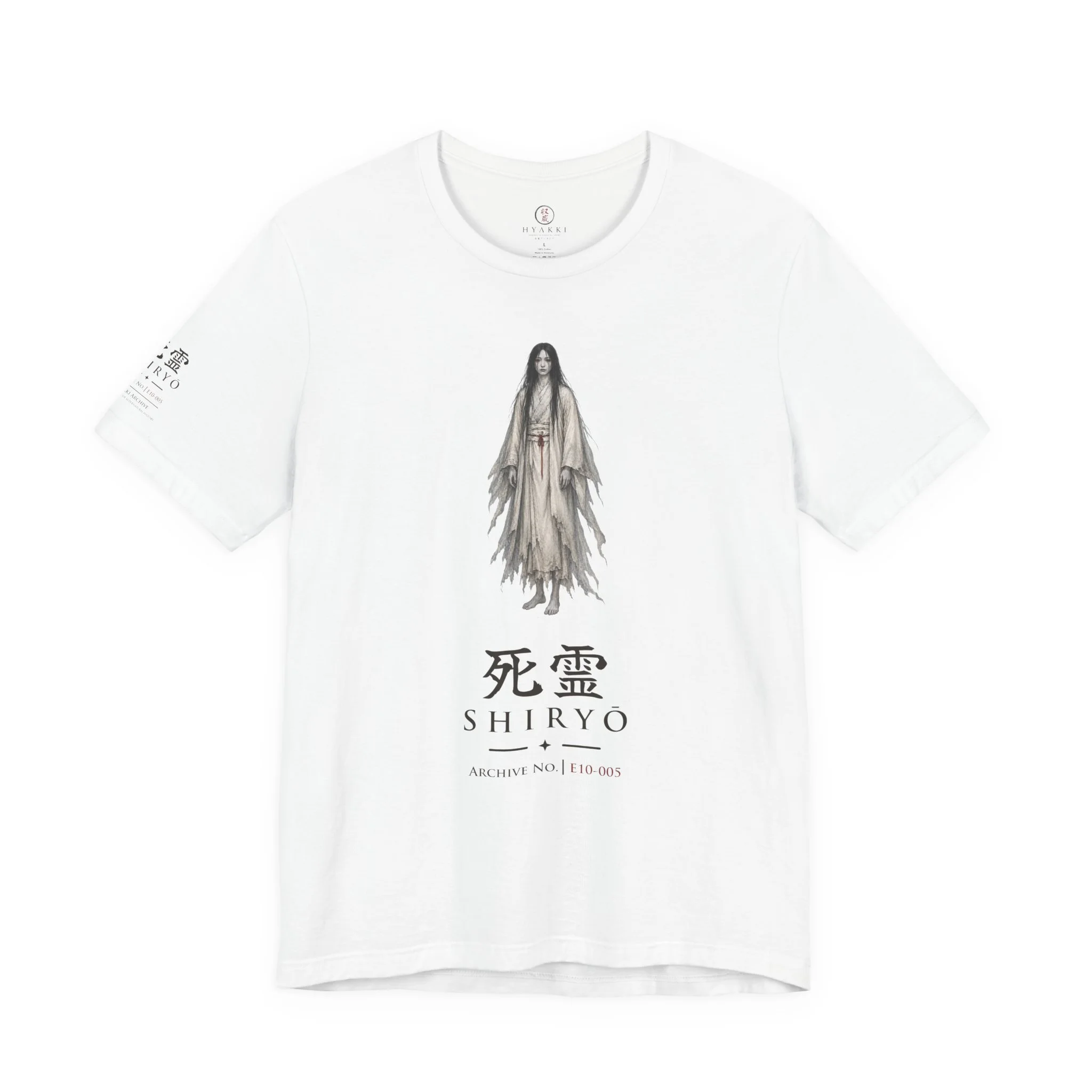
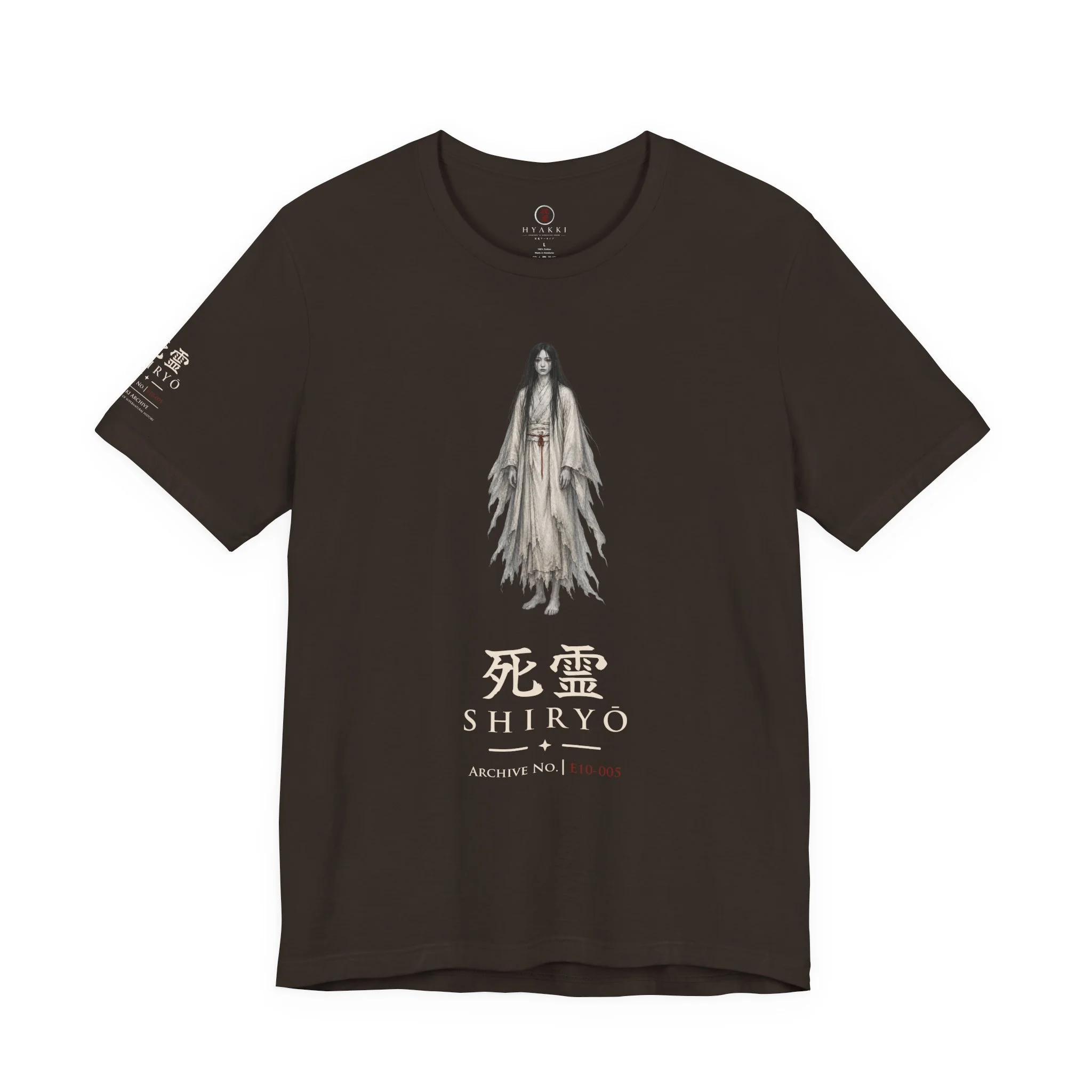
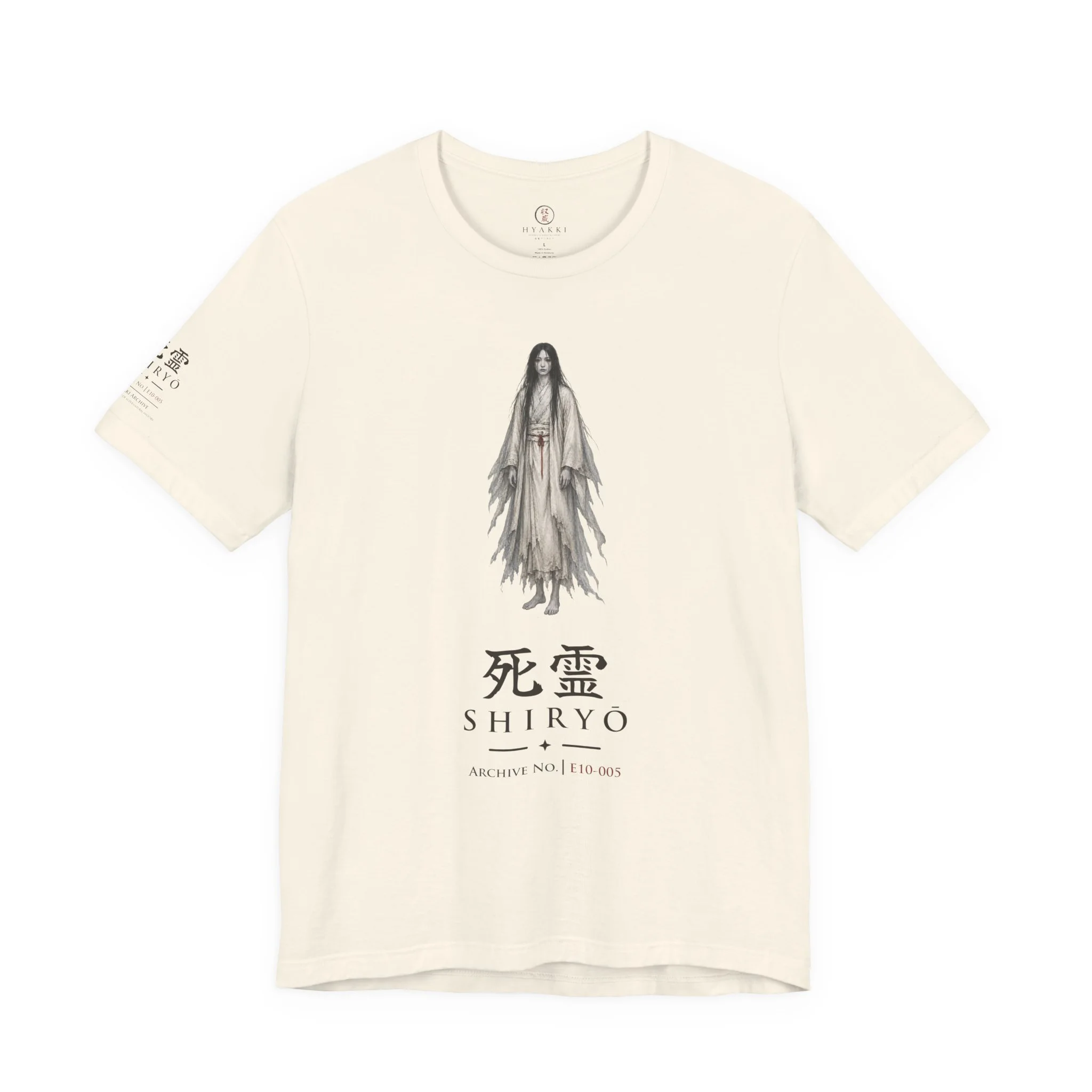
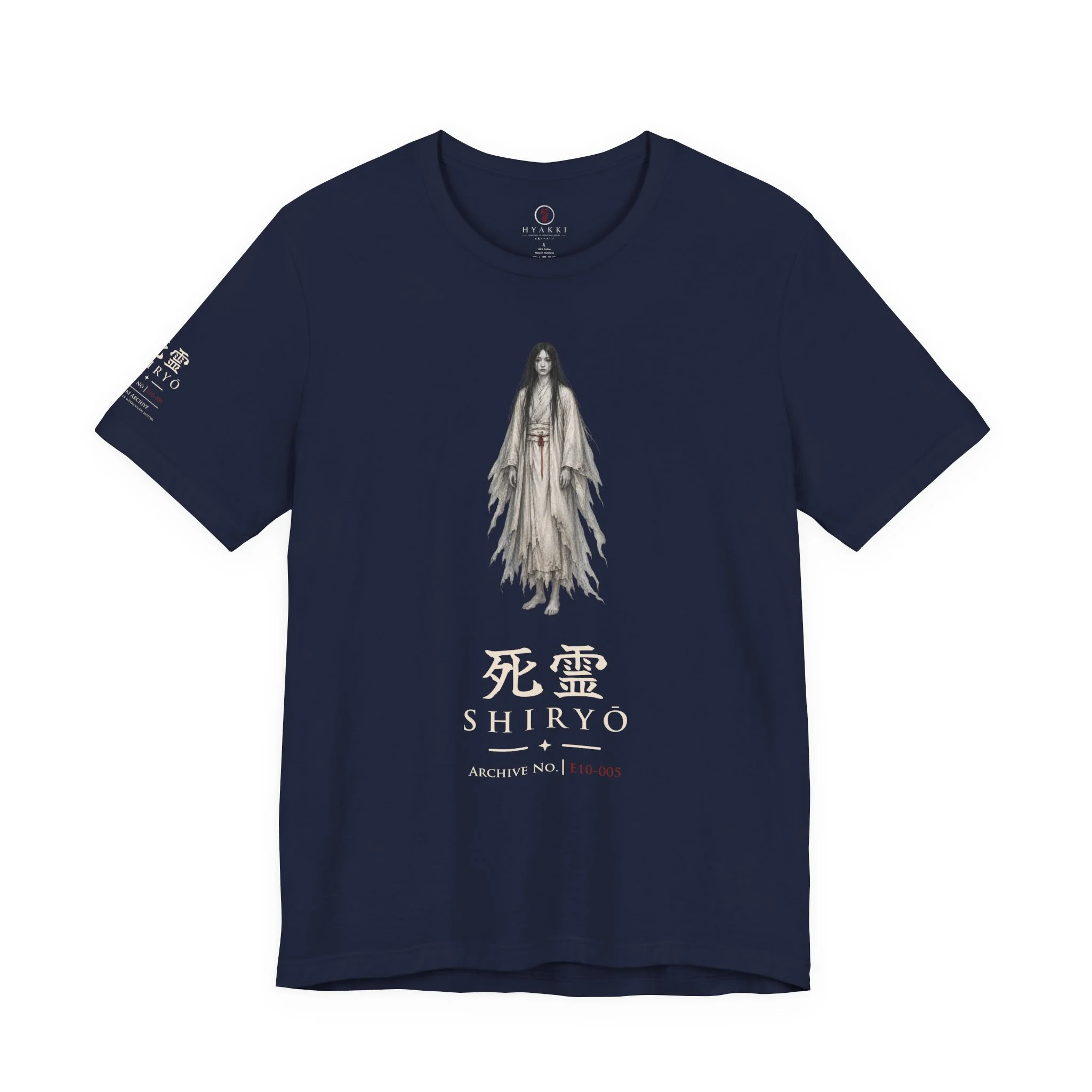
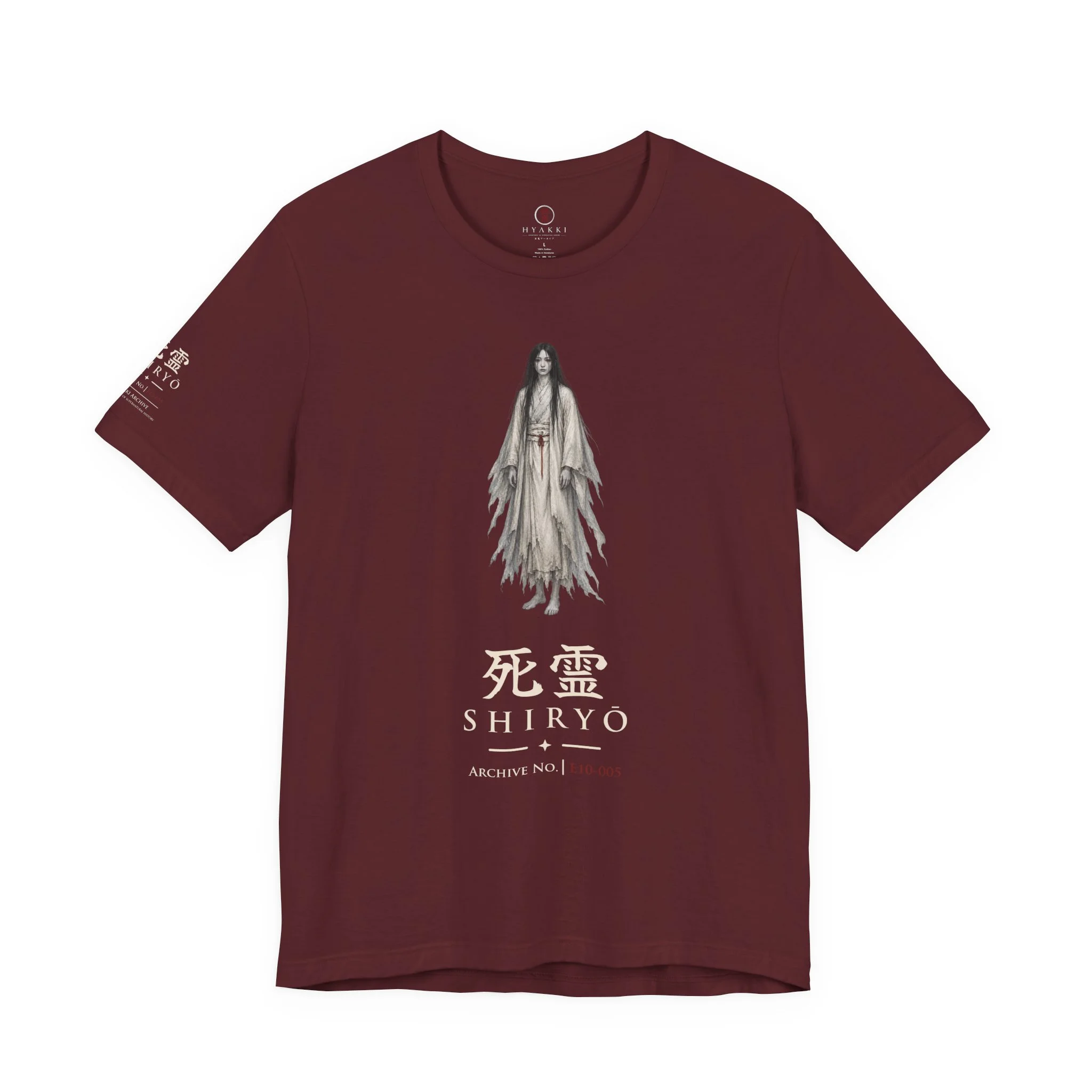
The E10-005 Shiryō design presents the spirit in a restrained human form rather than as an overtly monstrous ghost.
At the center stands a pale woman shown full-body in long, worn white robes. Her black hair hangs straight around her face and shoulders, while her arms rest loosely at her sides. The clothing is torn and frayed at the edges, and a small red cord at the waist provides the only strong accent against the otherwise muted grey-white palette.
The expression is calm, distant, and unreadable. There are no exaggerated wounds, glowing eyes, or dramatic supernatural effects.
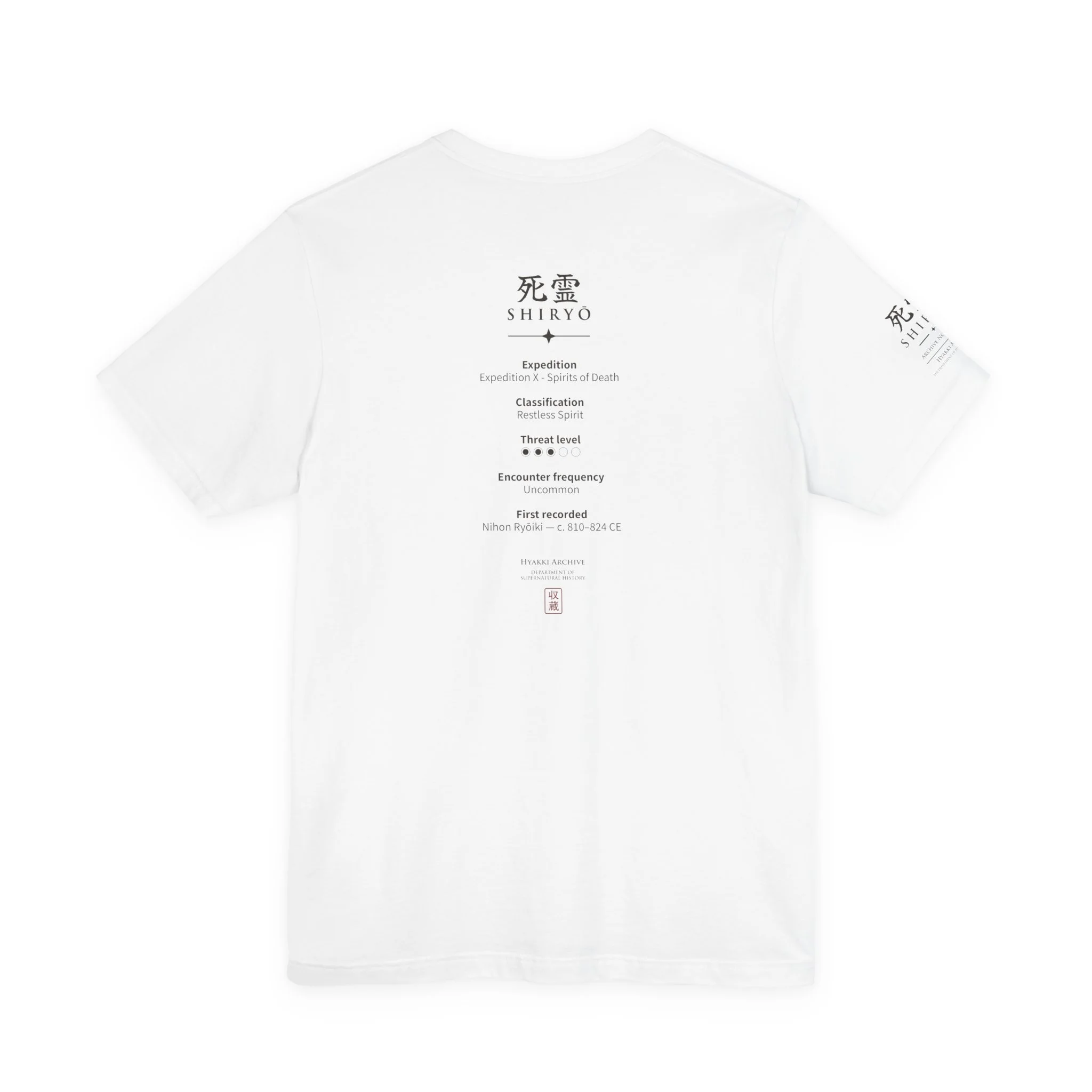
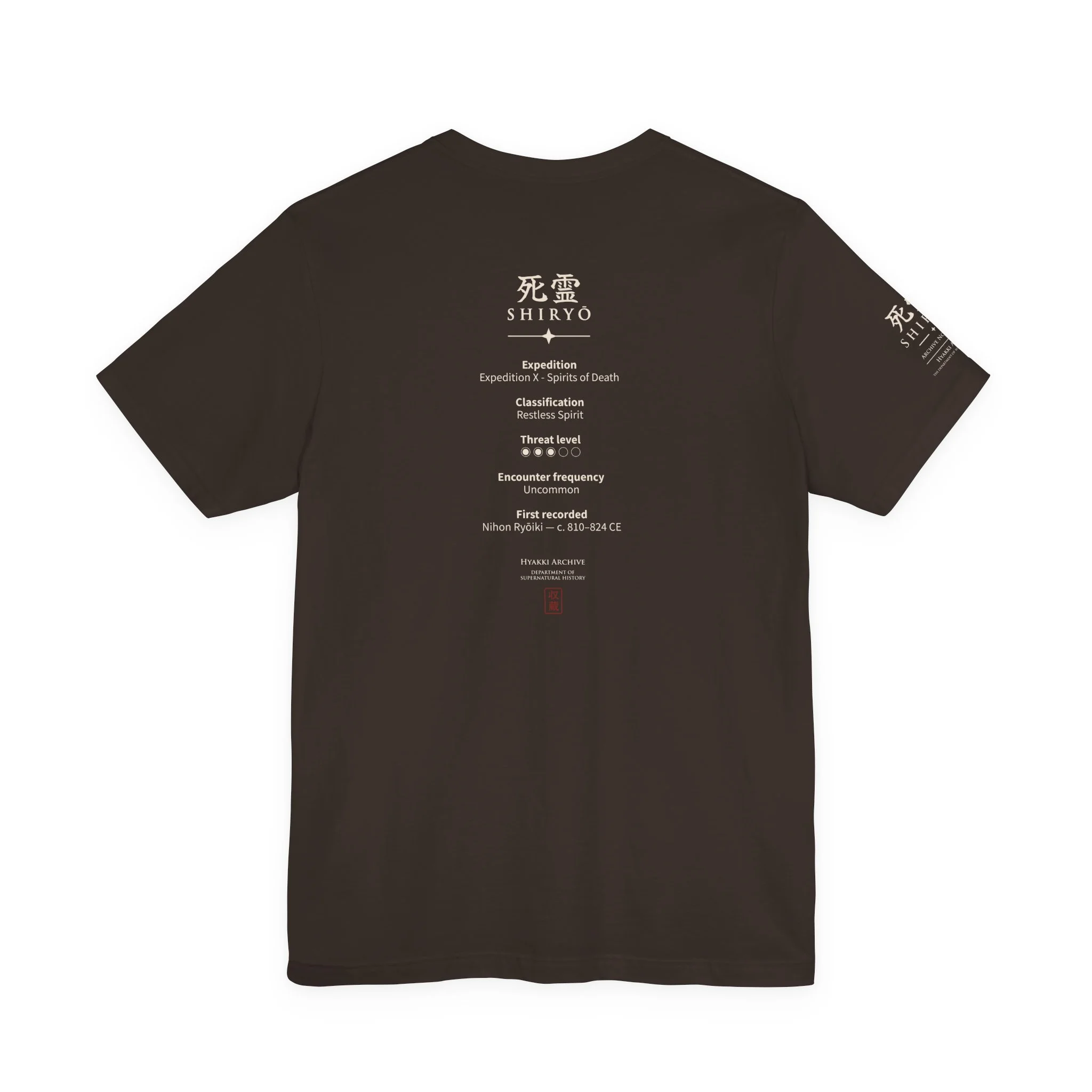
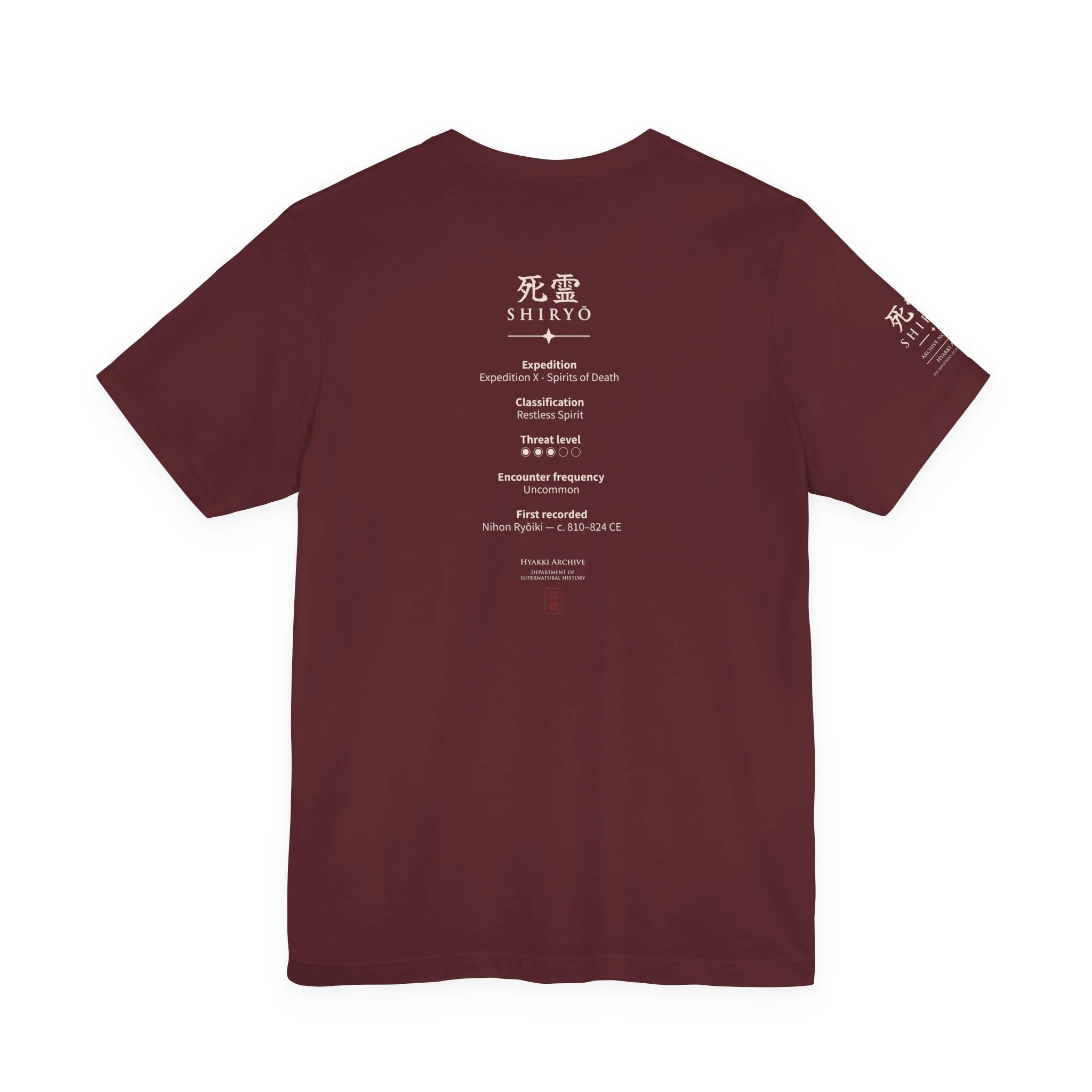
Beneath the figure, 死霊, SHIRYŌ, and Archive No. E10-005 continue the Hyakki archive format.
The result feels less like an attack and more like an encounter with someone who should no longer be standing there.
The Entity Behind the Design
Shiryō is a broad Japanese term for the spirit of a dead person.
That makes it fundamentally different from a more narrowly defined apparition. Shiryō does not describe one fixed creature, one personality, or one visual form. It identifies the condition of the spirit itself: the person is dead, but some aspect of their presence remains.
Historically, Shiryō is often contrasted with Ikiryō, the spirit of someone still living. Some Shiryō traditions involve resentment, possession, or supernatural retribution, while others describe the dead returning to relatives or lingering near familiar places.
The category is therefore wider than “vengeful ghost.”
A Shiryō may be dangerous.
It may be sorrowful.
It may simply be unable, or unwilling, to leave.
Known For
Shiryō is especially known for returning after death.
Historical stories describe dead spirits appearing to relatives, possessing living people, remaining near the place where they died, or expressing unresolved resentment through supernatural disturbance.
Possession is an important part of the tradition. In some historical narratives, the dead use the body or voice of a living person to communicate grievances that could not be resolved during life.
Shiryō also overlaps with other Japanese ghost categories, but the terms should not be treated as interchangeable. An Onryō, for example, is defined especially by resentment and vengeance. A Shiryō can be vengeful, but vengeance is not required.
That distinction matters because Shiryō is one of the broadest death-spirit categories in the archive.
The defining fact is not what the spirit wants.
It is that the person has died, and yet some form of agency or presence continues.
From Folklore to Design
Because Shiryō has no single historical appearance, this design is intentionally a representative reconstruction.
The pale skin, long dark hair, white robes, and frayed fabric draw on familiar Japanese ghost imagery while keeping the figure grounded and human. The design avoids a floating lower body, dramatic blood, exposed wounds, or exaggerated horror elements.
That restraint suits the category.
The figure looks recognizably human because a Shiryō begins with a human life. What separates her from the living is subtler: the grey pallor, worn clothing, still posture, and expression that feels emotionally removed from the world around her.
The red waist cord is the only sharp color in the composition, giving the otherwise drained figure a single visual point of tension without claiming a specific folkloric meaning.
This is not meant to show what every Shiryō looks like.
It shows one possible form of the dead returning.
From the Hyakki Archive
Archive File E10-005 continues Expedition X — Spirits of Death by stripping the supernatural problem back to its simplest form.
No animal transformation.
No corpse-thief.
No ritual bird.
No calamitous spirit requiring a city to respond.
Only someone who has died.
And is still here.
The body is gone from ordinary life.
The relationship should have ended.
The familiar face should now exist only in memory.
Yet the figure remains.
At what point does a person truly cease to be present among the living?
収蔵
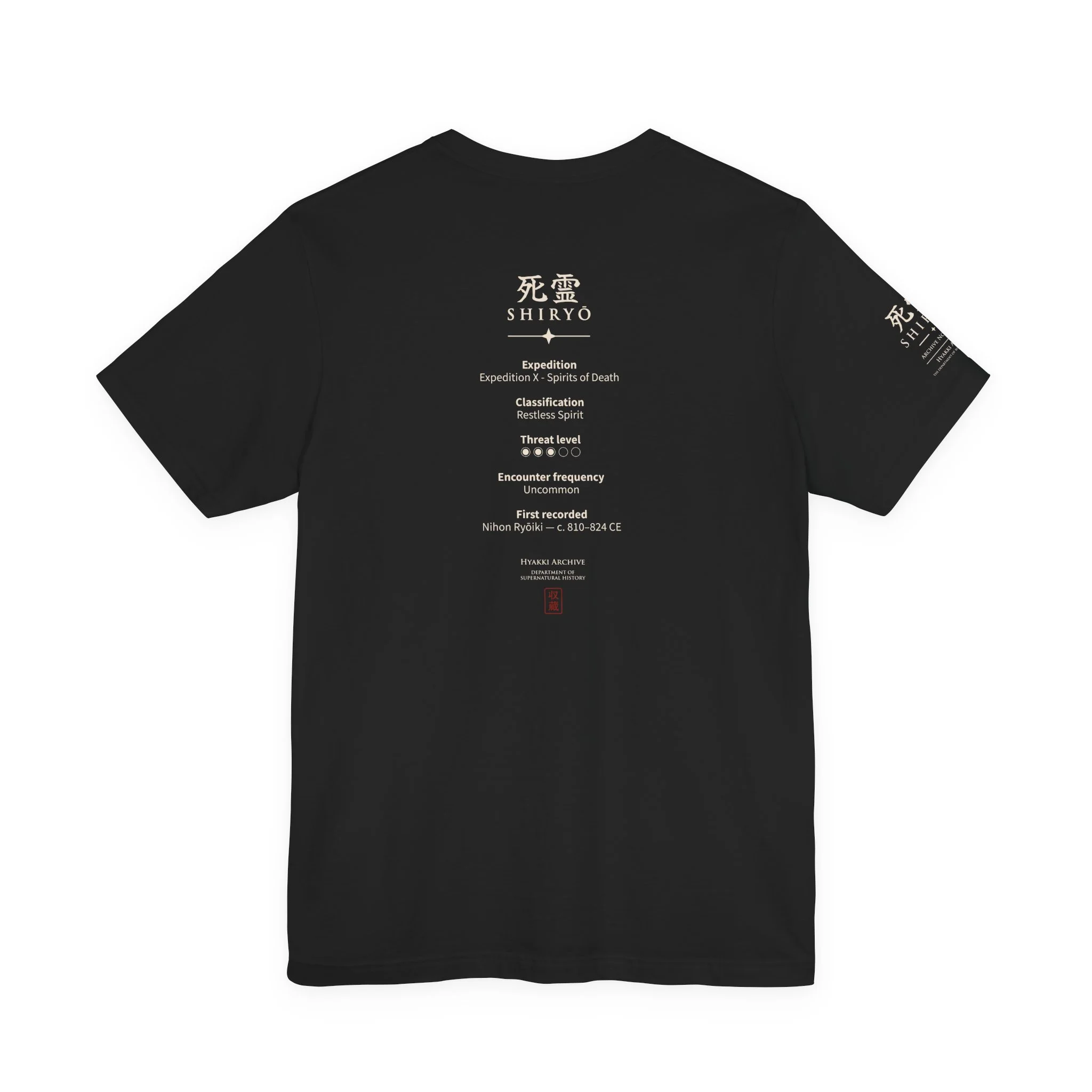
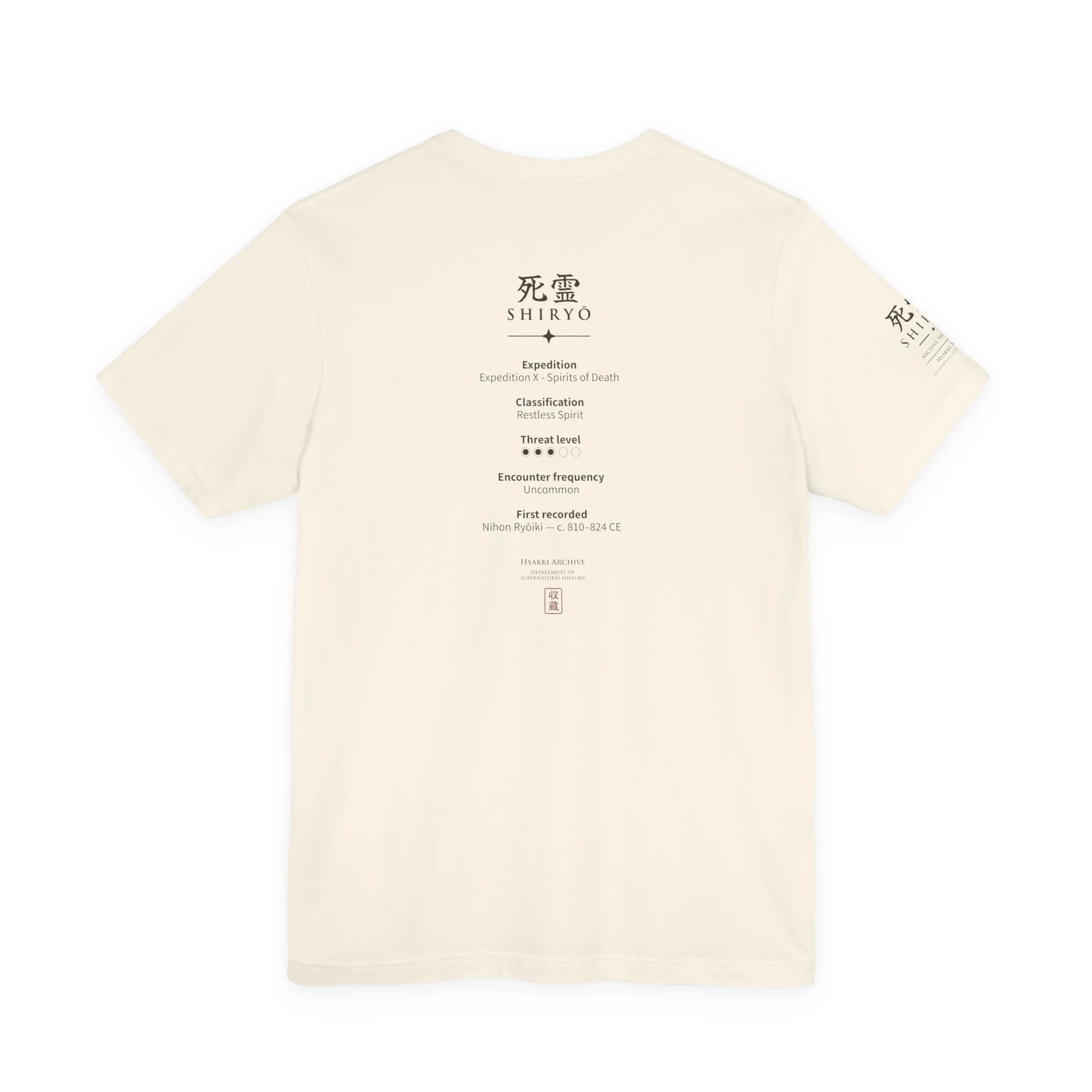
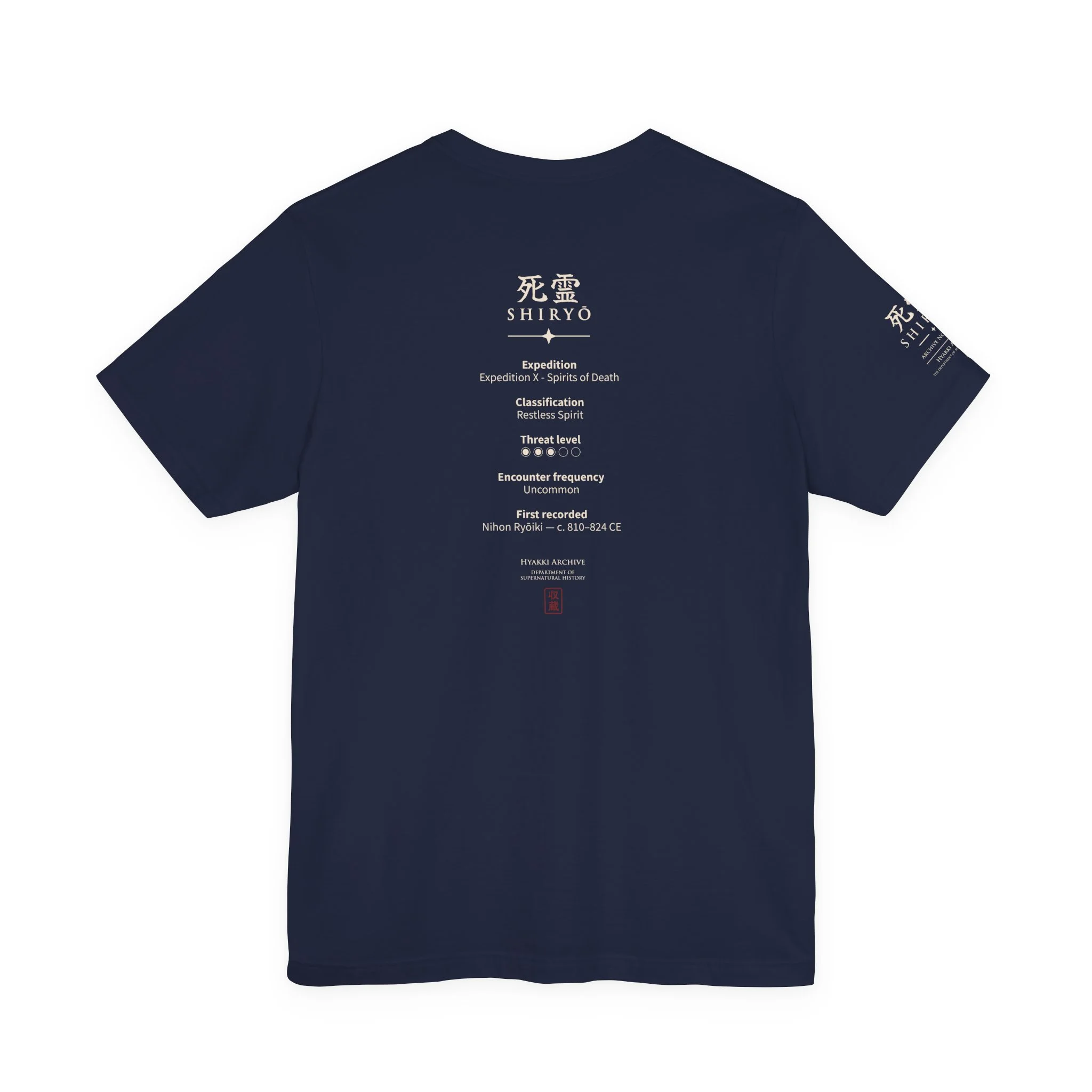
| Temperament |
Variable • Mournful • Potentially Vengeful |
| Activity |
Associated with Death, Attachment and Possession |
| Encounter Frequency |
Rare |
| Habitat |
Unfixed • Homes • Death Sites • Roads • Burial and Memorial Spaces |
| Known Variants |
Vengeful Dead • Returning Dead • Possessing Dead |
01 · What Is It?
Shiryō means the spirit or soul of a dead person.
That makes it one of the broadest categories in this expedition. A Shiryō is not defined by claws, wings, a particular costume, or one specific way of haunting. The word identifies the condition of the spirit: its human body has died.
Japanese dictionaries explicitly contrast shiryō with ikiryō, the spirit of a living person believed capable of separating from the body and affecting others. The same sources also note that Shiryō could be understood as the resentful dead capable of possession or tatari, supernatural retribution.
But resentment is only one possibility.
Folklore also preserves dead spirits returning to familiar people, appearing near the place of death, or attempting to draw relatives toward the world of the dead.
02 · Historical Record
The term has a long documentary history.
The Nihon Ryōiki, compiled in the early ninth century, contains an early surviving use of 死霊, making this far older than many catalogued Edo-period supernatural beings. The Heike Monogatari also uses the term in contrast with living spirits, showing that the distinction remained recognizable in medieval literature.
Shiryō continued to appear in religious, literary, and popular traditions.
A particularly important early-modern example is Shiryō Gedatsu Monogatari, published in 1690. It tells of the vengeful spirit Kasane possessing a living woman and eventually being released from worldly attachment through religious intervention. The narrative became influential in later theatrical and ghost-story traditions.
By the modern folklore period, stories collected in works such as Tōno Monogatari continued to preserve accounts of dead people returning to interact with the living.
03 · Appearance
Shiryō has no universal appearance.
That follows directly from what the term means. Any dead person could theoretically become a Shiryō, so the spirit may retain some resemblance to the person in life or appear in a more altered ghostly form.
Classical and folkloric material often places greater emphasis on recognition and behaviour than on anatomy. A dead relative may be recognized because they look familiar, speak in a familiar manner, or appear somewhere connected with their former life.
Later visual culture increasingly developed standardized ghost imagery, including pale faces, long hair, white funerary clothing, and indistinct lower bodies. Those conventions became enormously influential, but they should not be treated as the fixed historical anatomy of Shiryō.
For Hyakki, any single human reconstruction is therefore necessarily representative rather than definitive.
The category is the dead person.
The body shown in art is only one possible manifestation.
04 · Behaviour & Encounters
Shiryō traditions cover a wide range of encounters.
Some dead spirits are believed to possess living people, causing suffering or using the possessed person to communicate. The seventeenth-century Kasane tradition is a well-documented example of this pattern.
Others return directly to family members.
In one story preserved in Tōno Monogatari, the spirit of a dead father repeatedly appears to his daughter and attempts to take her away with him.
Other accounts describe spirits lingering near where death occurred or appearing briefly to loved ones around the time of death.
These behaviours are too varied to reduce to one “power set.”
What joins them is the same basic rupture:
the physical person is dead, yet agency, attachment, resentment, or intention appears to continue.
A Shiryō encounter is therefore fundamentally an encounter with unfinished presence.
05 · Belief, Ritual & Meaning
Shiryō belongs to a much wider Japanese history of beliefs surrounding death, memorialization, possession, and relations between the living and the deceased.
Because some dead spirits were feared as resentful or dangerous, religious intervention could focus on pacification, memorial rites, prayer, or release from attachment.
The 1690 Shiryō Gedatsu Monogatari makes this especially explicit. The spirit Kasane possesses a living woman, recounts her suffering, and is eventually brought toward spiritual release through the intervention of Yūten Shōnin.
But not every returning dead spirit is an enemy requiring exorcism.
The broader category also includes the possibility that the deceased remains attached to people or places because relationships have not yet settled.
That makes Shiryō less about a single form of supernatural danger than about one of the oldest questions surrounding death:
At what point does a person truly cease to be present among the living?
06 · Regional & Historical Variations
Shiryō is so broad that variation is unavoidable.
In some traditions, the dead return because of resentment, making the Shiryō overlap with concepts such as onryō. In others, the spirit possesses a living person. Elsewhere it simply appears before relatives or remains around a familiar location.
That does not mean Shiryō and Onryō are identical.
Shiryō primarily identifies the spirit as belonging to someone who has died. Onryō emphasizes resentment and vengeance. A resentful dead spirit may therefore be described using both ideas, but one term does not automatically imply the other.
Later ghost imagery also changed how the dead were visualized. Edo and modern popular culture increasingly created recognizable conventions for the Japanese ghost, even though older Shiryō traditions did not require one standardized appearance.
The safest archival approach is therefore to preserve Shiryō as a category of the dead, rather than turning it into another visually fixed species.
07 · What We Actually Know
| Shiryō means the spirit or soul of a dead person |
DOCUMENTED |
| The term is explicitly contrasted with Ikiryō, the spirit of a living person |
DOCUMENTED |
| An early use of 死霊 appears in the early ninth-century Nihon Ryōiki |
DOCUMENTED |
| Possession by the dead appears in historical Shiryō traditions |
DOCUMENTED |
| Some Shiryō traditions describe dead relatives returning to the living |
DOCUMENTED |
| Every Shiryō is necessarily vengeful |
INCORRECT |
| Shiryō and Onryō are exactly the same category |
INCORRECT |
| There is one fixed physical appearance shared by all Shiryō |
UNSUPPORTED |








Reviews
There are no reviews yet.