The Design
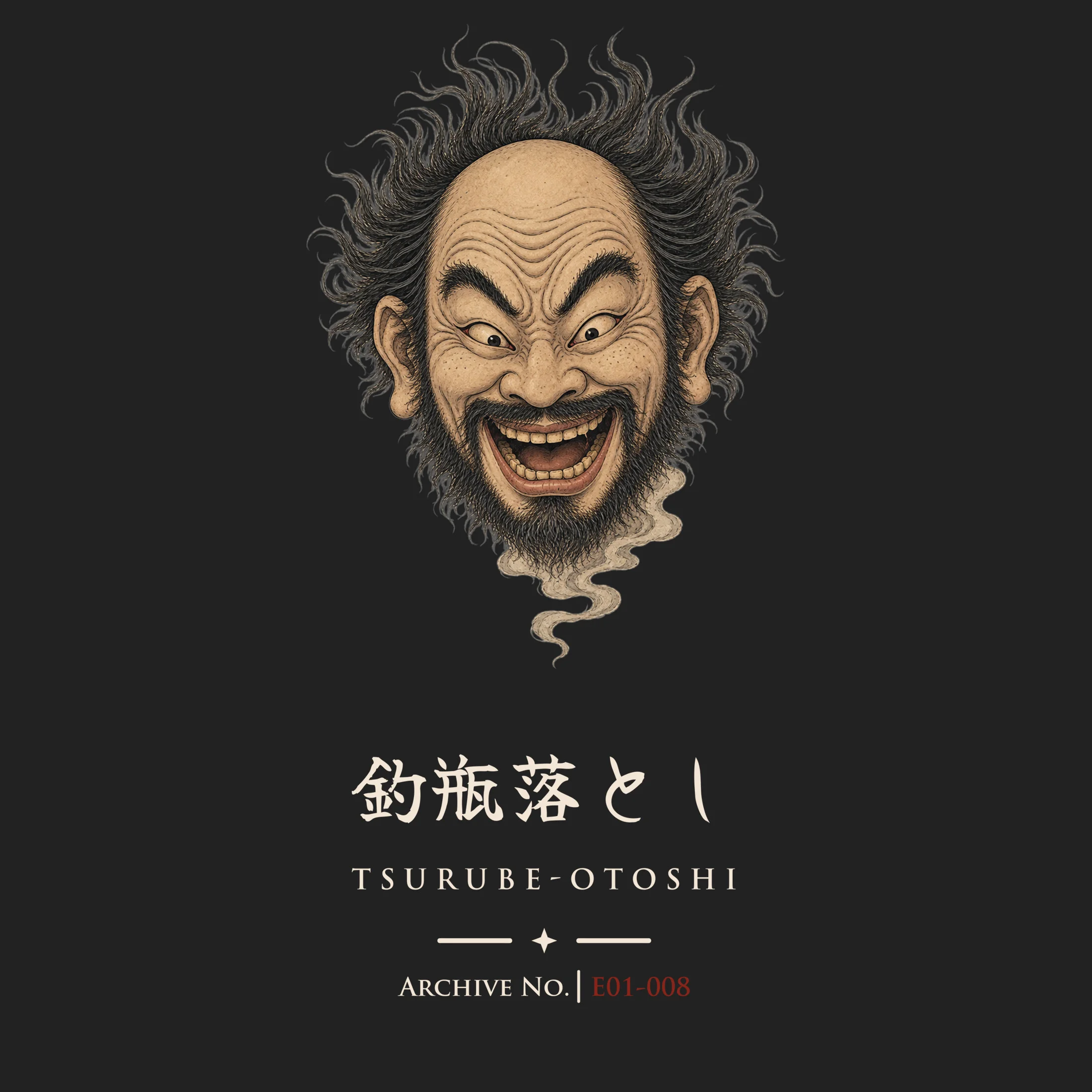
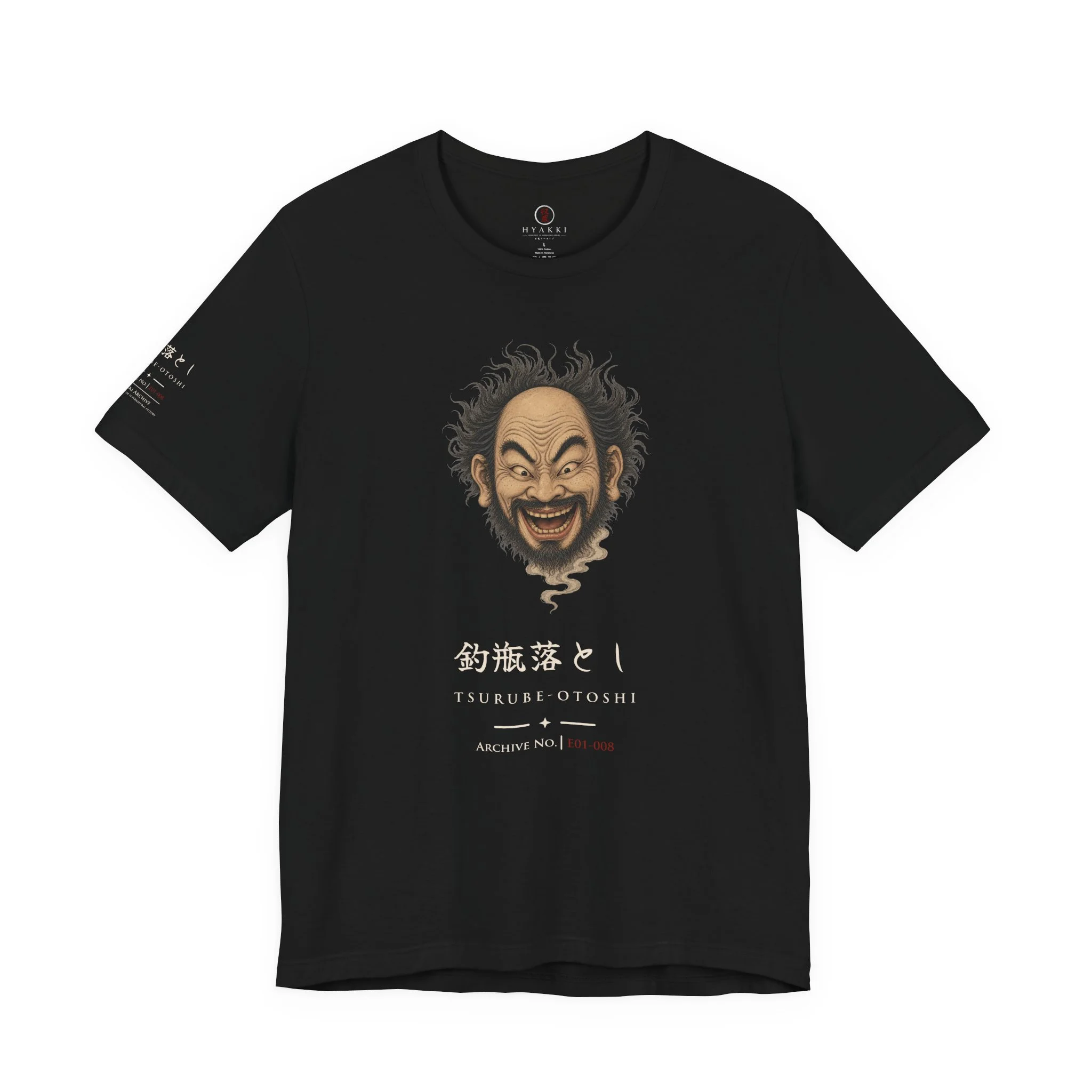
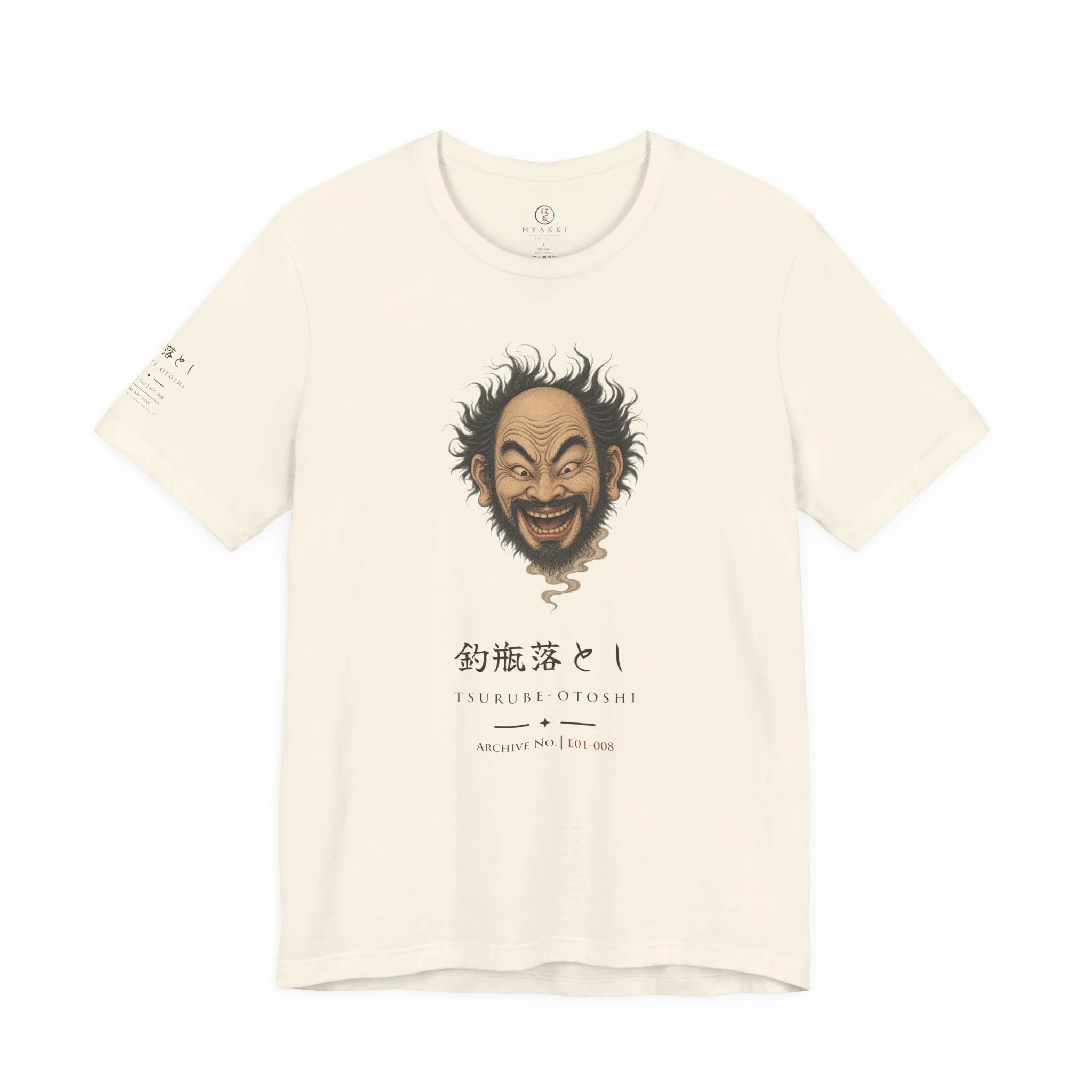
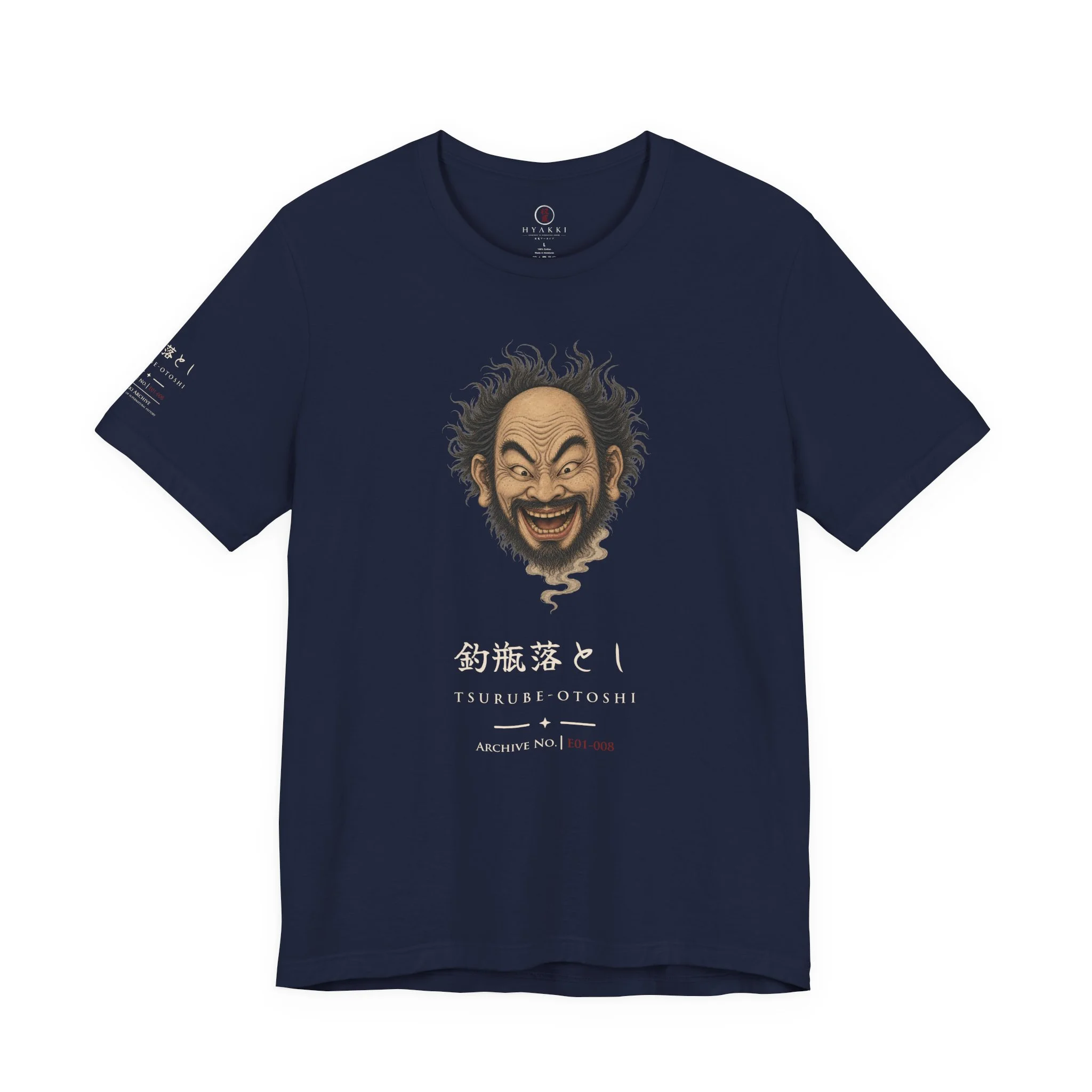
The E01-008 Tsurube-otoshi design chooses the entity’s most recognizable modern form: a huge disembodied human head suspended in midair.
The face is exaggerated and theatrical, with a high bald forehead, sharply arched brows, wide staring eyes, a heavy beard, and an unnervingly broad grin. Wild dark hair radiates around the head like a tangled halo, while the lower edge of the beard dissolves into a narrow smoke-like trail, removing any sense of an attached body.
That floating silhouette makes the figure feel as though it has just descended into view.
Beneath the illustration, 釣瓶落とし, TSURUBE-OTOSHI, and Archive No. E01-008 keep the design aligned with the rest of the Hyakki collection. The simple vertical composition works especially well here because the entity itself already suggests movement from above to below.
The Entity Behind the Design
Tsurube-otoshi is a regional supernatural tradition associated with large trees and sudden descent from above.
Today, it is commonly represented as a giant human head dropping from the canopy toward unsuspecting travellers. Historical folklore is less consistent. Regional records also describe buckets lowered or dropped from trees, unseen voices calling from the branches, and tree-dwelling beings capable of seizing people below.
That variation is important because Tsurube-otoshi is not really defined by one fixed body.
Its most persistent feature is movement.
Something occupies the darkness overhead. A person passes beneath it. Then something descends.
The familiar giant-head image gives that fear a face, but the underlying tradition is broader and stranger than a single monster design.
Known For
Tsurube-otoshi is best known for ambushing travellers from above.
Stories are commonly set around large trees beside roads, paths, or settlement boundaries. A traveller passes underneath, unaware that something is concealed in the canopy, and the encounter begins vertically rather than from somewhere ahead.
Some regional traditions describe an actual tsurube, the bucket historically lowered into a well, descending from the branches. Others describe an oni or another supernatural inhabitant using such a bucket to seize people. Related Tsurube-oroshi traditions may involve voices calling from trees, questions posed to passersby, or objects lowered suddenly toward the road.
The giant-head form became the most visually memorable version, but it is only one branch of that tradition.
What remains remarkably consistent is the spatial fear behind it: the traveller is watching the road while the threat is directly overhead.
From Folklore to Design
This artwork deliberately uses the giant-head interpretation rather than attempting to combine every regional version into one figure.
The disembodied face makes the danger immediately readable, while the expression pushes the design toward grotesque folklore rather than realistic portraiture. The huge grin, intense eyes, and tangled hair create the impression of something that takes pleasure in being noticed only after it has already descended.
The tapering lower edge is an especially effective choice. Instead of suggesting that the head was physically severed from a human body, it fades into an almost vaporous form. That keeps the figure supernatural rather than simply gruesome.
There is also no tree illustrated around it. That removes the usual environmental explanation and leaves the viewer in the position of the traveller below.
The head is already here.
Whatever branches it came from are somewhere outside the frame.
From the Hyakki Archive
Archive File E01-008 closes Expedition I — Sacred Forests with a final change in perspective.
Throughout the expedition, attention has been drawn toward what inhabits the trees, what moves between them, and what waits beyond the path.
Tsurube-otoshi changes the direction entirely.
Do not look deeper into the forest.
Do not watch only the road.
Look up.
By the time the presence above becomes visible, the encounter may already have begun.
収蔵
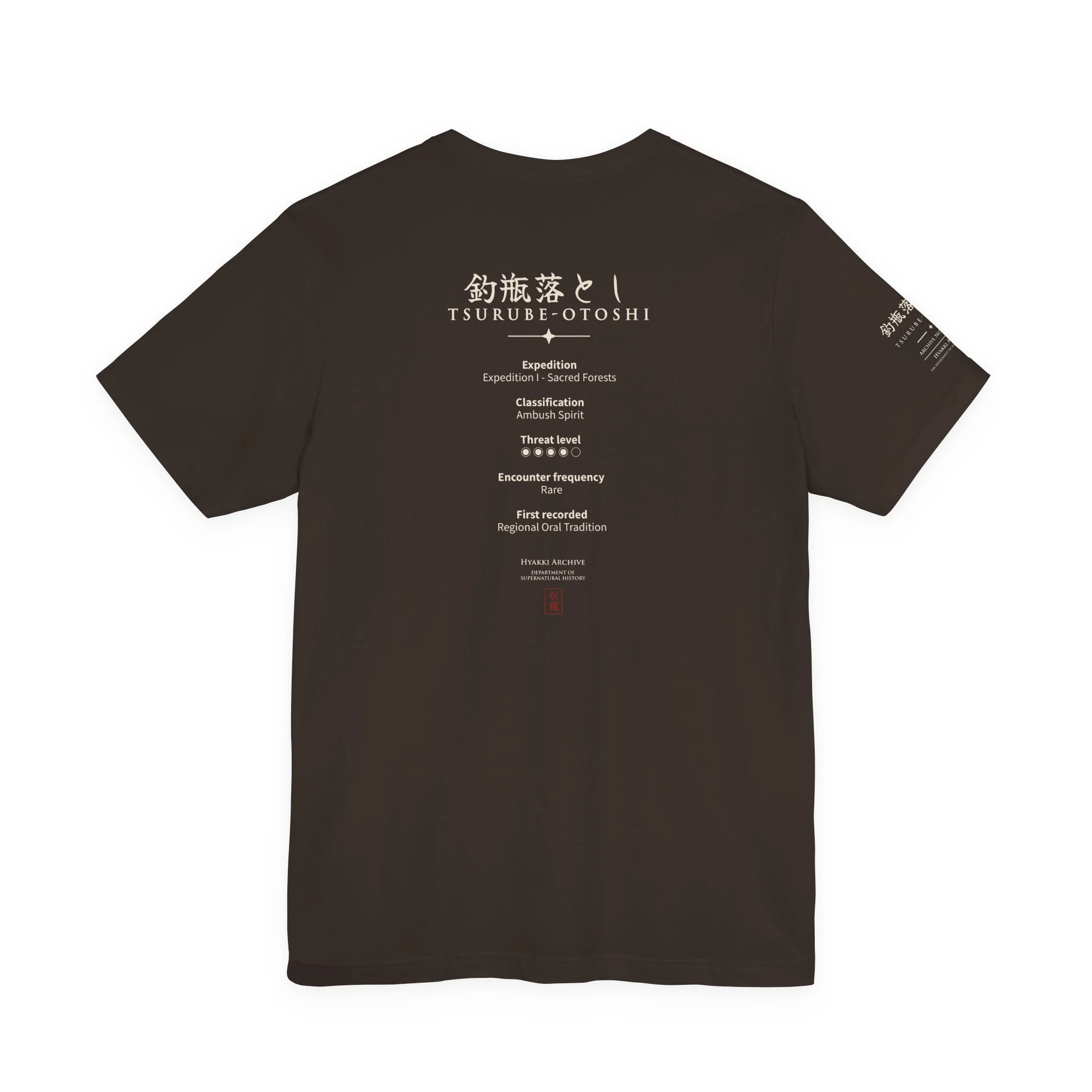
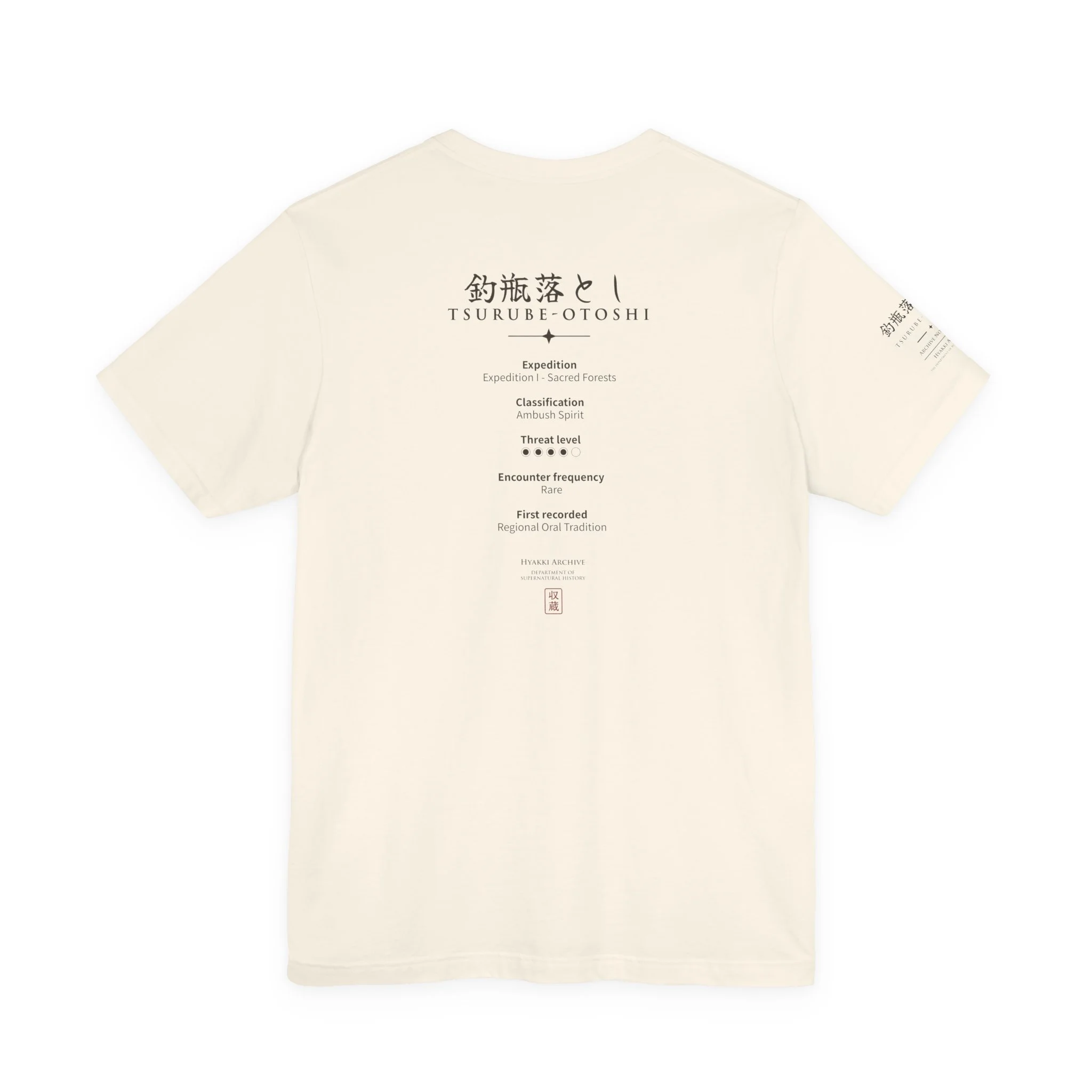
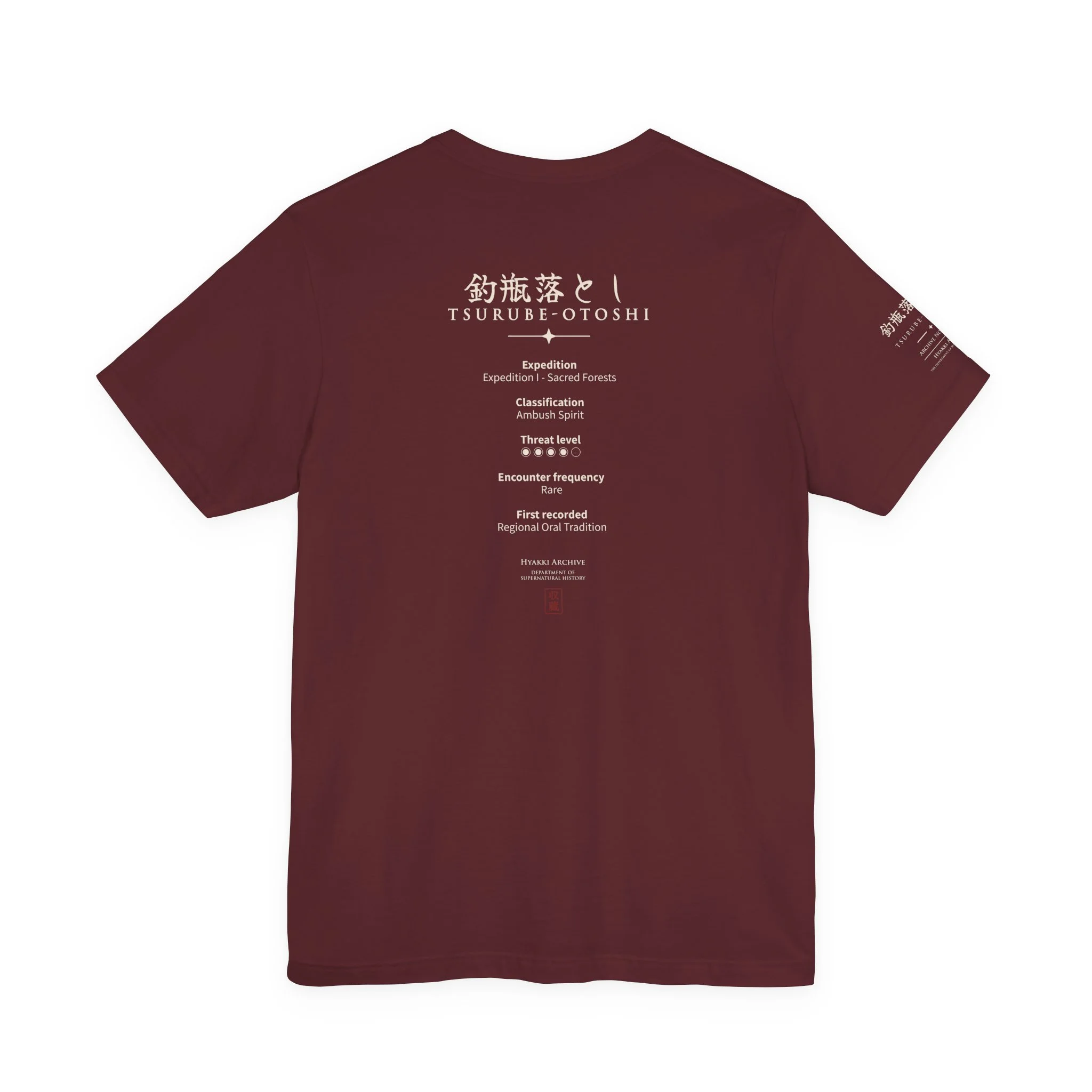
| Temperament |
Ambushing • Hostile • Unpredictable |
| Activity |
Primarily Nocturnal |
| Encounter Frequency |
Rare |
| Habitat |
Large Trees • Forest Roads • Village Outskirts • Mountain Paths |
| Known Variants |
Tsurube-oroshi • Regional Bucket and Tree-Dwelling Forms |
01 · What Is It?
Tsurube-otoshi is a supernatural tradition centered on something descending suddenly from a large tree.
Its name contains tsurube, the traditional bucket lowered into a well. That vertical movement is one of the strongest clues to understanding the entity. Something above is lowered, dropped, or sent down toward the person beneath it.
Modern illustrations often standardize Tsurube-otoshi as a gigantic severed human head hiding among the branches. That is a legitimate later representation, but it does not describe every recorded tradition.
Some accounts involve an actual bucket. Others describe an oni or another supernatural being dwelling in a tree. In still others, the encounter begins with a voice from the canopy.
Tsurube-otoshi is therefore better treated as a regional family of descending tree apparitions than as one fixed supernatural species.
02 · Historical Record
The clearest surviving documentation comes largely from modern folklore collections preserving regional oral traditions.
Folklorist Kunio Yanagita recorded Tsurube-otoshi and related Tsurube-oroshi traditions in his twentieth-century work on supernatural beings. Accounts from Aichi describe something descending suddenly from the crown of a large tree, including a story in which an oni inhabiting a great cedar uses a metal bucket to seize people passing underneath.
Records from Fukui preserve a strikingly different form. A large zelkova was said to lower or drop a bucket onto travellers at night. Other versions describe a voice from the tree asking whether it should lower the bucket.
The documentary trail therefore supports the tradition itself, but not one universally accepted appearance.
This is exactly the kind of entity where later illustrations became more standardized than the folklore that preceded them.
03 · Appearance
Tsurube-otoshi has no securely universal body.
The famous giant-head form is only one part of the tradition. Depending on the region and account, the apparition may instead involve a bucket, an oni-like tree inhabitant, an unidentified creature, or something never clearly seen at all.
This makes physical reconstruction difficult.
The safest historical approach is not to ask, “What does a Tsurube-otoshi look like?” but rather, “What did this particular tradition say descended from the tree?”
Later yōkai art has made the enormous head especially recognizable, so using that form in modern artwork is entirely reasonable. It should simply be identified as one visual tradition, rather than the entity’s fixed anatomy.
With Tsurube-otoshi, the movement is more reliable than the body.
04 · Behaviour & Encounters
Tsurube-otoshi encounters usually exploit the traveller’s blind spot above.
A person walks beneath a large tree, often at night. Something then drops, lowers itself, calls down, or reaches toward them from the branches.
Some regional stories describe falling buckets that injure travellers. Others tell of supernatural beings using a bucket to scoop people up. There are also accounts where contact with the descending thing prevents the victim from escaping as it pulls them upward.
Not every encounter is immediately violent. In some stories, a voice calls from the tree or asks a question before anything happens.
The details vary, but the spatial pattern remains remarkably consistent.
The person is watching the road.
The danger is somewhere they are not looking.
05 · Belief, Ritual & Meaning
Tsurube-otoshi does not appear to belong to a major formal system of worship or ritual practice.
Its power comes instead from landscape and behaviour.
Old roadside trees create natural uncertainty after dark. Their crowns disappear into shadow, while branches hang directly over paths used by travellers. Tsurube-otoshi transforms that ordinary physical vulnerability into supernatural danger.
The well-bucket image makes the tradition particularly effective. A tsurube is an everyday object whose defining action is to descend vertically and then be pulled upward again.
Placed in a tree rather than a well, that familiar action becomes deeply wrong.
The folklore reverses the traveller's normal expectation of danger. Forest roads encourage people to watch ahead, into the darkness.
Tsurube-otoshi suggests that the most dangerous part of the road may already be directly overhead.
06 · Regional & Historical Variations
Regional variation is central to the tradition.
In Aichi, accounts include beings descending from large trees and an oni associated with a cedar and a metal bucket.
In Fukui, traditions include a bucket dropping from a zelkova and voices calling from the branches before lowering something toward travellers.
Other versions associated with the related name Tsurube-oroshi include supernatural beings that question, threaten, or seize people from above.
Modern yōkai culture increasingly favors the giant-head form, which gives Tsurube-otoshi an immediately recognizable visual identity. That later standardization should not erase the stranger regional material that survives alongside it.
There may never have been one correct body.
The shared structure is simpler:
A large tree.
A traveller underneath.
Something descending.
07 · What We Actually Know
| Tsurube-otoshi is associated with large trees and danger from above |
DOCUMENTED |
| Regional traditions describe buckets descending from trees |
DOCUMENTED |
| Some accounts involve an oni or another being inhabiting the tree |
DOCUMENTED |
| Tsurube-oroshi appears as a related regional name |
DOCUMENTED |
| Every Tsurube-otoshi is a giant severed human head |
INCORRECT |
| The entity has one standardized anatomy throughout Japan |
UNSUPPORTED |
| Every encounter ends with the victim being eaten |
INCORRECT |
| The descending movement is more consistent than the physical form |
INTERPRETATION |

















Reviews
There are no reviews yet.