The Design
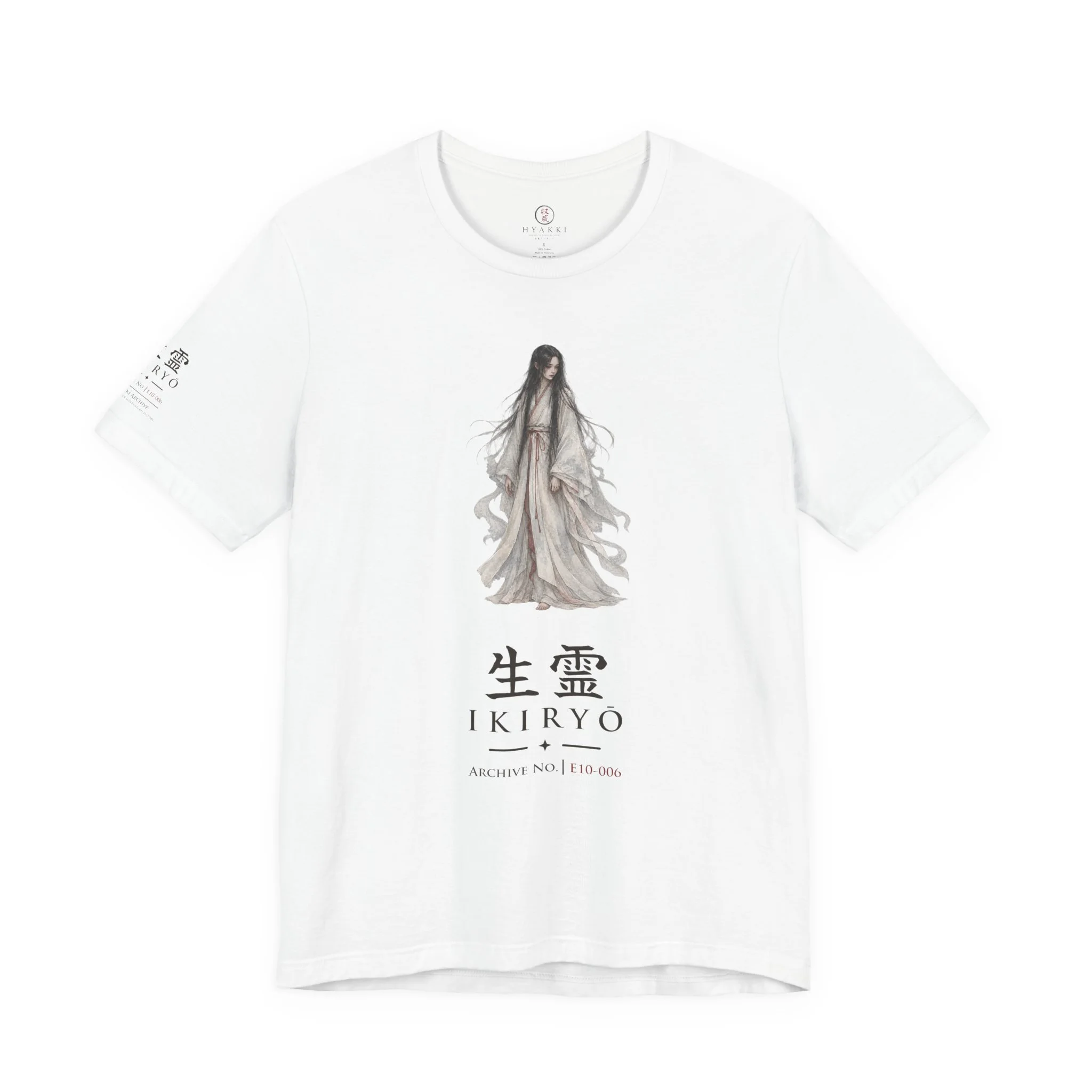
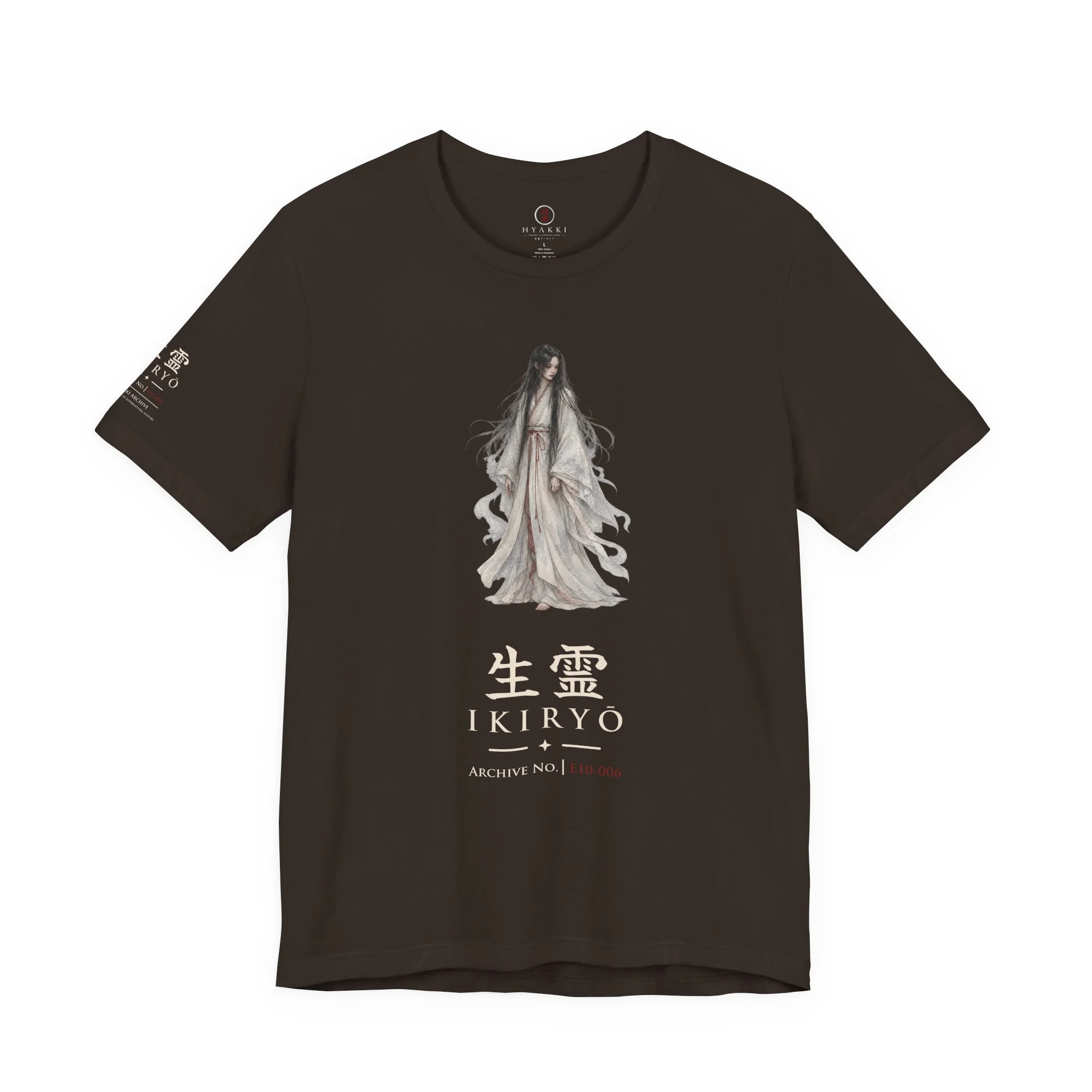
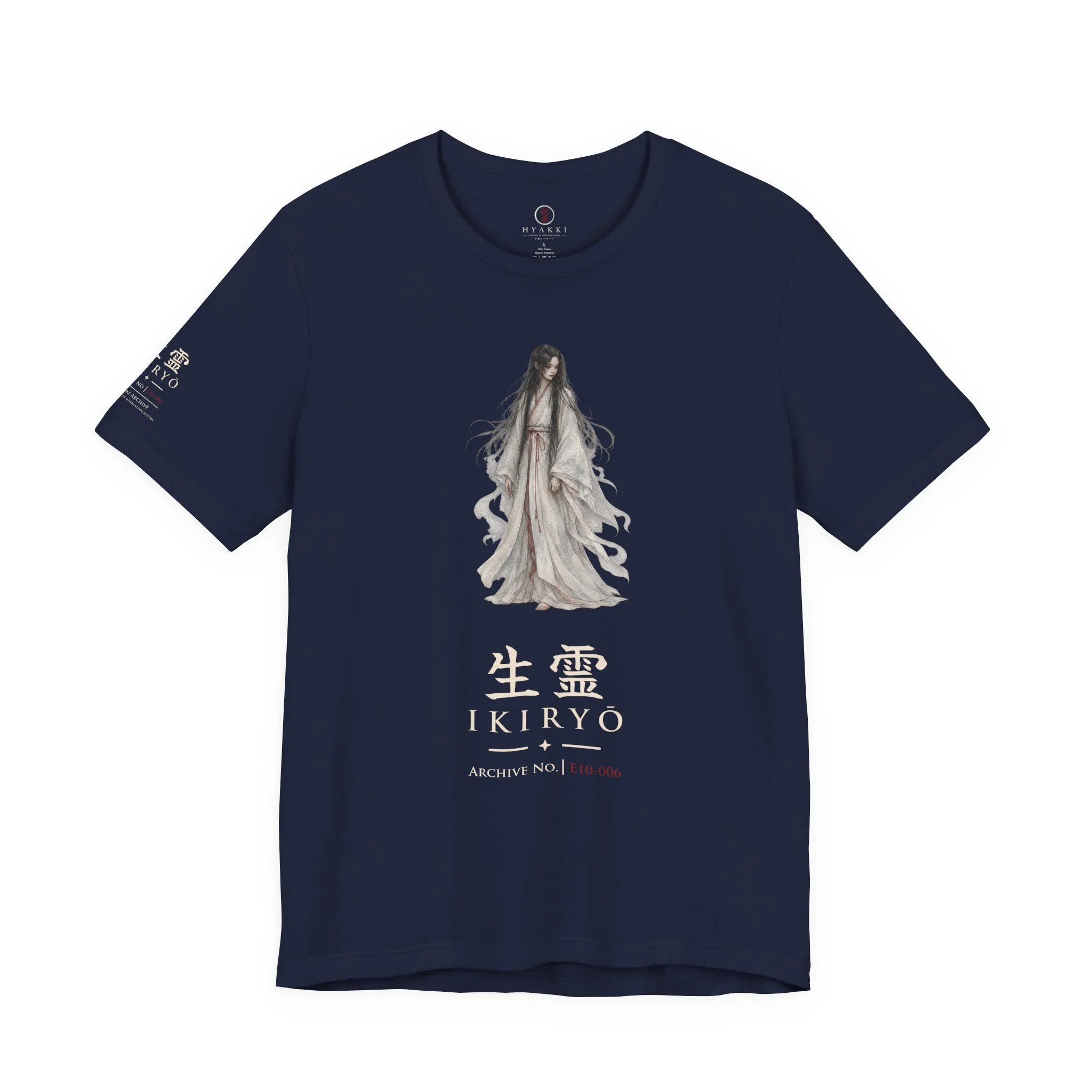
The E10-006 Ikiryō design presents the living spirit as a pale human figure whose body seems only partly anchored to the physical world.
At the center stands a young woman in flowing white robes with restrained red ties and inner layers. Her long black hair falls across the front of the body, while thinner strands and ribbons of fabric drift outward around her, creating the impression that part of her presence is being pulled away from ordinary space.
The figure is shown full-body and barefoot, with no wounds, blood, or signs of physical death. That distinction is central to the design.
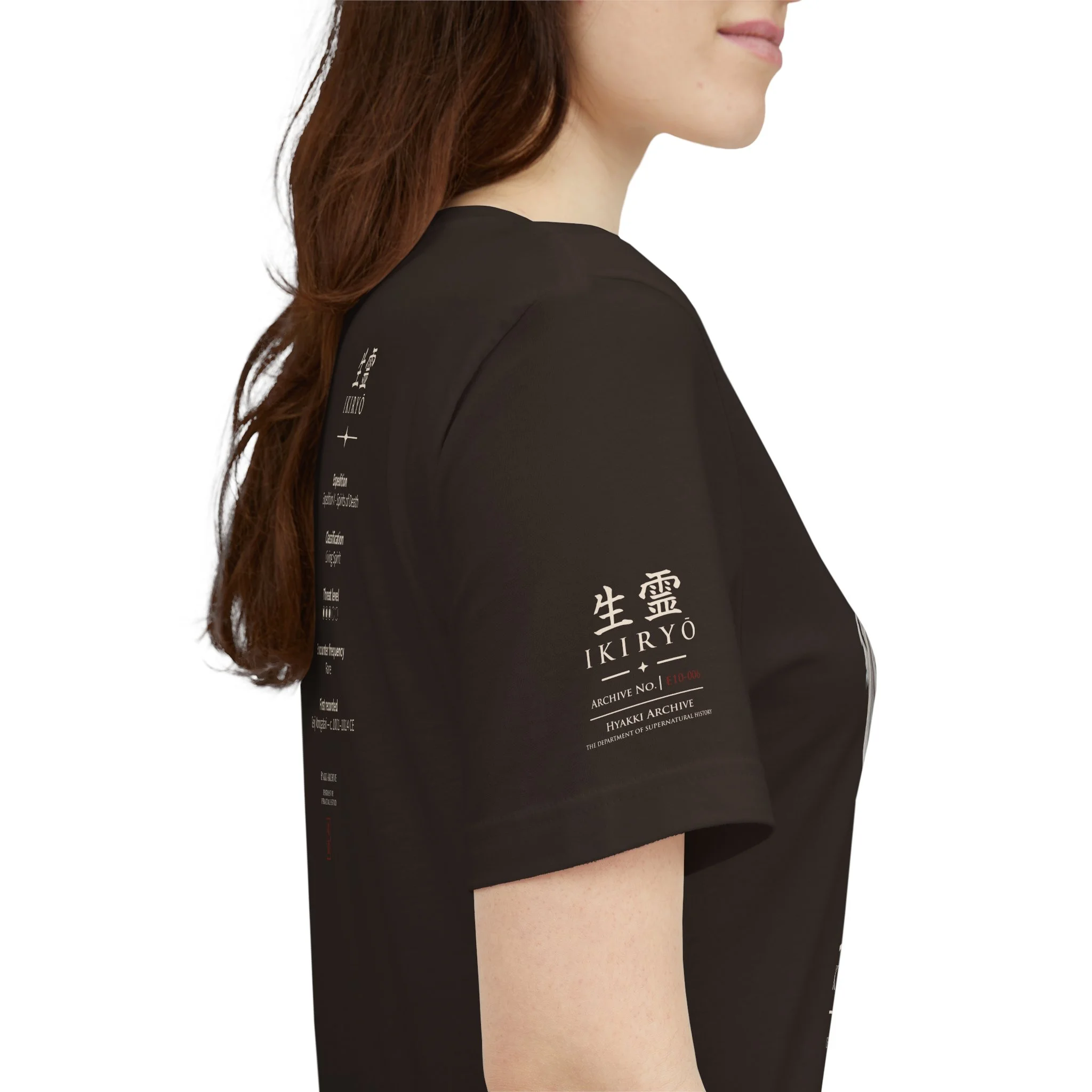
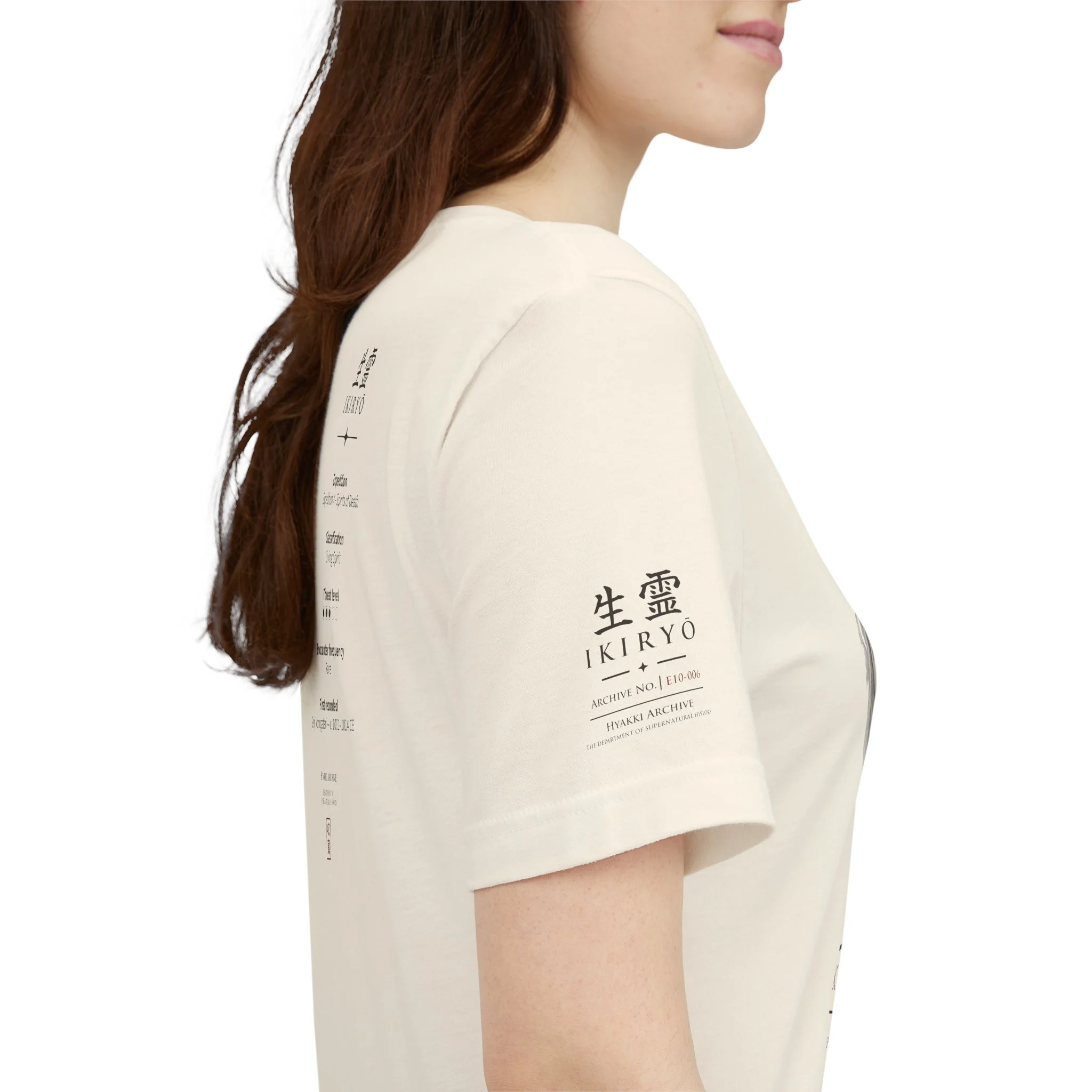
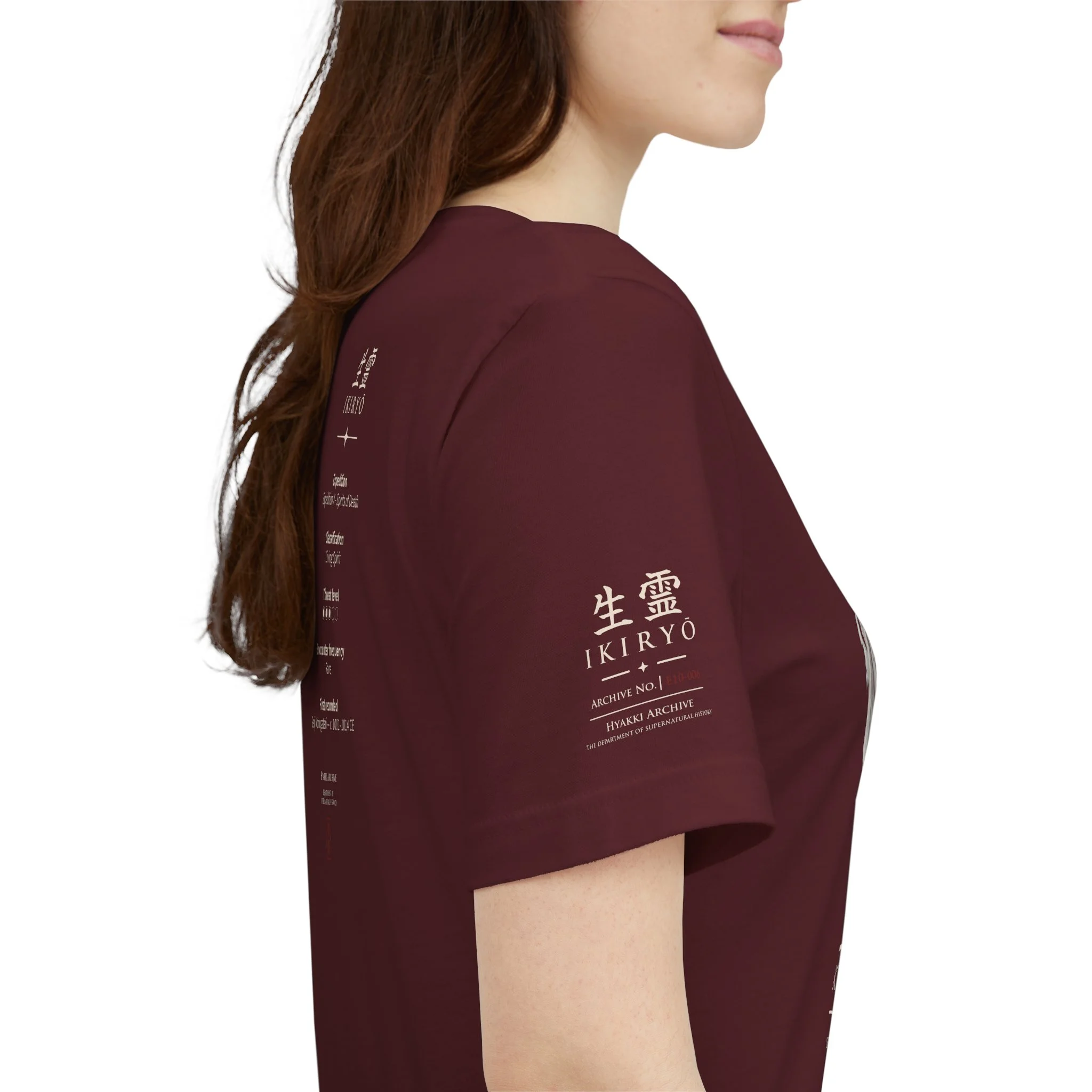
Beneath the illustration, 生霊, IKIRYŌ, and Archive No. E10-006 continue the restrained Hyakki archive format.
The composition deliberately resembles a ghost while withholding the one fact normally assumed about a ghost:
this person is still alive.
The Entity Behind the Design
Ikiryō is the spirit of a living person believed capable of separating from the physical body and affecting someone elsewhere.
That makes it one of the strangest entities in Expedition X — Spirits of Death. Unlike Shiryō, no death has occurred. The person whose spirit manifests may remain alive, physically distant, and sometimes not fully aware of what their own emotions have produced.
Classical Japanese literature often connects Ikiryō with intense states such as jealousy, resentment, fixation, or emotional suffering.
The best-known example is Lady Rokujō in The Tale of Genji, whose living spirit becomes associated with the possession and torment of Aoi no Ue.
Ikiryō therefore turns an internal emotional state into something external.
The body remains in one place.
The spirit does not.
Known For
Ikiryō is especially known for possession produced by the living.
Rather than a dead spirit returning to haunt someone, the supernatural presence originates from a person who still exists in the ordinary world. In some traditions, intense resentment or jealousy appears capable of sending the spirit outward without a deliberate ritual or conscious decision.
Lady Rokujō remains the most famous literary example. Her complicated jealousy and humiliation become associated with a possessing spirit in the “Aoi” chapter of The Tale of Genji, creating one of the defining portrayals of the living spirit in Japanese literature.
The older related term ikisudama also appears in classical sources.
What makes the concept especially disturbing is the question of responsibility. A person may cause real supernatural harm while not necessarily choosing, or even understanding, what their spirit is doing.
Ikiryō is therefore not simply “astral projection.”
It is a tradition about emotion becoming powerful enough to act beyond the body.
From Folklore to Design
This design focuses on the central contradiction of Ikiryō:
the figure looks ghostly, but she is not dead.
The pale robes and long black hair draw on familiar Japanese spirit imagery, but the clothing is cleaner and more intact than the torn garments used for Shiryō. The face also retains more warmth and human presence, avoiding the drained corpse-like quality of the preceding design.
The drifting fabric and loose hair are the strongest interpretive elements. They suggest separation without showing a literal second body or transparent duplicate. The figure seems to be in the process of becoming less physically fixed.
The red cords provide a subtle visual connection to the living body, almost like the last trace of something still tethered.
That is an artistic interpretation rather than a fixed historical symbol, but it supports the underlying folklore well.
The woman has not crossed the boundary of death.
Only her spirit has crossed the boundary of distance.
From the Hyakki Archive
Archive File E10-006 continues Expedition X — Spirits of Death with an anomaly that should not, strictly speaking, belong among the dead at all.
Shiryō asks what remains after a person dies.
Ikiryō reverses the problem.
The person remains alive.
The body remains elsewhere.
Yet something carrying their emotion has already arrived.
No grave has been opened.
No funeral has taken place.
The haunting begins before death.
How far can a human emotion travel before it becomes something separate from the person who felt it?
収蔵
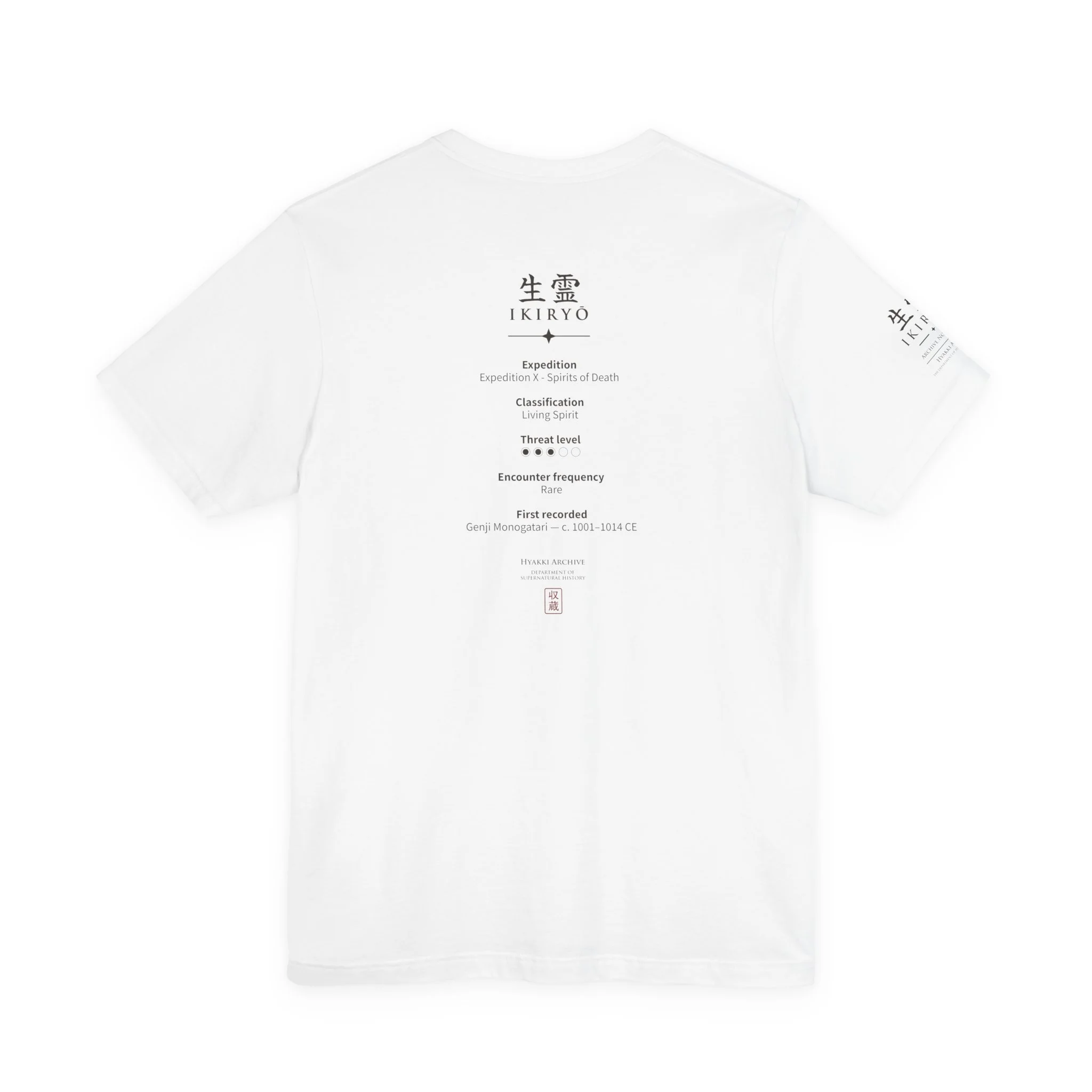
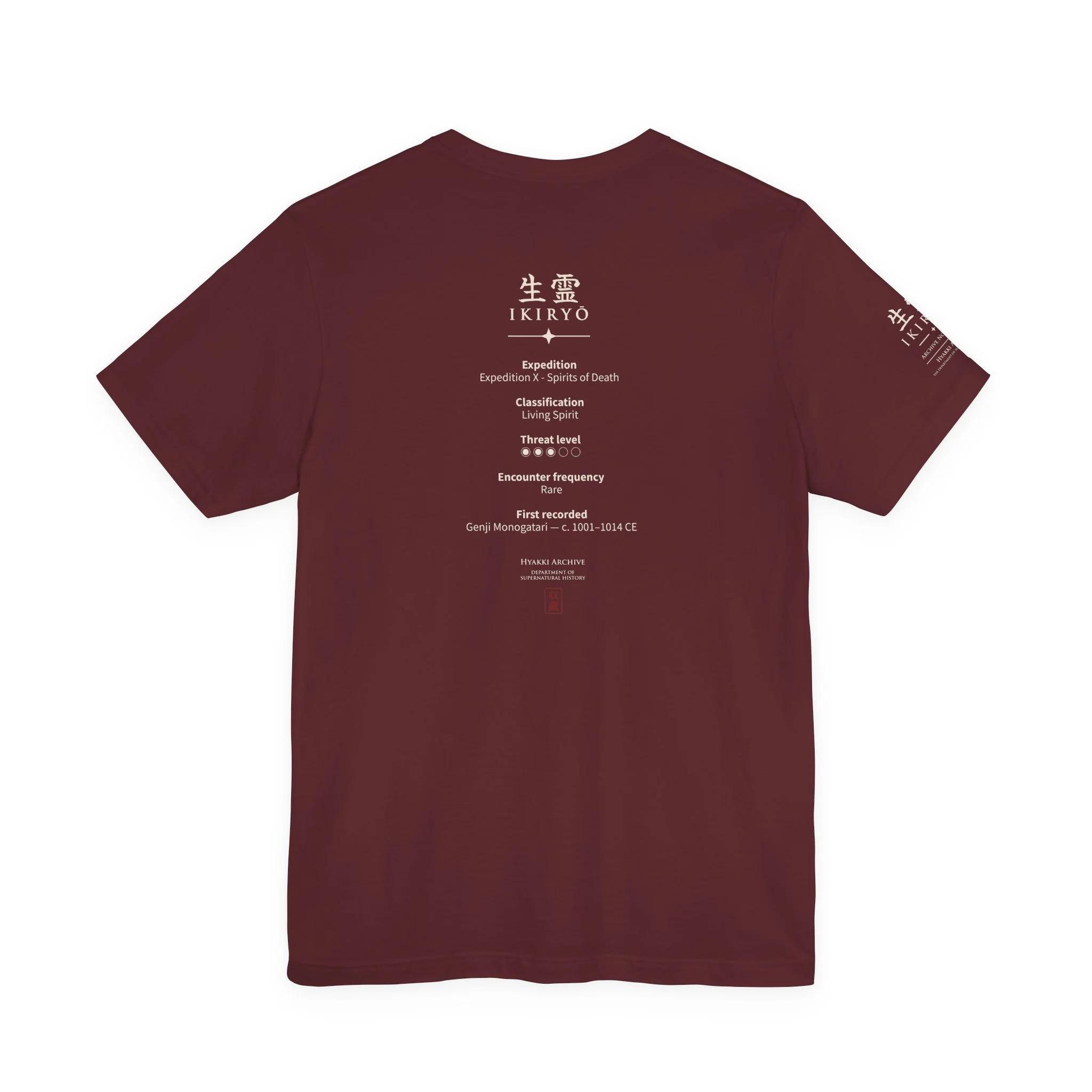
| Temperament |
Variable • Obsessive • Potentially Vengeful |
| Activity |
Associated with Strong Emotion and Possession |
| Encounter Frequency |
Rare |
| Habitat |
Unfixed • Wherever the Living Spirit Manifests |
| Known Variants |
Ikisudama • Possessing Living Spirit |
01 · What Is It?
Ikiryō refers to the spirit of a living person believed capable of separating from its body.
The concept is traditionally contrasted with Shiryō, the spirit of someone who has already died. Japanese dictionaries define Ikiryō specifically as a living person’s resentful spirit that attaches itself to another person and causes supernatural harm. An older related term is ikisudama, which appears in classical literature.
The person producing the spirit does not necessarily need to die, and in some literary traditions may not even fully understand what is happening.
That makes Ikiryō particularly unsettling. The supernatural presence is not a remnant left behind after death.
Its source is still somewhere in the world of the living.
02 · Historical Record
One of the most famous early examples appears in The Tale of Genji, composed in the early eleventh century.
In the “Aoi” chapter, the spirit associated with Lady Rokujō becomes attached to Aoi no Ue during pregnancy and childbirth. Scholarly studies of the episode identify Rokujō’s manifestation as a rare and particularly important example of the living spirit in Heian literature.
The older expression ikisudama also appears in the same chapter, and Japanese lexicographical sources trace the term to classical literature and tenth-century dictionaries.
By around the early twelfth century, Konjaku Monogatarishū also records the term 生霊, demonstrating that the concept was not confined to a single literary work.
Ikiryō therefore has a long historical record, but it appears much less frequently than stories of the ordinary dead.
03 · Appearance
Ikiryō has no fixed physical appearance.
Because the spirit originates from a living person, it may resemble that individual, manifest through another body, or remain effectively invisible.
Classical accounts often focus less on seeing the spirit directly than on recognizing its presence through possession, speech, illness, dreams, or unusual behaviour.
This differs from later popular ghost imagery, where spirits are often standardized as pale figures in white clothing. There is no reason to assume every Ikiryō historically appeared that way.
For Hyakki, any visible human representation should therefore be treated as a reconstruction of the person whose spirit has separated from the body, not as a universal supernatural anatomy.
The defining characteristic is not what the spirit looks like.
It is the impossible fact that the person represented by it is still alive elsewhere.
04 · Behaviour & Encounters
Ikiryō traditions are especially associated with possession and harm produced by strong emotion.
Resentment, jealousy, attachment, or obsession may be imagined as powerful enough to separate the spirit from the living body and send it toward another person.
The Lady Rokujō episode in The Tale of Genji is the best-known example. Her jealousy and emotional distress become entangled with the possessing spirit afflicting Aoi no Ue. Importantly, scholarship has emphasized how unusually vivid and psychologically complex the episode is compared with other contemporary spirit narratives.
The spirit can therefore behave independently enough to cause suffering while its living source remains physically elsewhere.
This creates a disturbing uncertainty about responsibility.
Did the person consciously send it?
Did emotion itself produce the manifestation?
Or did the spirit act beyond the person’s control?
Historical literature does not always provide a simple answer.
05 · Belief, Ritual & Meaning
Ikiryō belongs to a broader Heian and medieval world in which possession by mononoke could be used to explain serious illness, emotional disturbance, and unexplained suffering.
Religious specialists could perform prayers or rituals intended to identify and drive out the possessing presence. In some contexts, a spirit might be encouraged to reveal its identity through a medium or intermediary.
The remarkable feature of Ikiryō is that the source of the spirit remains alive.
This makes the concept a powerful expression of the idea that intense human emotion is not entirely contained within the person experiencing it.
Jealousy, resentment, longing, and fixation can cross physical distance.
In supernatural terms, they can acquire agency.
Ikiryō therefore sits in an unusual position within Spirits of Death. It is associated with haunting and possession, yet no death is required.
The boundary being crossed is not between life and death.
It is between body and spirit.
06 · Regional & Historical Variations
Ikiryō is more strongly documented through classical literature and later ghost traditions than through one standardized nationwide folk description.
The classical term ikisudama overlaps closely with Ikiryō and appears in The Tale of Genji. Later texts use 生霊 more explicitly for the living spirit, while the term becomes clearly contrasted with Shiryō, the spirit of the dead.
Literary treatments also vary in how consciously the living person participates.
In some stories, resentment appears almost involuntarily to produce the spirit. Other later interpretations make the living spirit feel more intentional or closer to a supernatural attack.
The famous Rokujō tradition was also adapted into Noh theatre, particularly Aoi no Ue, helping preserve and reshape the image of the jealous living spirit long after the Heian period.
Because the tradition develops across literature, performance, religious interpretation, and folklore, Ikiryō should not be reduced to a single rule such as “anger causes astral projection.”
The historical concept is stranger and less mechanical than that.
07 · What We Actually Know
| Ikiryō refers to the spirit of a person who is still alive |
DOCUMENTED |
| Ikiryō is traditionally contrasted with Shiryō, the spirit of the dead |
DOCUMENTED |
| The Tale of Genji contains the most famous classical living-spirit episode |
DOCUMENTED |
| Lady Rokujō is associated with a possessing living spirit in the Aoi chapter |
DOCUMENTED |
| Ikisudama is an older related term for the living spirit |
DOCUMENTED |
| Every Ikiryō is deliberately sent by its living source |
UNSUPPORTED |
| Every Ikiryō is created only through jealousy |
INCORRECT |
| Ikiryō traditions express the idea that powerful emotion can act beyond the physical body |
INTERPRETATION |















Reviews
There are no reviews yet.