The Design
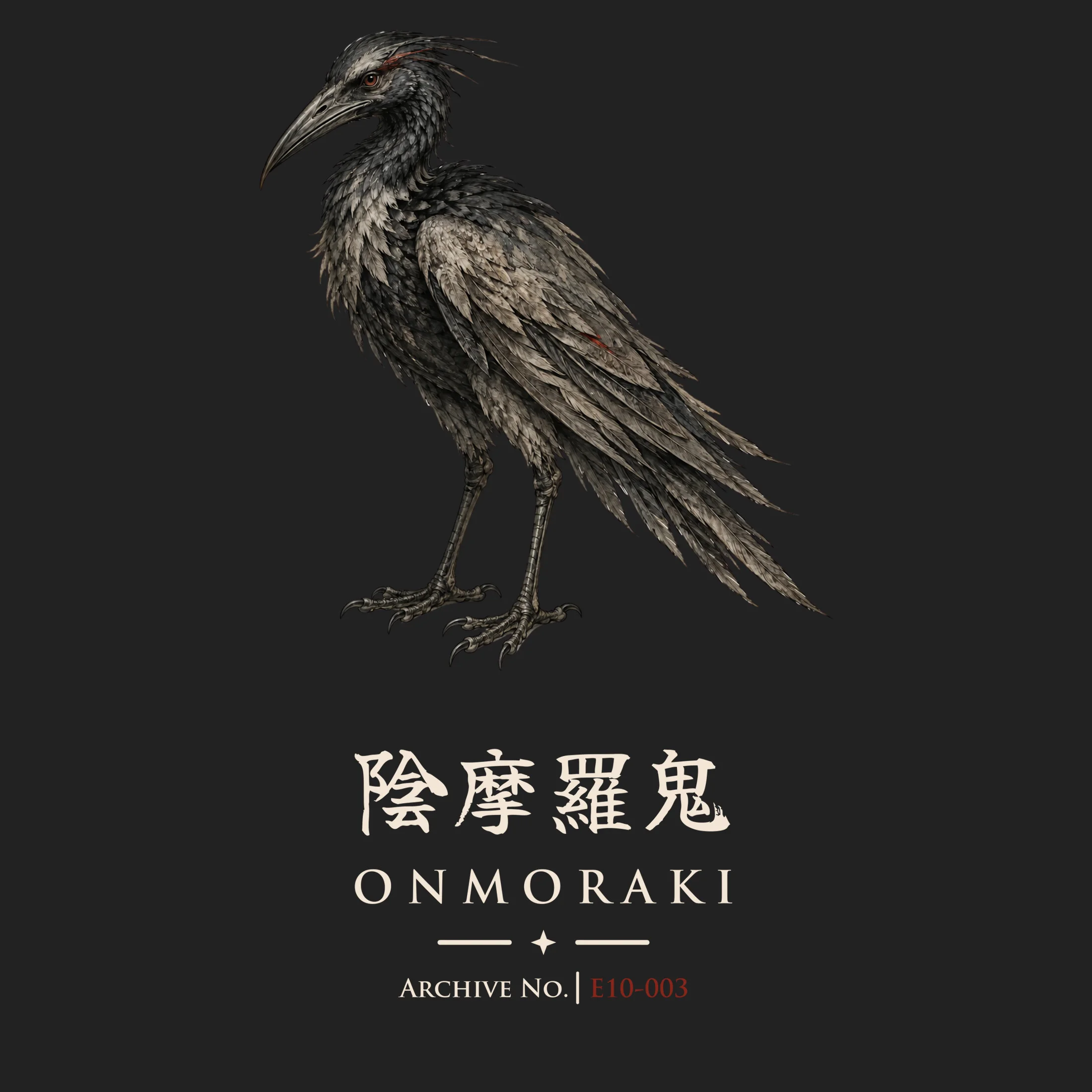
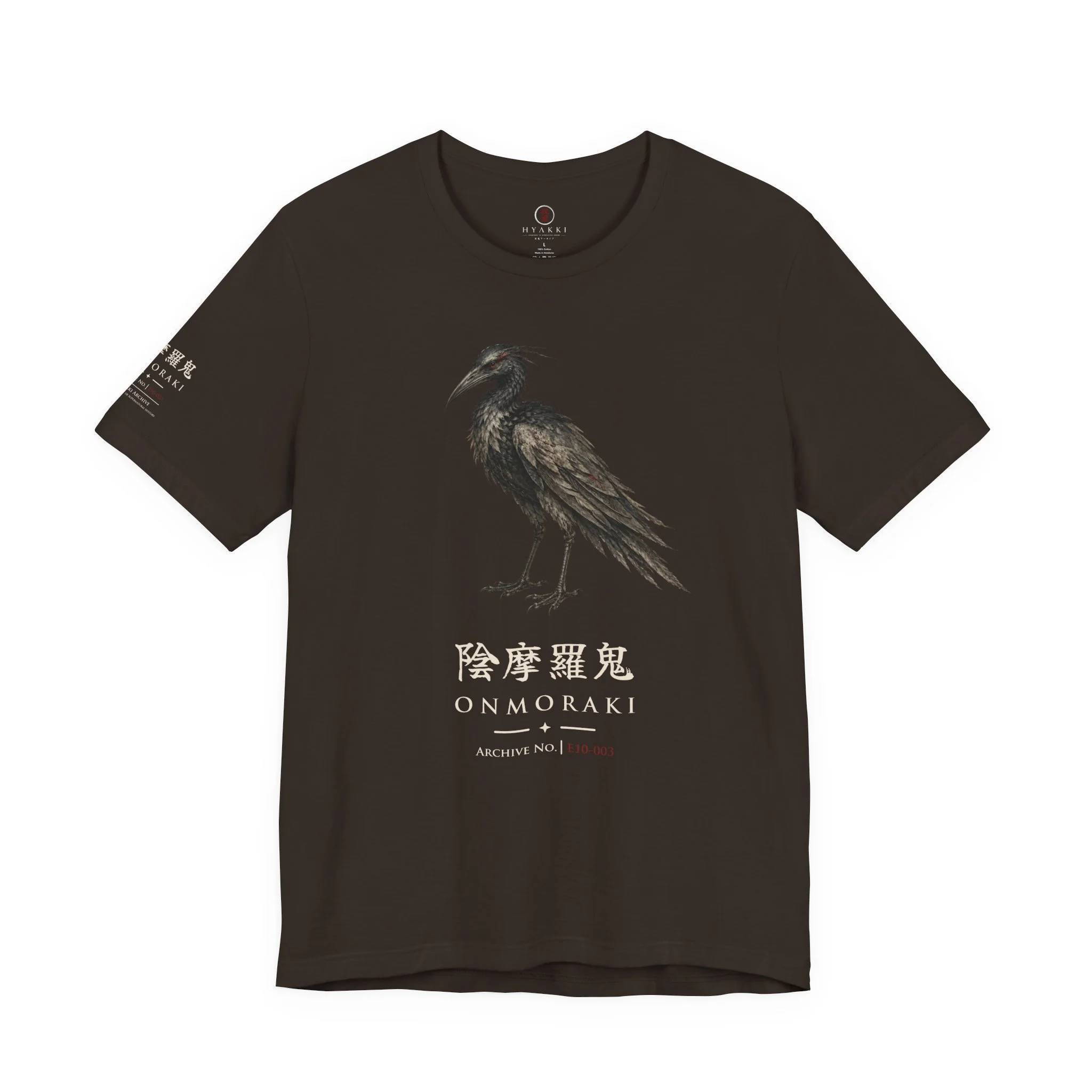
The E10-003 Onmoraki design presents the entity as a dark, long-legged bird with a severe, almost funerary presence.
The figure is shown full-body with black and charcoal plumage, a long narrow beak, angular legs, and a slightly raised crest. The feathers are layered in muted greys and deep black, with small restrained red accents around the eye and scattered through the plumage. Its posture is still and upright rather than aggressive, which gives the creature the feeling of something waiting rather than hunting.
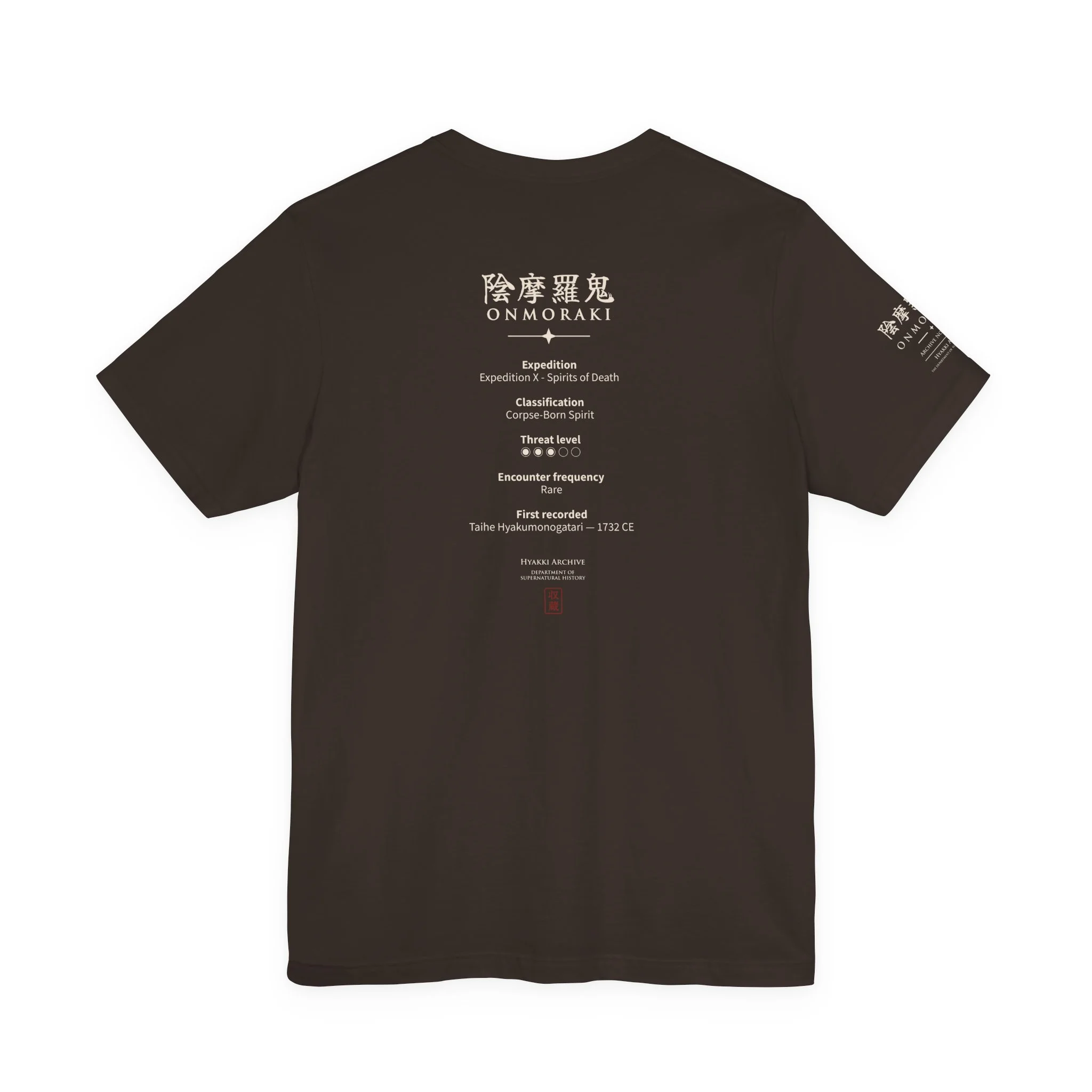
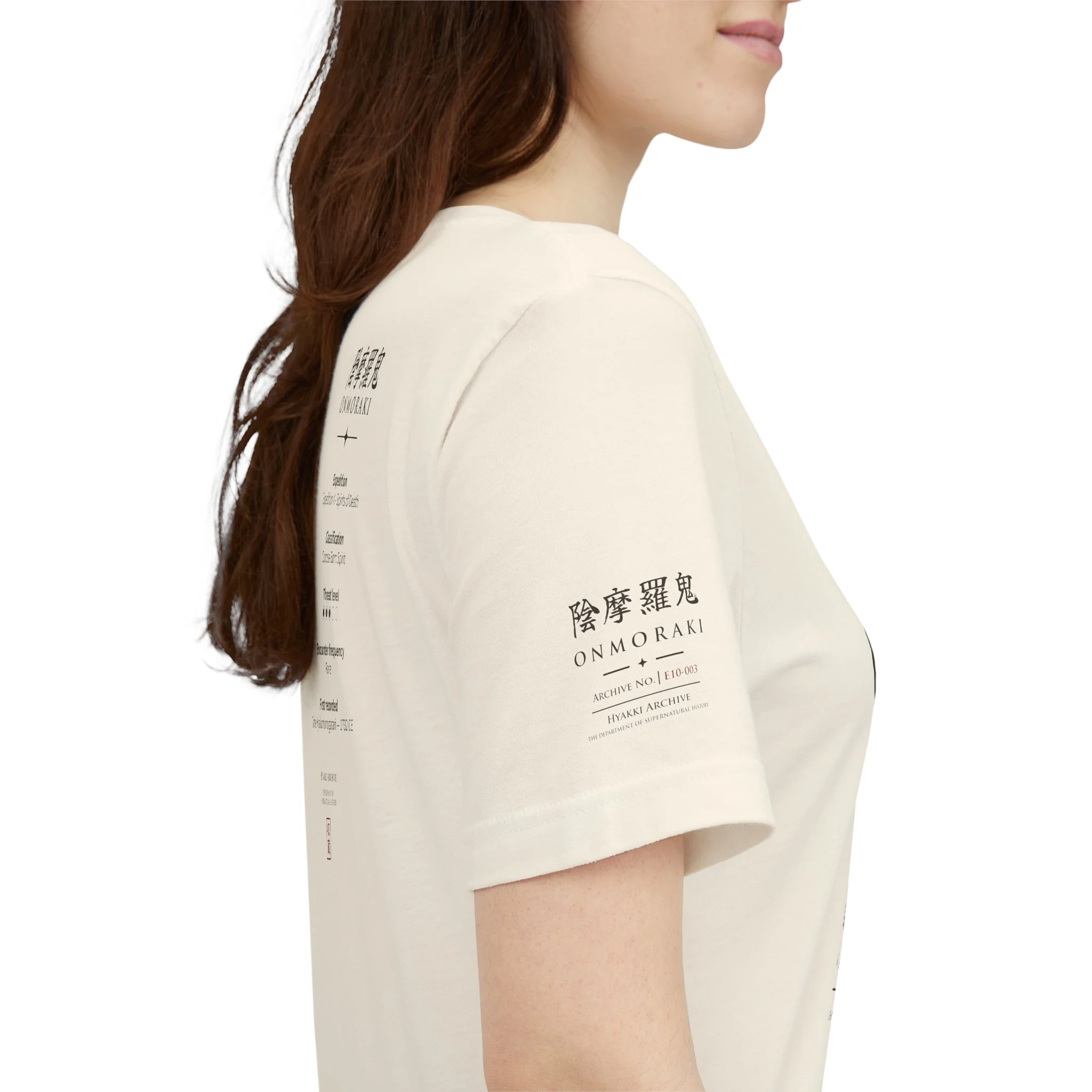
Beneath the illustration, 陰摩羅鬼, ONMORAKI, and Archive No. E10-003 continue the Hyakki archive format.
The design avoids turning the creature into a generic raven, skeletal bird, or flame-covered demon. Instead, it stays close to the more unusual crane- or heron-like form associated with the historical tradition.
The Entity Behind the Design
Onmoraki is a corpse-associated bird apparition found in Japanese supernatural literature through an older Chinese textual tradition.
In the core story, a strange dark bird appears at a Buddhist temple where a recently dead body has been placed. It is described as crane-like, with bright eyes and a harsh cry. The apparition is later explained as something produced from the lingering energy of the corpse.
That makes Onmoraki different from a conventional ghost.
The dead person does not simply return in human form. Instead, something unfamiliar emerges from the presence of death itself.
Japanese retellings preserved this idea, and Toriyama Sekien later gave Onmoraki a strong visual identity in the Edo period.
Known For
Onmoraki is best known for its connection with recently dead bodies.
Its stories commonly take place around temples or mortuary spaces, where a corpse has not yet fully passed through the rituals and processes surrounding death. The bird appears during this unsettled period, often at night.
The creature is also known for its distinctive appearance. Historical descriptions emphasize a dark crane-like or heron-like body, bright eyes, agitated wings, and a disturbing cry.
Later interpretations increasingly linked the apparition with neglected Buddhist rites, suggesting that Onmoraki could arise when the dead were not properly memorialized or when religious obligations had been left incomplete.
That later moral interpretation is not identical to the earlier story, but both share the same underlying unease:
death has happened, yet something about it is still unfinished.
From Folklore to Design
This design deliberately follows the dark crane- or heron-like tradition rather than replacing Onmoraki with a more familiar raven or crow.
The long beak, tall legs, and narrow silhouette help distinguish it immediately from those more common death-bird images. The layered black and grey plumage keeps the figure grounded in something recognizably avian, while the sharper proportions and slight red details push it just beyond naturalism.
The eye is especially important. It is small but intense, giving the bird a watchful quality without resorting to exaggerated glowing effects.
The artwork also avoids a corpse, temple, or funeral scene around the creature. That keeps the design clean, but it changes the emphasis in an interesting way.
Instead of showing what created the apparition, the shirt presents only what remains after it has appeared.
The body is elsewhere.
The bird is already here.
From the Hyakki Archive
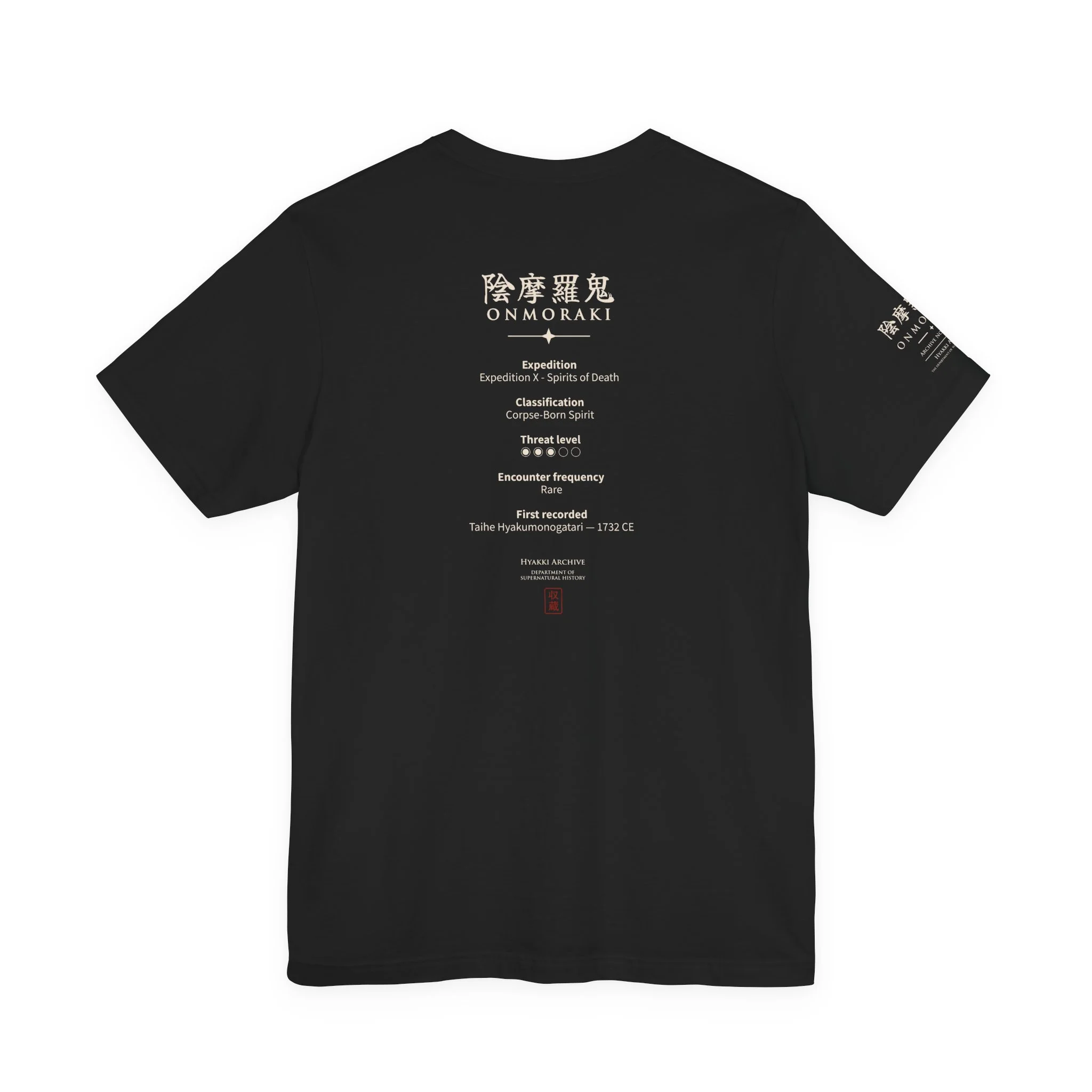
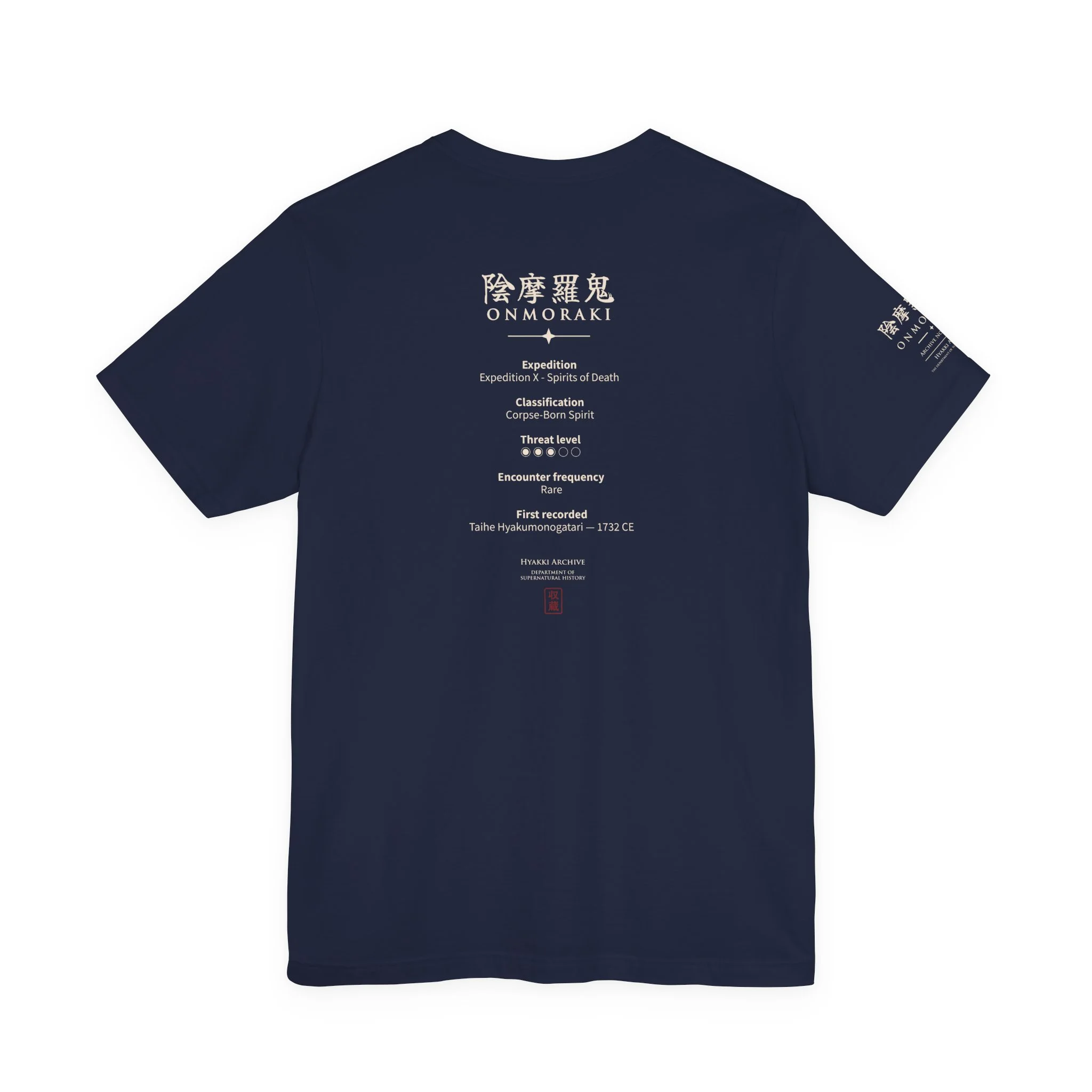
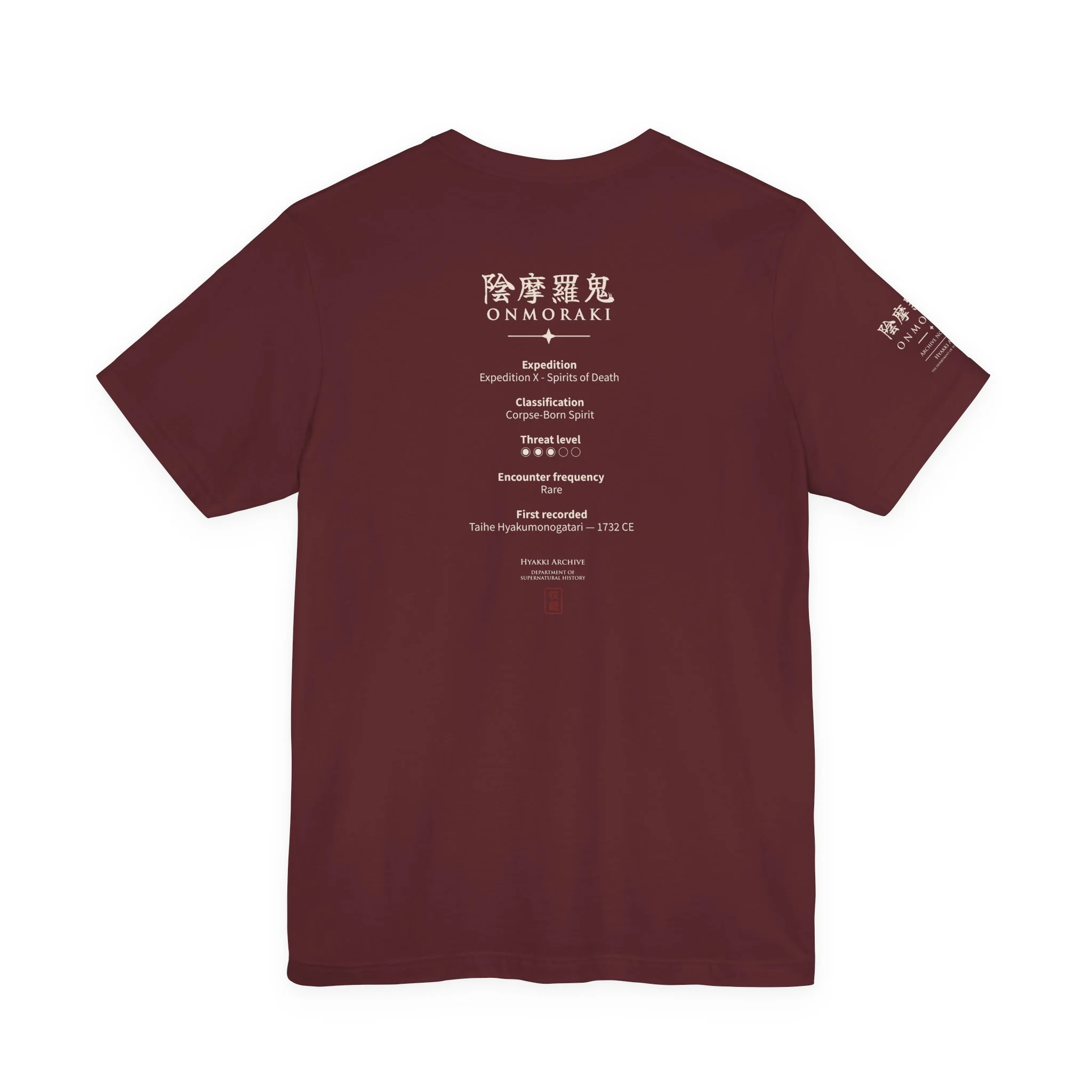
Archive File E10-003 continues Expedition X — Spirits of Death with an apparition that sits between corpse, ritual, and transformation.
Kasha tries to claim the dead.
Ubume remains because something was left unfinished.
Onmoraki suggests something stranger:
that the dead may leave behind more than memory.
A body rests inside the temple.
The night grows quiet.
Then something begins to move in the darkness.
Not the corpse.
Something that came from it.
What can arise when death has occurred, but its final rites are not yet complete?
収蔵
| Temperament |
Hostile • Disturbing • Corpse-Bound |
| Activity |
Nocturnal |
| Encounter Frequency |
Extremely Rare |
| Habitat |
Temples • Mortuary Spaces • Places Holding Recent Corpses |
| Known Variants |
Chinese Source Tradition • Edo-Period Japanese Form |
01 · What Is It?
Onmoraki is a supernatural bird associated with the presence of a recent corpse.
The entity appears in Japanese yōkai literature through older Chinese textual material. In the story commonly associated with Onmoraki, a traveller or scholar sleeps in a temple where a corpse has recently been placed. During the night, a strange bird appears, cries loudly, and terrifies the witness.
The creature is described as crane-like, dark in color, and possessing eyes that shine like lamps.
Later explanations say that the Onmoraki is formed from the lingering ki, or vital residue, of the newly dead.
That makes it different from a conventional ghost. The dead person does not simply return in human form. Something else seems to emerge from the corpse instead.
02 · Historical Record
The Onmoraki tradition has a Chinese literary ancestry.
Chinese texts preserve a story in which a man named Cui Sifu sleeps in a Buddhist temple and encounters a strange bird. The creature is described as crane-like, dark, brightly eyed, and violently vocal. A monk later explains that the apparition is produced from the energy of a newly dead corpse.
A Japanese version appears in Edo-period supernatural literature, including Taihei Hyaku Monogatari, where the setting is adapted to Yamashiro and the witness encounters the bird in a temple containing a recently deceased body.
Toriyama Sekien then gave Onmoraki one of its most influential visual forms in Konjaku Gazu Zoku Hyakki, published in 1779. The Tokyo Museum Collection confirms the work and date, while the surviving illustration clearly identifies Onmoraki among Sekien's supernatural subjects.
03 · Appearance
Onmoraki has one of the more consistent visual descriptions among the entities in this expedition.
The creature is typically described as resembling a crane or large heron-like bird, with a dark or black body.
Its eyes are one of its most distinctive features. They are described as shining or glowing intensely, compared in some texts to lamps.
The bird also beats its wings and gives a harsh, frightening cry.
Sekien's 1779 illustration follows this avian tradition rather than turning Onmoraki into a humanoid demon.
That matters for modern design. Onmoraki should not automatically be rendered as a raven, vulture, skeletal bird, or flame-covered monster. Those choices may work artistically, but the older textual image is closer to a dark crane-like apparition.
04 · Behaviour & Encounters
Onmoraki does not behave like a hunting predator in most early descriptions.
Its defining action is appearing near a recent corpse.
The witness usually encounters it at night, often inside or around a temple. The bird cries loudly, flaps its wings, and creates terror through its unnatural presence rather than through a prolonged physical attack.
In the Chinese and Japanese narrative traditions, the apparition is directly connected with a corpse that has recently been brought into or temporarily stored at the temple.
Later descriptions sometimes moralize the creature more strongly, linking it with neglected memorial rites or monks who fail in their religious duties.
Those later explanations are important, but they should not be assumed to describe every stage of the tradition.
The oldest narrative core is simpler:
A corpse is present.
Something birdlike appears.
The living are confronted with the fact that death has not yet settled.
05 · Belief, Ritual & Meaning
Onmoraki is strongly connected with Buddhist mortuary space.
Its stories often take place in temples because such locations could temporarily house the dead, host religious rites, and act as boundaries between the living and the deceased.
The explanation that a fresh corpse's remaining energy can become a supernatural bird reflects older East Asian ideas about death as a process rather than a single instant.
The body may be dead, but something associated with it has not yet dispersed.
Later Japanese interpretations sometimes add a moral dimension: the apparition appears because proper sutra reading, memorial observance, or funerary treatment has been neglected.
That interpretation fits Buddhist concerns about correct treatment of the dead, but it should be distinguished from the simpler earlier idea of corpse-energy transforming into a bird.
The central question is therefore:
What can arise when death has occurred, but the rites surrounding it are not yet complete?
06 · Regional & Historical Variations
Onmoraki varies less by Japanese region than by textual transmission and interpretation.
The oldest strand is Chinese. A crane-like bird appears in a Buddhist temple and is explained as the transformation of energy from a recently dead body.
Japanese retellings relocate and adapt the story but preserve much of the structure.
By the Edo period, Sekien's 1779 illustration helped give the creature a stable visual identity: dark, avian, and corpse-associated.
Later yōkai references increasingly explain Onmoraki as a consequence of improper memorial treatment, especially a failure to perform appropriate Buddhist rites.
That development shifts the emphasis.
The earlier story asks what a corpse can become.
The later interpretation asks what happens when the living fail to perform what the dead require.
Both belong to the tradition, but they are not quite the same idea.
07 · What We Actually Know
| Onmoraki has a Chinese textual background |
DOCUMENTED |
| Japanese versions preserve the apparition in Buddhist temple settings |
DOCUMENTED |
| The creature is described as a dark crane-like or heron-like bird |
DOCUMENTED |
| Bright lamp-like eyes and a harsh cry are recurring features |
DOCUMENTED |
| Onmoraki is associated with recently dead corpses |
DOCUMENTED |
| Toriyama Sekien illustrated Onmoraki in 1779 |
DOCUMENTED |
| Onmoraki is simply the ghost of the dead person in bird form |
UNSUPPORTED |
| Later ritual-neglect explanations represent the oldest form of the tradition |
UNRESOLVED |

















Reviews
There are no reviews yet.