The Design
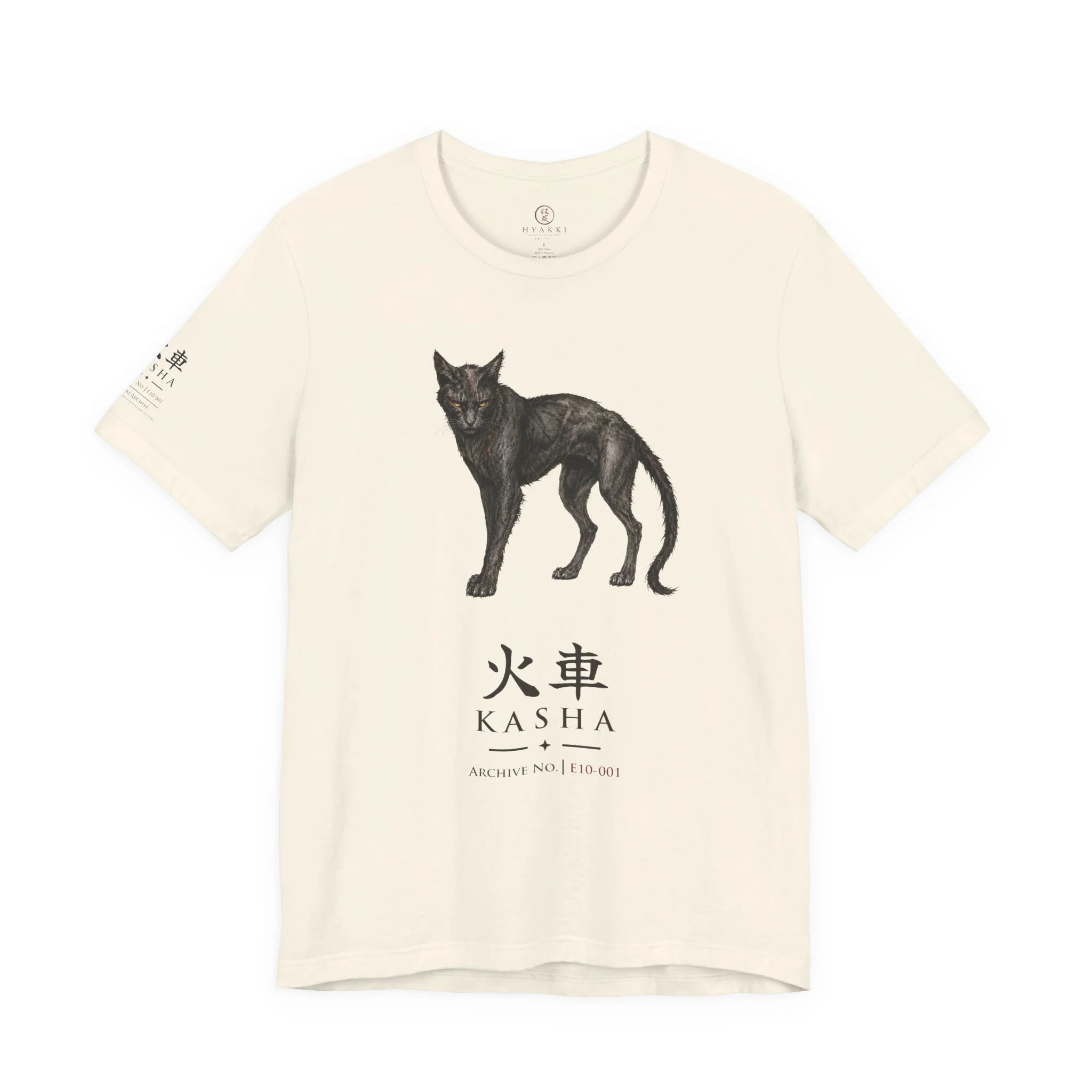
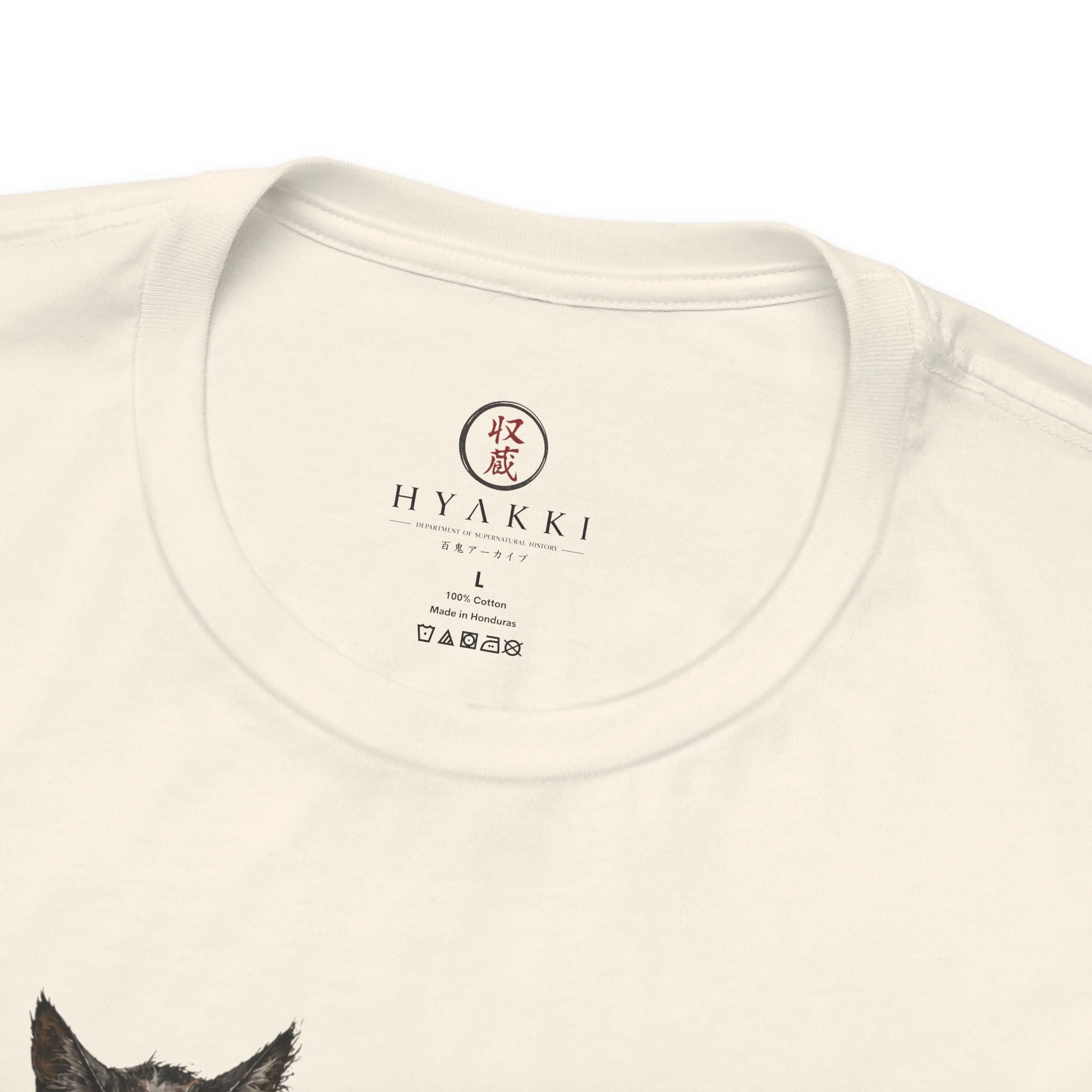
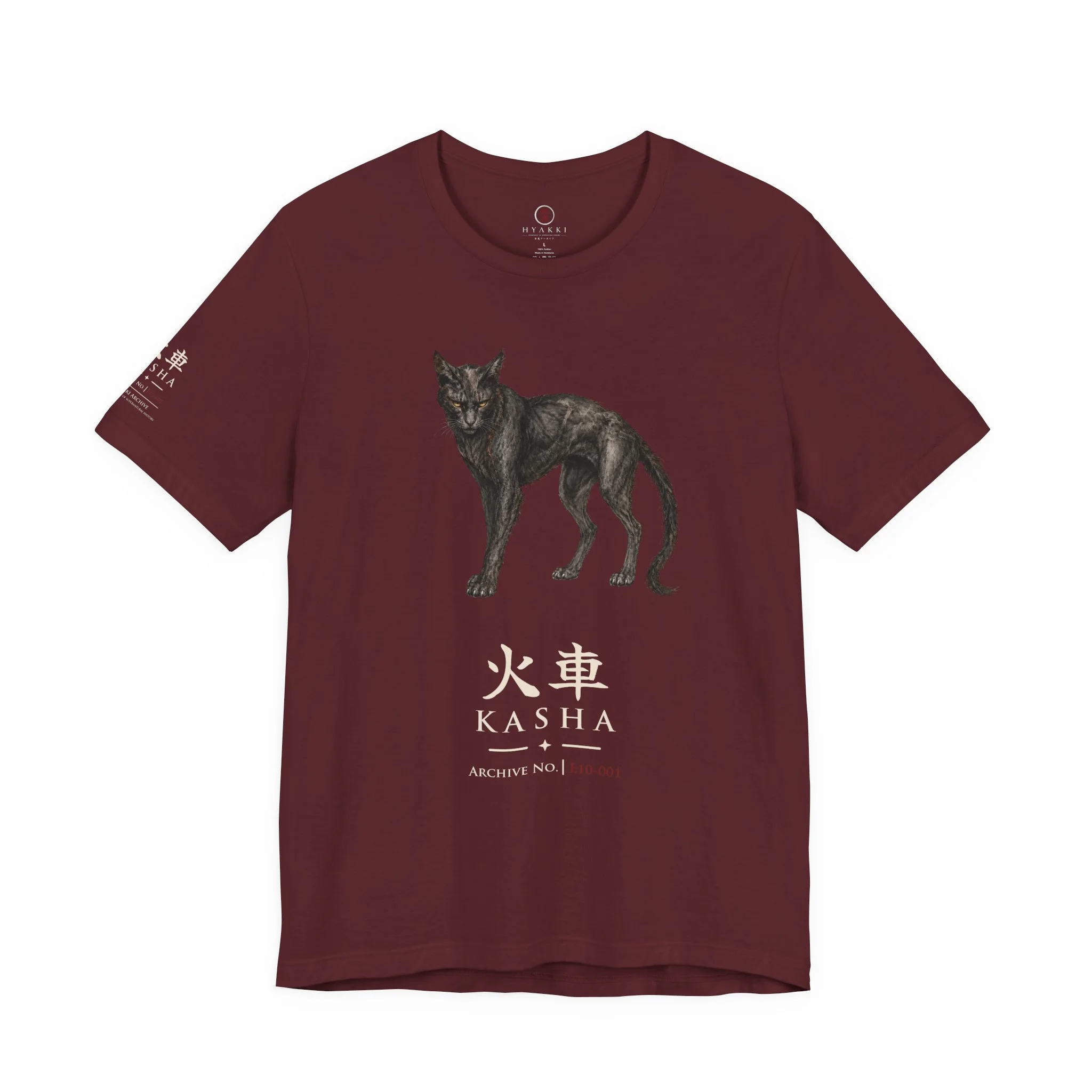
The E10-001 Kasha design presents the entity as a gaunt, black supernatural cat, drawing on the later feline form that became strongly associated with Kasha folklore.
The animal is shown full-body with a lean, almost emaciated build, long legs, dark weathered fur, and intense amber eyes. Its posture is tense rather than aggressive, as if it has paused in the middle of approaching something. Subtle reddish marks break through the dark coat, hinting at heat, injury, or something infernal beneath the surface without surrounding the figure in literal flames.
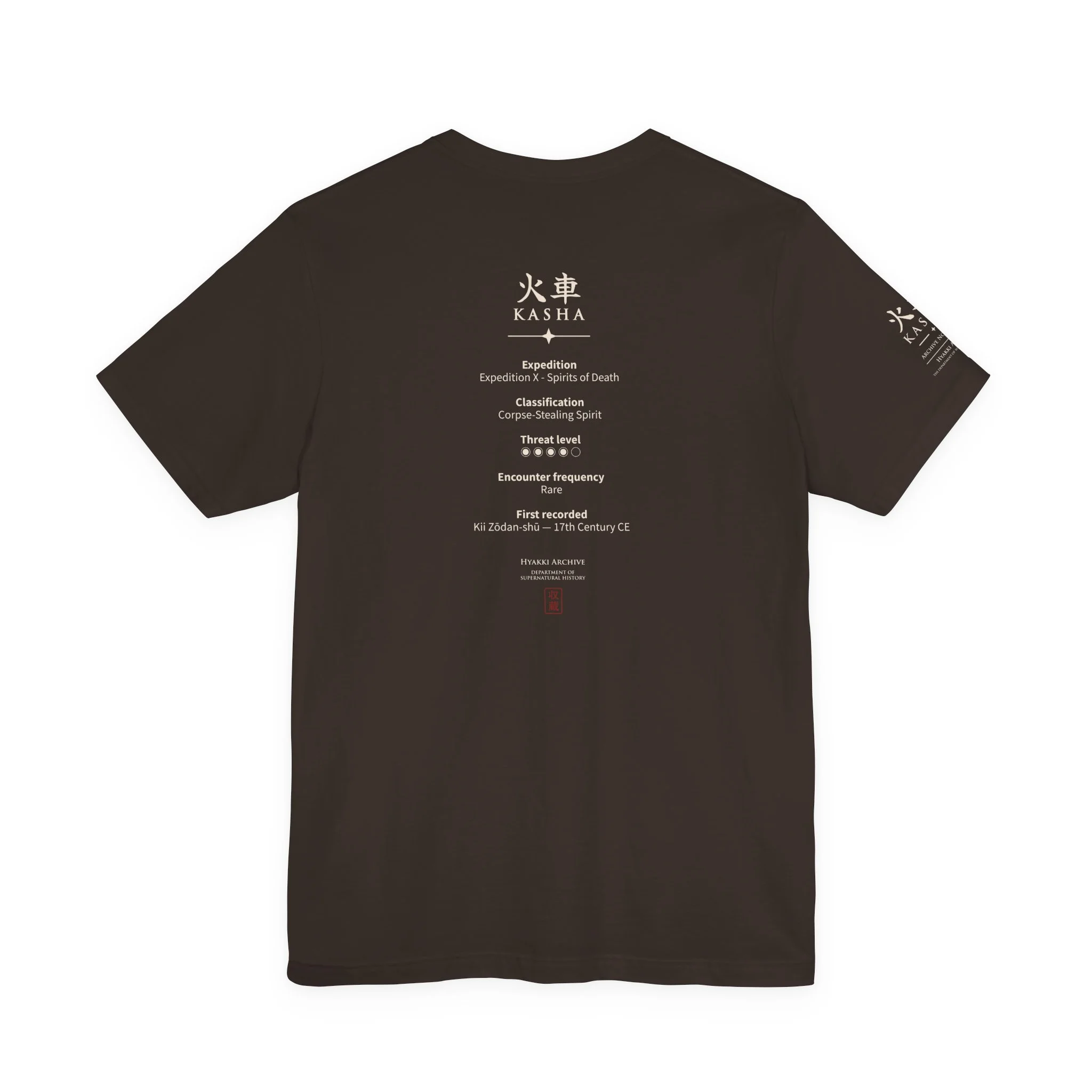
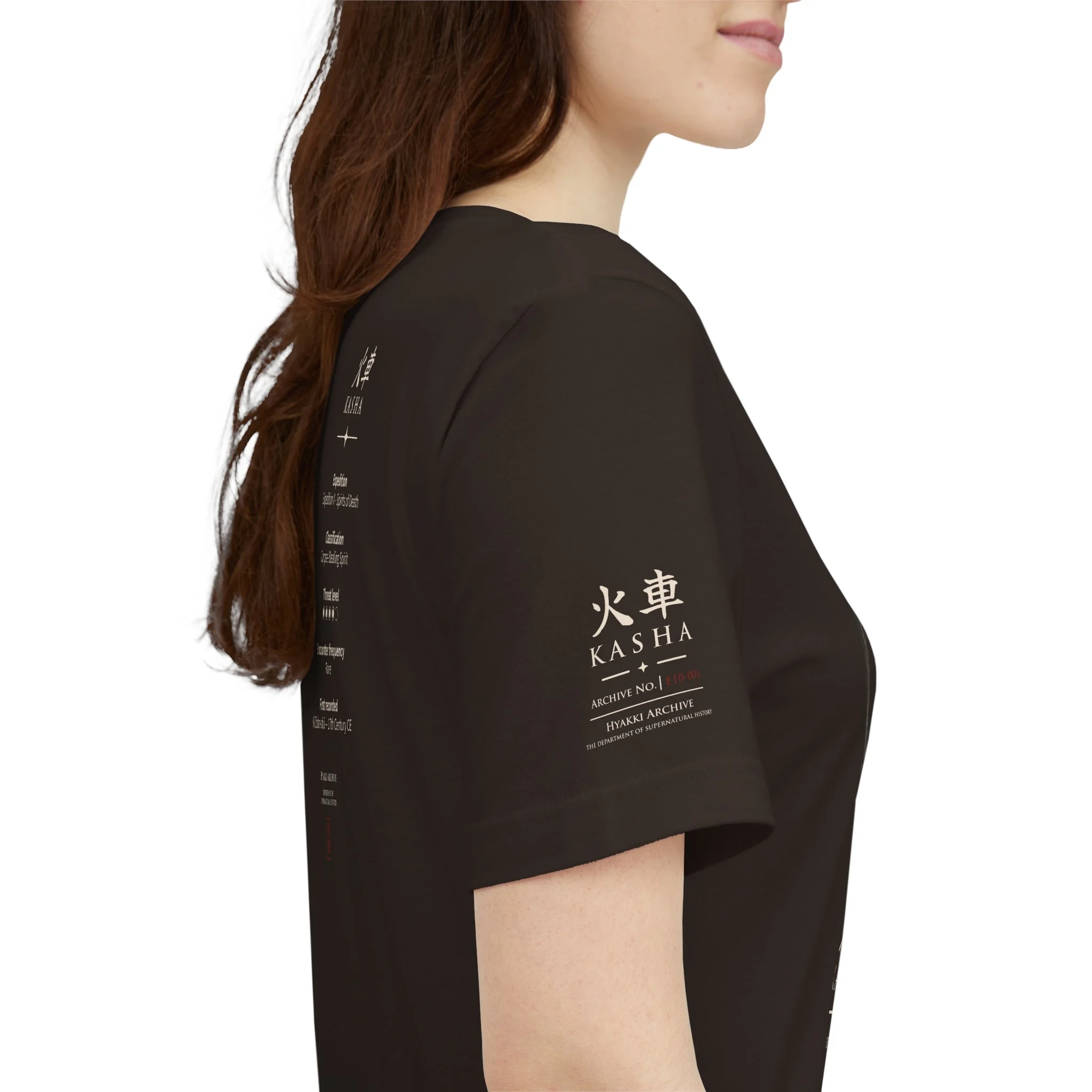
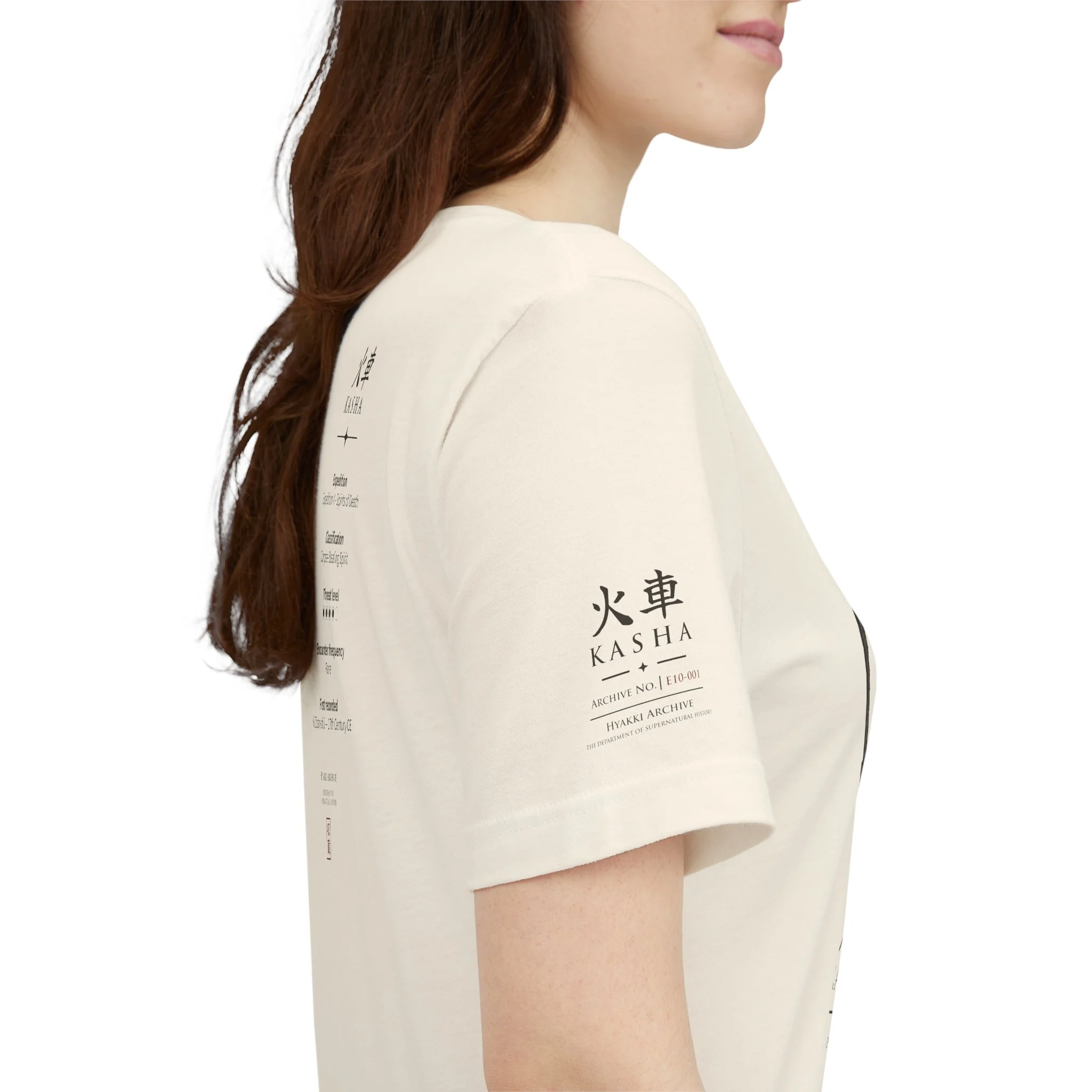
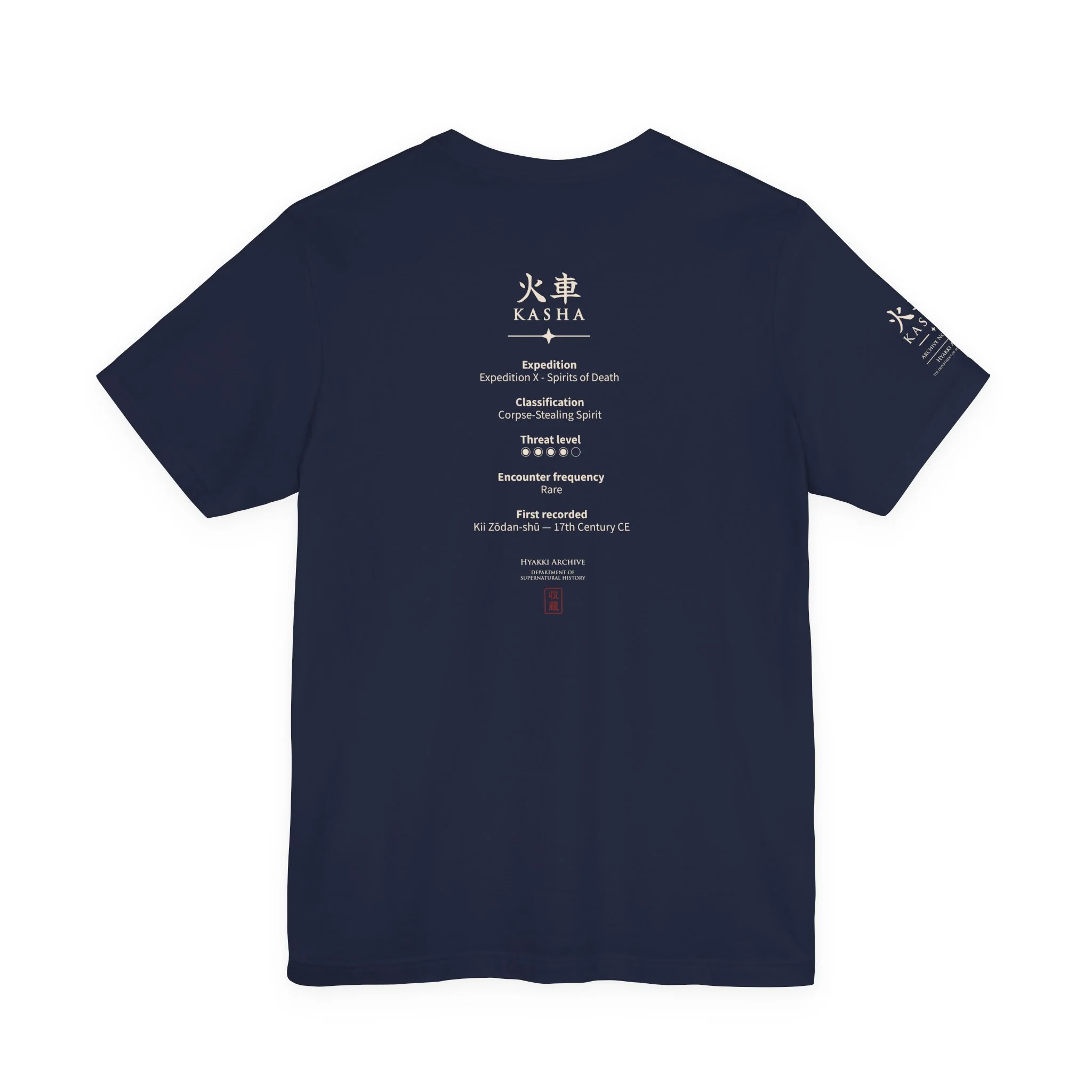
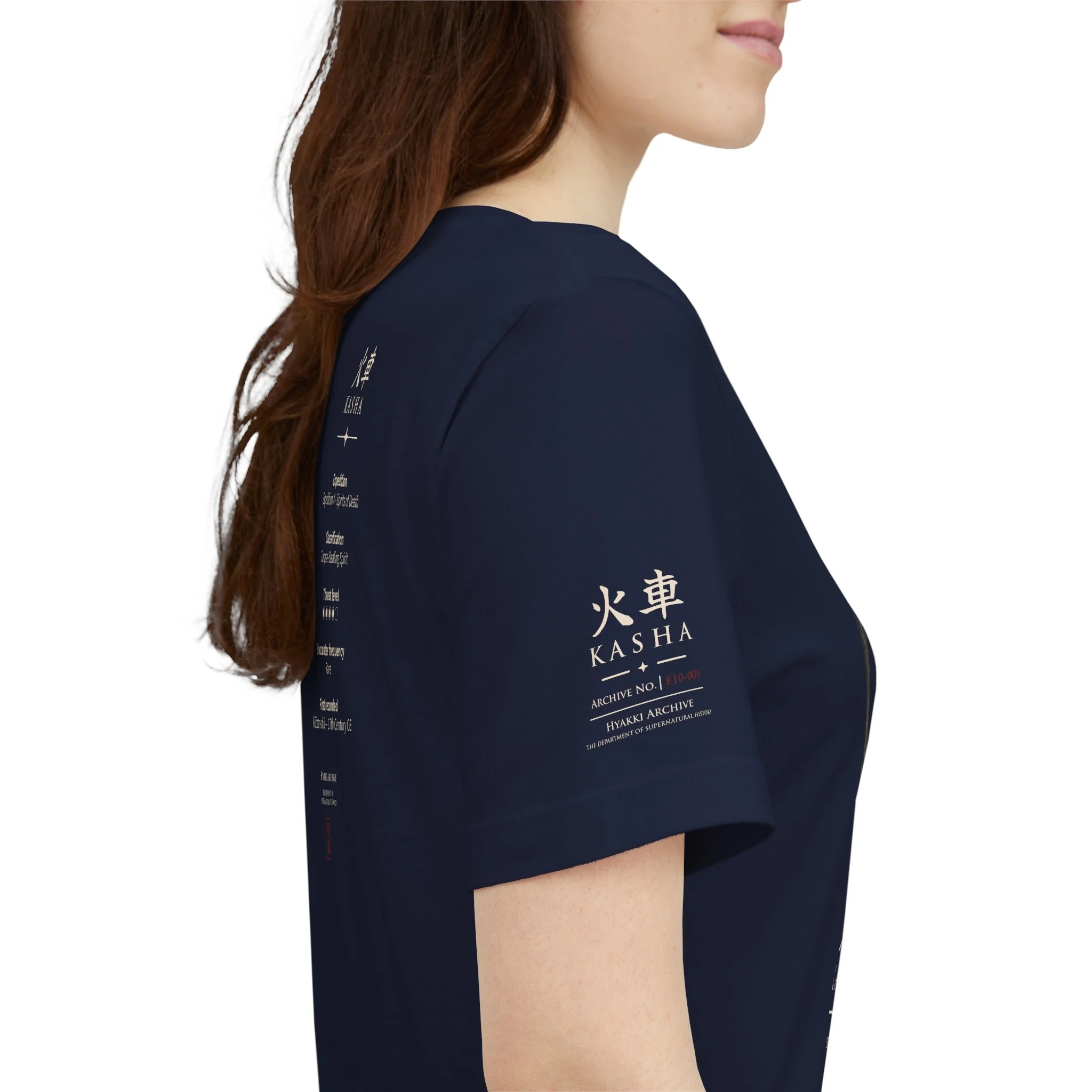
Beneath the illustration, 火車, KASHA, and Archive No. E10-001 retain the restrained Hyakki specimen layout.
The design avoids turning Kasha into an elaborate fantasy beast. There are no horns, wings, oversized fangs, or burning wheels. What remains is more unsettling: a recognizable cat altered just enough to suggest that it does not belong among the living.
The Entity Behind the Design
Kasha is one of the more complicated beings in Japanese death folklore because its identity changed considerably over time.
The name 火車 means “fire cart.” In Buddhist religious imagery, the kasha was originally an infernal vehicle associated with carrying sinners toward hell.
Later traditions moved the danger into the funeral itself. Stories describe corpses or coffins being seized during burial rites, often amid violent wind, thunder, or dark clouds. Eventually, some of these traditions became strongly connected with supernatural cats, contributing to the feline Kasha now familiar from yōkai imagery.
The cat in this design therefore represents one important later form of the tradition, not the beginning of it.
Behind that form remains the older and more disturbing idea: after death, the body may still be vulnerable to something trying to claim it.
Known For
Kasha is most famous for stealing the dead.
In regional funeral traditions, a corpse may disappear from its coffin, a coffin may suddenly become unnaturally light, or something may descend during a storm and attempt to carry the body away. Priests sometimes appear in these stories as protectors, defending the dead long enough for proper burial to take place.
Cats became especially important in later Kasha belief. Some communities feared allowing a cat to approach, cross over, or jump across a corpse because doing so could cause the body to move or invite supernatural disturbance.
Various regional protective customs developed around that fear, including watching the corpse carefully or placing objects near the body. These practices were not universal across Japan, but they show how seriously the boundary between the dead and the supernatural could be treated.
Kasha is therefore not simply a “demon cat.” It belongs to a broader funerary anxiety about whether burial can be completed before something else intervenes.
From Folklore to Design
This design chooses the feline Kasha but deliberately strips away many of the visual clichés that usually accompany it.
There is no literal burning cart and no wall of supernatural fire. Instead, the body itself carries the unease. The dark coat feels scorched or weathered, while the small reddish traces suggest a connection with the “fire” preserved in the entity’s name without making flames the entire identity of the creature.
The lean proportions also matter. This does not look like a powerful guardian animal or a comfortable domestic cat. It feels hungry, restless, and slightly unnatural.
The amber eyes are the strongest focal point. They make the animal appear alert and deliberate, suggesting that it has not wandered into the scene accidentally.
That restraint keeps the design connected to the historical complexity of Kasha.
The cat is visible.
The cart is not.
The funeral it has come for is somewhere outside the frame.
From the Hyakki Archive
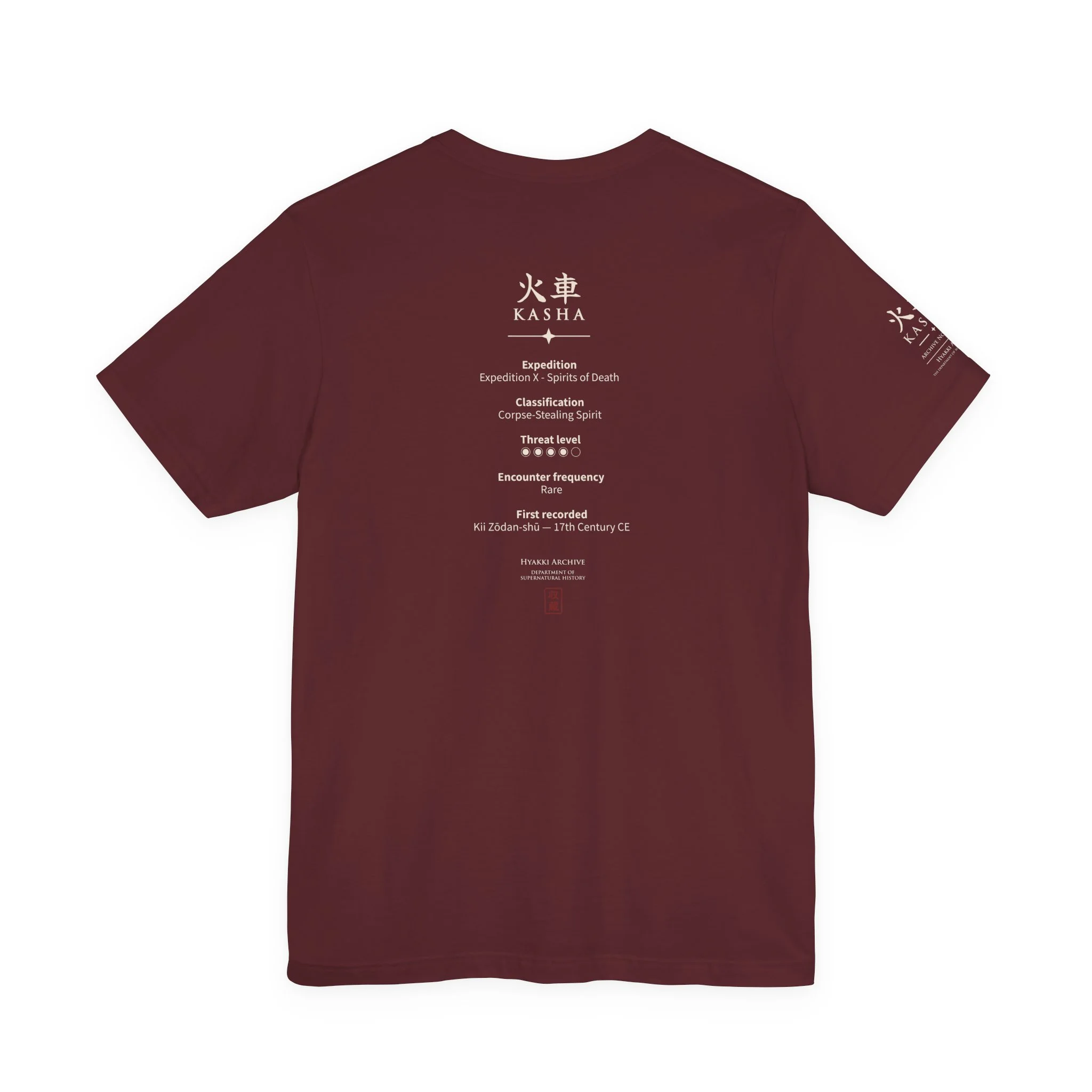
Archive File E10-001 opens Expedition X — Spirits of Death with a being defined by what happens after life has already ended.
Kasha does not primarily threaten the living.
It threatens the completion of death itself.
A body has been prepared.
The mourners have gathered.
The burial is underway.
Then the weather changes.
Something approaches the coffin.
And suddenly the question is no longer how the person died.
It is who will be allowed to take them next.
収蔵
| Temperament |
Predatory • Funerary • Hostile |
| Activity |
Associated with Death and Funerals |
| Encounter Frequency |
Rare |
| Habitat |
Funeral Routes • Cemeteries • Temples • Places of Burial |
| Known Variants |
Fire Cart • Storm-Borne Corpse Thief • Feline Kasha |
01 · What Is It?
Kasha is best understood as a layered funerary tradition, rather than a single monster with one fixed body.
The word 火車 literally means “fire cart” or “fiery vehicle.” In Buddhist imagery, such a vehicle was associated with carrying sinners toward punishment in hell.
Later Japanese folklore brought the danger closer to the human funeral. Instead of merely transporting the damned after death, Kasha could appear during the funeral itself, descend amid violent weather, seize the coffin, or carry away the corpse.
Still later, the entity became strongly connected with cats, especially old or supernatural cats thought capable of interfering with the dead.
These forms overlap, but they should not be collapsed into one timeless image. The Kasha tradition changed significantly over time.
02 · Historical Record
The earliest layer of Kasha belongs to Buddhist religious imagery, where the fire cart represented infernal punishment and the fate awaiting sinners.
By later medieval and early-modern tradition, the concept had begun to shift. Stories increasingly describe funerals interrupted by sudden storms, black clouds, thunder, or supernatural forces attempting to remove a corpse.
Regional folklore collections preserve many examples of this later form. A Miyazaki account describes a funeral suddenly overtaken by violent weather as a Kasha attempts to seize the body, only for a monk to repel it. In that version, the Kasha is identified as a cat.
Other records preserve the same corpse-seizing motif without requiring a visible feline form. In some cases the coffin itself is lifted or disappears, while in others something reaches from dark cloud or storm.
The historical development therefore appears to move from infernal vehicle, to funerary seizure, to increasingly concrete supernatural forms.
03 · Appearance
Kasha does not have one secure universal appearance.
Its oldest conceptual form is the fiery cart itself.
Later funeral legends may leave the entity almost invisible, revealing it only through black clouds, sudden storms, thunder, a coffin rising into the air, or an unknown limb reaching from above. One folklore record describes a fur-covered, bear-like hand emerging from a dark cloud during a funeral.
The cat form became especially influential later. Some records explicitly identify Kasha as an old supernatural cat or connect cats with the danger of disturbing corpses.
For Hyakki, a feline Kasha is therefore historically defensible, but it should be presented as one later manifestation, not the original or universal body of the entity.
A flaming demon cat may be visually memorable, but it compresses several centuries of changing tradition into one modern image.
04 · Behaviour & Encounters
Kasha is primarily associated with taking possession of a corpse.
The attack may happen during a funeral procession, at the moment of burial, or while the dead are being watched before burial. Some stories describe a coffin becoming suddenly light because the body has disappeared. Others describe the coffin being lifted into the air or carried away by a supernatural force.
Storms are a recurring feature. A clear day may suddenly darken, wind rises, black clouds gather, and the funeral becomes the scene of a supernatural struggle.
Some traditions describe Kasha as trying to eat the corpse. A Yamanashi story tells of a creature repeatedly attempting to steal funeral bodies until a priest deceives it with a stone-filled coffin while the real burial proceeds separately.
The danger is therefore aimed less at the mourners themselves than at the boundary between the living community and the body it is trying to bury.
05 · Belief, Ritual & Meaning
Kasha traditions are closely tied to funerary protection.
Regional customs include keeping cats away from the corpse, placing blades near the body, laying a broom across the coffin, relying on priests, or using other protective measures intended to stop the dead from being taken or disturbed.
These practices should not be treated as one universal Japanese ritual system. They vary considerably by region and period.
The cat taboo is especially important. Many records say that if a cat crosses, approaches, or jumps over a corpse, something unnatural may happen to the dead. The corpse might move, rise, or become spiritually disturbed.
Kasha therefore sits at the point where religious fear, funeral etiquette, animal superstition, and anxiety about the physical body all meet.
Its central question is unusually stark:
Who has the right to claim the body after death?
06 · Regional & Historical Variations
Kasha changes dramatically depending on source and period.
In the Buddhist layer, it is an infernal fire cart associated with sinners.
In later funeral traditions, the fire can almost disappear. Instead, the defining signs become thunder, violent weather, dark clouds, and the sudden removal of a corpse.
In some areas, Kasha is explicitly a supernatural cat. A Miyazaki record identifies the corpse-seizing Kasha as a cat, while other traditions connect ordinary cats with the fear that a corpse might move or become dangerous if the animal comes too close.
Elsewhere the entity remains unidentified. The coffin simply rises, vanishes, or is seized from the procession.
The moral dimension also varies. Some stories connect Kasha particularly with people believed to have behaved badly in life, preserving something of the older Buddhist punishment motif. Others describe the corpse as vulnerable simply because it is dead.
07 · What We Actually Know
| Kasha originally has a strong connection with Buddhist fire-cart imagery |
DOCUMENTED |
| Later folklore associates Kasha with stealing corpses during funerals |
DOCUMENTED |
| Storms, black clouds, and sudden disturbances appear in corpse-seizure traditions |
DOCUMENTED |
| Some regional traditions explicitly identify Kasha as a supernatural cat |
DOCUMENTED |
| Keeping cats away from corpses appears in regional funerary belief |
DOCUMENTED |
| Kasha was always imagined as a flaming demon cat |
INCORRECT |
| Every Kasha victim was considered morally wicked |
UNSUPPORTED |
| The Kasha tradition developed substantially across different historical periods |
INTERPRETATION |














Reviews
There are no reviews yet.