The Design
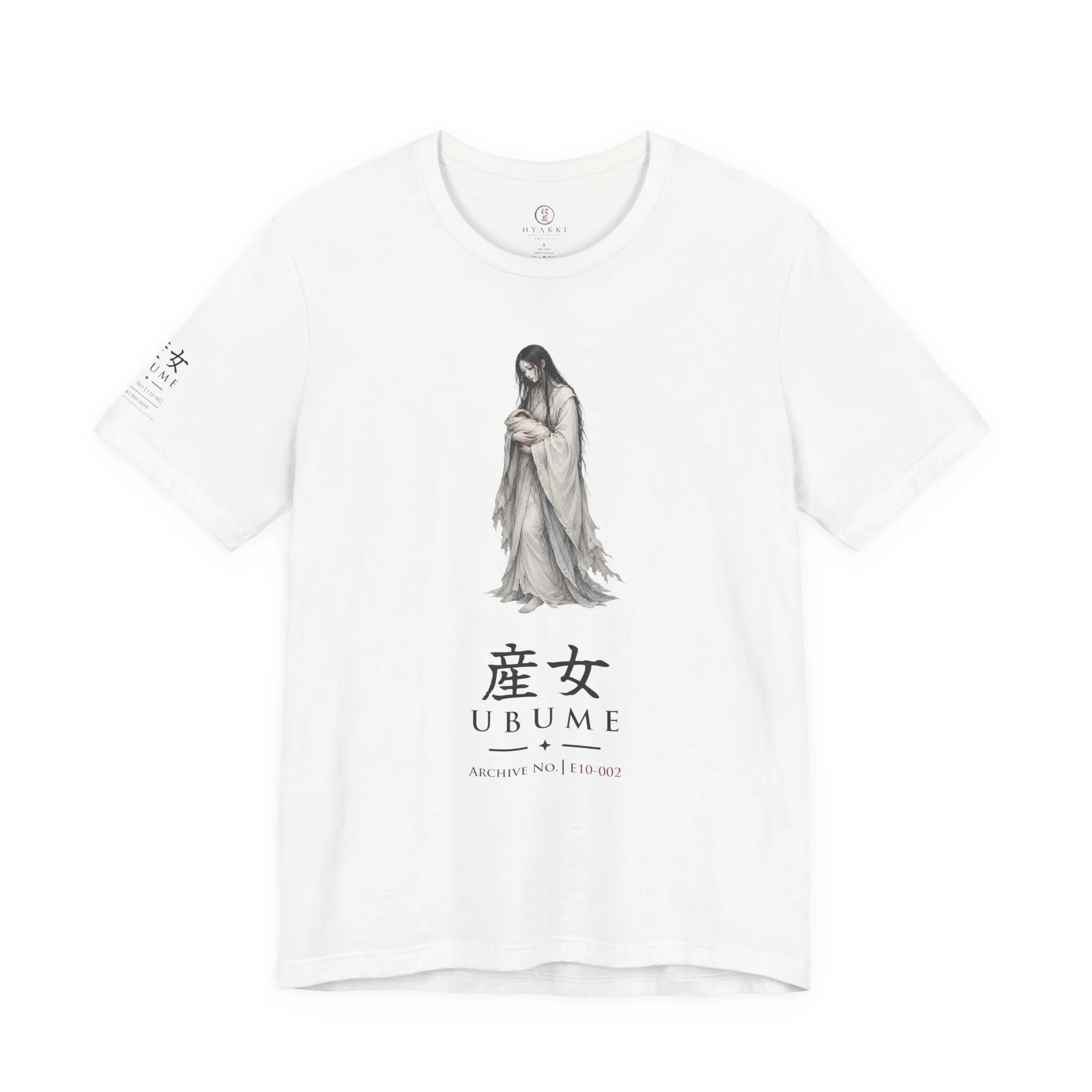
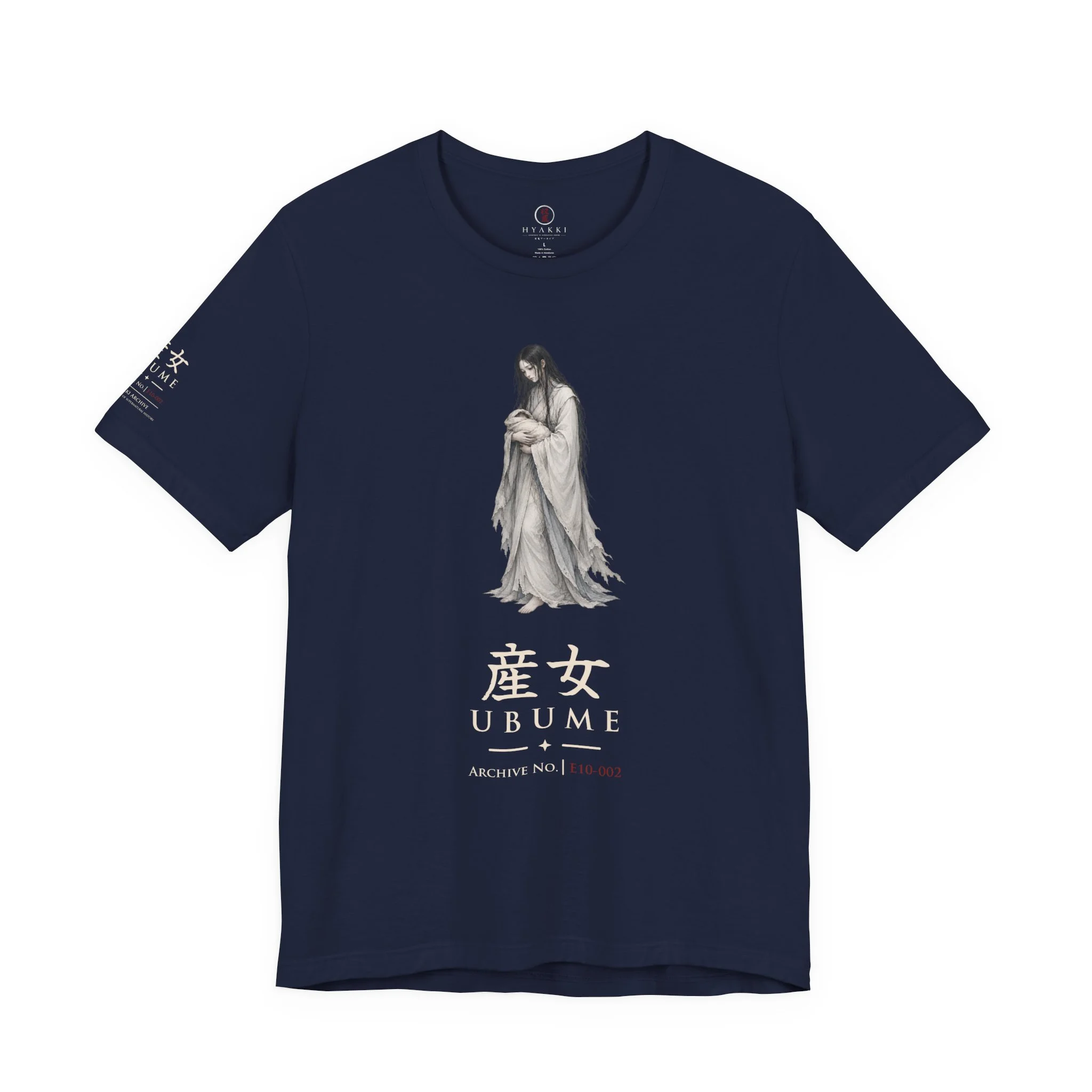
The E10-002 Ubume design presents the entity in its human maternal-ghost form.
At the center stands a pale woman in long, worn white robes, shown full-body and barefoot. Her black hair falls heavily around her shoulders, while her head is lowered toward the wrapped infant she carries in both arms. The entire figure is quiet rather than theatrical. There are no bird features, weapons, blood effects, or exaggerated supernatural elements.
That restraint is important. The image reads first as grief and only then as haunting.
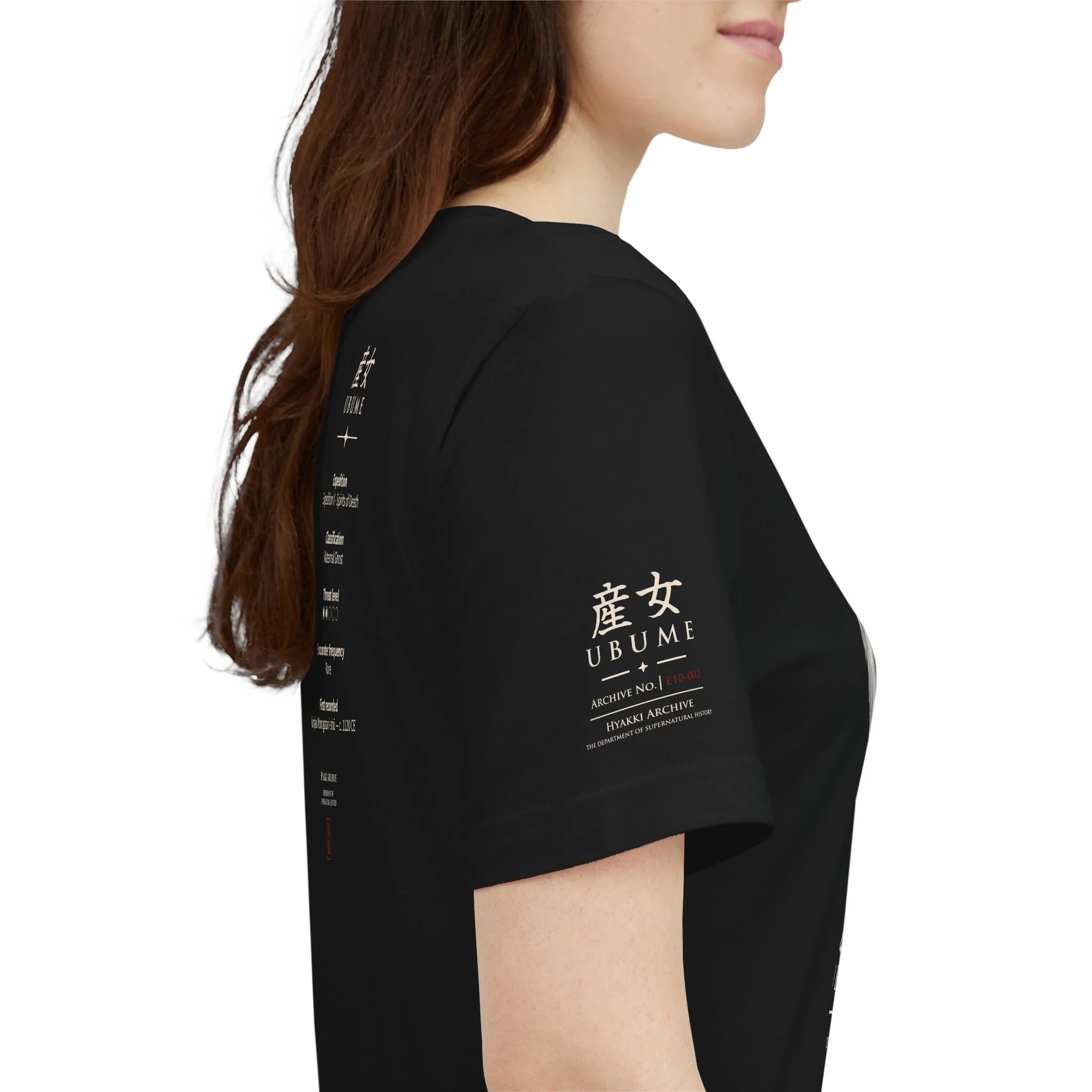
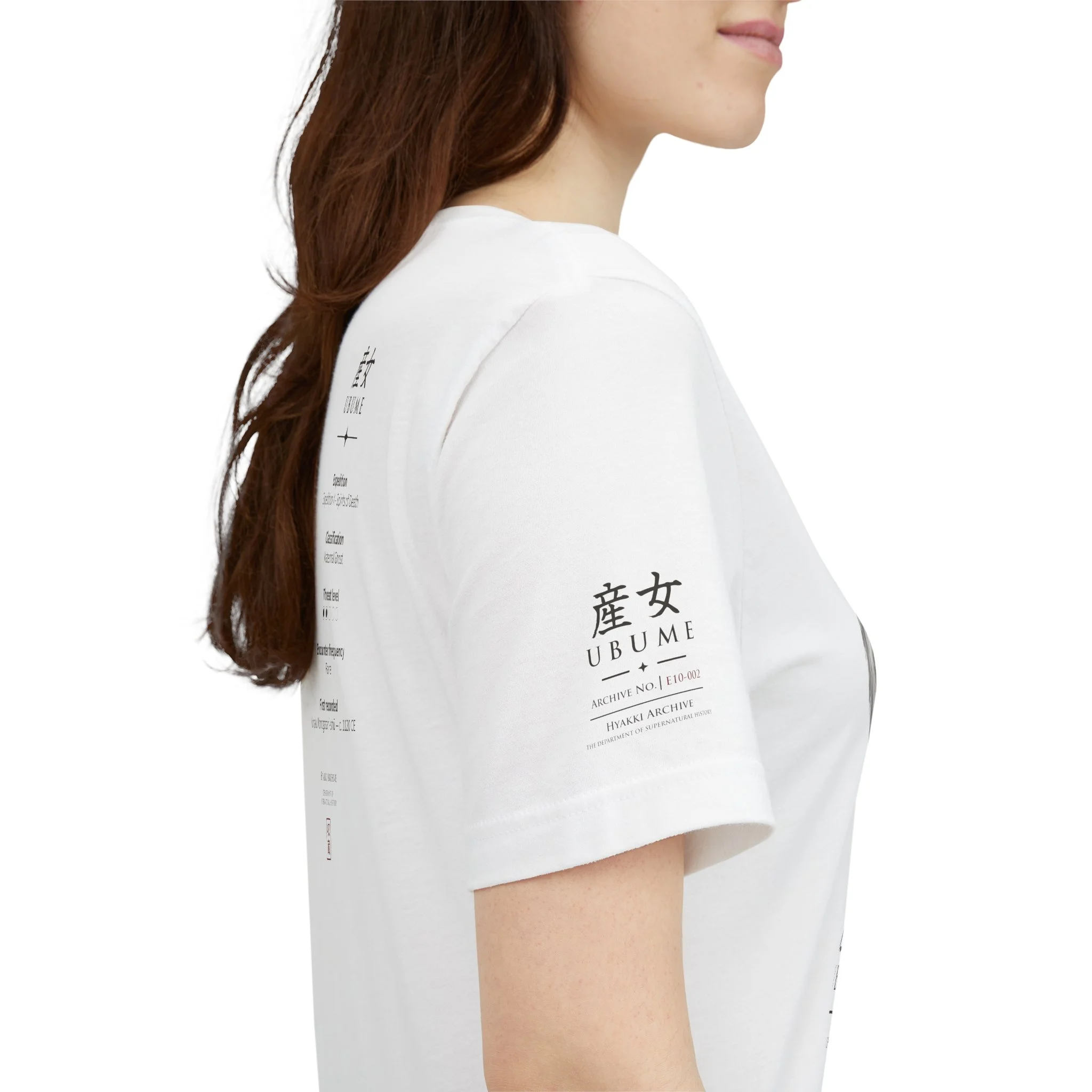
Beneath the illustration, 産女, UBUME, and Archive No. E10-002 continue the Hyakki archive format, keeping the design visually consistent with the rest of Expedition X — Spirits of Death.
The Entity Behind the Design
Ubume is a Japanese ghost tradition strongly associated with women who died while pregnant or during childbirth.
Many stories center on a woman appearing after death while still carrying or seeking help for a child. She may ask a traveller to hold the infant, disappear once the request is accepted, or leave behind a burden that becomes impossibly heavy or reveals itself to be something else.
The emotional center of these stories is not simple hostility.
Ubume represents an obligation that death has failed to end.
Later Japanese sources also connected Ubume with the Chinese 姑獲鳥 tradition, producing birdlike or hybrid depictions. The artwork here deliberately avoids that later strand and instead focuses on the human maternal ghost that lies at the heart of many Japanese Ubume traditions.
Known For
Ubume is especially known for appearing with an infant.
A recurring story has the ghost approach someone at night and ask them to take the child. If the person agrees, she may vanish, leaving them with a baby that grows progressively heavier or transforms into a stone or other object.
Regional traditions also connect Ubume with the burial of women who died while pregnant, reflecting historical concerns about whether mother and unborn child had been properly separated in death.
Some depictions emphasize the physical trauma of childbirth, including blood-stained clothing, while others present the woman almost entirely without visible injury.
The tradition later became entangled with the Chinese bird-being 姑獲鳥, which introduced very different imagery involving flight, child stealing, and supernatural bird forms.
That means the familiar image of a woman carrying a baby is only one strand, but it remains one of the strongest and most emotionally recognizable forms of Ubume.
From Folklore to Design
This design chooses the maternal ghost rather than the later bird-woman interpretation.
The woman is presented as pale, exhausted, and withdrawn. Her long robes are frayed and irregular at the edges, helping separate her from an ordinary living figure without resorting to overt horror.
The infant is almost completely wrapped, keeping attention on the act of carrying rather than on the child itself.
Her downward gaze is the key detail.
She is not confronting the viewer.
She is looking at the burden she continues to hold.
That makes the design feel much closer to the emotional logic of Ubume folklore than a more aggressive ghost would. The figure is unsettling because she appears unable to complete something that should have ended with death.
The absence of blood, wings, and dramatic supernatural effects also makes the interpretation deliberately specific: this is Ubume as unresolved motherhood, not a composite of every form the name later acquired.
From the Hyakki Archive
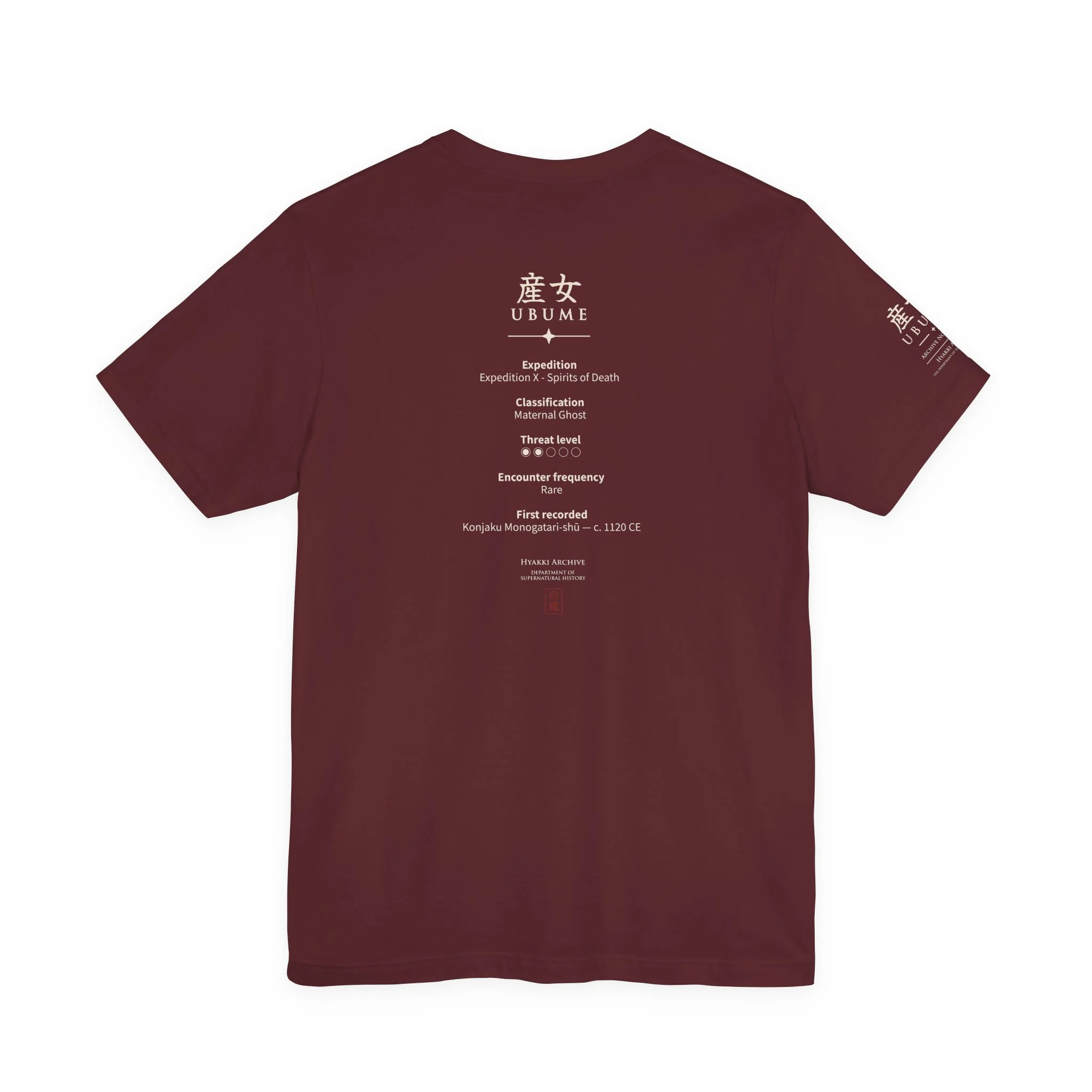
Archive File E10-002 continues Expedition X — Spirits of Death with a very different kind of haunting from Kasha.
Kasha threatens to take the body.
Ubume remains because something could not be left behind.
A woman has died.
The child is still in her arms.
The relationship between them has not ended simply because her life has.
The question is not why the ghost returned.
It is whether death can truly cancel an obligation that was never completed.
収蔵
| Temperament |
Mournful • Protective • Unpredictable |
| Activity |
Primarily Nocturnal |
| Encounter Frequency |
Rare |
| Habitat |
Roadsides • Bridges • Riverbanks • Burial Sites |
| Known Variants |
Maternal Ghost • Bird-Woman Ubume • Regional Child-Bearing Forms |
01 · What Is It?
Ubume is most fundamentally a maternal ghost associated with death during pregnancy or childbirth.
A typical encounter involves a woman carrying a baby who appears beside a road, bridge, riverbank, or other liminal place. She asks a passerby to hold the child. If the person accepts, the woman disappears, leaving them with a burden that may grow increasingly heavy or reveal itself to be something unexpected, such as a stone. A 1929 Ōita record preserves exactly this kind of story.
The tradition is not simply about a frightening ghost. Its emotional centre is unfinished maternal responsibility.
The woman has died, but something connected with the child remains unresolved.
Later sources complicate this image by connecting Ubume with a Chinese supernatural bird. That birdlike form became important in early-modern art, but it represents a later fusion rather than the only meaning of Ubume.
02 · Historical Record
The maternal-ghost motif associated with Ubume can be traced in Japanese literature to at least the twelfth century. Konjaku Monogatarishū contains a famous story of a woman encountered near water who asks a warrior to hold her child, establishing several elements that became characteristic of later Ubume tales.
The tradition remained culturally active into the early-modern period.
A major change occurred in the seventeenth century, when Japanese scholars began connecting the domestic Ubume tradition with the Chinese guhuoniao, written 姑獲鳥. Manami Yasui identifies the Confucian scholar Hayashi Razan as particularly important in bringing these traditions together.
The Chinese creature was birdlike and associated with stealing or harming children. Once merged with Japanese maternal-ghost beliefs, Ubume could be depicted either as a woman carrying a child or as a supernatural bird-woman.
That historical fusion explains why apparently contradictory Ubume forms coexist in later sources.
03 · Appearance
There is no single canonical appearance for Ubume.
The most recognizably Japanese form is a woman associated with pregnancy or childbirth death, often carrying an infant. Early-modern descriptions sometimes portray her lower garments as stained with blood, emphasizing the circumstances of her death. Regional material from Ōita preserves this blood-stained maternal appearance.
Other traditions leave her almost completely ordinary in appearance until something supernatural happens.
The birdlike Ubume belongs to another strand. After the Chinese 姑獲鳥 tradition became connected with Japanese Ubume, artists could depict the entity as a woman capable of becoming a bird or as a hybrid bird-woman. Yasui notes that Kawanabe Kyōsai's birdlike depictions show clear Chinese influence.
Neither form should erase the other.
For Hyakki, the human maternal ghost is the strongest primary representation, while the avian form is best identified as an important early-modern development.
04 · Behaviour & Encounters
The defining Ubume encounter often begins with a request:
Hold my child.
A traveller meets a woman carrying an infant and agrees to take it. The woman then disappears. In some traditions, the child becomes steadily heavier; in others, it turns into a stone, grave marker, or another unexpected object. A 1939 Niigata record describes the child becoming heavier before being discovered to have transformed into stone.
The behaviour is unusual because the ghost often does not directly attack the person who helps her.
Acceptance can even be the safer response in some versions.
Bird-influenced traditions behave differently. These may involve child stealing, nocturnal flight, or supernatural contamination of children's clothing, reflecting the influence of the Chinese 姑獲鳥 tradition.
These different behaviours should not be flattened into one universal list of supernatural abilities.
05 · Belief, Ritual & Meaning
Ubume is closely connected with historical anxieties surrounding pregnancy, childbirth, burial, and unfinished obligations between mother and child.
Yasui notes traditions in which a woman who died late in pregnancy or during childbirth was believed capable of remaining in the living world unless the fetus was ritually separated from her. Such beliefs contributed to specific mortuary practices surrounding pregnant women.
The stories therefore reflect more than fear of ghosts.
They concern the problem of a relationship interrupted at the moment when mother and child were expected to be physically separated through birth.
Some traditions resolve the haunting through correct burial treatment. Others dramatize the unresolved relationship through the ghost physically handing the child to another person.
Later Buddhist ideas about women, childbirth, blood, and posthumous suffering also shaped interpretations of Ubume, particularly during the early-modern period.
The central question is:
What obligation can survive the death of the person who carried it?
06 · Regional & Historical Variations
Ubume varies considerably by region and period.
In some areas, the central story involves the ghost handing a child to a traveller. In Ōita, one recorded tradition says the child may become a mallet or stone after being accepted.
In Niigata, another account describes a woman appearing on a wooden bridge and asking someone to hold her child, which gradually becomes heavier before revealing itself as stone.
Other traditions emphasize bloody clothing, burial precautions, or the treatment of a fetus when a pregnant woman dies.
The Chinese-influenced strand is markedly different. 姑獲鳥 could become a bird, steal children, or harm them through blood or milk. Early-modern Japanese texts merged some of these ideas with the maternal Ubume, creating a hybrid tradition.
The result is not one stable monster but a layered supernatural tradition shaped by childbirth, death, regional custom, and imported textual imagery.
07 · What We Actually Know
| Ubume is strongly associated with women who died during pregnancy or childbirth |
DOCUMENTED |
| The maternal ghost motif appears in Japanese literature by the medieval period |
DOCUMENTED |
| Stories of Ubume asking travellers to hold a child are widely recorded |
DOCUMENTED |
| The child may become extremely heavy or transform into stone in regional traditions |
TRADITION |
| Japanese Ubume became entangled with the Chinese 姑獲鳥 tradition in the seventeenth century |
DOCUMENTED |
| Every Ubume was historically imagined as a bird-woman |
INCORRECT |
| Every Ubume is hostile toward the person who accepts her child |
INCORRECT |
| The tradition expresses anxieties about interrupted motherhood and incomplete death rites |
INTERPRETATION |


















Reviews
There are no reviews yet.