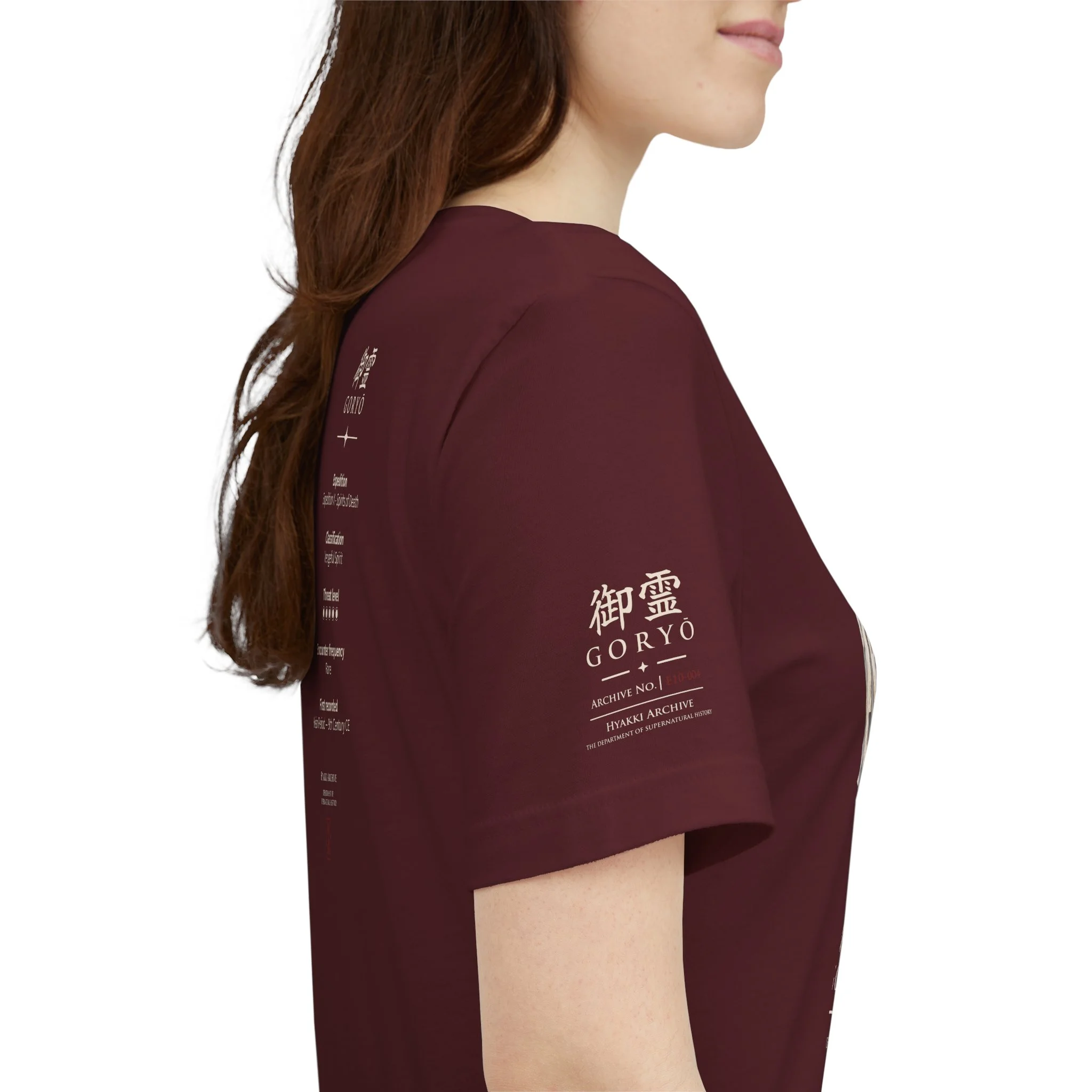

E10 – 004 Goryō

The Dead Who Would Not Be Ignored

Japanese Name 御霊
Romanization Goryō
Classification Vengeful Spirit
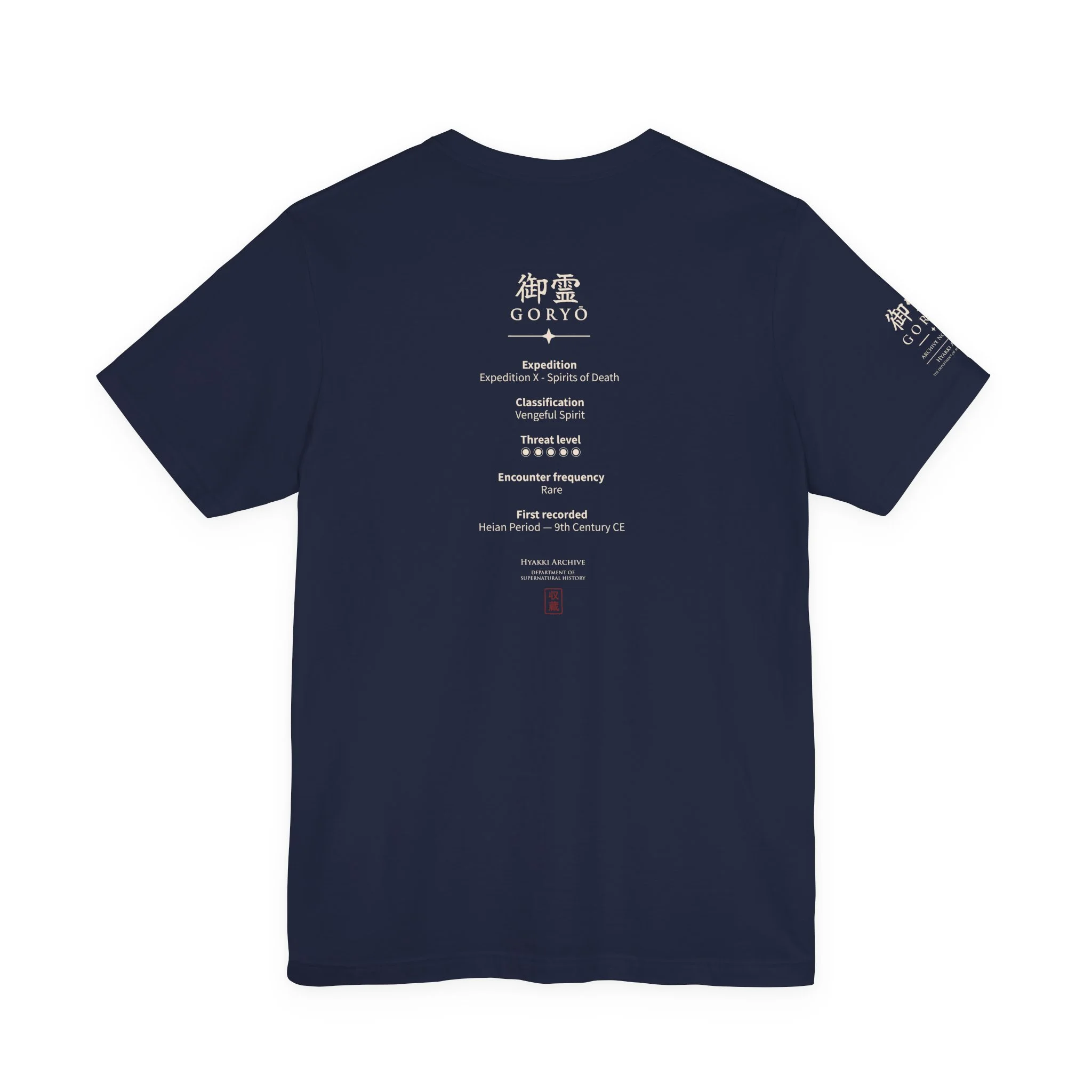
Expedition Expedition X — Spirits of Death
Threat Level ■■■■□ (Level IV – Severe)
First Recorded Heian Period — 9th Century CE

Goryō are feared spiritual beings historically associated with epidemic, calamity, and social disturbance. The category included the spirits of people who had lost power or status as well as certain epidemic-associated kami. From the medieval period onward, the term increasingly came to refer to angry spirits of the dead. Rather than simply destroying them, communities could attempt to appease, send away, or permanently enshrine these spirits, transforming dangerous spiritual power into protection.

The Design

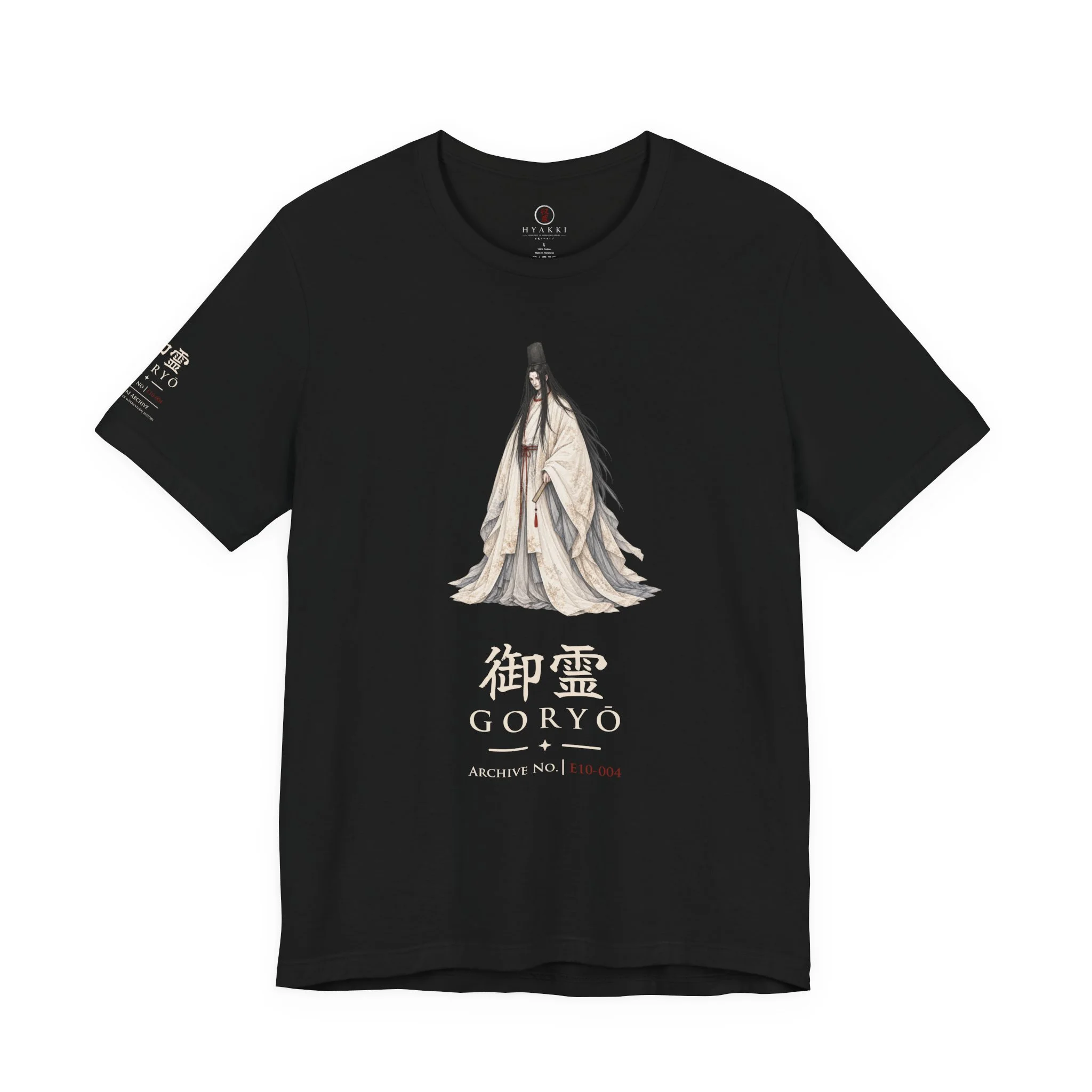
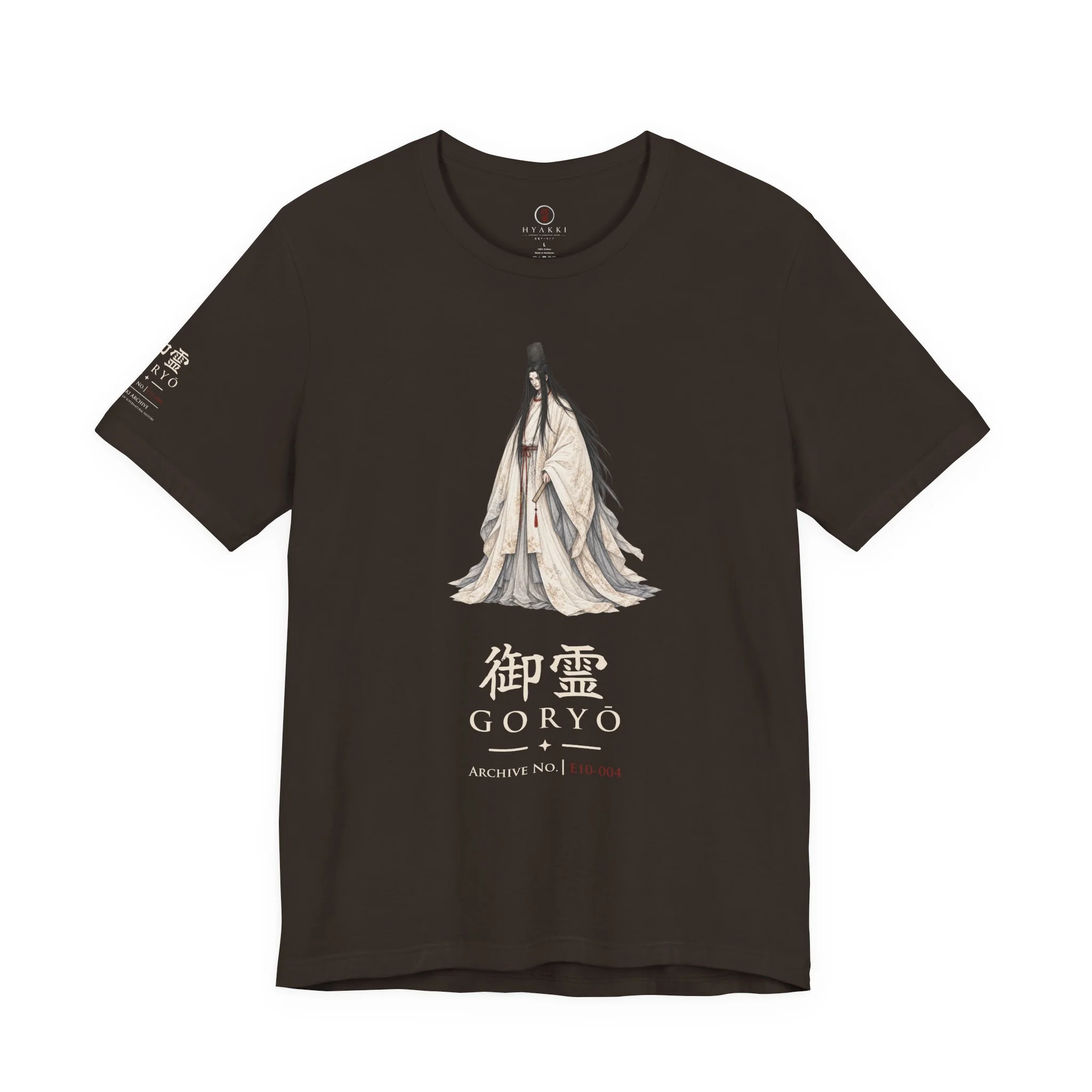
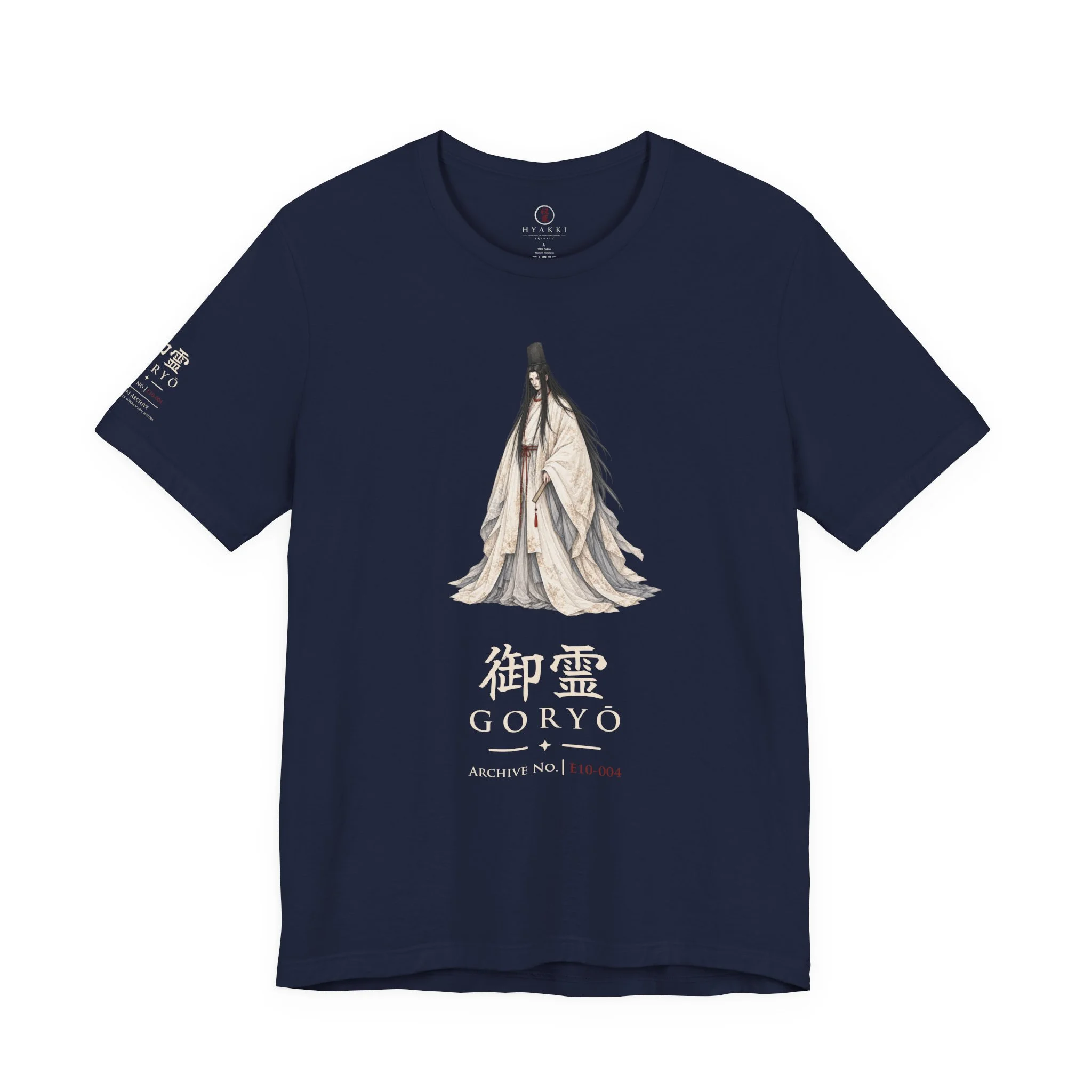
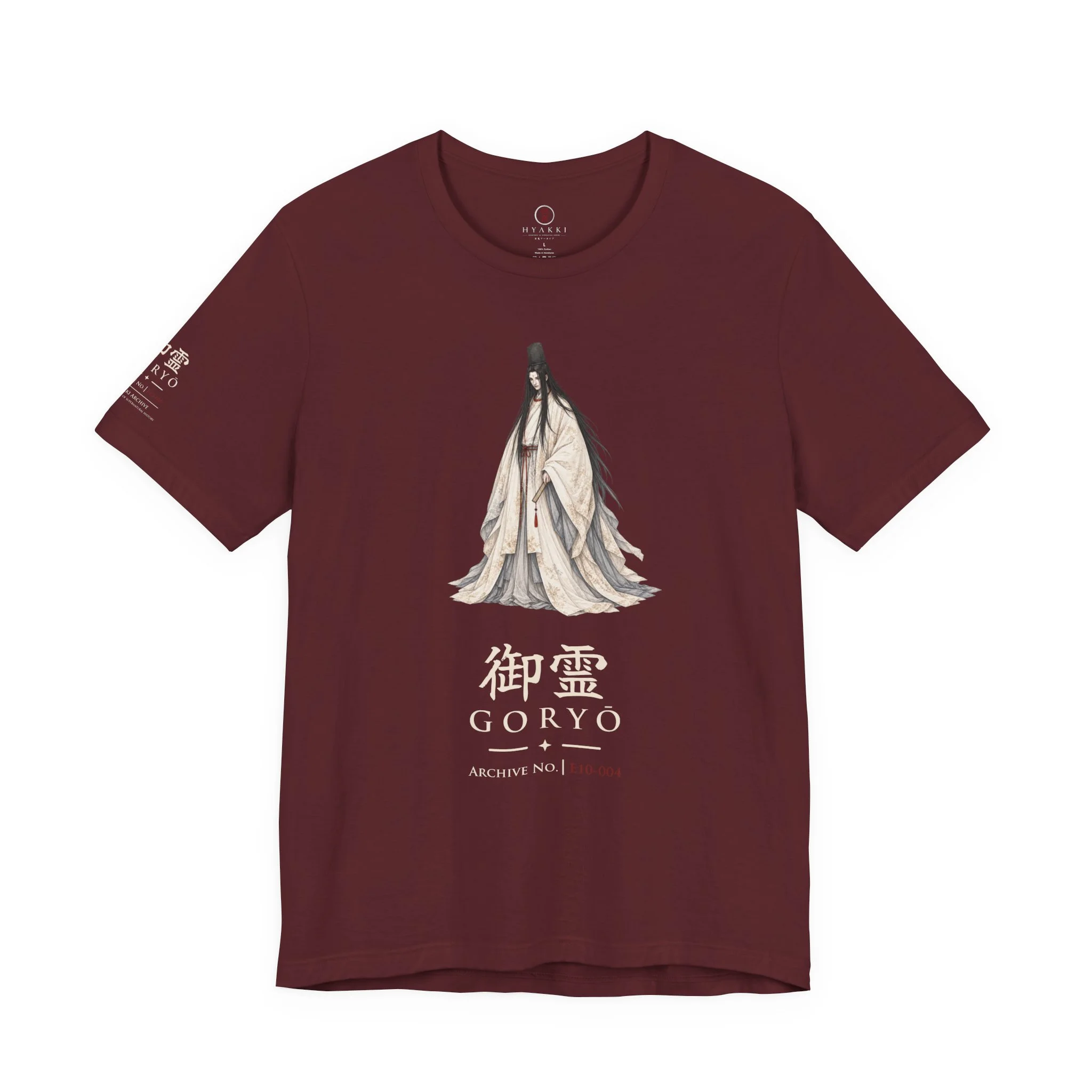
The E10-004 Goryō design presents the spirit as a formal, aristocratic human figure rather than as a monster.

The figure is shown full-body in layered pale court robes with subtle woven patterning, long black hair, a tall black court cap, and restrained red accents at the collar, waist, forehead, and hanging cord. One hand holds a narrow wooden object, reinforcing the impression of rank, ritual, or official status. The face is pale and severe, with a controlled expression rather than rage.

That choice works especially well for Goryō because the tradition is not defined by monstrous anatomy. The danger comes from identity, grievance, and posthumous power.

Beneath the figure, 御霊, GORYŌ, and Archive No. E10-004 keep the design aligned with the rest of Expedition X — Spirits of Death.

The Entity Behind the Design

Goryō is not one fixed ghost type, but a historical category of dangerous spiritual beings associated with calamity, epidemic, political grievance, and unresolved posthumous anger.

Some of the best-known Goryō traditions concern people who had been exiled, disgraced, wronged, or removed from power before death. When disaster followed, those events could be interpreted as evidence that the dead had not been properly appeased.

This makes Goryō very different from a creature that simply attacks individuals.

Its presence may be inferred through what happens to an entire community.

Disease spreads.
Misfortune continues.
Political disorder deepens.

The question becomes whether these events are random, or whether the dead are demanding recognition.

Known For

Goryō is especially known for its connection with calamity and appeasement.

One of the most important historical examples is the Goryō-e ceremony held at Shinsen’en in 863 CE, when an epidemic was associated with six dangerous spirits, including Prince Sawara. The ceremony was intended to pacify these beings through offerings, Buddhist recitation, and ritual performance.

The tradition is also closely associated with the idea that a feared spirit could eventually become protective.

A dangerous dead figure did not always need to be banished. In some cases, continued ritual attention and enshrinement transformed the relationship between spirit and community.

Sugawara no Michizane is one of the clearest examples of this wider pattern. After exile and death, he became associated with disaster and was eventually enshrined and worshipped as Tenjin.

That transformation from feared dead to protective deity is one of the most distinctive features of Goryō belief.

From Folklore to Design

Because Goryō has no universal physical form, this design is best read as a representative aristocratic reconstruction rather than a literal depiction of one specific historical spirit.

The clothing, court cap, long hair, and formal bearing evoke the political and aristocratic world from which some of the most famous Goryō traditions emerged. The pale robes make the figure feel removed from ordinary life, while the restrained red details introduce tension without turning the character into a conventional horror figure.

The expression is especially important.

The figure does not appear wild or enraged.

It appears composed.

That makes the design more effective for Goryō because grievance here is not theatrical fury. It is authority that continues after death.

The result is less “ghostly noble” and more a presence that still expects to be acknowledged.

From the Hyakki Archive

Archive File E10-004 continues Expedition X — Spirits of Death with a spirit whose danger is measured not by claws, teeth, or pursuit, but by consequence.

A Goryō may never stand before you.

It may instead be recognized in the pattern left behind.

An epidemic.
A failed harvest.
A city in disorder.
A dead figure whose grievance was never settled.

And if the living finally decide that the dead were wronged, the answer is not always destruction.

Sometimes it is worship.

Sometimes the feared spirit becomes the guardian.

What happens when catastrophe becomes evidence that the dead had a legitimate grievance?

収蔵
Temperament Wrathful • Restless • Potentially Protective
Activity Manifested Through Calamity and Epidemic
Encounter Frequency Rare
Habitat Unfixed • Ritual Sites • Shrines • Communities Under Calamity
Known Variants Wronged Dead • Displaced Elites • Epidemic-Associated Goryō


01 · What Is It?

Goryō is a historical category of dangerous spiritual beings believed capable of bringing calamity to a broad community.

Unlike a yōkai with a recognizable body or repeated encounter pattern, a Goryō may never appear physically at all. Its presence is inferred through consequences: epidemic disease, widespread misfortune, crop failure, political disorder, or other disasters that seem too significant to be accidental.

Kokugakuin University’s Encyclopedia of Shinto defines Goryō as spiritual entities associated with calamity and epidemics affecting an unspecified range of people. It notes that the category included spirits of people who had lost positions of power and certain epidemic-related kami. From the medieval period onward, the term increasingly narrowed toward angry spirits of the dead.

The key idea is therefore not appearance.

It is dangerous spiritual grievance expressed through society itself.

02 · Historical Record

One of the most important early records dates to 863 CE, when a formal Goryō-e was held at Shinsen’en in the Heian capital.

According to the surviving record, a severe epidemic was attributed to six vengeful spirits, including Prince Sawara, who had been exiled and was later posthumously honored as Emperor Sudō. The ceremony was intended to console the spirits, redirect their anger, and restore stability.

The source also indicates that related rites had taken place previously, but 863 marks the first written reference to the ceremony as an official event. Later Goryō-e developed in connection with epidemic prevention and urban religious life, including the Gion Goryō-e beginning in 970.

This gives Goryō one of the clearest historical trails in the archive.

The tradition is not primarily an illustrated monster tradition.

It is a documented religious and social response to catastrophe.

03 · Appearance

There is no single Goryō appearance.

This is one of the most important things to preserve.

A Goryō might be conceptualized as the spirit of a known historical person, an angry dead aristocrat, a displaced political figure, or an epidemic-associated spiritual presence. Because the category concerns the identity and effects of a spirit more than its anatomy, historical sources do not provide one universal body.

Later art may depict famous Goryō in human form, especially if the spirit belonged to a recognizable historical person. But that does not establish a standard supernatural anatomy.

A pale noble, ghostly court figure, or wrathful aristocratic apparition can therefore work as an artistic interpretation, but it should be presented as a representative reconstruction rather than “what all Goryō look like.”

For Hyakki, the archive should treat identity, grievance, and consequence as more historically meaningful than visual features.

04 · Behaviour & Encounters

Goryō do not usually behave like encounter-based predators.

They are understood through calamity.

An epidemic spreads. Political instability worsens. A community experiences repeated misfortune. Such events may then be interpreted as evidence that a dangerous spirit has not been properly pacified.

This distinguishes Goryō from many more personal forms of haunting.

An Onryō may be imagined as directing vengeance toward particular individuals. Goryō, by contrast, could be associated with harm affecting a much wider and less specific population. Kokugakuin explicitly notes this distinction while also acknowledging that the categories overlap.

That means a Goryō encounter may not involve seeing anything at all.

The “encounter” can be collective.

A city becomes sick.

A disaster is interpreted as intentional.

The dead become part of the explanation.

05 · Belief, Ritual & Meaning

The central response to Goryō was appeasement.

Ceremonies called Goryō-e were performed to soothe these dangerous spirits and restore tranquility. The 863 Shinsen’en ceremony included offerings, Buddhist scripture recitation, and public performance. In some rites, spirits were eventually sent away through ritual action associated with the water’s edge.

But removal was not the only solution.

Some Goryō eventually became permanently enshrined. Kokugakuin notes that dangerous spiritual power could be redirected through continued worship, transforming what was feared into protective force.

This is one of the most important ideas in Goryō belief.

The spirit is not necessarily destroyed.

Its relationship with the living is changed.

Fear becomes ritual attention.

Ritual attention becomes worship.

And, in some cases, a former threat becomes a guardian.

06 · Regional & Historical Variations

The meaning of Goryō changed over time.

Early Goryō belief included both spirits of displaced or disgraced people and certain epidemic-associated kami. From the medieval period onward, the term became more strongly associated with the angry spirits of the human dead.

One of the best-known later examples of this wider pattern is Sugawara no Michizane.

Michizane was exiled to Dazaifu in 901 and died there in 903. A small shrine was built at his grave in 905, and a larger sanctuary followed in 919. He was later posthumously restored in rank and eventually worshipped as Tenjin, the deity of learning, culture, and the arts.

His story demonstrates how a politically wronged or displaced dead figure could move from feared posthumous presence to permanent divine worship.

That transformation is one of the defining possibilities within Goryō belief.

07 · What We Actually Know

Goryō were historically associated with calamity and epidemic DOCUMENTED
The first written official Goryō-e record dates to 863 CE DOCUMENTED
Prince Sawara was among the spirits associated with the 863 epidemic rites DOCUMENTED
Some Goryō traditions involved politically displaced or wronged dead DOCUMENTED
Goryō and Onryō are exactly the same category INCORRECT
Every Goryō has a fixed ghostly human appearance UNSUPPORTED
Goryō could be pacified and transformed into protective objects of worship DOCUMENTED
Goryō belief reflects the idea that catastrophe may reveal an unresolved social or spiritual grievance INTERPRETATION
Weight N/A
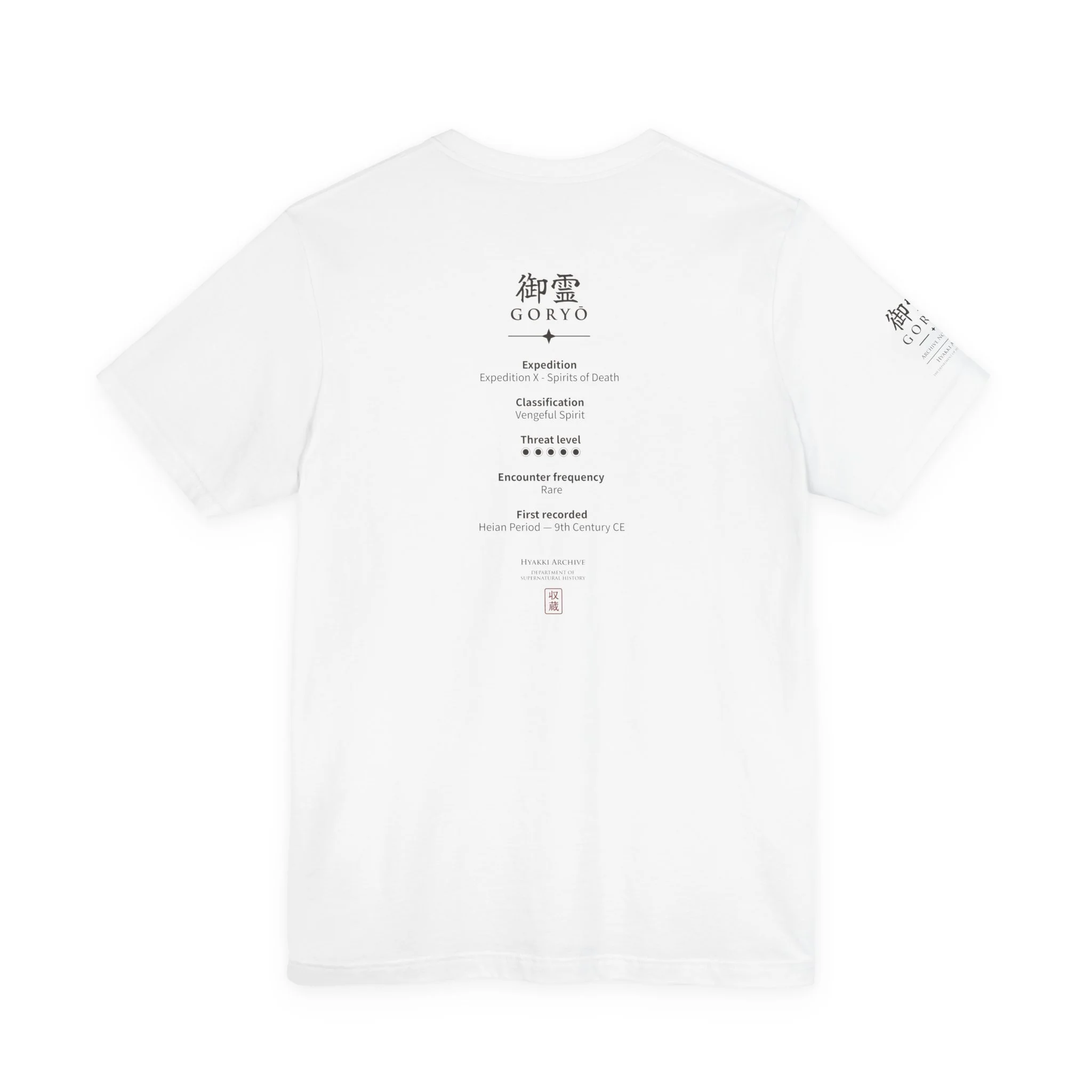
Expedition

Expedition X — Spirits of Death

Classification

Vengeful Spirit

Threat Level

■■■■■ Level V

Reviews

There are no reviews yet.

Only logged in customers who have purchased this product may leave a review.