The Design
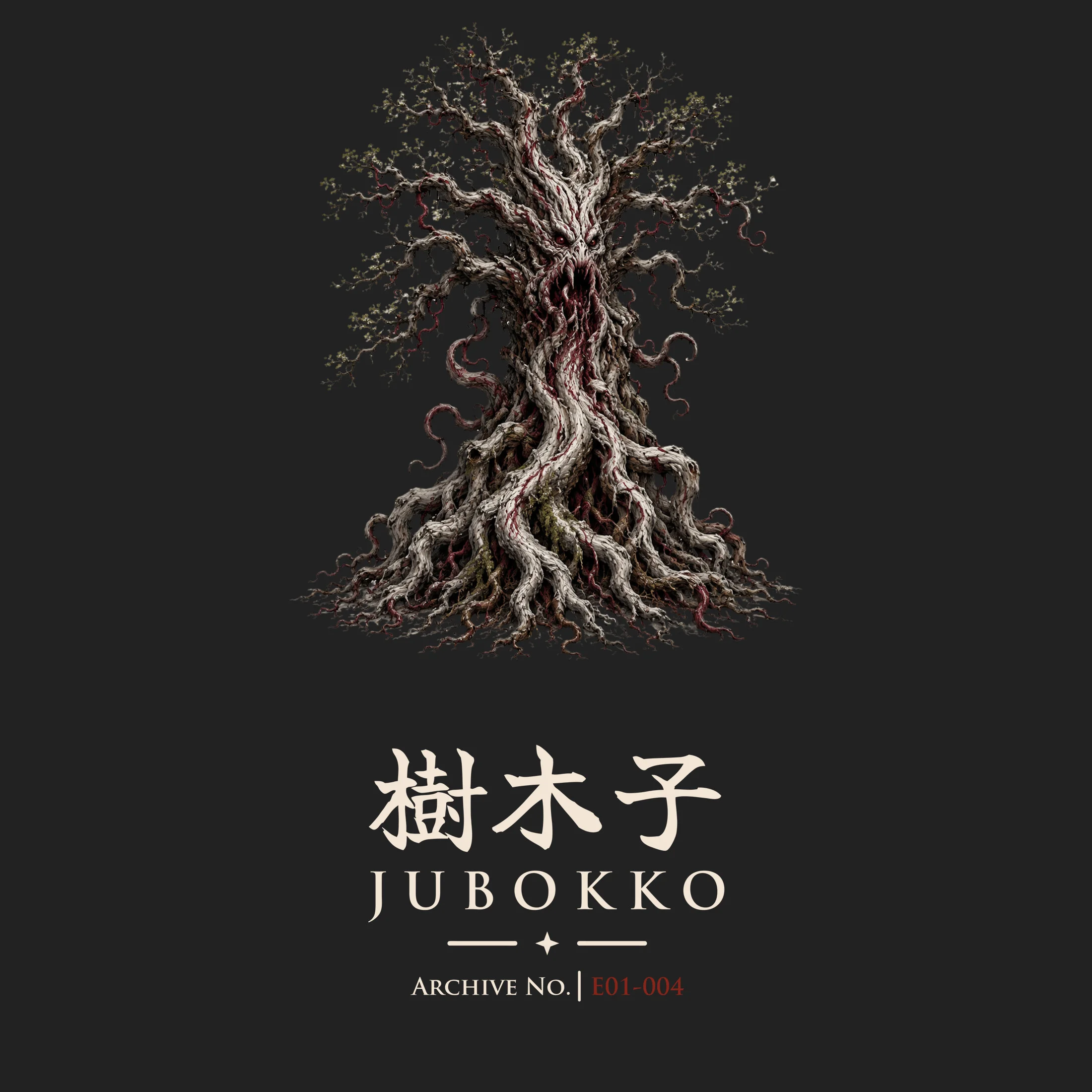
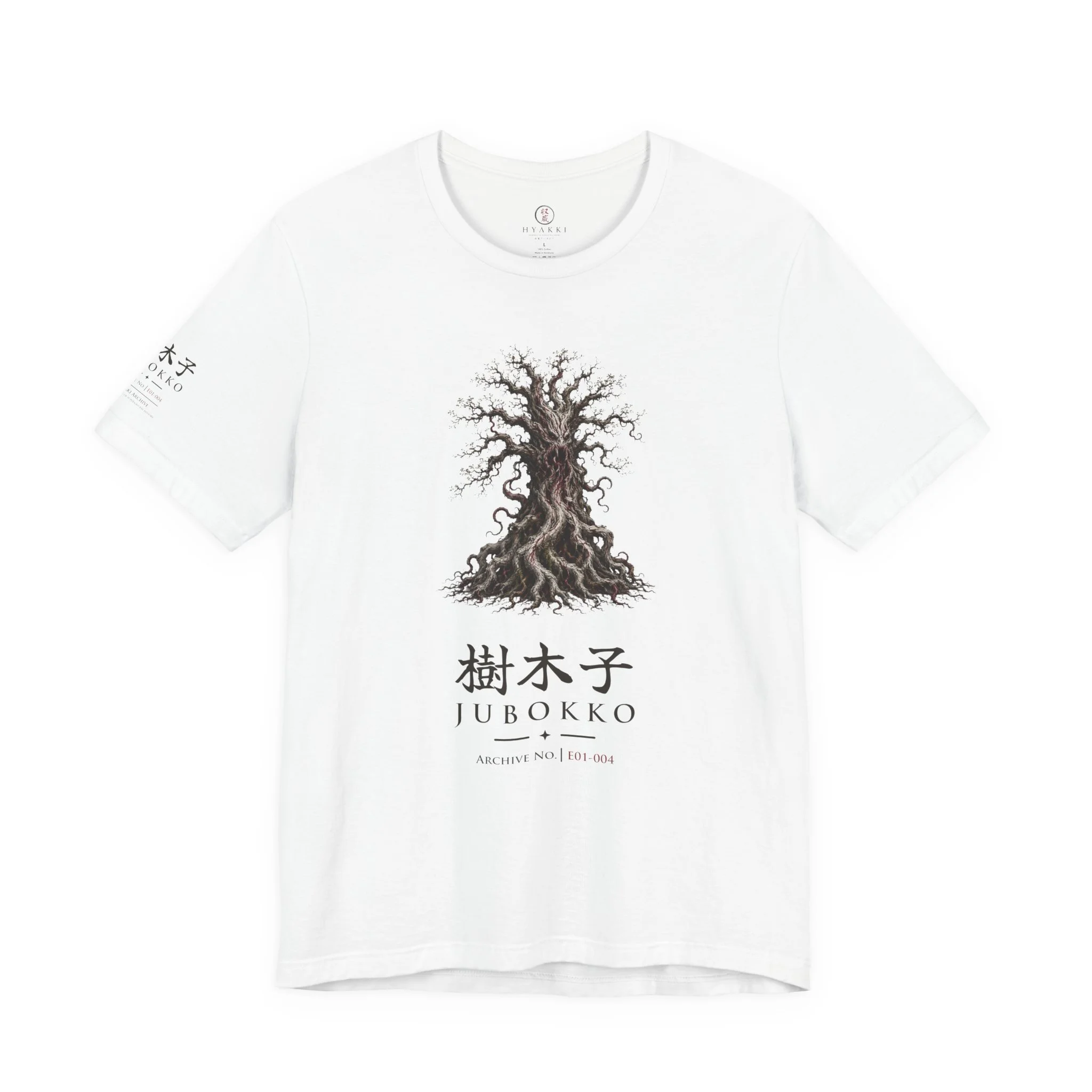
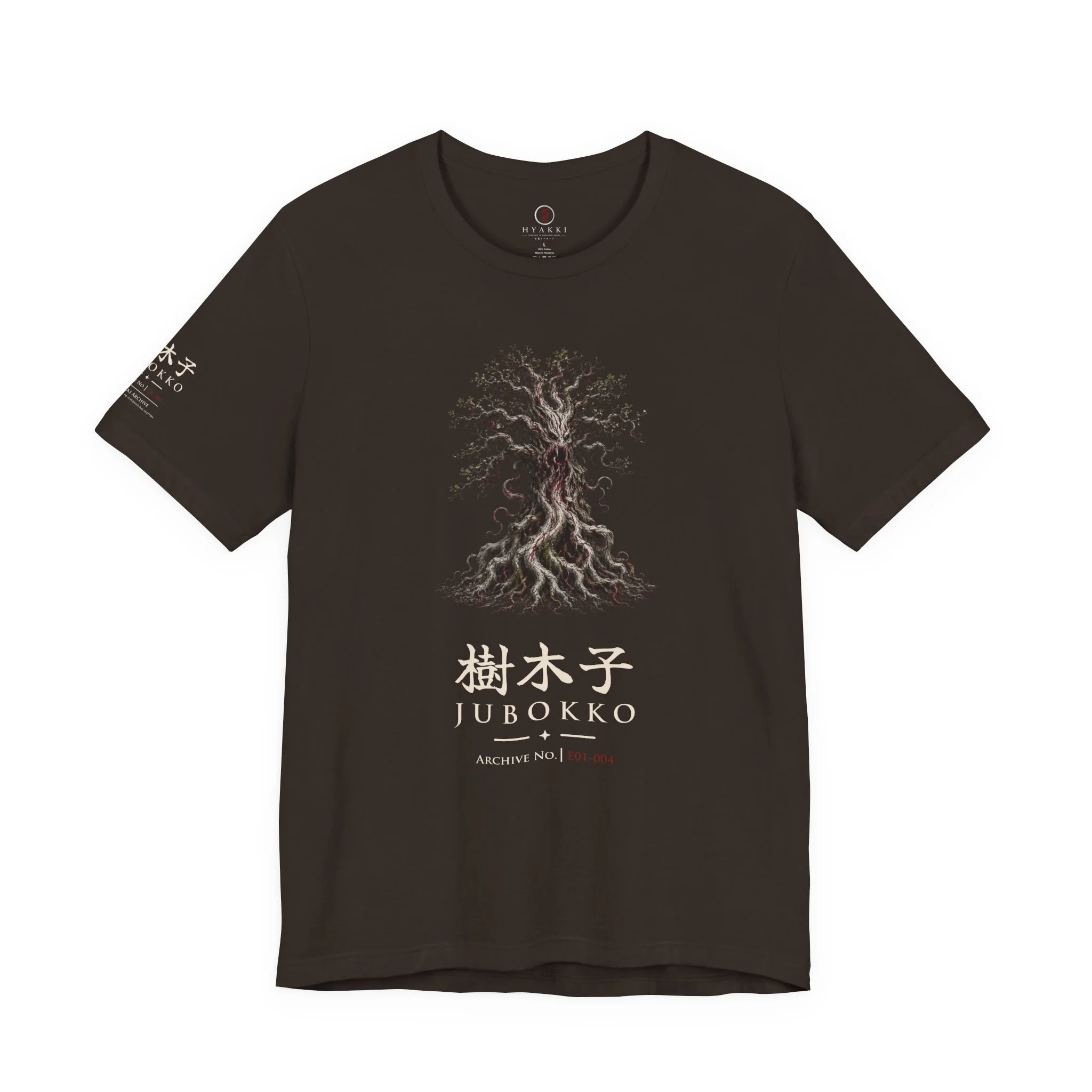
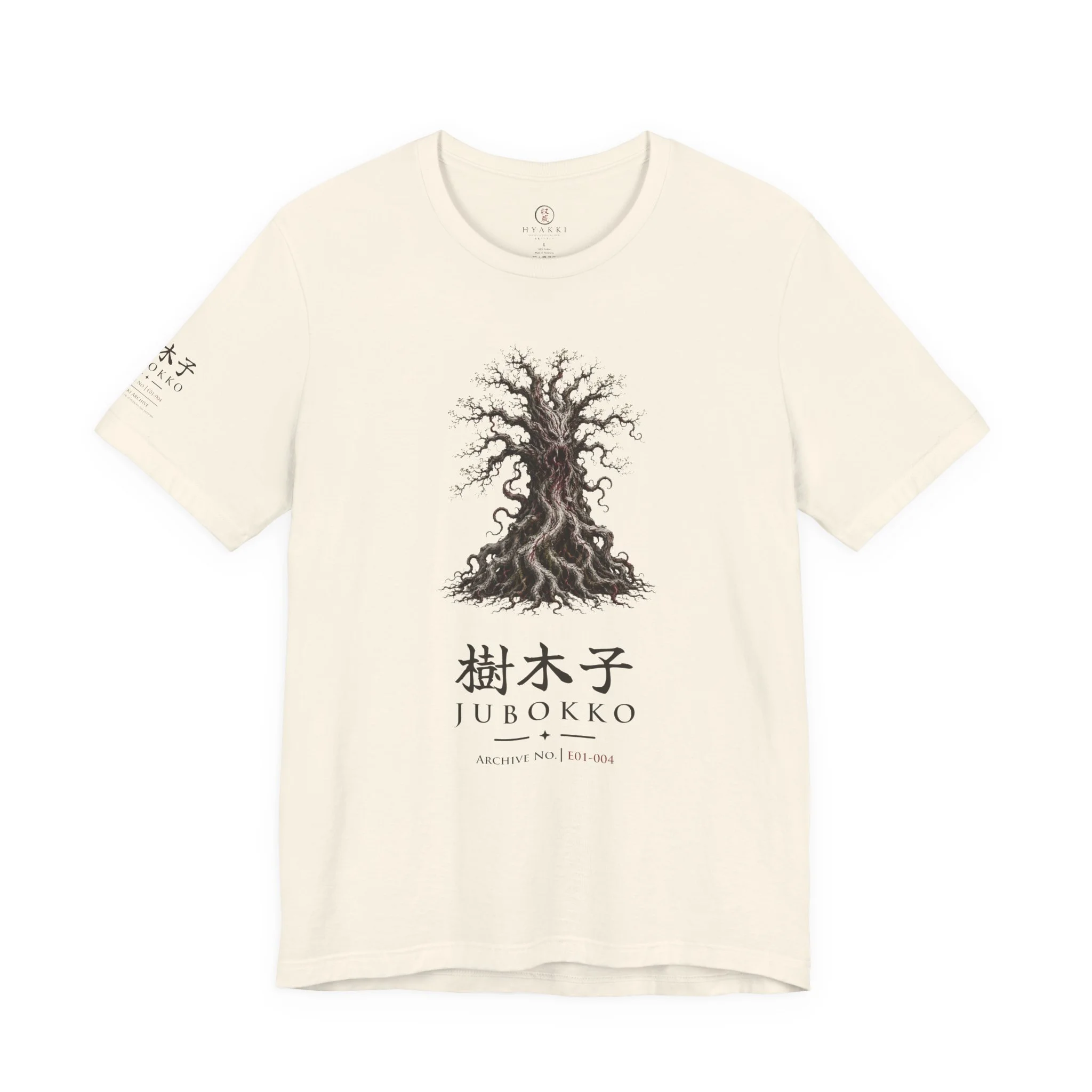
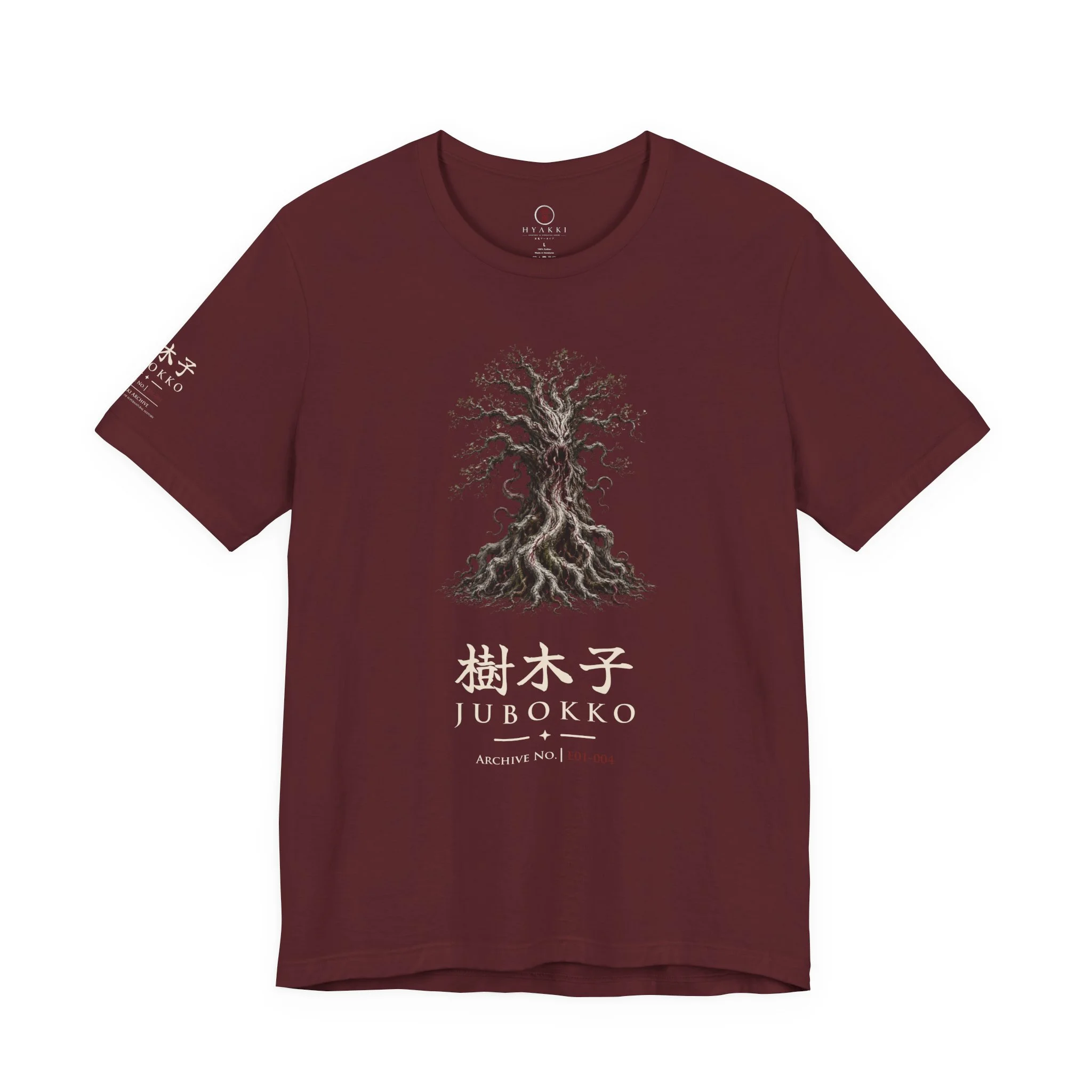
The E01-004 Jubokko design presents the entity in its most aggressive modern form: not as a suspicious tree on the edge of a battlefield, but as a fully awakened presence.
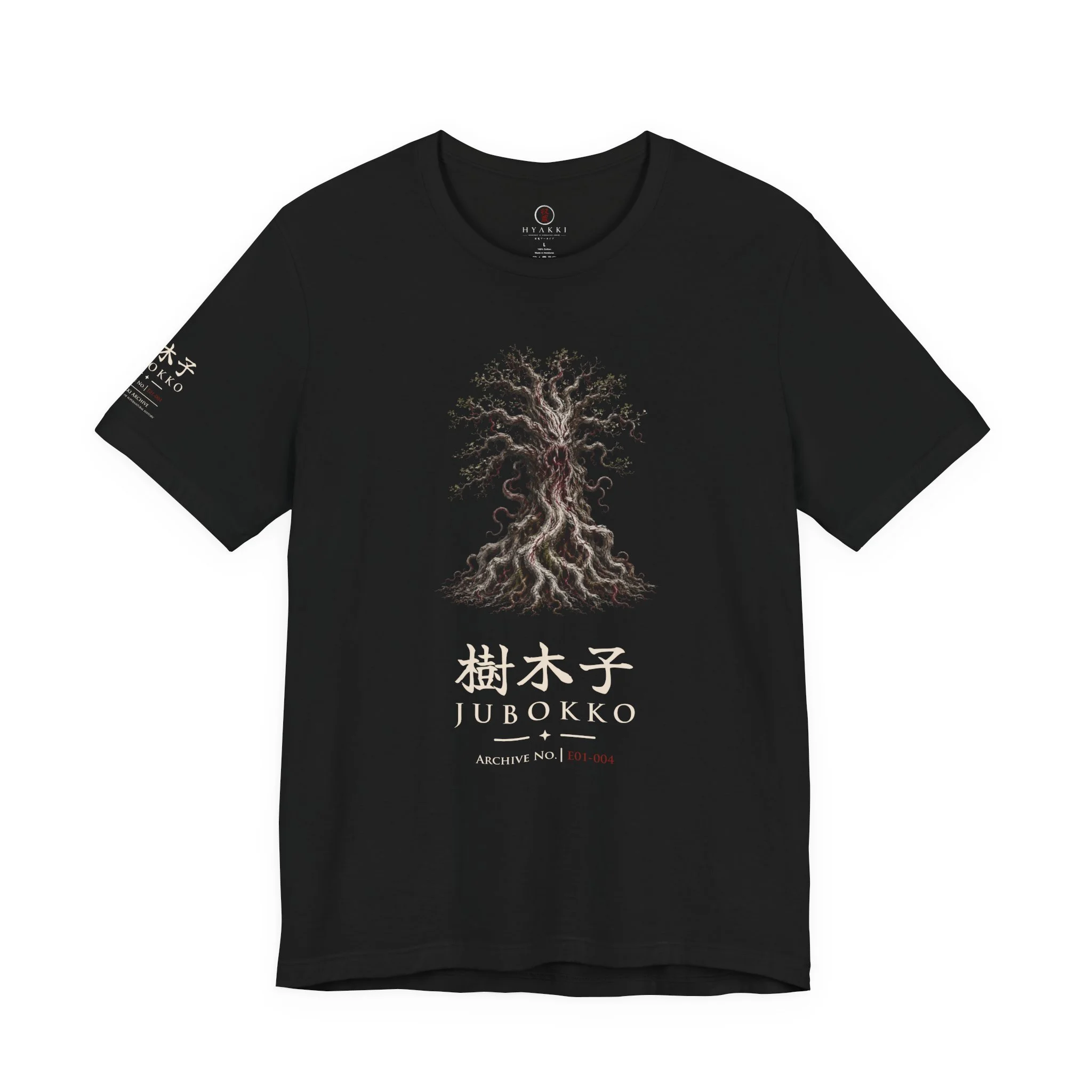
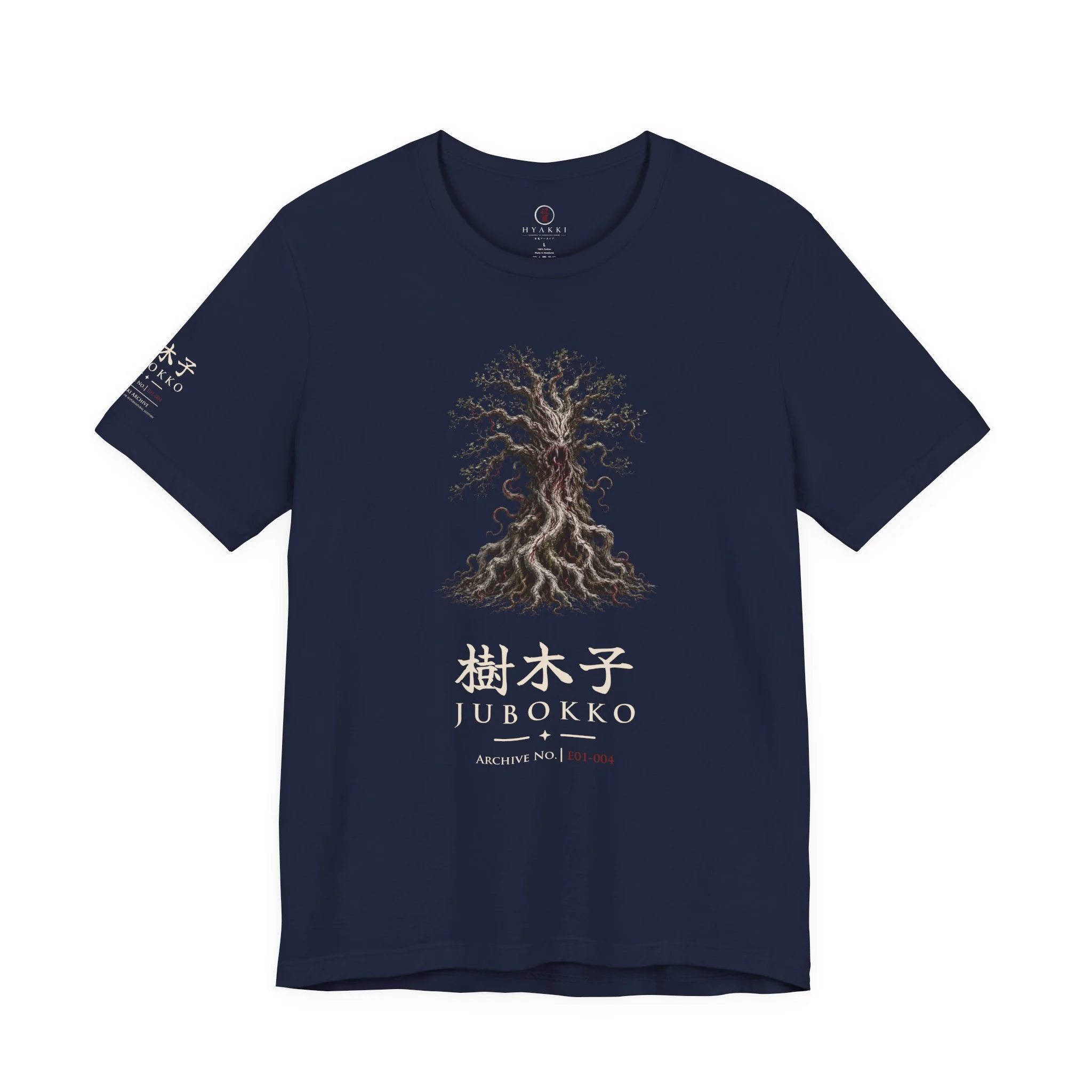
At the center of the composition stands a twisted, predatory tree whose trunk has opened into a screaming face. Pale bark coils upward and outward into a dense crown of branches, while deep red fissures and root-like tendrils run through the wood like exposed veins. The lower trunk spreads into a mass of grasping roots, giving the entire figure a sense of motion even though it remains rooted in place.
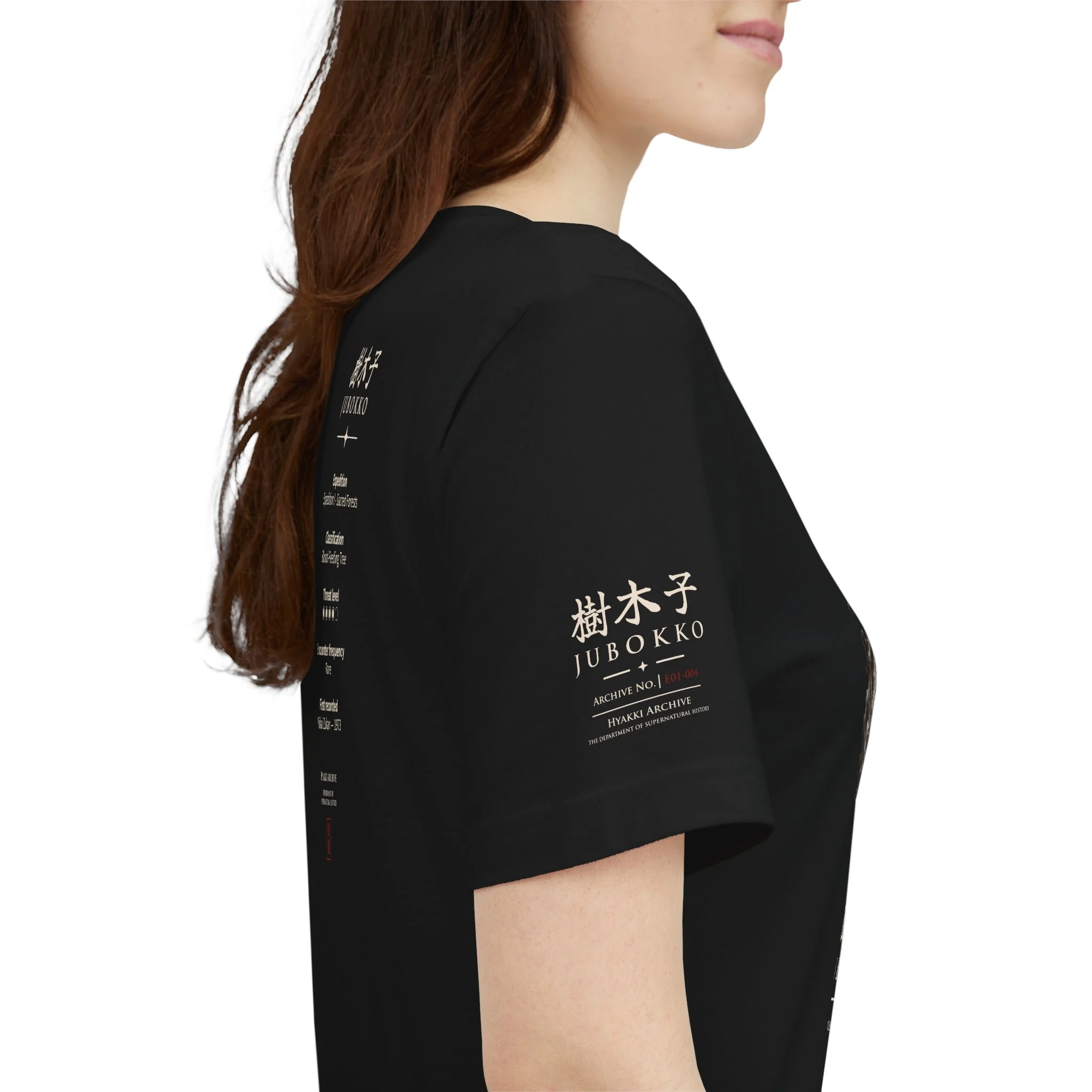
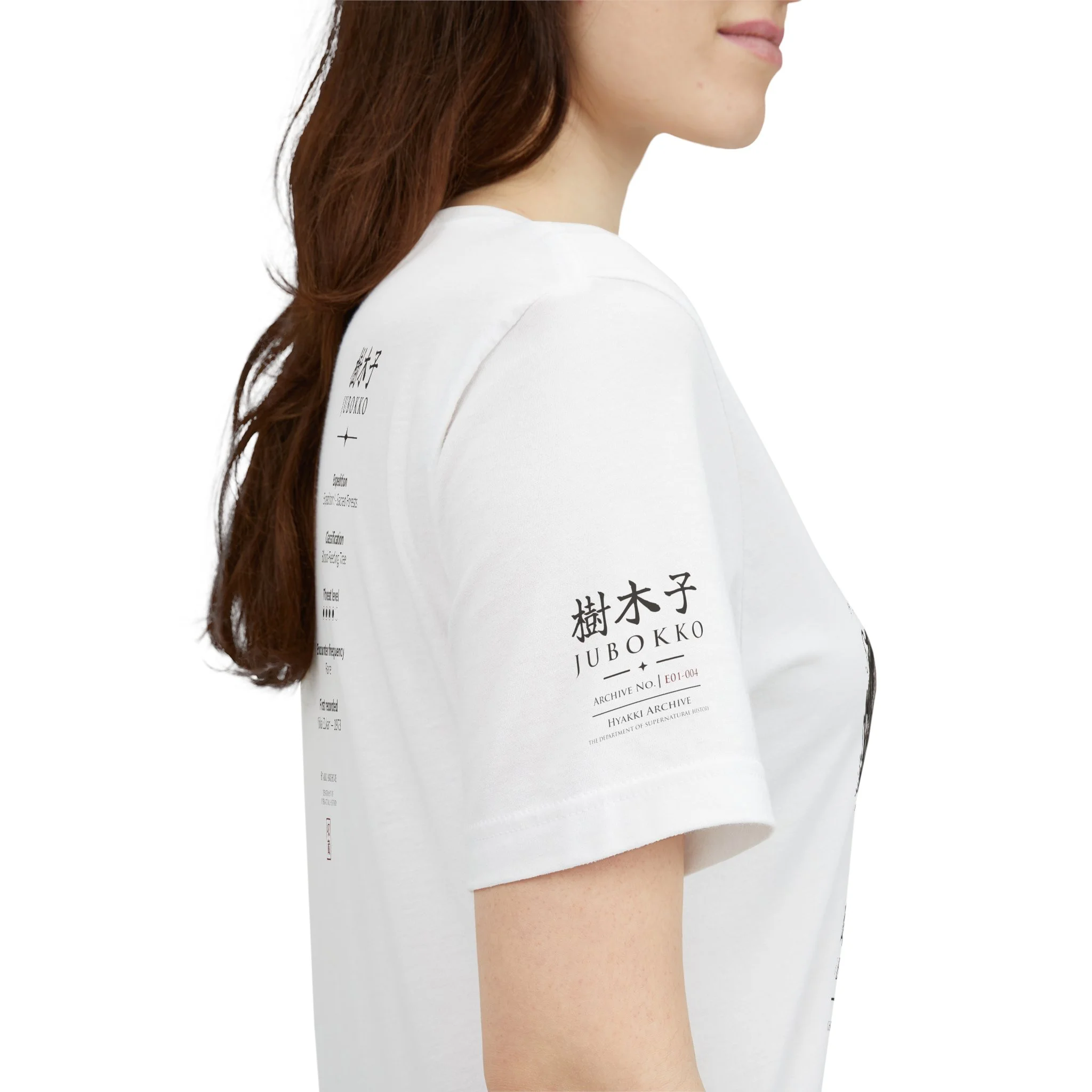
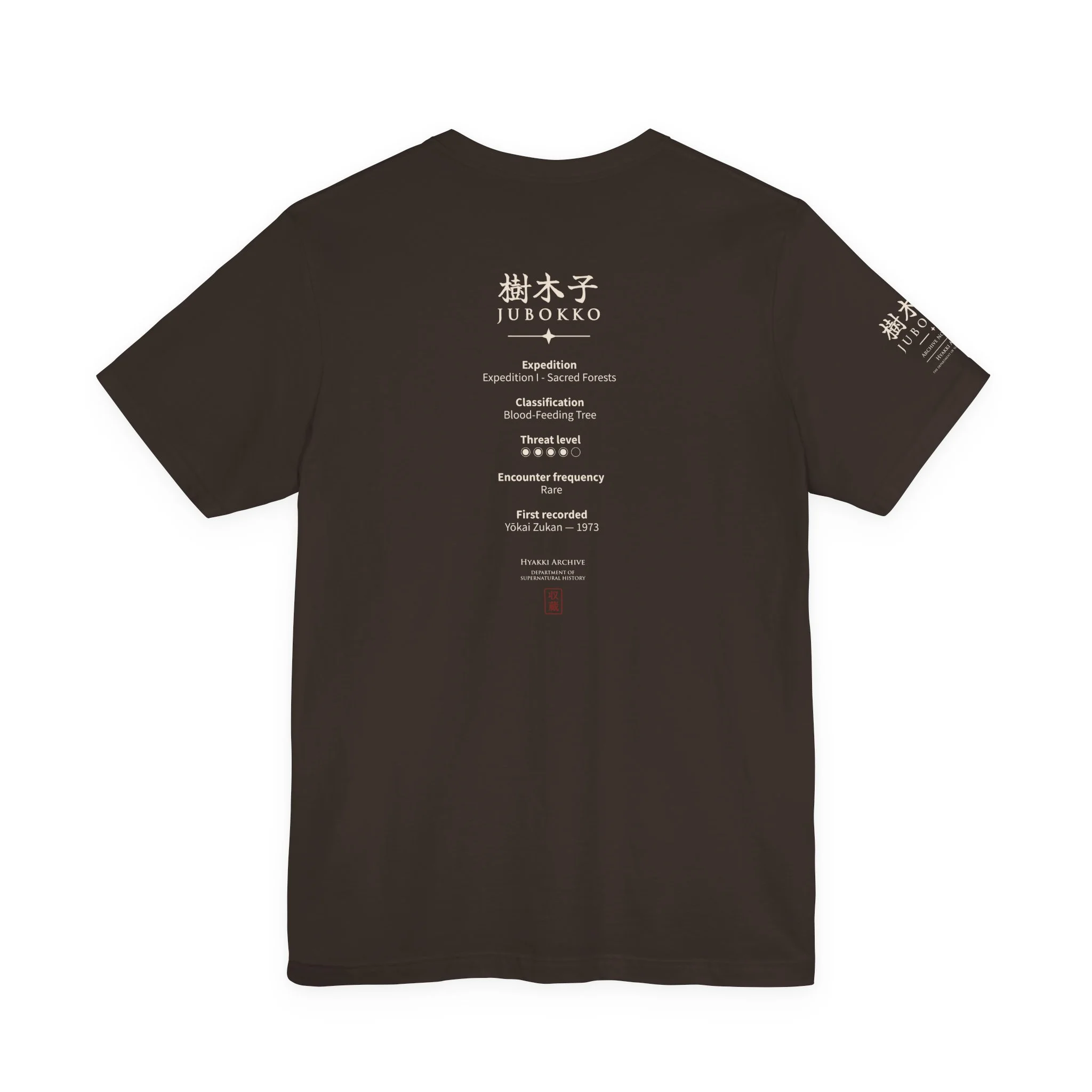
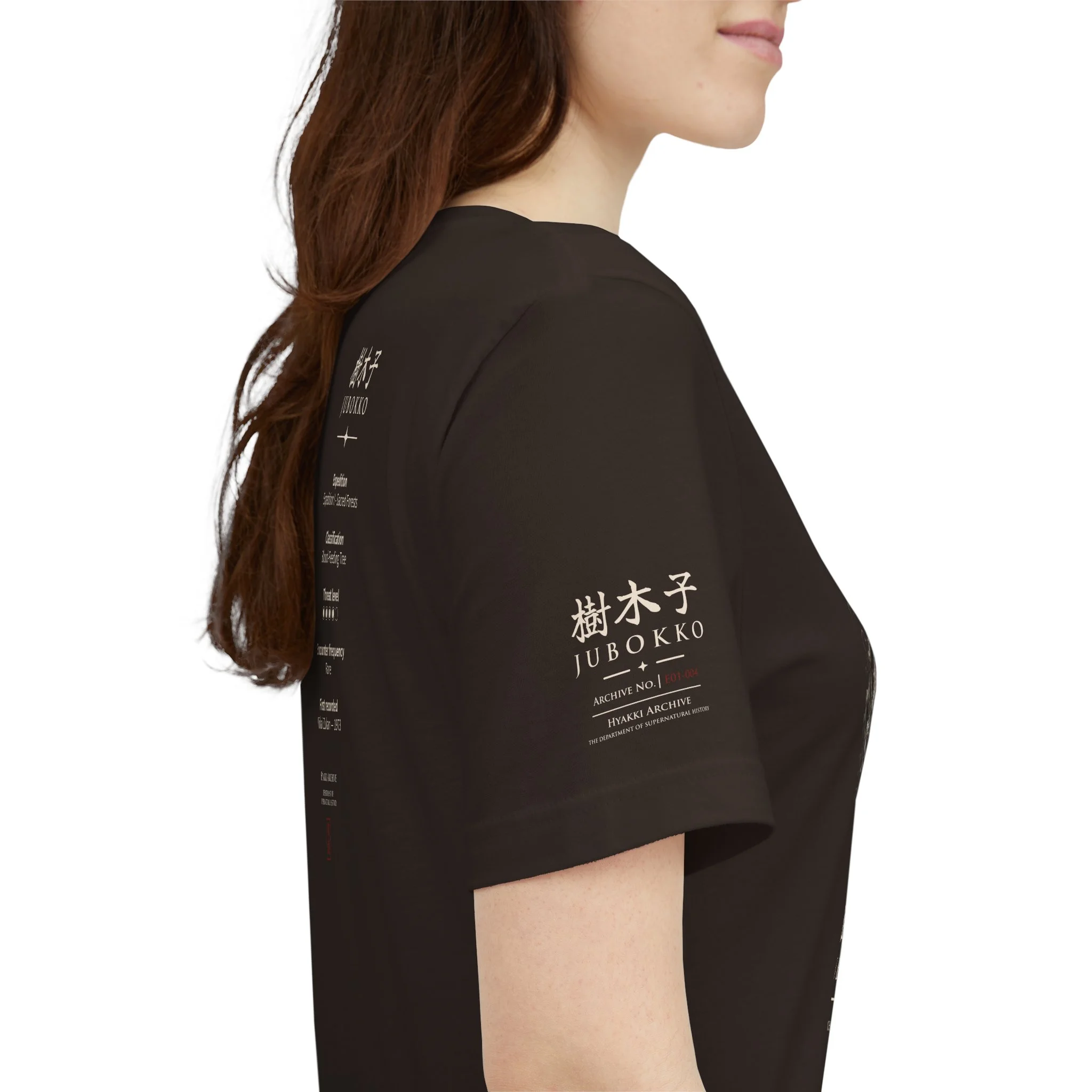
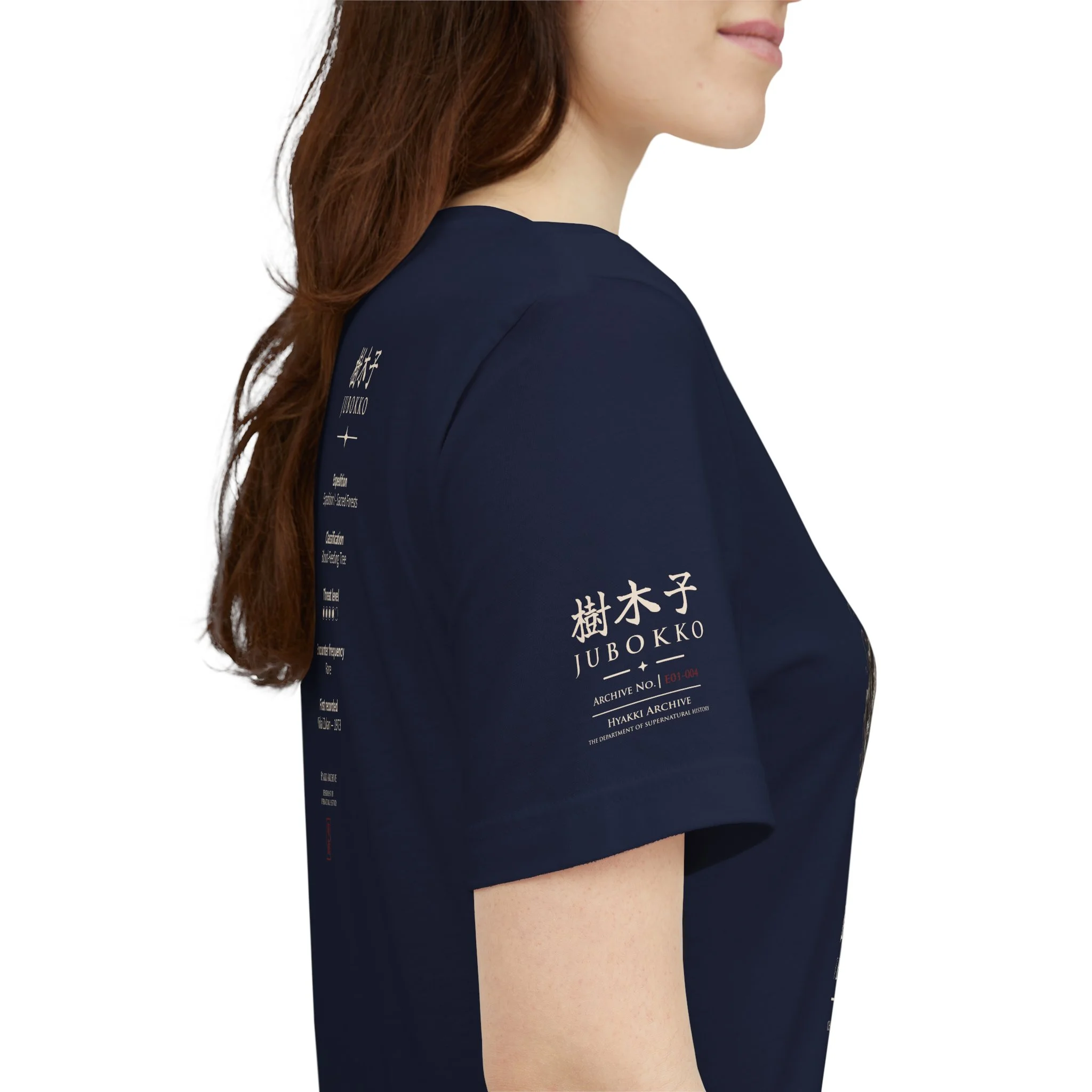
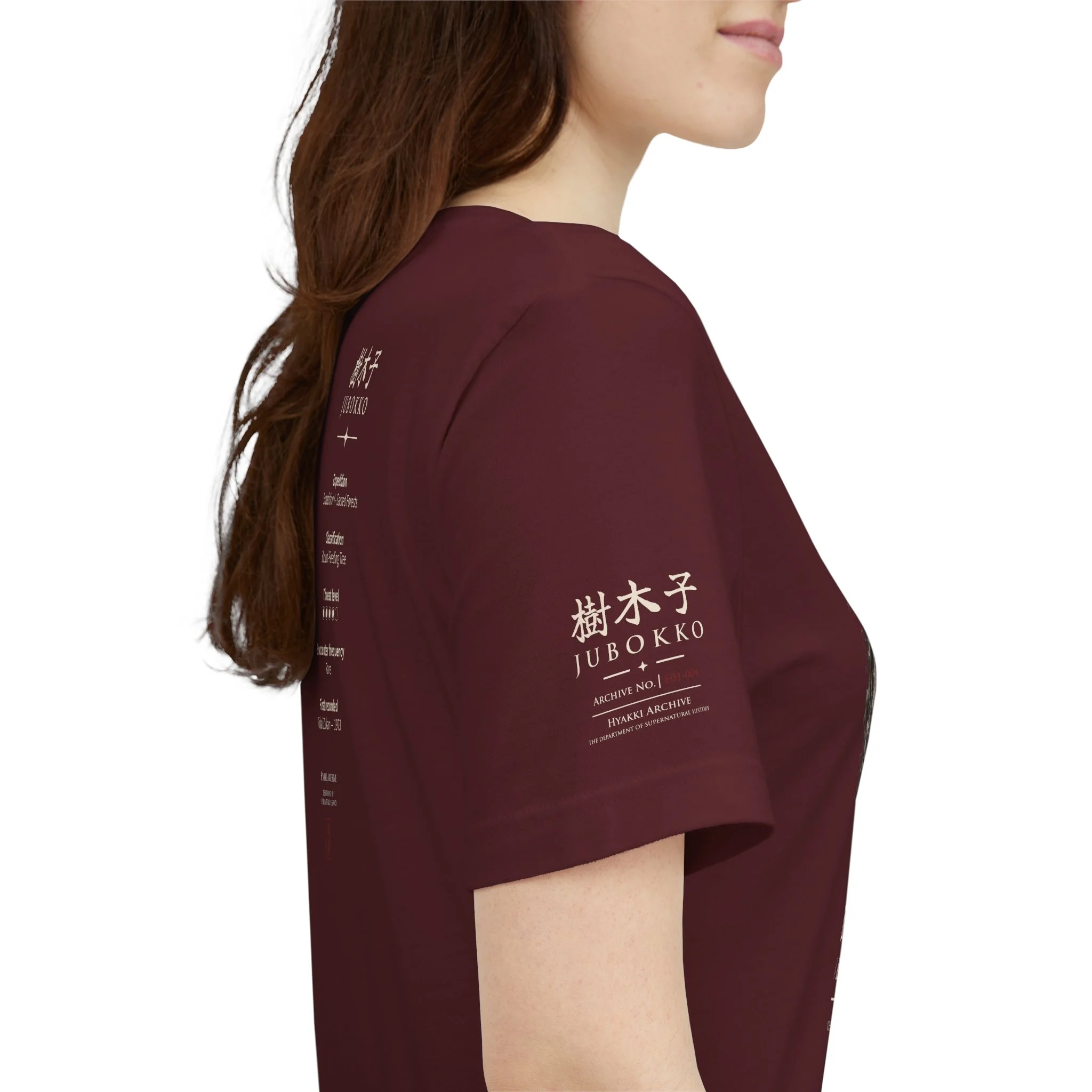
Beneath the illustration, 樹木子, JUBOKKO, and Archive No. E01-004 place the design firmly within the Hyakki archive system. The shirt layout stays clean and centered, which helps the highly detailed tree remain the focus without visual clutter.
The Entity Behind the Design
Jubokko is a modern supernatural tree most commonly described as growing on former battlefields or places of mass death. In the familiar version of the story, the tree absorbs the blood of the dead through its roots and eventually develops a hunger for the living, seizing victims who pass within reach of its branches.
What makes Jubokko especially interesting is that this now-famous form is not securely traceable to old folklore. Unlike Kodama, whose historical roots are much older, Jubokko belongs more clearly to twentieth-century yōkai culture and later popular transmission. Its reputation feels ancient because the imagery is so convincing: battlefield death, blood entering the earth, and a tree made monstrous by accumulated violence.
That tension matters. Jubokko is powerful not because it is one of the oldest beings in the archive, but because it is one of the clearest examples of a modern entity that has come to feel old.
Known For
Jubokko is best known for three connected ideas: battlefields, blood, and predatory branches.
In its best-known form, the tree grows where many people have died. It absorbs blood through its roots, becomes unnaturally vigorous, and later attacks living humans. Some later descriptions add that when cut, the tree itself bleeds, further blurring the line between plant and living flesh.
It is also known for the uncertainty surrounding its origin. Jubokko is often presented as if it were an ancient Japanese monster, but the currently known record points instead toward modern published tradition rather than securely documented classical folklore.
That mix of convincing old-world imagery and much newer documentation is exactly what has made Jubokko so memorable. It looks like something that should have existed in the archive for centuries, even though its familiar form appears to be much more recent.
From Folklore to Design
This design deliberately embraces the later, fully monstrous Jubokko image.
Rather than depicting an ordinary tree that becomes frightening only after closer inspection, the artwork reveals the tree’s predatory nature immediately. The face in the trunk, the gaping mouth, the red inner grain, and the writhing roots all push the figure toward horror rather than ambiguity. That makes it far more dramatic than the most cautious historical reading would require, but it fits the now-standard modern image of Jubokko very well.
The most effective part of the composition is the way the bark and flesh-like elements are fused together. The tree still reads as wood, but the red channels and exposed interior suggest that it has become something halfway between plant and body.
For Hyakki, that makes this design an interpretation of the modern Jubokko tradition, not a reconstruction of a securely ancient one.
From the Hyakki Archive
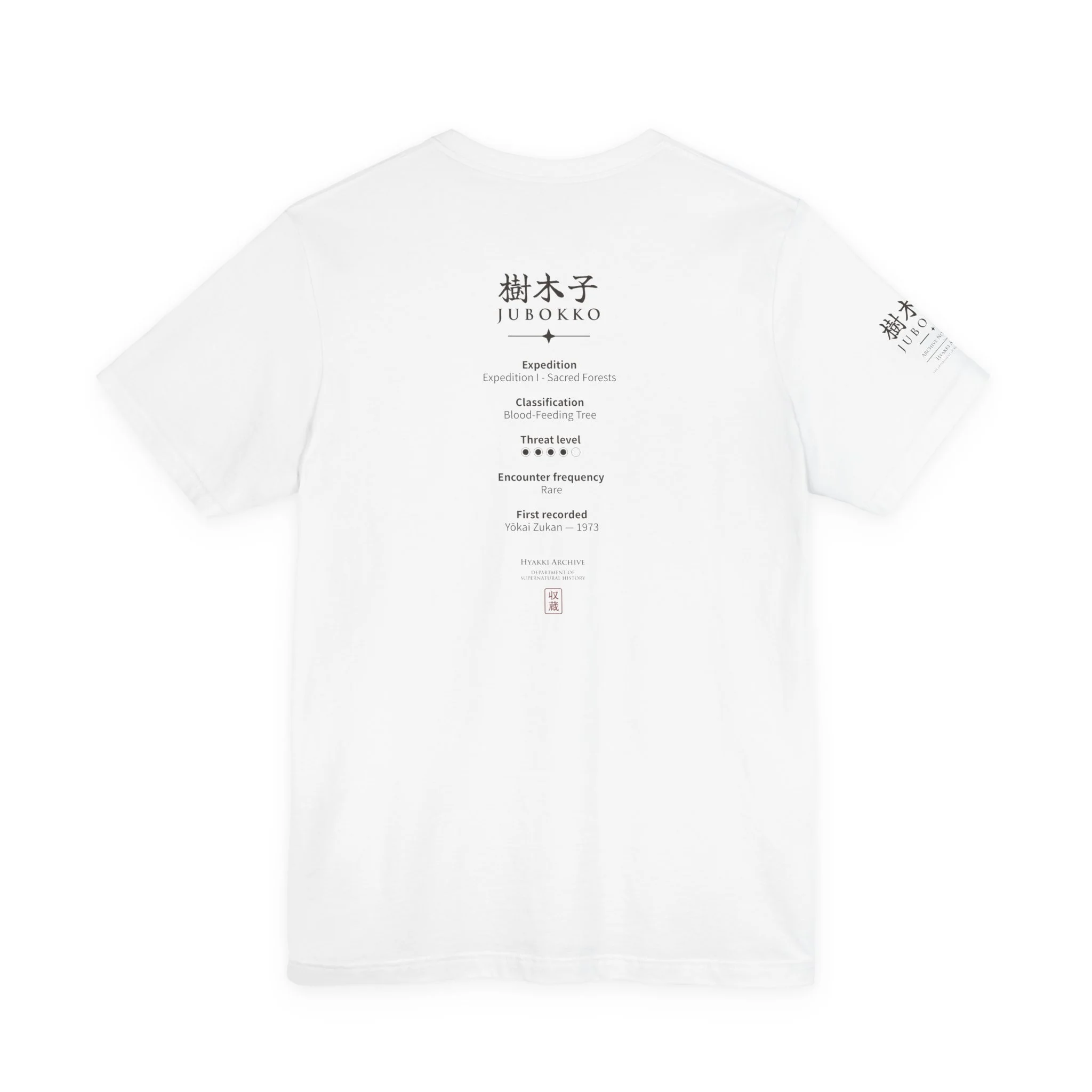
Archive File E01-004 continues Expedition I — Sacred Forests by moving from living woodland presence into something far darker.
Kodama asks whether a tree may be inhabited.
Jubokko asks what happens when a tree has been fed too much death.
This is not a quiet forest spirit, and it is not a sacred tree deserving cautious reverence.
It is a tree remembered for hunger.
The roots remain in the earth.
The violence remains in the wood.
And the mouth in the trunk suggests that the battlefield is not finished speaking.
収蔵
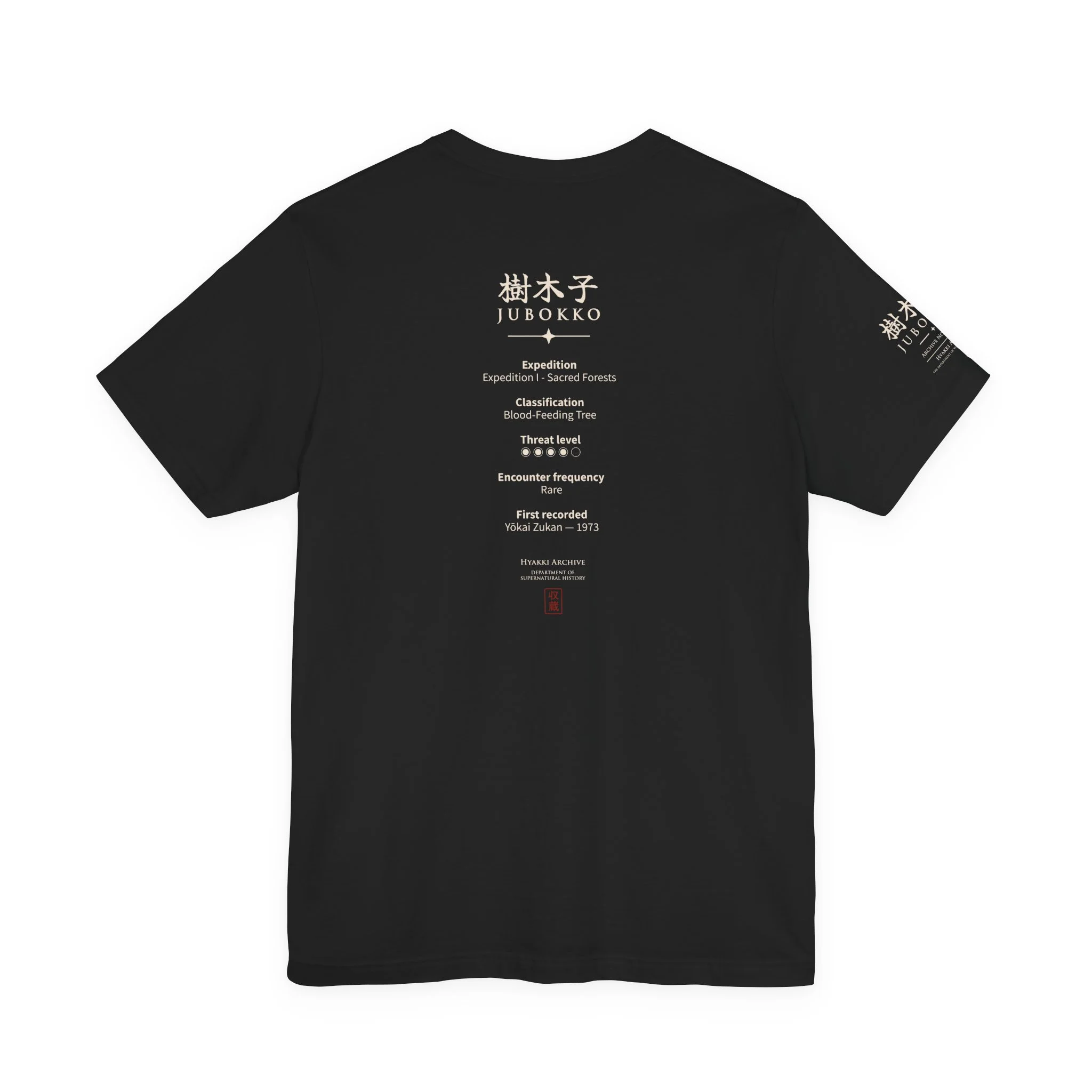
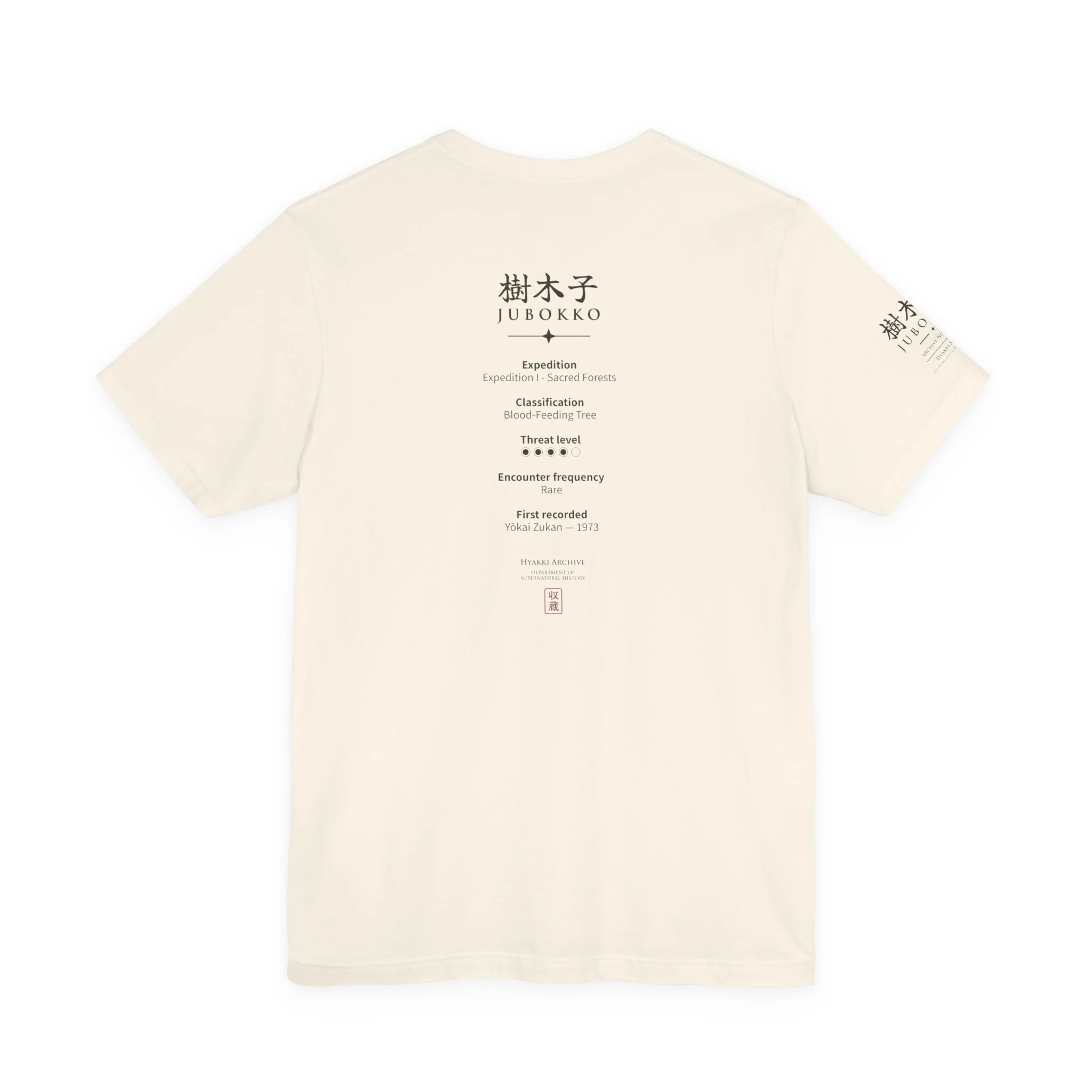
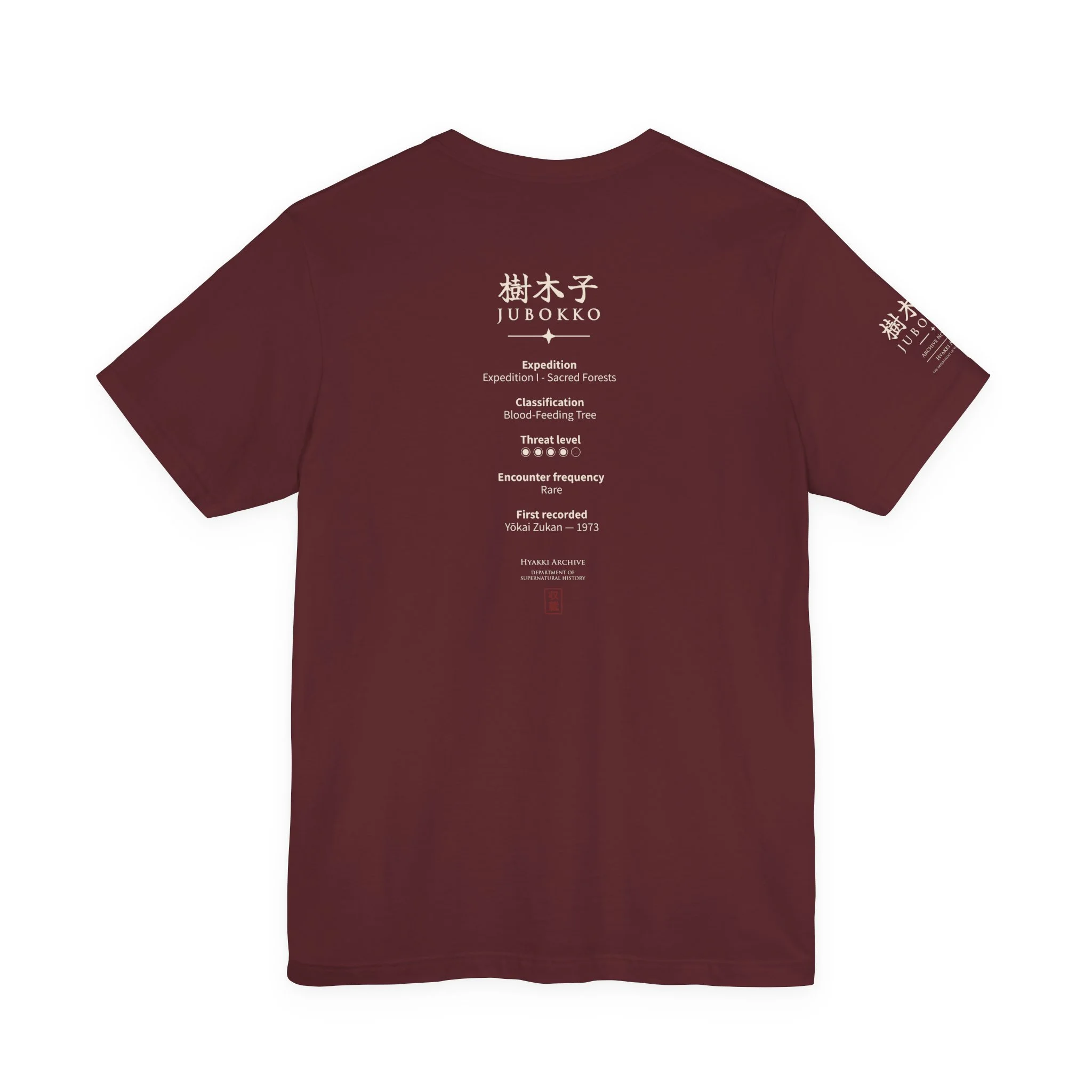
| Temperament |
Predatory |
| Activity |
Passive Until Approached |
| Encounter Frequency |
Extremely Rare |
| Habitat |
Former Battlefields • Sites of Mass Death |
| Known Variants |
Earlier Spirit-Possessed Tree Form |
01 · What Is It?
Jubokko is the name given to a supernatural tree said to arise where large numbers of people have died.
In the familiar version of the story, a normal tree grows on soil saturated with battlefield blood. After absorbing enough of it through its roots, the tree develops a taste for human blood. It then seizes passing victims with its branches and feeds from them.
That description is widespread in modern yōkai books and online references, but its apparent antiquity is misleading.
Researchers have been unable to identify an old folktale, regional legend, Edo-period text, or classical yōkai source that clearly contains this blood-drinking battlefield tree. The evidence instead places Jubokko within the modern development of yōkai culture.
That uncertainty is not a weakness in the record. It is the most interesting thing about the entity.
02 · Historical Record
The earliest currently reported appearance connected with Jubokko dates to November 1966, in Bessatsu Shōjo Friend.
Significantly, the version described there does not yet appear to contain the complete battlefield-blood mythology familiar today. According to later research discussing the magazine material, the tree was instead associated with the spirit of a person who had died on the road possessing a tree.
The more elaborate form became strongly associated with the work of Shigeru Mizuki, whose twentieth-century yōkai publications helped define how many supernatural beings are visualized today. Later descriptions characterize Jubokko as growing on battlefields, absorbing the blood of corpses, and attacking living humans.
Because researchers have not located a convincing pre-Mizuki source for the creature, Jubokko is often suspected of being a modern creation. However, assigning sole authorship remains difficult because the 1966 magazine material complicates the genealogy.
03 · Appearance
The most important feature of Jubokko is that it supposedly looks almost indistinguishable from an ordinary tree.
There is no secure traditional anatomy to reconstruct because the entity itself is not securely documented in older folklore.
Modern descriptions usually portray a large tree with branches capable of grasping human victims. Some versions add hollow or tube-like twigs used to draw blood. When cut, the tree may supposedly bleed like an animal.
These details belong to the modern Jubokko tradition rather than an ancient visual canon.
For Hyakki, that makes exaggerated monster-tree imagery less interesting than something closer to a real tree. The danger should come from the realization that the tree is behaving incorrectly, not from obvious fantasy anatomy visible from a distance.
04 · Behaviour & Encounters
The standard modern Jubokko story describes a patient predator.
Unlike an animal that hunts actively, the tree remains rooted in place and waits for someone to come within reach. Its branches then seize the victim and draw blood from the body.
Later descriptions also claim that Jubokko remains unusually healthy because of this feeding and may bleed when cut. Some accounts even assign medicinal properties to its branches.
These details should be treated as part of the modern published description, not as independently verified regional traditions.
There is also an important contrast between the reported 1966 form and later versions. The earlier material apparently concerns a human spirit inhabiting a tree, while the familiar battlefield Jubokko becomes monstrous because the tree itself absorbs human blood.
That shift may show the creature being actively developed rather than merely recorded.
05 · Belief, Ritual & Meaning
There is little evidence that Jubokko belonged to an established historical system of local belief, ritual practice, or religious observance.
That separates it sharply from entities such as Kodama.
Kodama traditions can be connected with historical ideas about spiritually inhabited trees, sacred landscapes, and caution surrounding particular old trees. Jubokko instead appears primarily in modern yōkai publishing and popular culture.
Its imagery still draws on powerful ideas: battlefield death, blood entering the earth, and nature transformed by human violence.
Those themes make the creature feel ancient because they fit easily into older supernatural aesthetics. But an old-looking idea is not necessarily an old tradition.
For Hyakki, Jubokko is therefore valuable not just as a monster, but as an example of how convincing modern folklore can become once it is repeatedly presented alongside genuinely historical yōkai.
06 · Variations & Later Development
The Jubokko record appears to change noticeably even within the twentieth century.
The reported 1966 magazine version involves the spirit of a person who died on a road entering or possessing a tree. The later and now much more familiar description instead places Jubokko on old battlefields and explains its transformation through the absorption of blood from fallen soldiers.
That difference is substantial.
It changes the entity from a haunted tree into something closer to a supernatural predatory organism.
Later books, games, websites, and illustrated encyclopedias have largely standardized the battlefield version, which is why it can now appear to be an established piece of traditional Japanese folklore.
The evidence presently available does not justify that conclusion.
Jubokko is better classified as a modern yōkai whose published mythology developed rapidly and was later mistaken for an older tradition.
07 · What We Actually Know
| Jubokko appears in twentieth-century Japanese yōkai material |
DOCUMENTED |
| A Jubokko-related tree apparition is reported in a 1966 magazine |
DOCUMENTED |
| The 1966 form differs from the later battlefield version |
DOCUMENTED |
| Later Jubokko descriptions involve battlefield blood and predatory feeding |
DOCUMENTED |
| Jubokko is securely documented in ancient or medieval folklore |
INCORRECT |
| Shigeru Mizuki definitely created Jubokko alone |
UNRESOLVED |
| Jubokko belongs to an established historical tree-worship tradition |
UNSUPPORTED |
| The creature is a useful example of modern folklore being mistaken for ancient tradition |






Reviews
There are no reviews yet.