

雪の怪異 — Yuki no Kaii
Mission: Document supernatural encounters associated with snowfall, frozen landscapes, and severe winter weather.


Mission: Document supernatural encounters associated with snowfall, frozen landscapes, and severe winter weather.

| Japanese Name | 雪女 |
| Romanization | Yuki-onna |
| Classification | Snow Spirit |
| Expedition | Expedition IV — Winter Apparitions |
| Threat Level | ■■■□□ (Level III – Dangerous) |
| First Recorded | Late Muromachi–Early Edo Period — Fushimi Tokiwa |
Some spirits belong to houses, roads, or graves.
The Yuki-onna belongs to winter itself.
She is one of the most enduring figures in Japanese folklore, a mysterious woman associated with snow, mountain passes, freezing winds, and the deadly stillness of winter nights. Accounts vary widely, but she is often described as extraordinarily beautiful, pale, and almost unnaturally calm, appearing where cold and isolation have already placed travellers in danger.
Sometimes she kills.
Sometimes she spares.
Sometimes she disappears without revealing why.
That uncertainty is central to the Yuki-onna.
In many stories, she approaches people caught in snowstorms or travelling through remote mountain country. Her breath may freeze a victim, or her presence may bring a cold so intense that life simply leaves the body. Yet other tales give her a more complicated nature. She may allow someone to live, form a relationship with a human, or remain among people for years under a hidden identity.
The danger is often tied to a condition.
A promise must be kept.
A secret must remain unspoken.
A boundary must not be crossed.
When that condition is broken, the supernatural world returns.
This gives the Yuki-onna a different character from a simple winter monster. She is not merely cold made flesh. Her stories repeatedly combine beauty, danger, intimacy, and distance. The person standing before the traveller may appear completely human, yet something about her remains unreachable.
She belongs to a landscape where familiar rules weaken.
Snow erases roads.
Wind removes footprints.
Distance becomes difficult to judge.
A place crossed safely in summer may become unrecognizable overnight.
Within Hyakki, the Yuki-onna represents the moment when weather stops being background and becomes presence.
The storm does not simply hide the spirit.
The storm may be part of her.
Her pale form mirrors the snow. Her silence belongs to the frozen landscape. Even her beauty becomes dangerous because it encourages the traveller to move closer when instinct should tell them to leave.
The Yuki-onna does not need to chase.
Winter already slows the body.
Cold weakens judgment.
The mountain closes behind you.
Then, through the falling snow, someone appears.
A woman where no one should be.
No footprints behind her.
No sign that she feels the cold.
She may ask nothing.
She may simply watch.
And in a landscape where everything has turned white, the traveller is left with one question:
Did she emerge from the storm?
Or did the storm arrive with her?
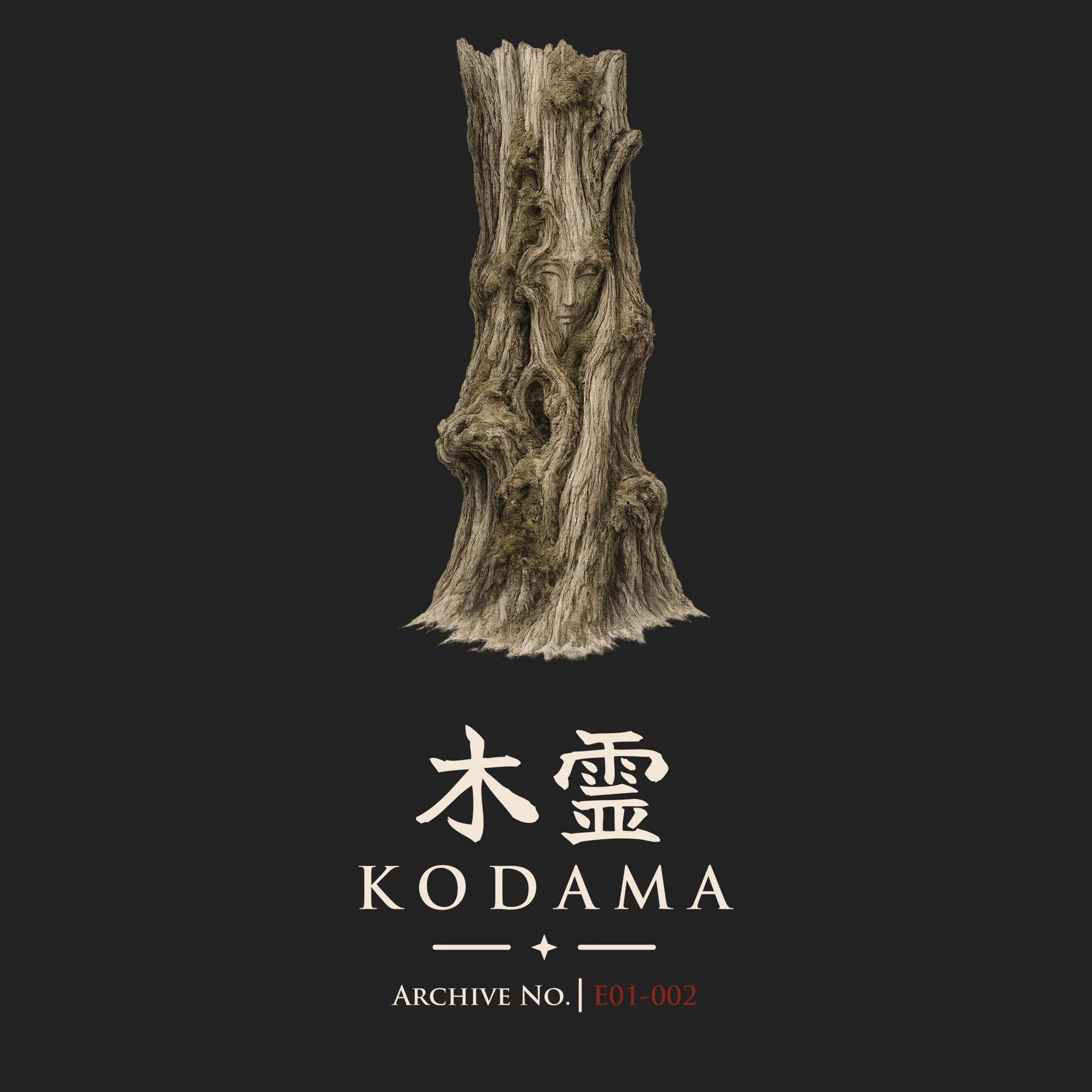
The Silent Guardian of Ancient Trees
| Japanese Name | 木霊 |
| Romanization | Kodama |
| Classification | Tree Spirit |
| Expedition | Expedition I — Sacred Forests |
| Threat Level | ■□□□□ (Level I – Minimal) |
| First Recorded | 927 CE — Engishiki |
Kodama are spirits associated with trees, particularly old or significant trees. Japanese tradition remembers them as presences inhabiting the wooded landscape, capable of inspiring reverence as well as fear. The word later also came to mean an echo, reflecting an older belief that voices returning from mountains and valleys could be the response of a spirit within the landscape.
Deep in the forest, silence is rarely empty.
A branch shifts without wind. A sound returns from farther away than it should. An ancient trunk stands apart from the surrounding trees, marked by age, shape, or an atmosphere difficult to explain.
In Japanese tradition, such places may be associated with the kodama.
Kodama are spirits connected to trees, especially old or remarkable trees believed to possess a sacred presence. Rather than simply living within the forest, they express a deeper idea: that the tree itself may be inhabited, conscious, or inseparable from a spiritual force.
The word kodama is also associated with echoes, suggesting that a voice returning through the mountains or forest may be more than a reflection of sound. It may be an answer.
This makes the kodama difficult to define as a creature. It does not need to emerge from behind a tree. The tree may already be the spirit.
Within Japanese religious and folkloric traditions, certain natural places are treated as more than landscape. Mountains, waterfalls, stones, and ancient trees may become sites where the boundary between the physical and sacred feels unusually thin. Some trees are marked with shimenawa, sacred ropes that indicate spiritual significance and distinguish them from ordinary surroundings.
Stories surrounding kodama reflect this relationship. To harm or cut down a tree inhabited by such a spirit could invite misfortune. The warning carries a larger idea: a forest may contain lives and meanings that remain invisible until they are disturbed.
Unlike many yōkai, the kodama has no single fixed appearance. Older traditions often express its presence through the tree itself rather than through a separate body. Later art and popular culture have given kodama more distinct forms, but the underlying idea remains powerful precisely because it is undefined.
A kodama may be encountered as an unexpected echo, an unnatural stillness, the feeling of being observed, or simply the sense that one tree is different from all the others.
Its identity is inseparable from place.
Roots. Bark. Shadow. Age. Memory.
If the kitsune stands at the threshold of Sacred Forests, the kodama waits beyond it. The first encounter asks whether the traveller can recognise something supernatural moving through the landscape. The second asks a more unsettling question:
What if the landscape itself is alive?
Kodama transform the forest from a setting into a presence. Every ancient tree becomes a possibility. Every echo suggests an answer. Every act of destruction carries the risk of disturbing something that was never visible in the first place.
The forest was occupied long before the traveller arrived.
It remembers.
It listens.
And sometimes, it answers.

The Shape-Shifter Beside the Road
| Japanese Name | 化け狸 |
| Romanization | Bake-danuki |
| Classification | Shapeshifting Animal Spirit |
| Expedition | Expedition I — Sacred Forests |
| Threat Level | ■■□□□ (Level II – Caution) |
| First Recorded | Early 17th Century CE |
Bake-danuki are supernatural tanuki associated with disguise, transformation, mischief and comic deception. Unlike the more ethereal fox traditions, tanuki stories often feel earthy and theatrical, with the animal fooling travellers, disguising itself as people or objects, and turning ordinary situations into elaborate supernatural performances.
Not every presence in the forest is solemn.
Some laugh.
Some lie.
Some wait until the traveller is certain of what they have seen, then change the shape of the world around them.
In Japanese folklore, the bake-danuki is a supernatural tanuki, or Japanese raccoon dog, known for transformation, illusion, mischief, and an almost theatrical delight in confusing human beings.
Like the kitsune, the bake-danuki can change form. It may appear as a person, an object, a monk, a traveller, or something entirely unexpected. Yet where fox spirits are often portrayed with an air of danger, mystery, or sacred ambiguity, tanuki stories frequently lean toward the comic, absurd, and mischievous.
A bake-danuki may imitate voices, create strange sounds, lead travellers astray, disguise itself to obtain food or drink, or construct elaborate illusions for no greater purpose than amusement. Some tales are harmless. Others are cruel. The uncertainty is part of the encounter.
What matters is that appearances cannot be trusted.
Tanuki are real animals native to Japan, and their nocturnal habits, adaptability, and presence near human settlements likely helped make them natural subjects for supernatural stories. Over time, the ordinary animal became something far stranger: a creature capable of slipping between the familiar and impossible without warning.
In folklore and later visual culture, bake-danuki are also associated with exaggerated physical features, enormous bellies, magical transformations, and famously oversized scrotums. These images were often comic rather than erotic, used in humorous prints and stories to emphasize elasticity, abundance, luck, and absurd supernatural possibility.
That humour is important.
The bake-danuki reminds us that the supernatural is not always frightening or sacred. Sometimes it is ridiculous. Sometimes the forest does not threaten the traveller. It makes a fool of them.
This makes the bake-danuki an unusual presence within Sacred Forests.
Where the kitsune introduces deception and the kodama gives spirit to the landscape itself, the bake-danuki introduces instability. A sound may have no visible source. A stranger may not be human. An object may not be what it appears to be. Even the rules governing shape and identity can become temporary.
The forest becomes a stage, and the traveller may discover too late that they are part of the performance.
The bake-danuki does not always guard a boundary or punish a transgression.
Sometimes it simply changes the signs.
Moves the path.
Borrows a face.
And waits nearby to see what happens next.
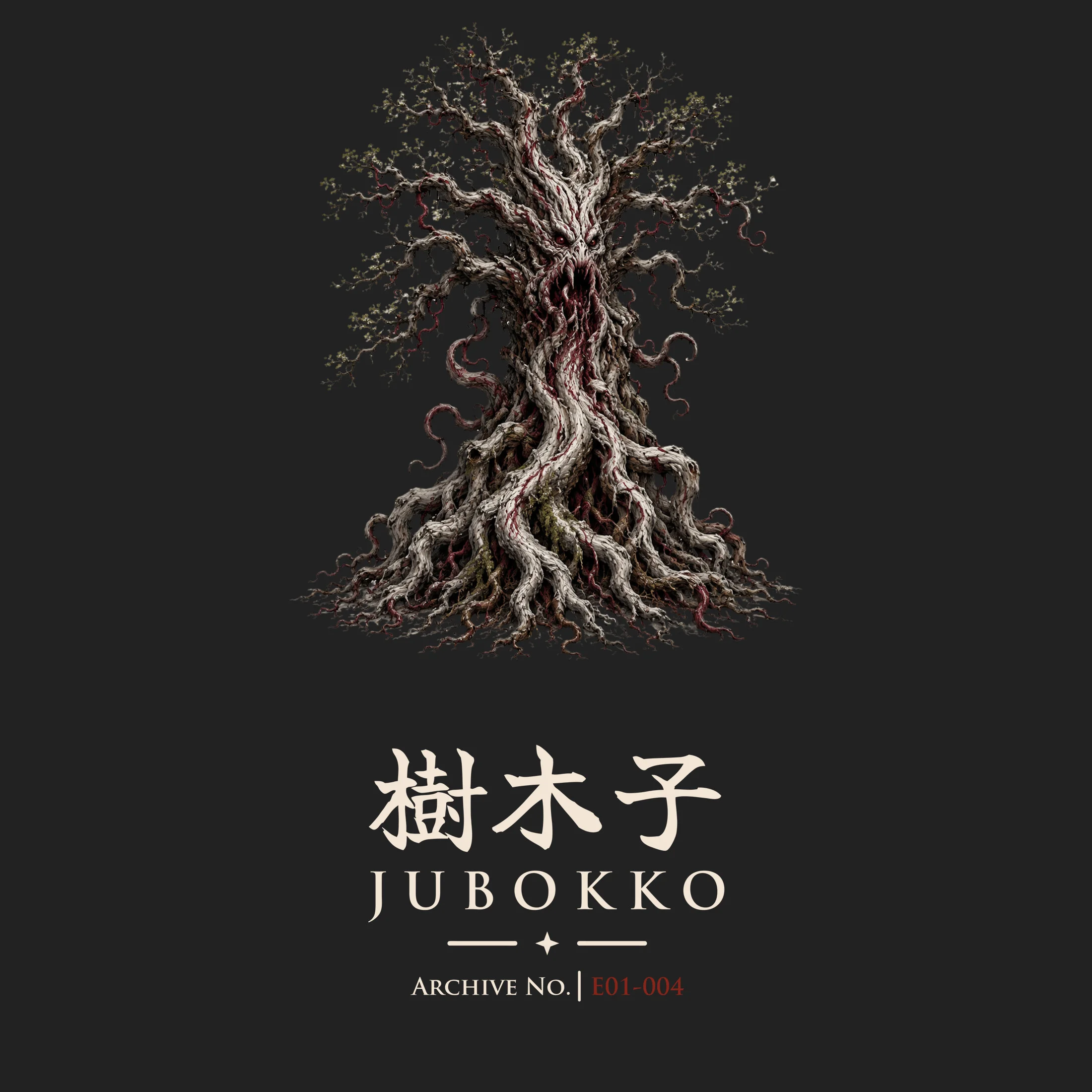
The Blood-Drinking Tree of the Battlefield
| Japanese Name | 樹木子 |
| Romanization | Jubokko |
| Classification | Blood-Feeding Tree |
| Expedition | Expedition I — Sacred Forests |
| Threat Level | ■■■■□ (Level IV – Severe) |
| First Recorded | 1966 CE |
Some forests grow from rain, sunlight, and soil.
Others remember what was buried beneath them.
The Jubokko is a supernatural tree said to appear where great numbers of people have died, especially on old battlefields. From a distance, it may look like any other tree. Its roots disappear into the earth. Its branches stretch toward the light. Nothing immediately reveals what it has become.
But the ground beneath it has been fed with blood.
According to modern yōkai accounts, a tree growing in soil saturated by the dead may absorb that blood through its roots until ordinary nourishment is no longer enough. Over time, the tree changes. It develops a hunger for the living.
A traveller who approaches too closely may find the branches moving toward them. The Jubokko captures its victim, pierces the body, and draws out blood as though drinking through hollow limbs. Its outward appearance remains healthy and strangely vigorous, sustained by something far darker than water or sunlight.
Unlike the Kodama, whose presence suggests a sacred consciousness within an ancient tree, the Jubokko represents nature transformed by human violence.
The tree did not begin as a monster.
The land made it one.
That distinction gives the Jubokko a particularly unsettling place within Sacred Forests. It suggests that landscapes do not simply witness what happens upon them. They absorb it. Violence enters the soil, memory becomes physical, and something that should have disappeared with the dead continues growing.
The Jubokko is therefore less a guardian of the forest than a wound within it.
Its horror lies partly in how ordinary it appears. There may be no twisted face carved into the bark, no warning light between the branches, no obvious boundary telling the traveller where safety ends.
Only a tree.
Only shade.
Only the remains of those who came too close before.
The Jubokko also occupies an unusual position within the wider world of yōkai. Unlike beings with clearly traceable roots in older regional folklore, researchers have noted that no established traditional source for the creature has been identified, and it is often associated with the twentieth-century work of yōkai artist and author Shigeru Mizuki.
Yet within Hyakki, that modern origin becomes part of its significance.
Folklore does not stop growing.
New fears take root beside old ones.
And in the Sacred Forests, even history can become nourishment.
Where the Kodama asks whether a tree can possess a spirit, the Jubokko asks something darker:
What kind of spirit grows when the earth has been given too much blood?
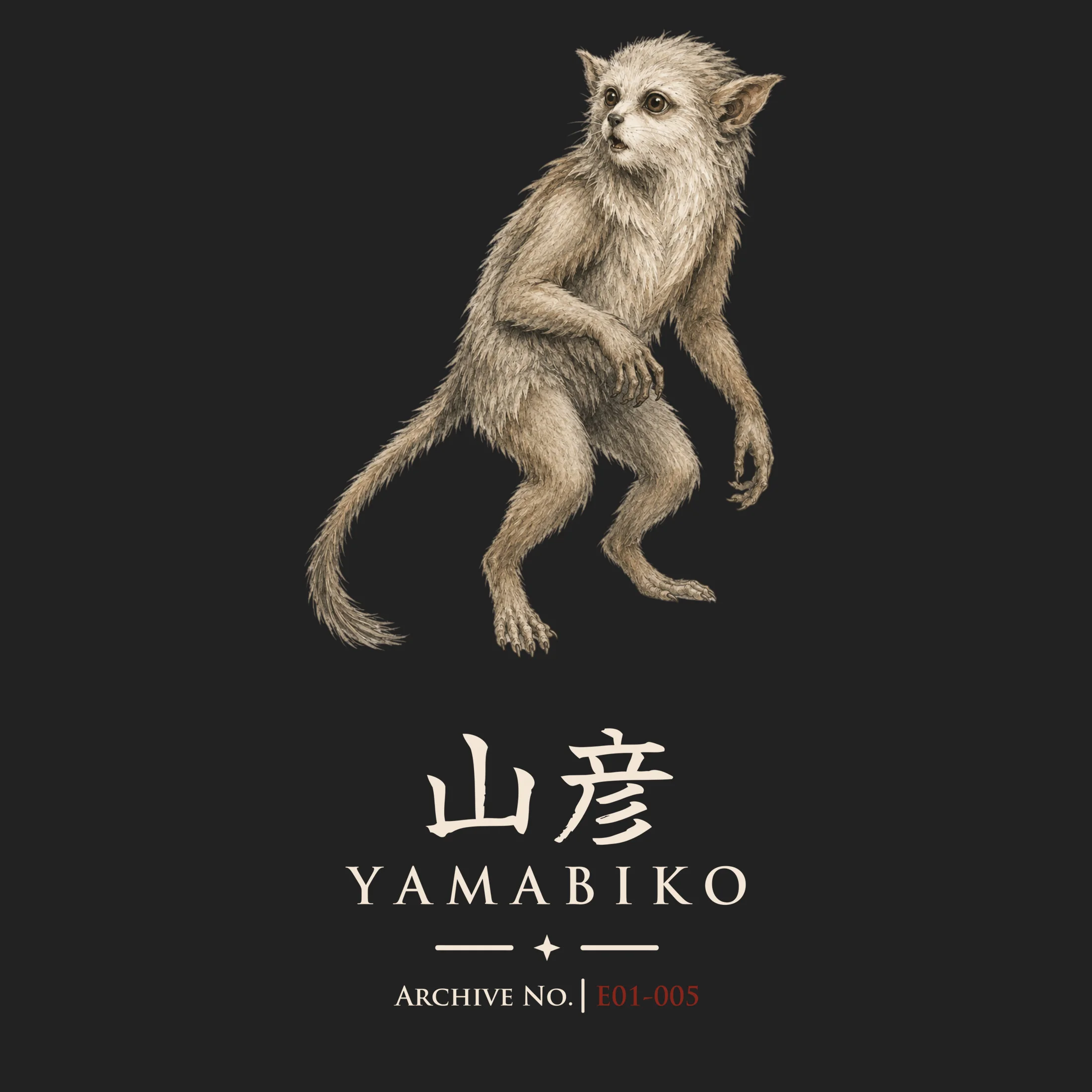
The Voice That Returns from the Mountain
| Japanese Name | 山彦 |
| Romanization | Yamabiko |
| Classification | Mountain Echo Spirit |
| Expedition | Expedition I — Sacred Forests |
| Threat Level | ■□□□□ (Level I – Minimal) |
| First Recorded | 1776 CE — Gazu Hyakki Yagyō |
Call into the mountains, and something calls back.
A voice crosses the valley, strikes the distant slopes, and returns altered by distance. Familiar words come back from somewhere unseen, as though the mountain itself has heard them and decided to answer.
In Japanese folklore, this phenomenon became associated with the Yamabiko, a spirit connected to mountains, forests, and echoes.
The name is commonly understood as “mountain echo,” and the Yamabiko occupies an unusual space between supernatural being and natural phenomenon. In some traditions, the echo itself is the spirit. In others, the sound is produced by an unseen creature dwelling deep within the mountains.
Either way, the effect is the same.
A human voice enters the wilderness and does not return alone.
Unlike yōkai defined by a clear physical appearance, the Yamabiko is often experienced through sound before anything else. A shout repeated across a valley, a voice answering from beyond the trees, or a strange call with no visible source may suggest that something hidden is listening.
This uncertainty has allowed the Yamabiko to take many forms in art and imagination. Edo-period yōkai illustrations gave it a more creature-like body, sometimes resembling a small dog, monkey, or mountain animal. Yet its identity has never depended entirely on appearance.
The Yamabiko exists most strongly in the moment of response.
Mountains have long carried spiritual significance in Japan. Remote peaks and deep forests lie beyond the rhythms of ordinary settlement, places associated with ascetic practice, sacred beings, dangerous spirits, and forces that cannot easily be controlled.
Within such landscapes, an echo can feel less like a mechanical reflection and more like evidence of presence.
Someone speaks.
The mountain replies.
That exchange makes the Yamabiko especially fitting for Sacred Forests. Where the Kodama suggests consciousness within the trees, the Yamabiko extends that possibility across the entire landscape. Cliffs, valleys, forests, and distant slopes become capable of returning the traveller’s voice.
But an echo carries a strange intimacy.
It knows exactly what you said.
It repeats your call, yet never reveals where the answer came from.
Perhaps this is why the Yamabiko remains so evocative. It transforms one of the simplest experiences in the mountains into an encounter with something unseen.
Not every spirit needs to appear on the path.
Some remain beyond sight, separated by mist, trees, and distance.
You may never see the Yamabiko.
You may never know where it waits.
But speak loudly enough into the mountains, and sooner or later, something speaks back.

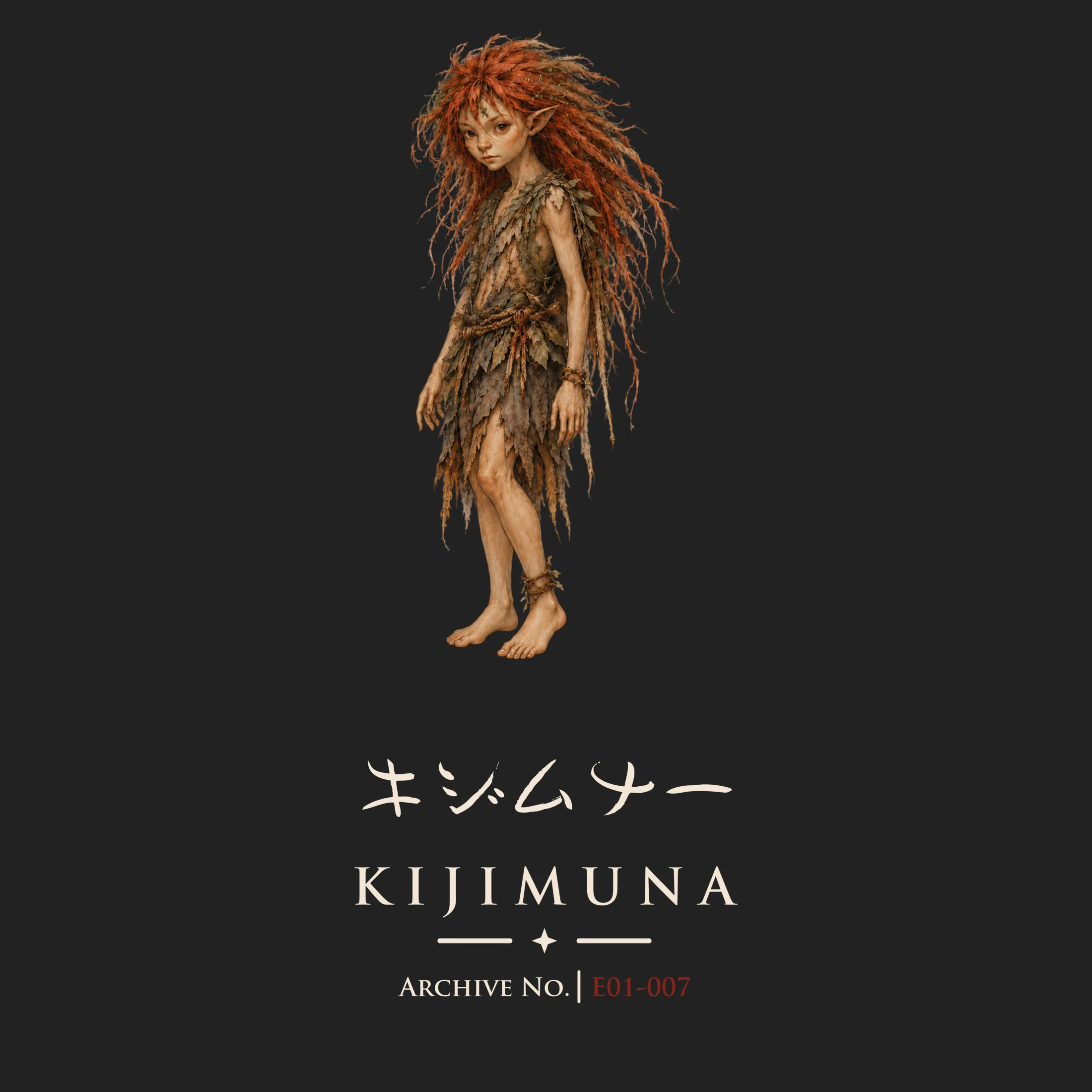
The Red-Haired Spirit of the Banyan
| Japanese Name | キジムナー |
| Romanization | Kijimuna |
| Classification | Shapeshifting Animal Spirit |
| Expedition | Expedition I — Sacred Forests |
| Threat Level | ■■□□□ (Level II – Caution) |
| First Recorded | Traditional Okinawan Folklore |
Not every fox belongs to the shrine.
Beyond the torii gates, deeper in the mountains and forests, another kind of presence waits. Less orderly. Less sacred. More difficult to predict.
The Nogitsune, literally “wild fox,” belongs to the more untamed side of Japanese fox folklore. It is often described as a type of kitsune associated with mischief, illusion, deception, and possession rather than divine service. Where foxes connected with Inari may appear as sacred messengers, the Nogitsune remains outside that order, closer to wilderness and its uncertainties.
Like other supernatural foxes, the Nogitsune is capable of transformation. It may disguise itself as a human, imitate familiar voices, create illusions, or manipulate what a traveller believes they are seeing. A road may seem to lead somewhere it does not. A stranger may be something else entirely. Hours can be lost following a path that appeared certain only moments before.
Its power lies less in direct confrontation than in confusion.
The Nogitsune does not need to attack the body if it can first disturb the mind.
Fox spirits have long been associated with the ability to bewitch, mislead, and possess human beings. Tales of kitsunetsuki, or fox possession, describe people behaving strangely or appearing to fall under the influence of an unseen fox spirit. Such beliefs were once taken seriously enough to become part of religious and social responses to unexplained illness and behaviour.
Within Sacred Forests, the Nogitsune reveals another side of the wilderness.
The forest is not only sacred because spirits protect it.
It is sacred because human control weakens there.
Paths disappear beneath leaves. Darkness erases distance. Sounds travel without revealing their source. A person who enters believing they understand the landscape may quickly discover how much of that understanding depends on being able to trust their senses.
The Nogitsune lives inside that uncertainty.
Unlike E01-001 Kitsune, which introduces the fox as a complex figure moving between sacred and supernatural worlds, the Nogitsune draws our attention toward the fox that refuses domestication. It belongs beyond the boundaries humans have marked and named.
It does not stand beside the gate.
It watches from beyond it.
Perhaps the light ahead is guiding you home.
Perhaps the figure between the trees is another traveller.
Perhaps the path has always curved this way.
Or perhaps something in the forest has noticed you are willing to believe what you see.
The Thing That Drops from the Trees
| Japanese Name | 釣瓶落とし |
| Romanization | Tsurube-otoshi |
| Classification | Tree Spirit |
| Expedition | Expedition I — Sacred Forests |
| Threat Level | ■■■□□ (Level III – Dangerous) |
| First Recorded | Early 20th Century Folklore Records |
Not every forest spirit hides in darkness.
Some climb.
Some laugh.
Some watch from the branches of an ancient tree and wait to see whether the traveller below is worth trusting.
The Kijimuna belongs to the folklore of Okinawa and the Ryukyu Islands, where it is closely associated with the gajumaru, or banyan tree. These great trees, with their tangled roots and hanging aerial branches, already seem to contain entire worlds within themselves. In local tradition, they may also shelter something unseen.
Kijimuna are often described as small, humanlike beings with vivid red hair. Their appearance can seem almost playful, but their nature is less easily defined. Like many spirits connected to the natural world, they may be friendly, mischievous, generous, or dangerous depending on how they are treated.
Stories sometimes describe Kijimuna forming relationships with humans, especially fishermen. A person who gains the spirit’s favour may receive help catching fish or navigating the sea. But such friendships depend on respect. Betrayal, cruelty, or breaking an agreement can turn a helpful companion into an unforgiving enemy.
The Kijimuna therefore represents a different kind of supernatural relationship.
It does not simply haunt a place.
It negotiates.
Its stories suggest that coexistence with the unseen is possible, but never automatic. Trust must be maintained, and the spirit is under no obligation to forgive those who take its goodwill for granted.
Its connection to the banyan tree is equally important. The gajumaru is not merely a hiding place. Its massive roots, twisting trunks, and long life give it an almost architectural presence, a natural threshold between open landscape and enclosed shadow.
To approach such a tree is to enter another kind of space.
Within Sacred Forests, the Kijimuna expands the expedition beyond the deep forests and mountain paths of mainland Japan. It leads south, into the subtropical landscapes of Okinawa, where different ecologies have produced their own traditions of spirits, sacred places, and encounters with the unseen.
Here, the forest feels warmer.
The trees grow differently.
The spirits do too.
The Kijimuna reminds us that the supernatural landscape of Japan is not one landscape at all. Every island, mountain, coastline, and grove carries its own relationships between people and place.
And beneath the spreading roots of an old banyan tree, the boundary may become especially thin.
A laugh above you may be only a bird.
A movement among the leaves may be nothing.
But if a small red-haired figure is watching from the branches, it may already have decided whether you are a guest, a friend, or someone who should leave.
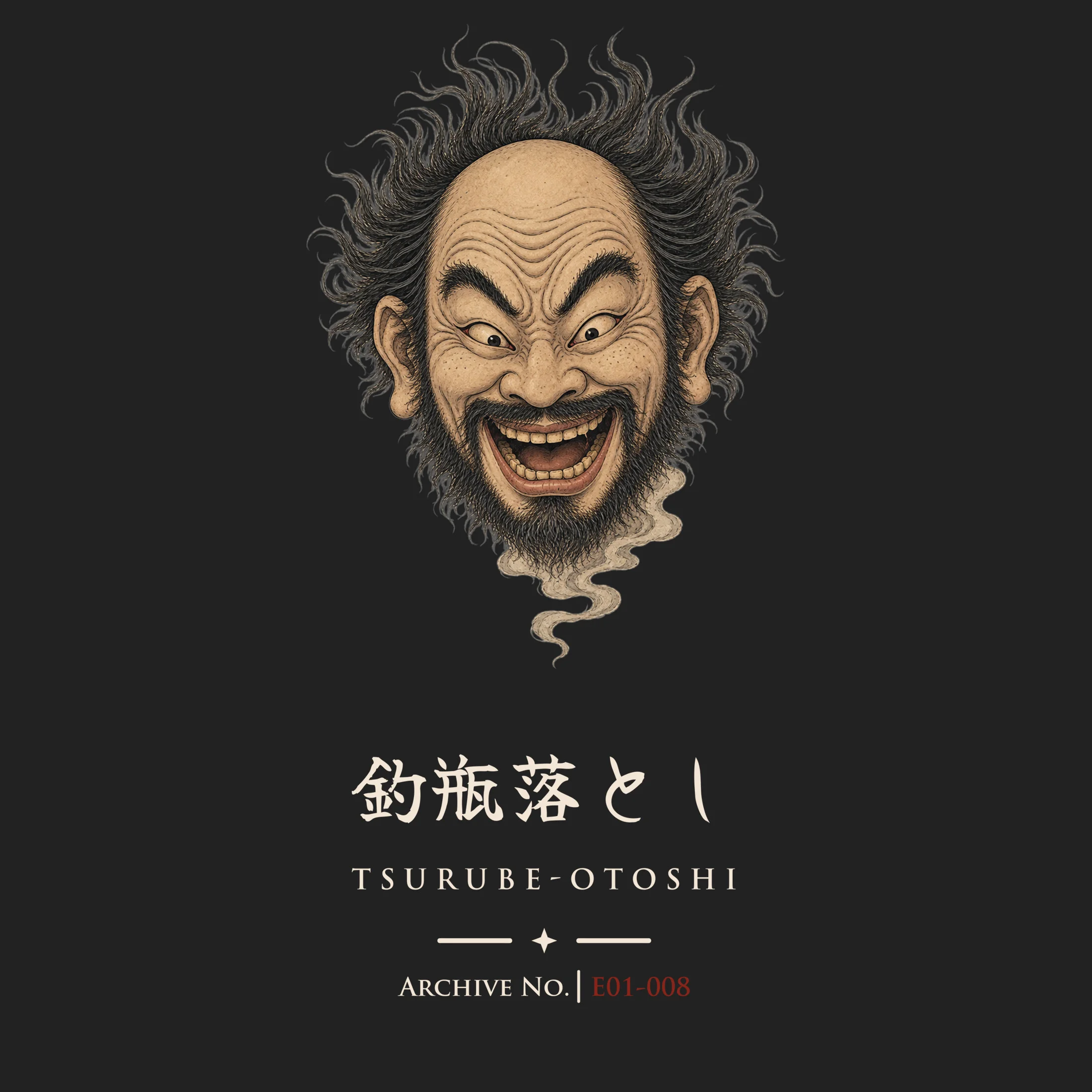
The Thing That Drops from the Trees
| Japanese Name | 釣瓶落とし |
| Romanization | Tsurube-otoshi |
| Classification | Ambush Spirit |
| Expedition | Expedition I — Sacred Forests |
| Threat Level | ■■■□□ (Level III – Dangerous) |
| First Recorded | Regional Oral Tradition |
Some dangers announce themselves from the road ahead.
Others wait above it.
The Tsurube-otoshi is a yōkai associated with remote forests and mountain paths, often described as a giant disembodied head that drops suddenly from the branches of tall trees onto unsuspecting travellers below.
Its name evokes the image of a tsurube, the bucket traditionally lowered into a well. Like that bucket, the creature descends vertically and without warning. One moment the path is empty. The next, something enormous falls from the darkness overhead.
Accounts vary in appearance and behaviour. In some stories, the Tsurube-otoshi resembles the gigantic head of a human or monk. In others, it is more monstrous, its face distorted by hunger or amusement. Some traditions describe it crushing victims beneath its weight. Others portray it as frightening travellers simply for the pleasure of watching them panic.
What remains consistent is the direction of the threat.
The traveller looks forward.
The Tsurube-otoshi waits above.
That simple reversal makes it particularly effective as a creature of the forest. Dense woodland naturally limits visibility. Branches overlap. The canopy conceals movement. At dusk, the space overhead becomes a continuous field of shadow, close enough to feel protective and dark enough to hide almost anything.
The Tsurube-otoshi turns that shelter into uncertainty.
A tree is no longer simply something beside the path. Its branches become a possible hiding place. A rustle above may be a bird, a falling branch, or the first warning that something much heavier is about to descend.
Within Sacred Forests, the Tsurube-otoshi introduces another dimension to the landscape.
The traveller has already learned to mistrust paths, voices, trees, and distant lights.
Now even the direction of danger can no longer be assumed.
The forest surrounds the body completely. Roots lie beneath the feet. Trunks close around the path. Branches meet overhead. There is no single direction from which the supernatural must approach.
And unlike spirits that guard sacred places or punish deliberate disrespect, the Tsurube-otoshi can feel almost arbitrary.
You do not need to disturb a shrine.
You do not need to cut down a sacred tree.
Sometimes it is enough simply to pass beneath the wrong branches at the wrong moment.
So the traveller learns another rule.
Watch the path.
Watch the trees.
And occasionally, look up.