The Design
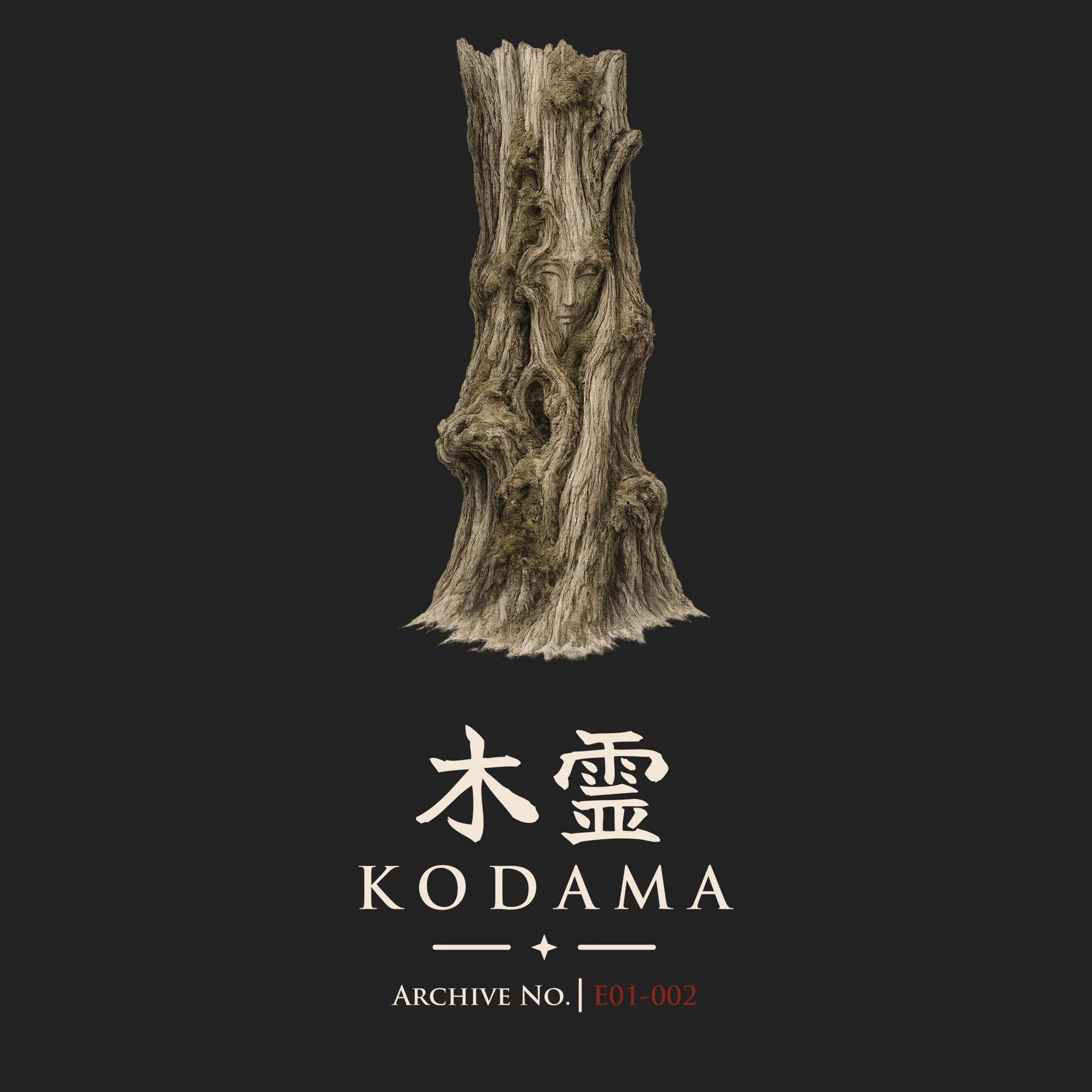
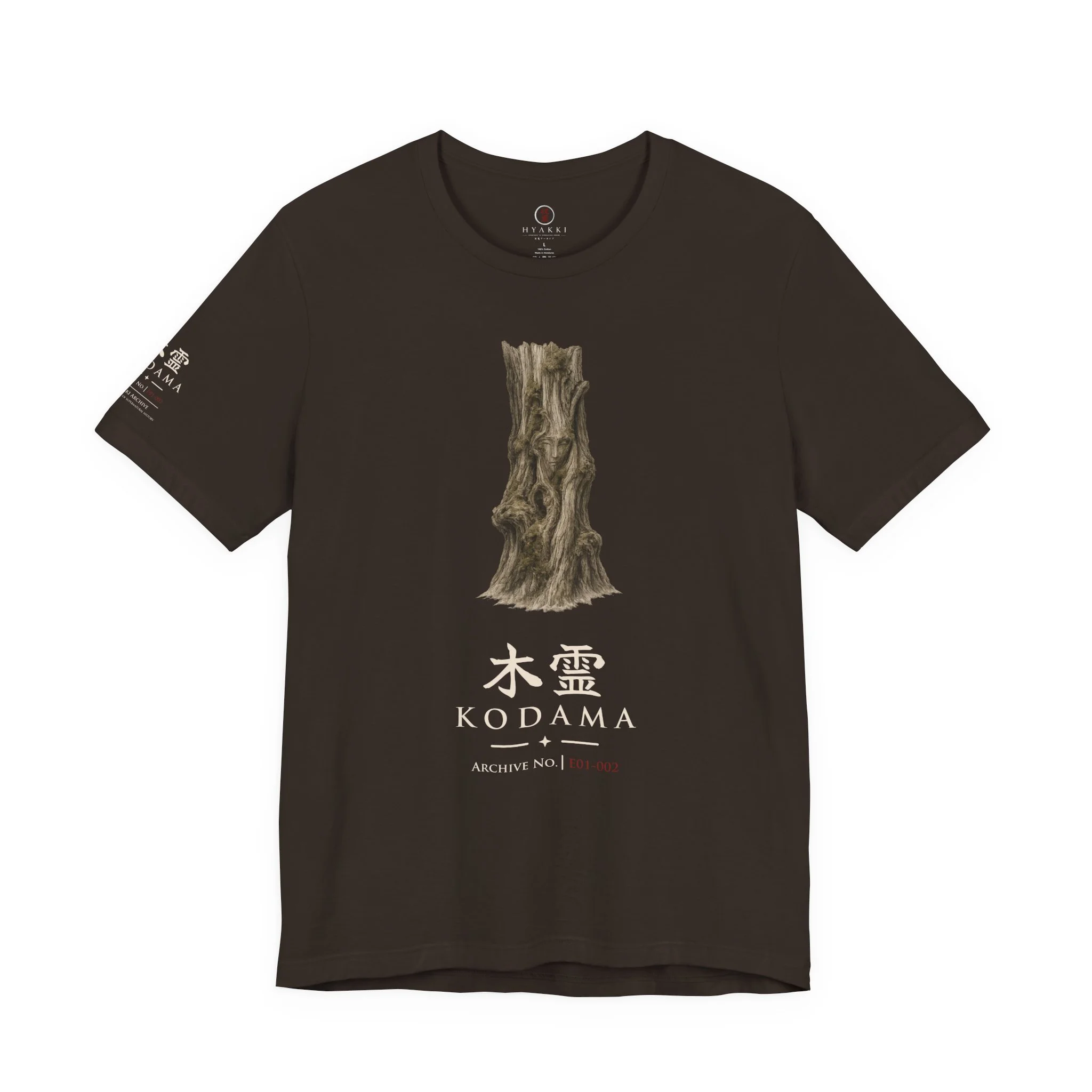
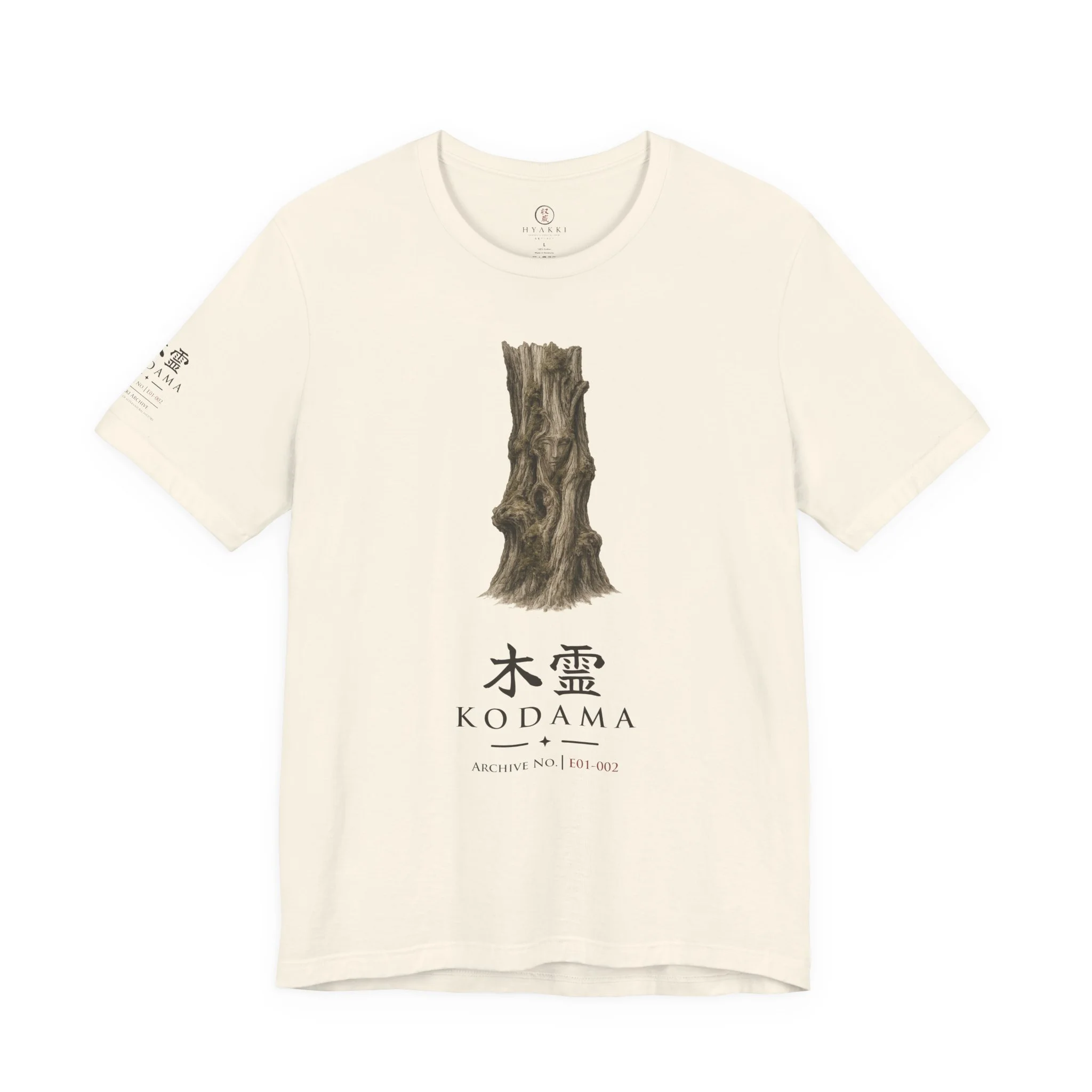
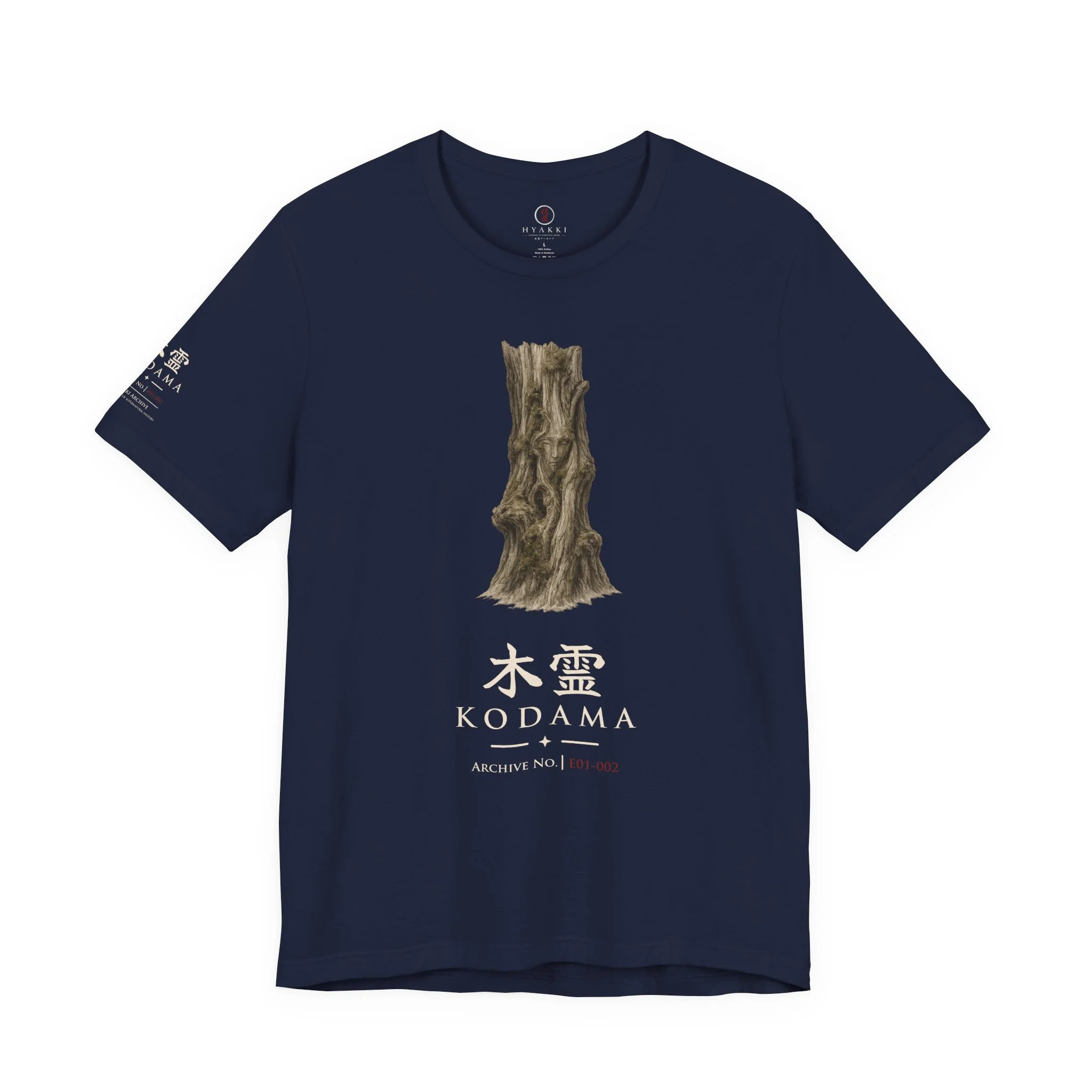
The E01-002 Kodama design treats the spirit and the tree as almost inseparable.
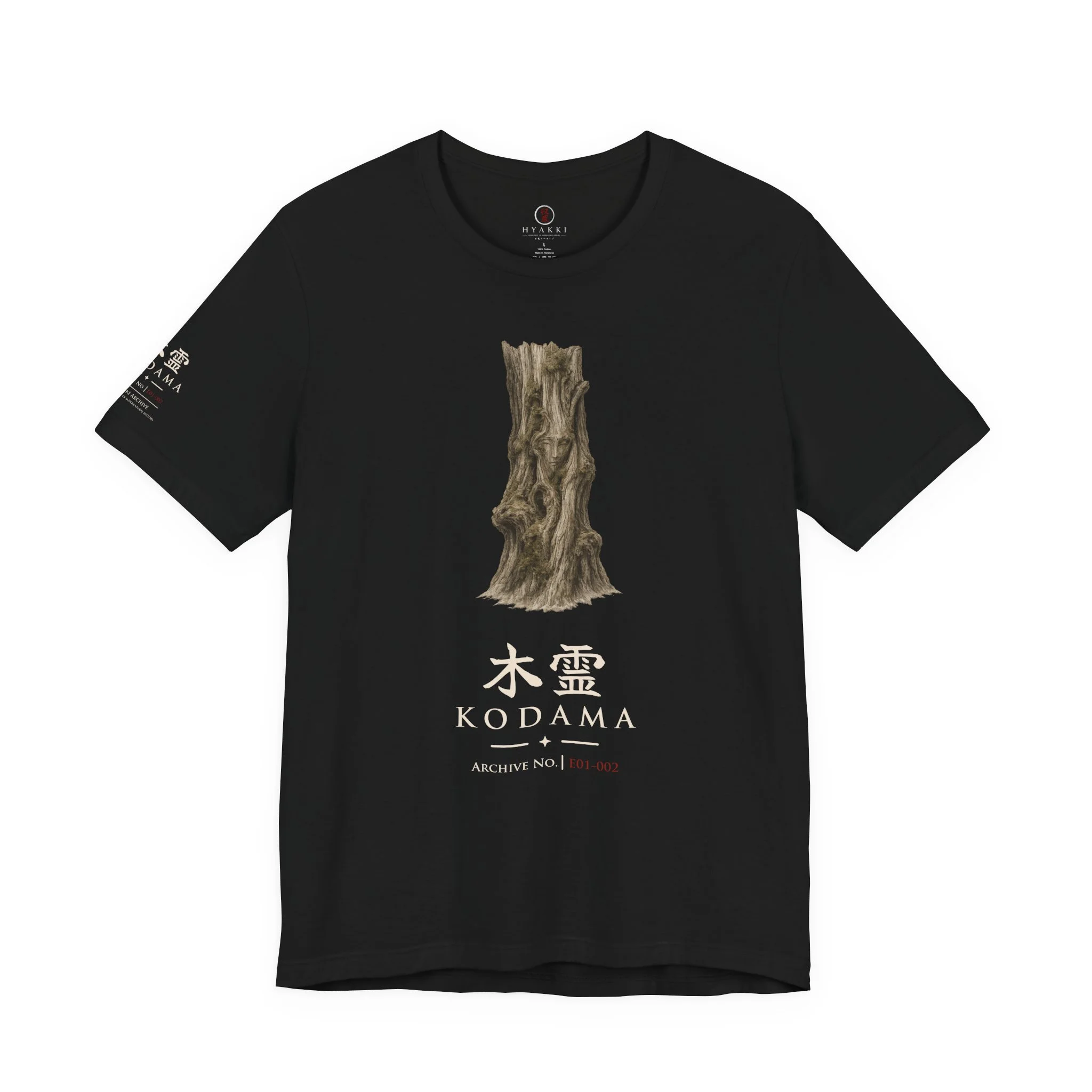
At its centre is an ancient, weathered trunk rendered like a preserved natural-history specimen. Deep grooves, broken wood and patches of moss give the tree a sense of enormous age, while a quiet humanlike face emerges almost imperceptibly from the grain. It is not presented as a creature standing beside a tree. The presence seems to belong within the wood itself.
Beneath the illustration, 木霊, KODAMA, and Archive No. E01-002 continue the restrained museum-catalogue language established across the Hyakki collection.
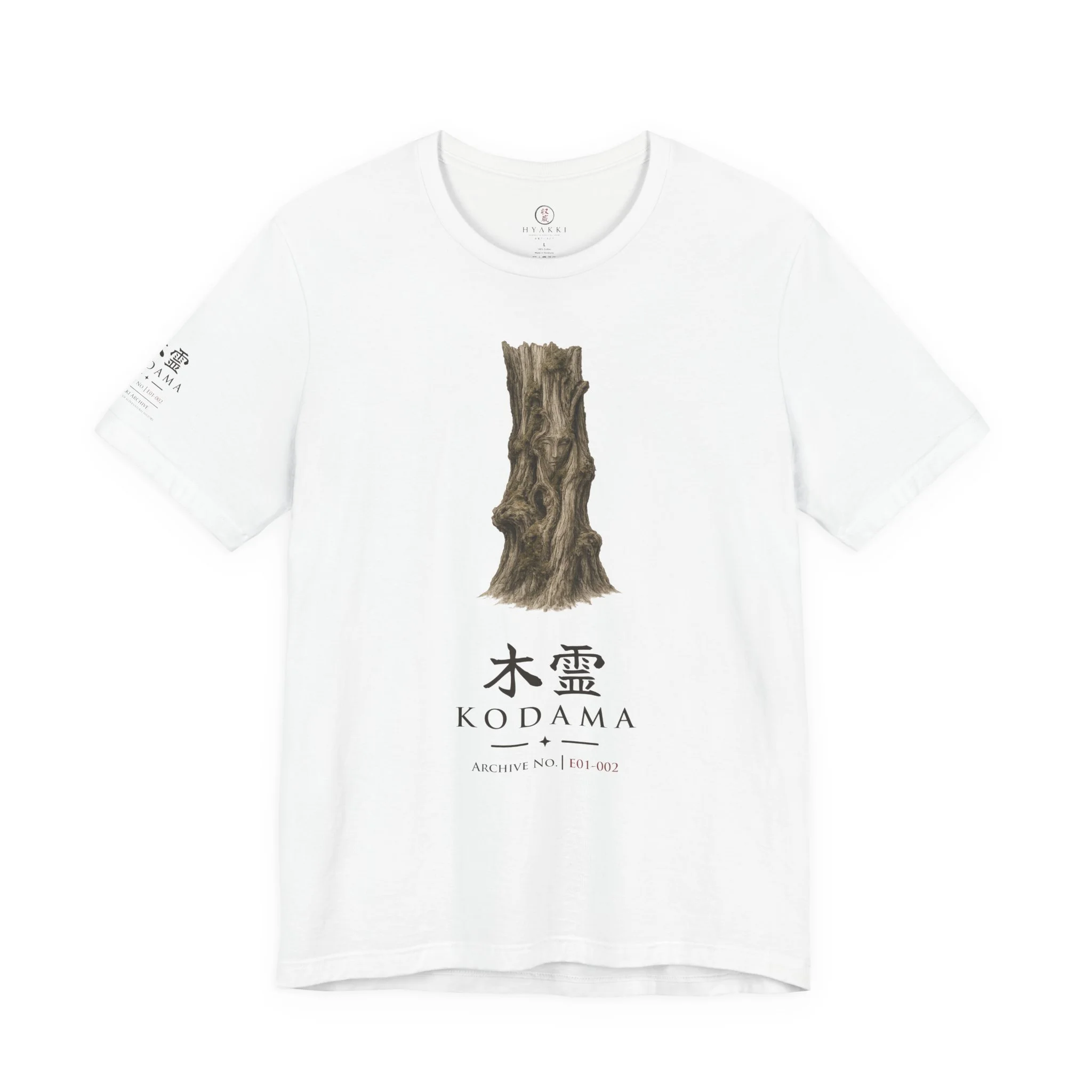
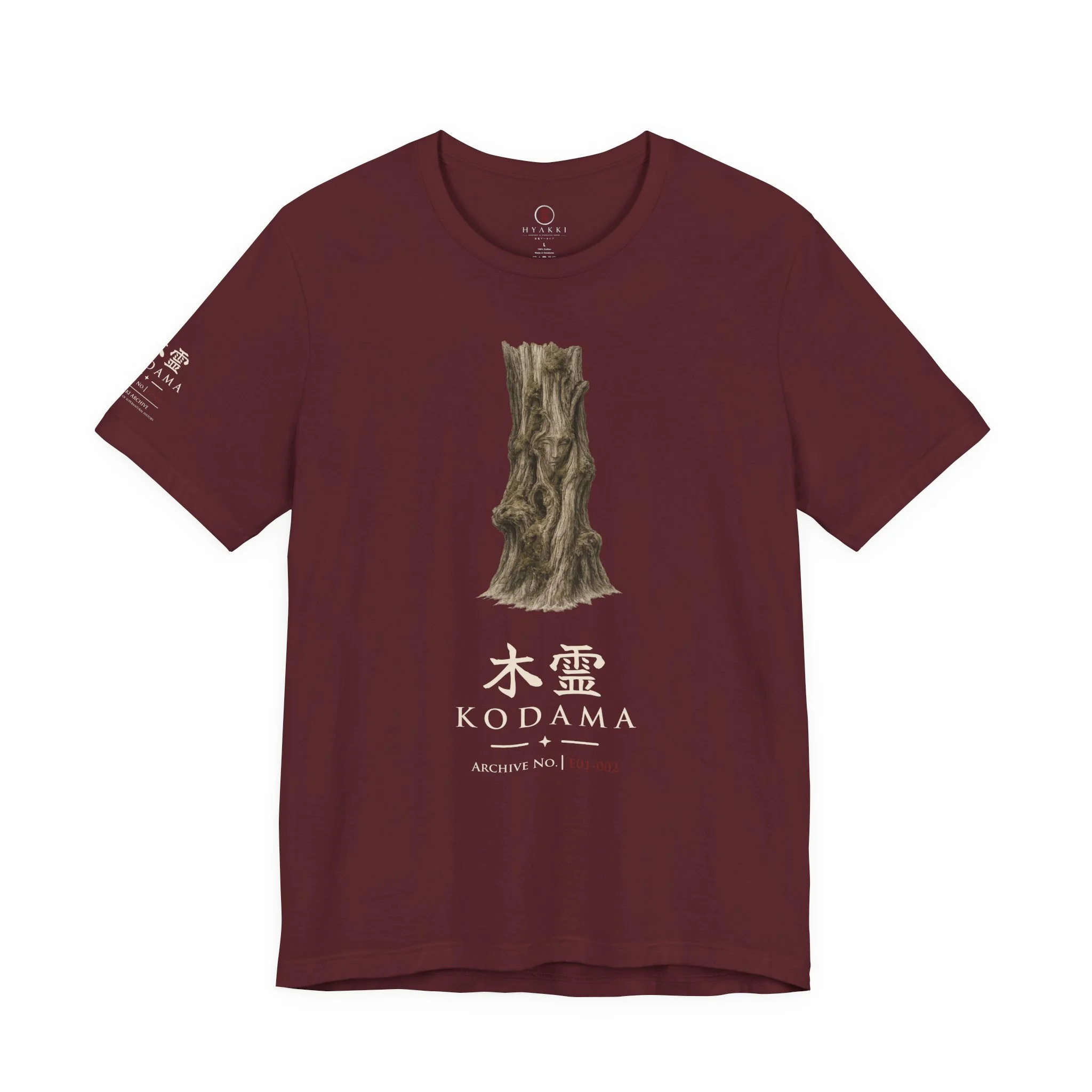
Available across the same palette of white, dark brown, black, warm cream, deep navy and muted burgundy, the subdued natural tones of the illustration allow the old wood and carved-looking face to remain the focus on every version.
The Entity Behind the Design
Kodama belongs to a long Japanese tradition of spirits associated with trees.
A concrete documentary reference appears in the Engishiki, completed in 927, which records rites involving kodama and mountain deities when timber was cut for ships. Later literature also remembers tree spirits as strange or potentially dangerous presences. In The Tale of Genji and Tsurezuregusa, kodama appears among the uncanny beings imagined to inhabit places beyond ordinary human control.
The name developed another familiar meaning as well: echo. Voices returning from mountains and valleys were once associated with the response of spirits inhabiting trees or the mountain landscape.
Kodama therefore sits somewhere between tree, spirit and place. It is not simply a tiny creature living in a forest. The older idea is much less clearly bounded.
Known For
Kodama is particularly associated with old and significant trees. In later regional traditions from islands such as Hachijōjima and Aogashima, large branching trees may be said to contain beings called Kidama-sama or Kodama-sama, and cutting such a tree could invite supernatural consequences.
The tradition also connects naturally with Japan’s wider culture of sacred trees. A shinboku, or sacred tree, may mark sacred territory, represent a place where a kami is present, or itself function as an object of reverence. Kodama and sacred-tree belief should not be treated as exactly the same thing, but they belong to a cultural landscape in which an old tree can be much more than timber.
Kodama is also historically connected with the phenomenon of the echo. The modern Japanese word kodama still refers to a sound returning from mountains or valleys, preserving an old idea that the landscape itself might be answering.
From Folklore to Design
The face visible in this design is a Hyakki interpretation, not a claim that traditional Kodama were universally described as humanoid faces embedded in bark.
That distinction matters.
Historical sources establish the spirit’s relationship with trees much more clearly than they establish one fixed physical body. Toriyama Sekien’s influential eighteenth-century depiction gave Kodama a visible humanoid form associated with an old tree, while other traditions leave the spirit unseen.
For this design, the two ideas are brought together. Rather than drawing a small independent forest creature, the humanlike presence is formed directly from the trunk. The eyes, nose and mouth remain subtle enough that the tree can still be seen first.
That ambiguity is intentional. The design asks whether the viewer is seeing a spirit inside the tree, or simply seeing a face because the tree has become old enough to suggest one.
From the Hyakki Archive
Archive File E01-002 continues Expedition I — Sacred Forests with a presence that cannot easily be separated from its environment.
Where Kitsune asks whether an animal is more than it appears, Kodama turns the question toward the landscape itself.
The tree is real.
Its age can be measured.
Its bark can be touched.
The presence within it is another matter.
Can a landscape be inhabited?
収蔵
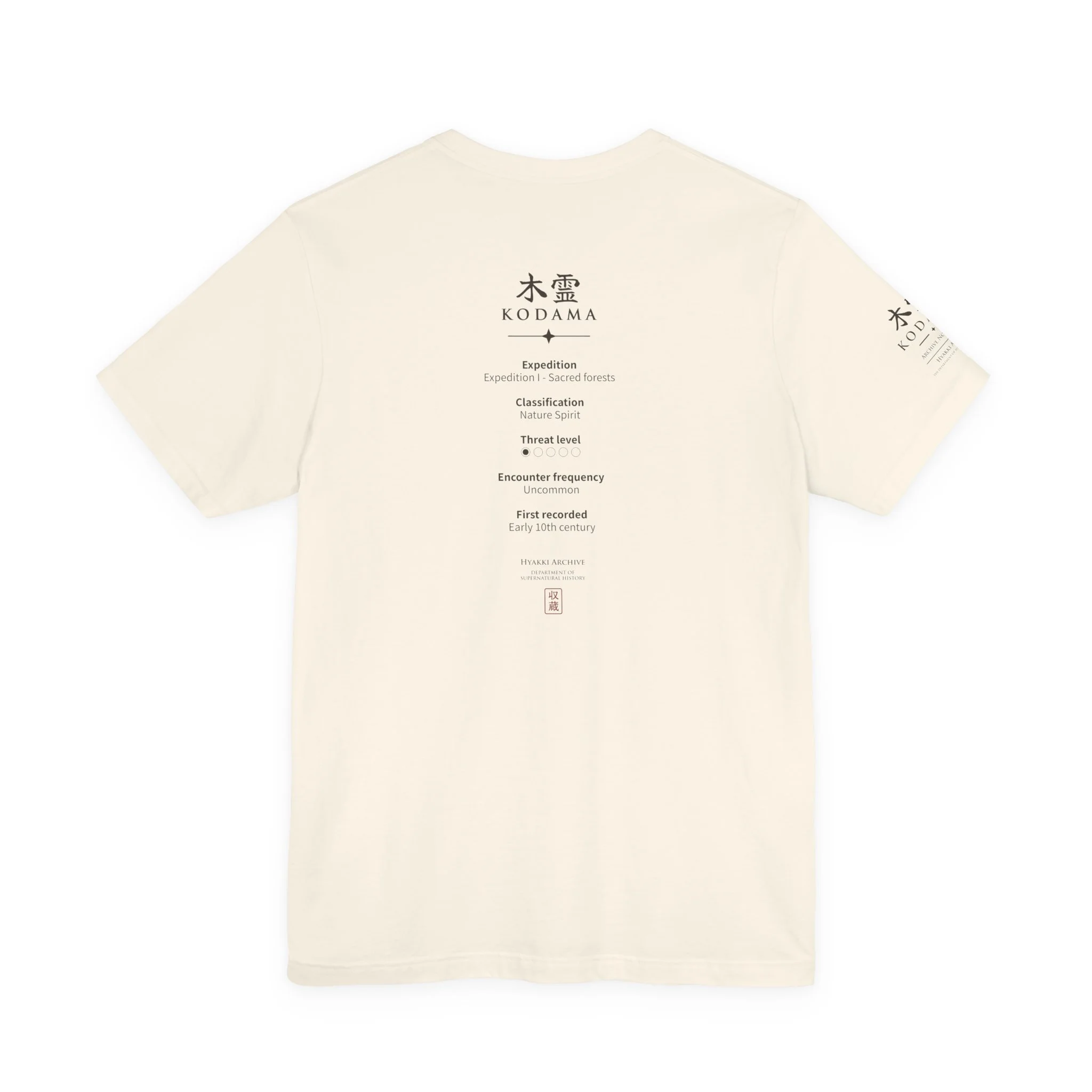
| Temperament |
Protective • Unpredictable |
| Activity |
Spiritual |
| Encounter Frequency |
Uncommon |
| Habitat |
Ancient Forests • Sacred Groves • Mountain Woodlands |
| Known Variants |
Kidama-sama • Kodama-sama |
01 · What Is It?
Kodama are spirits associated with trees, especially old, remarkable, or culturally significant trees. In Japanese tradition, the presence may be understood as inhabiting the tree itself or as belonging to the surrounding wooded landscape.
Unlike many modern depictions, Kodama were not historically defined as small humanoid forest creatures with one fixed appearance. The tradition is much broader and often leaves the spirit unseen.
The word later also came to mean an echo, particularly a sound returned from mountains or valleys. This reflects an older belief that an answering voice in the landscape could be interpreted as the response of a spirit.
Kodama is therefore best understood as a tree-associated spiritual presence, rather than a standardized supernatural species.
02 · Historical Record
Kodama has a long documentary history in Japan.
A concrete early reference appears in the Engishiki, completed in 927, where rites connected with kodama and mountain deities are recorded in relation to cutting timber for ships.
Later literary sources also preserve the idea of tree spirits. References appear in works such as The Tale of Genji and Tsurezuregusa, showing that the belief remained culturally recognizable across the medieval period.
By the Edo period, Kodama also entered illustrated yōkai culture. Toriyama Sekien included a visible tree-associated spirit in his 1776 Gazu Hyakki Yagyō, giving later audiences a more defined image of a being connected with an old tree.
The tradition therefore predates modern yōkai catalogues by many centuries, even though its visual form was never completely standardized.
03 · Appearance
There is no single canonical appearance for Kodama.
In many traditions, the spirit is not described visually at all. Its presence is understood through the tree, the atmosphere around it, or unusual sounds.
Later art sometimes gives Kodama a humanoid form. Sekien's eighteenth-century illustration helped establish the idea of a spirit physically emerging from or standing beside an old tree.
Modern popular culture has gone much further, often portraying Kodama as small pale creatures or forest beings. Those images are influential, but they should not be projected backward onto the older tradition.
For Hyakki, the most historically defensible approach is to treat the tree itself as the main visible form, with any face or humanlike presence clearly labelled as an interpretation.
04 · Behaviour & Encounters
Kodama is not primarily known for active encounters in the way Kitsune or Bake-danuki are.
The spirit is more often associated with the presence and condition of the tree itself.
Traditional beliefs may warn against cutting or damaging certain old trees, because doing so could bring misfortune or supernatural consequences. In some regional traditions, large trees are specifically believed to be inhabited by beings called Kodama-sama or Kidama-sama.
Kodama is also strongly associated with echoes. A voice or sound returning from a mountain or valley could be understood as something in the landscape answering back.
This makes Kodama a relatively passive but powerful presence. The encounter is usually not about being chased, deceived, or attacked.
It is about realizing that a tree or landscape may not be empty.
05 · Belief, Ritual & Meaning
Kodama belongs to a wider Japanese cultural landscape in which particular trees can be treated as spiritually significant.
This overlaps with the tradition of shinboku, sacred trees associated with kami, shrines, or places of religious importance. Kodama and sacred-tree belief are not identical, but both reflect the idea that an old tree can possess significance far beyond its physical material.
Ritual caution around cutting trees also appears in early documentary material. The Engishiki reference is important because it connects tree spirits with actual acts of timber cutting rather than abstract mythology.
The tradition therefore expresses several overlapping ideas: respect for age, fear of disturbing a spiritual presence, and the possibility that the natural landscape contains beings humans cannot easily perceive.
Kodama is less about controlling nature than about behaving as though the forest may already be inhabited.
06 · Regional & Historical Variations
Kodama traditions vary by region and period.
On Hachijōjima and Aogashima, later beliefs refer to beings called Kidama-sama or Kodama-sama inhabiting large, branching trees. Cutting such trees could bring a curse or other supernatural consequences.
Elsewhere, the word Kodama became strongly associated with the phenomenon of the echo itself.
Historical and artistic depictions also differ. Some sources leave the spirit completely unseen, while later illustrators give it a humanoid form. Modern culture has introduced further visual interpretations, especially the small forest-spirit image familiar from contemporary media.
The underlying idea remains more stable than the appearance: certain trees or wooded places are treated as spiritually inhabited, and disturbing them may have consequences.
07 · What We Actually Know
| Kodama is historically associated with trees and wooded landscapes |
DOCUMENTED |
| A Kodama-related reference appears in the Engishiki of 927 |
DOCUMENTED |
| Kodama is also historically associated with echoes |
DOCUMENTED |
| Some regional traditions warn against cutting trees believed to contain Kodama |
TRADITION |
| Every Kodama has a visible humanoid body |
UNSUPPORTED |
| Kodama are universally small white forest creatures |
INCORRECT |
| Kodama and sacred-tree traditions overlap culturally |
INTERPRETATION |
| Kodama is simply another word for a tree kami |
OVERSIMPLIFICATION |
























Reviews
There are no reviews yet.