The Design
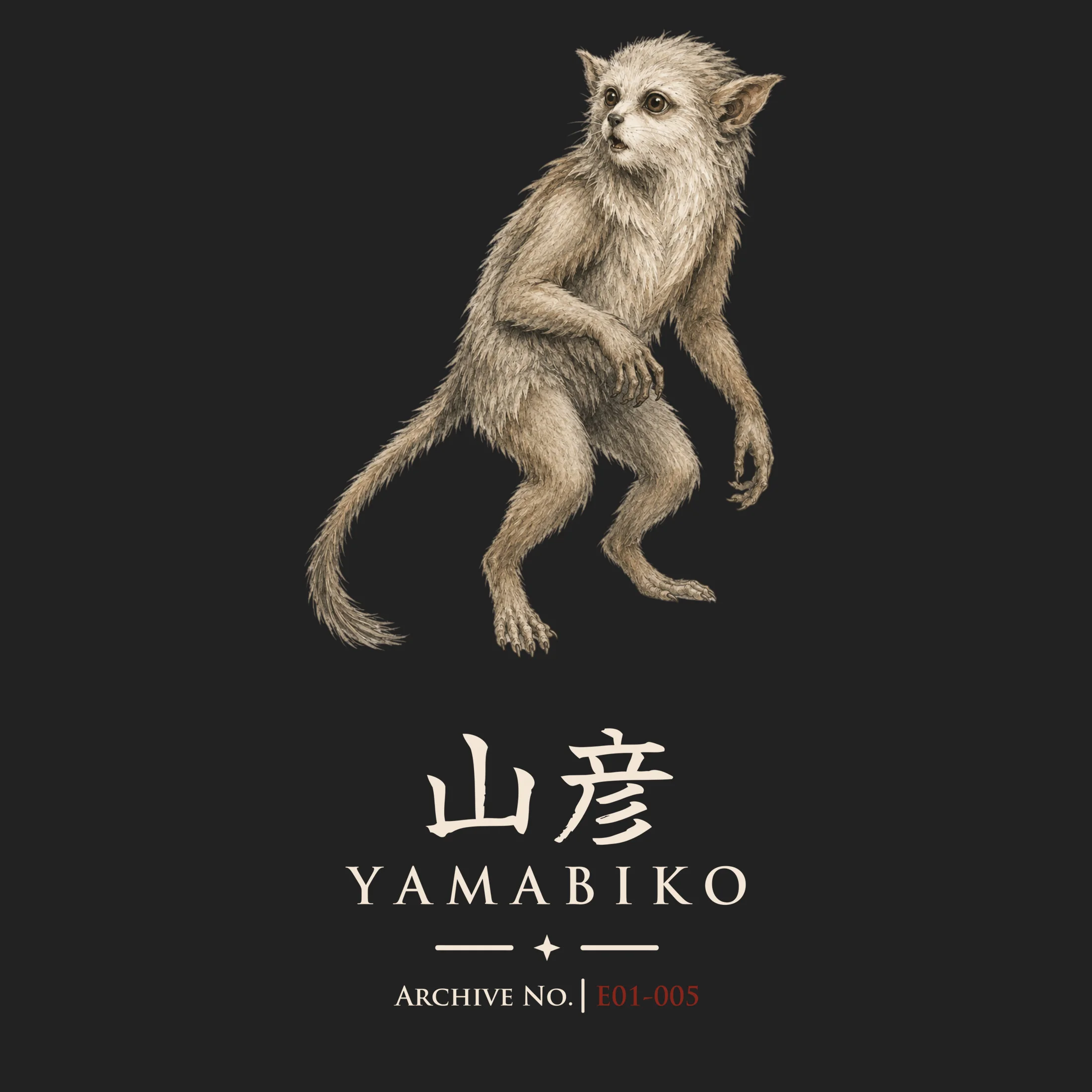
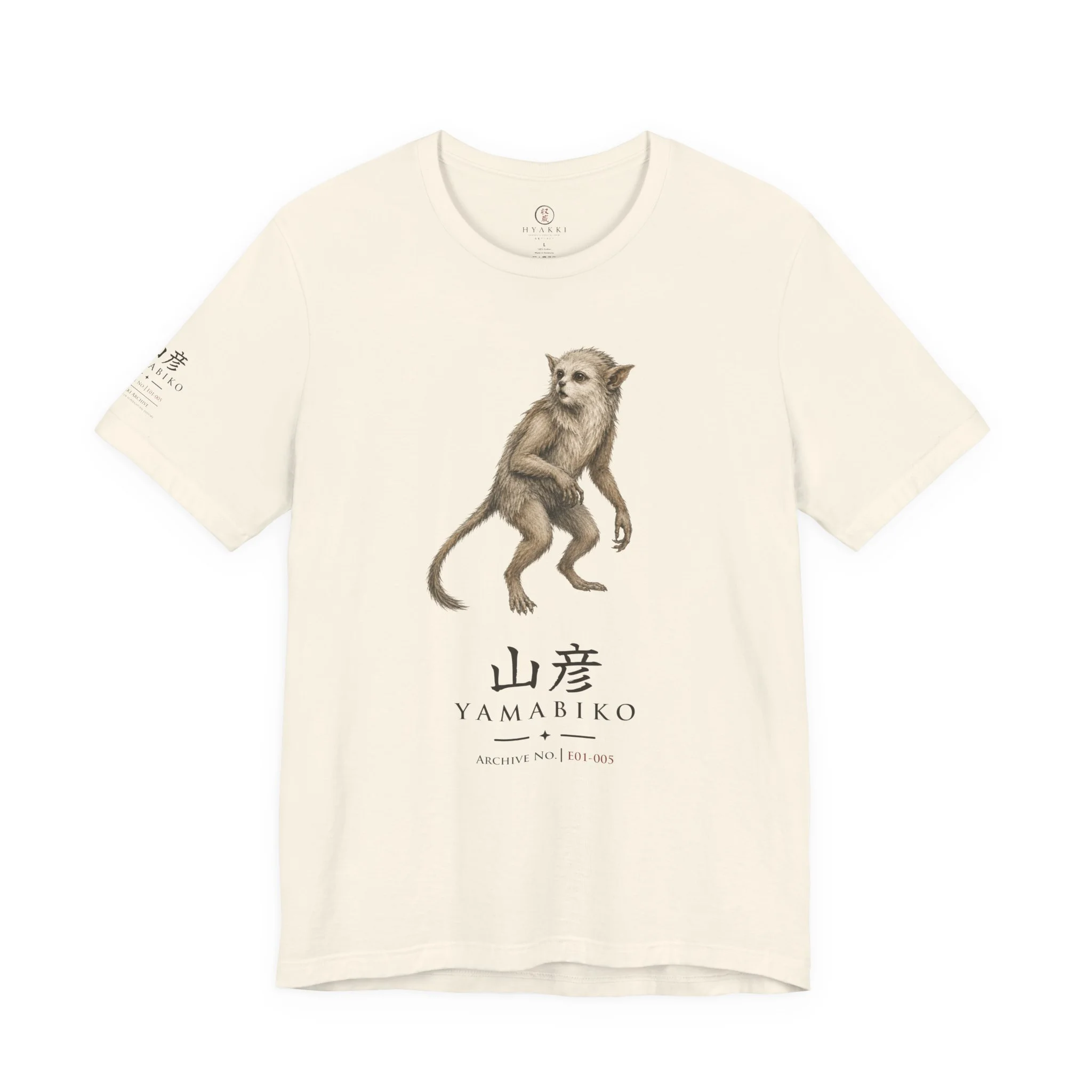
The E01-005 Yamabiko design gives a physical form to something that is usually known through sound.
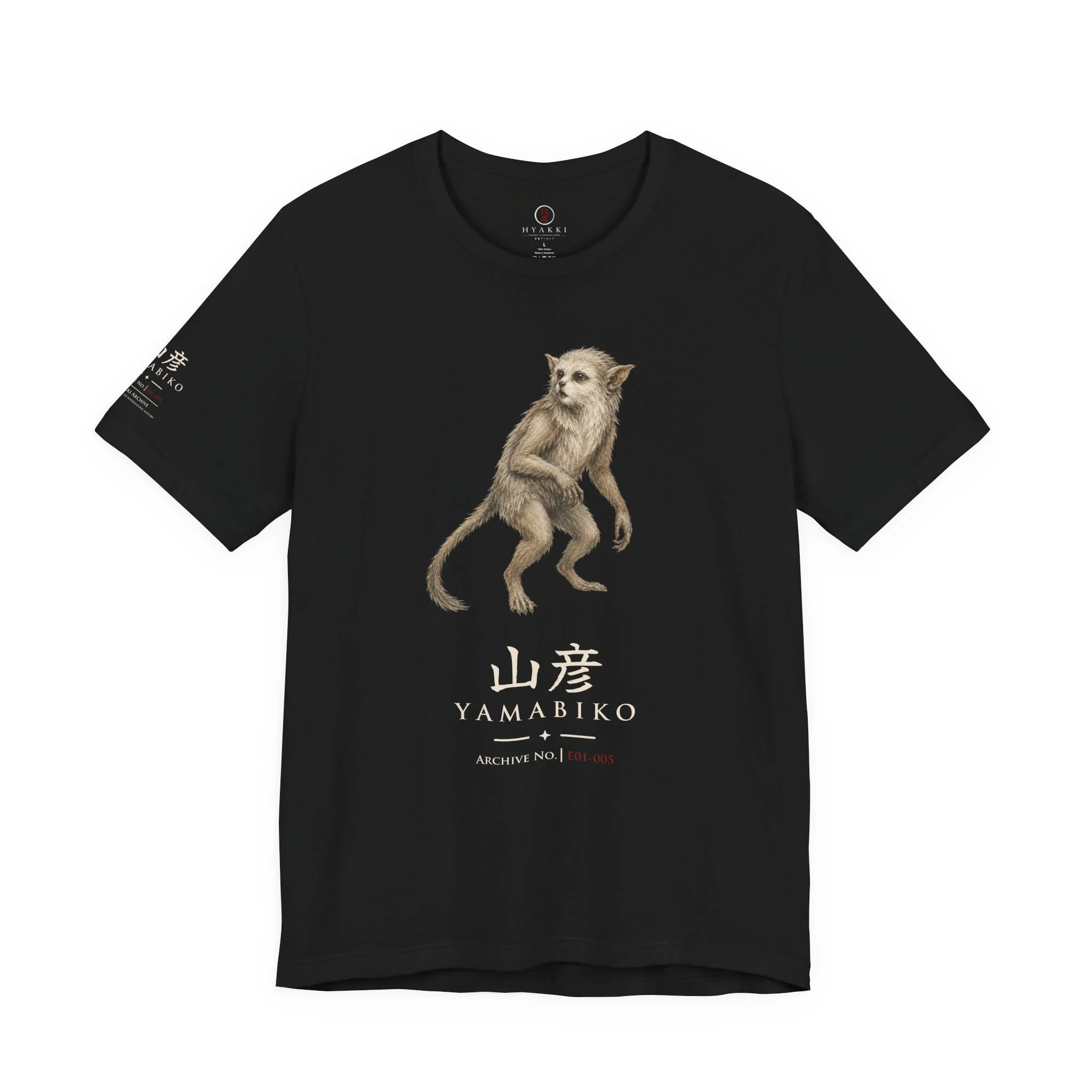
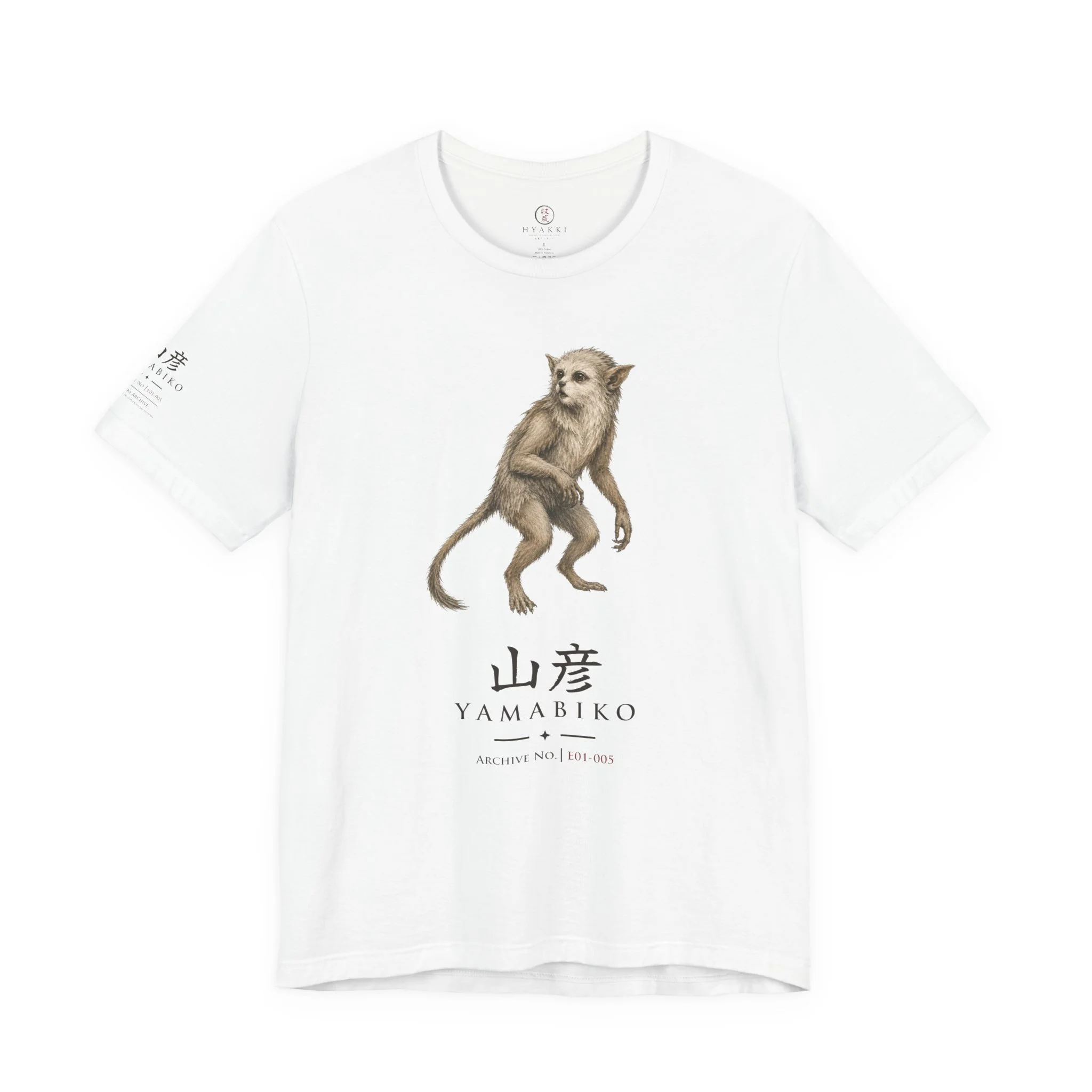
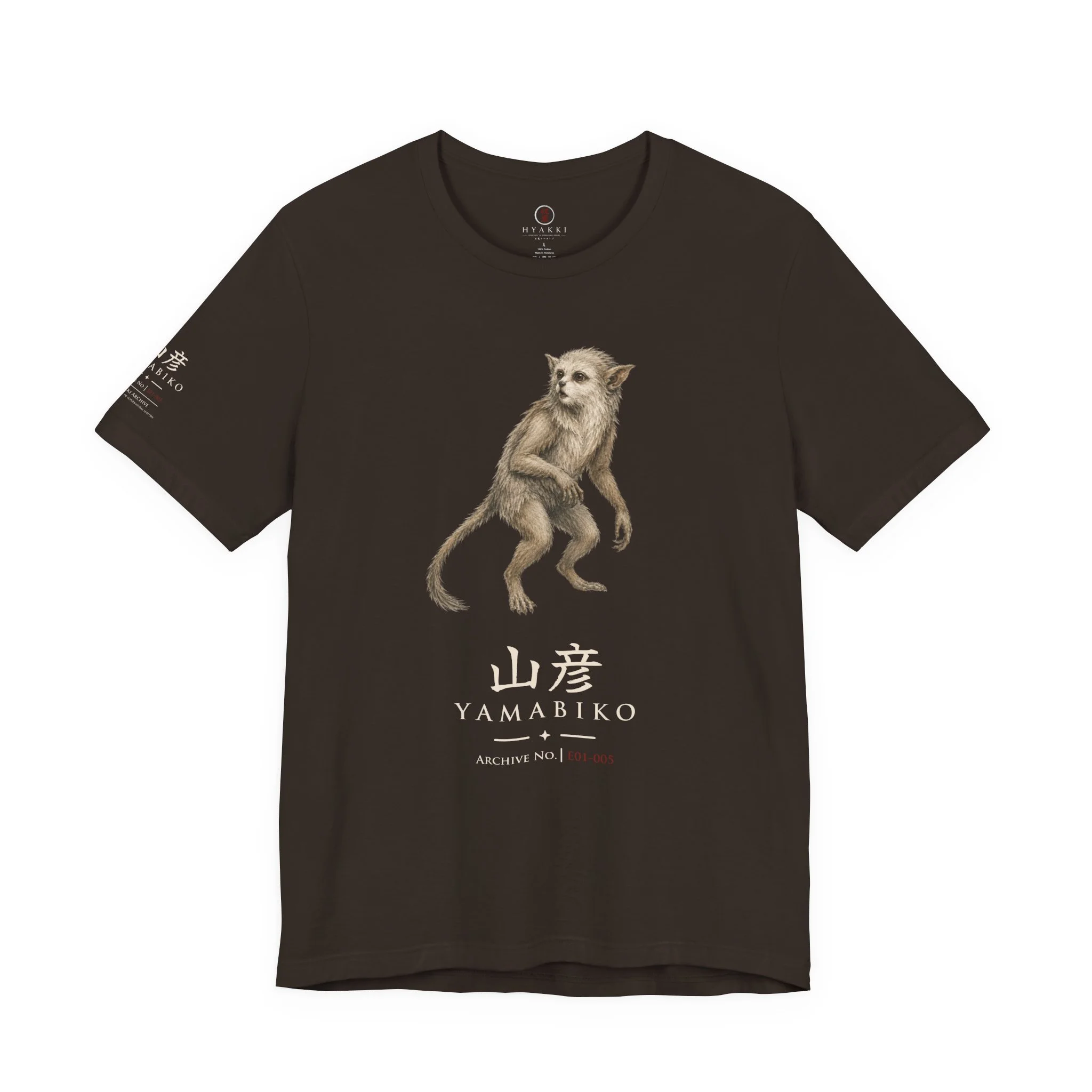
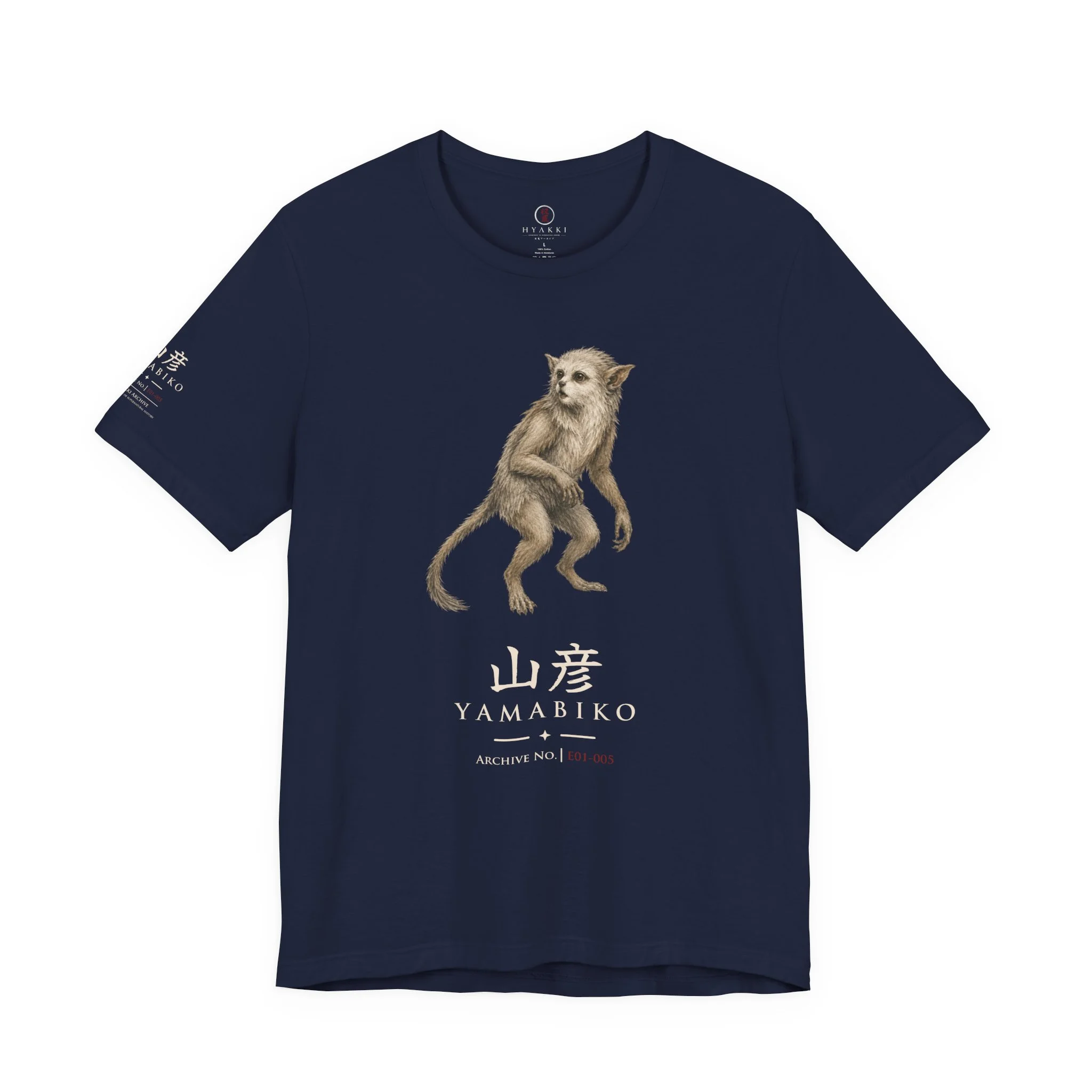
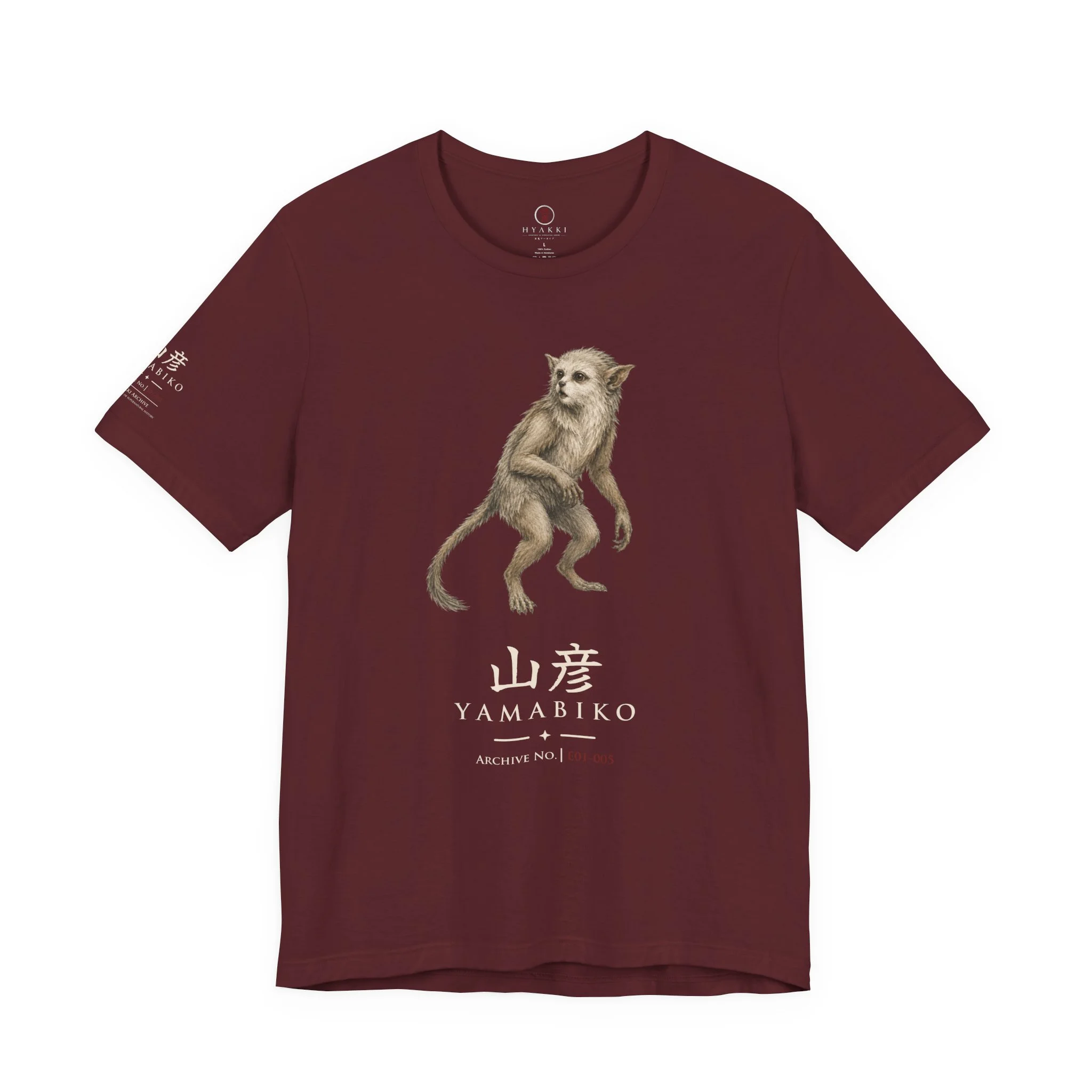
At the center of the composition stands a small, alert mountain creature with pale fur, oversized ears, wide watchful eyes, and a long tail. Its posture feels caught between curiosity and caution, as if it has just been disturbed by a call echoing through the trees. One arm hangs forward, the other draws inward, and the head turns sharply to the side, giving the whole figure a reactive, listening quality.
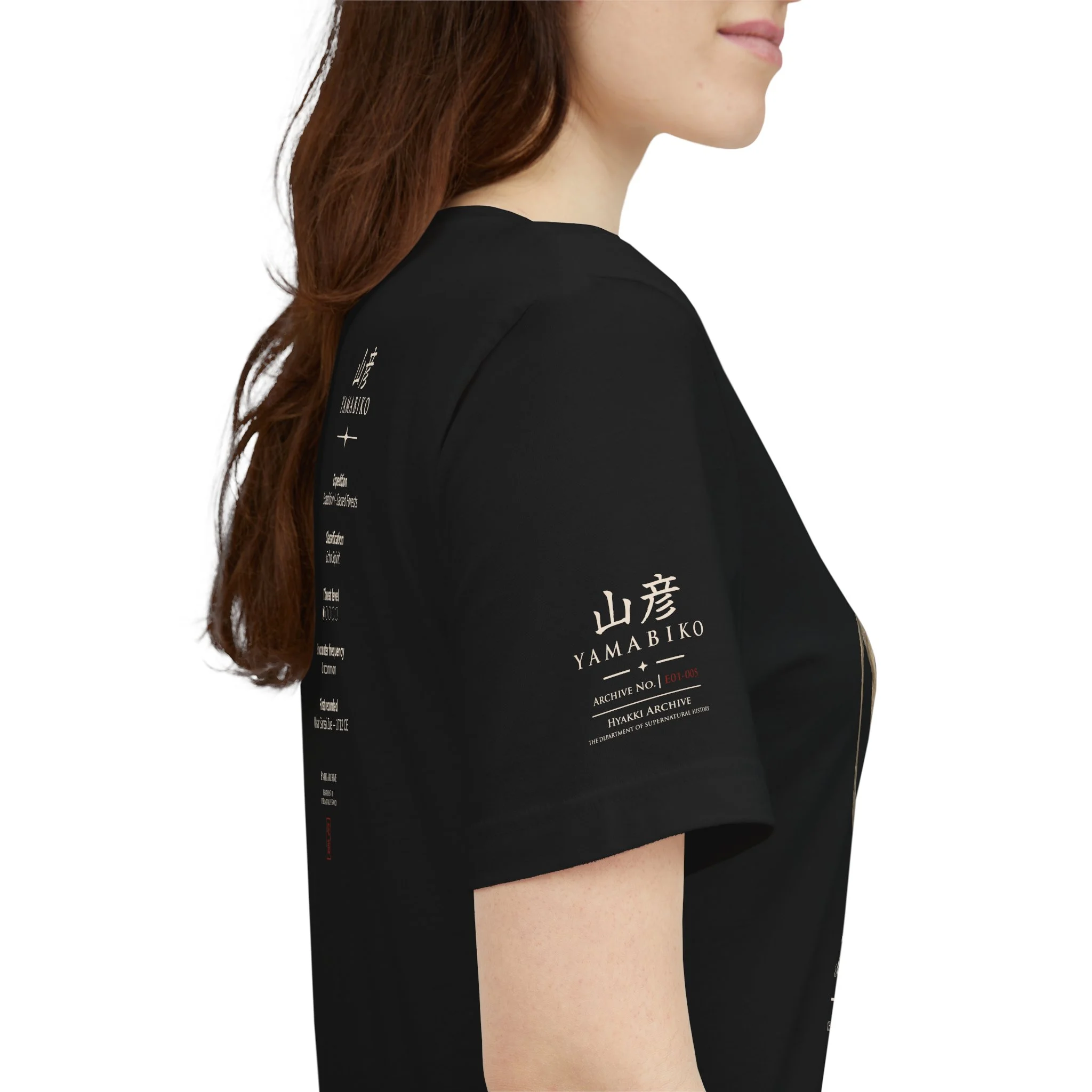
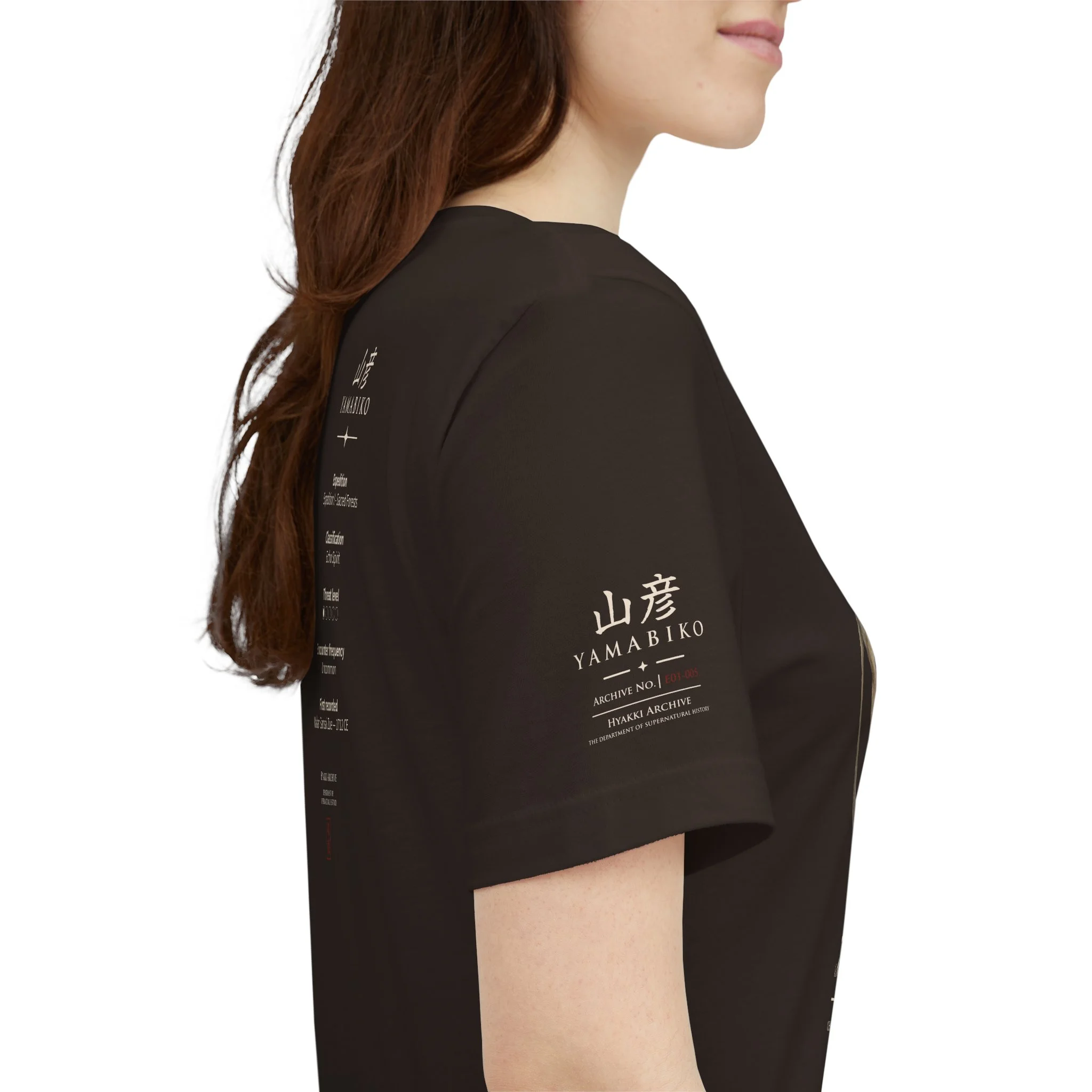
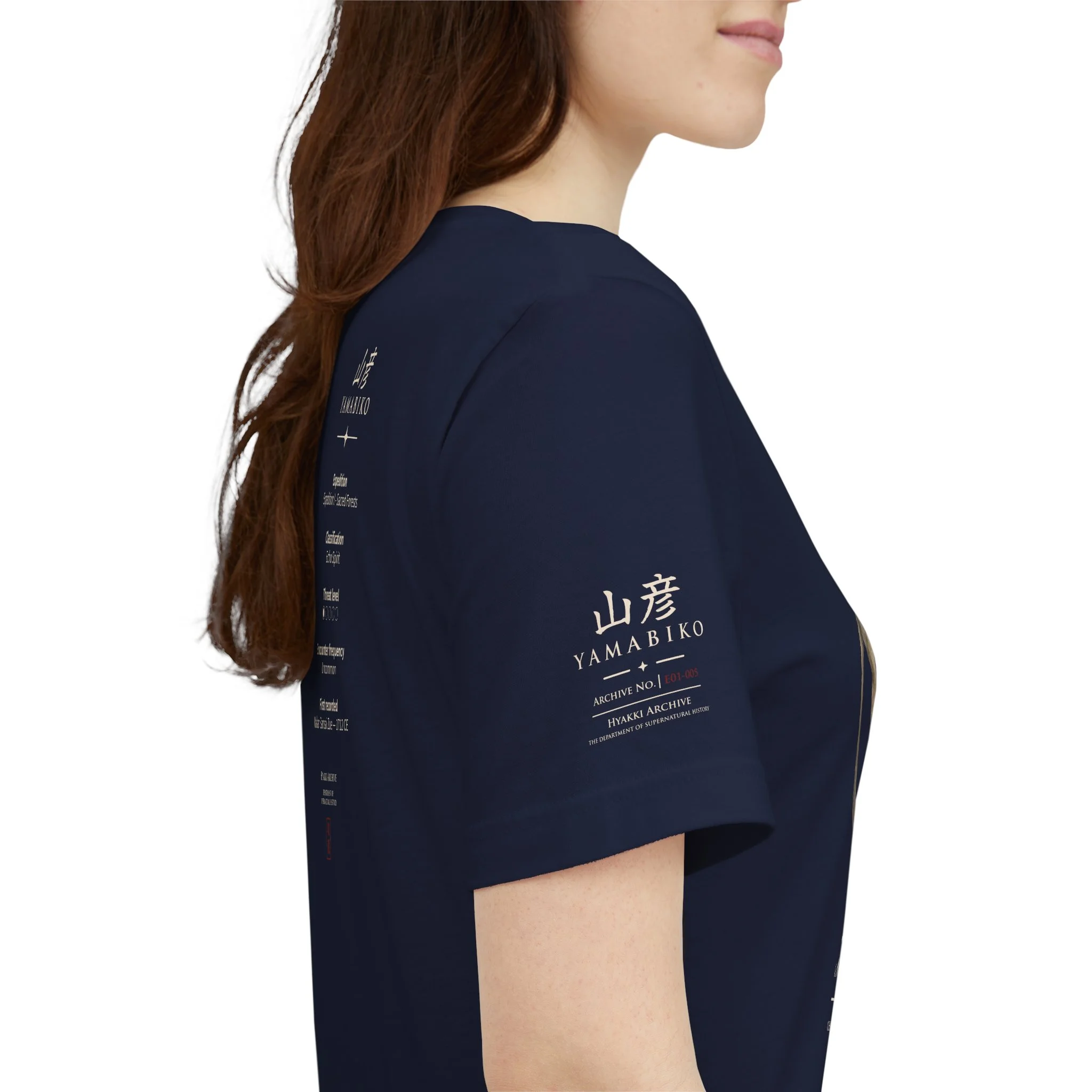
Beneath the illustration, 山彦, YAMABIKO, and Archive No. E01-005 place the design firmly within the Hyakki archive system. The layout remains clean and centered, allowing the unusual figure to carry the entire piece without extra scenery or visual noise.
Like the rest of the Hyakki series, the design works across the full palette of white, dark brown, black, warm cream, deep navy, and muted burgundy, with the darker shirt colors giving the pale figure especially strong presence.
The Entity Behind the Design
Yamabiko is the supernatural presence associated with echoes in the mountains.
In folklore, a voice, shout, or sudden sound might return from somewhere unseen across a valley or wooded slope, and that response could be understood as more than simple acoustics. Instead of hearing only an echo, a person might feel that something in the mountain had answered back.
That makes Yamabiko unusual among supernatural beings. It is not defined first by attack, trickery, or transformation. It is defined by response. A human voice enters the landscape, and the landscape seems to return it with intention.
Later yōkai art, especially from the Edo period onward, gave Yamabiko a visible body. But the older and more important idea remains the same: Yamabiko is the sense that the mountain is listening.
Known For
Yamabiko is best known for echoes.
Its most recognizable trait is the returning sound itself: a cry, a snapped branch, or a spoken word repeated from somewhere beyond sight. In regional tradition, that answering voice could be interpreted as the work of a supernatural mountain being rather than an ordinary acoustic effect.
It is also known for the uncertainty surrounding its form. Unlike entities with a more stable visual identity, Yamabiko often exists more clearly as an event than as a creature. The sound is consistent. The body is not.
In later yōkai tradition, Yamabiko became associated with a small mountain-dwelling being, sometimes animal-like and sometimes more humanoid. That image has remained influential because it gives a face to something that is normally invisible.
More than anything else, Yamabiko is known for turning a familiar natural phenomenon into a moment of unease. The mountain does not just reflect a sound. For an instant, it seems to answer it.
From Folklore to Design
This design chooses to give Yamabiko a fully visible bodily form, but it does so in a way that still feels appropriate to the folklore.
The creature is small, lean, and slightly awkward, with a body that feels halfway between animal and mountain spirit. The large ears and wide eyes are especially important. They make the figure seem built for listening and reacting, which fits Yamabiko far better than a more aggressive or theatrical design would.
Its pose also helps. Rather than standing like a fighter or lurking like a predator, the figure looks as though it has just heard something and turned toward it. That creates a strong link back to the echo tradition. The viewer is not simply looking at a monster. They are looking at a being defined by the act of hearing and answering.
The design avoids overloading the figure with props or mountain scenery. That restraint keeps the focus on the one thing Yamabiko needs most: the sense that it belongs to a sound just heard.
From the Hyakki Archive
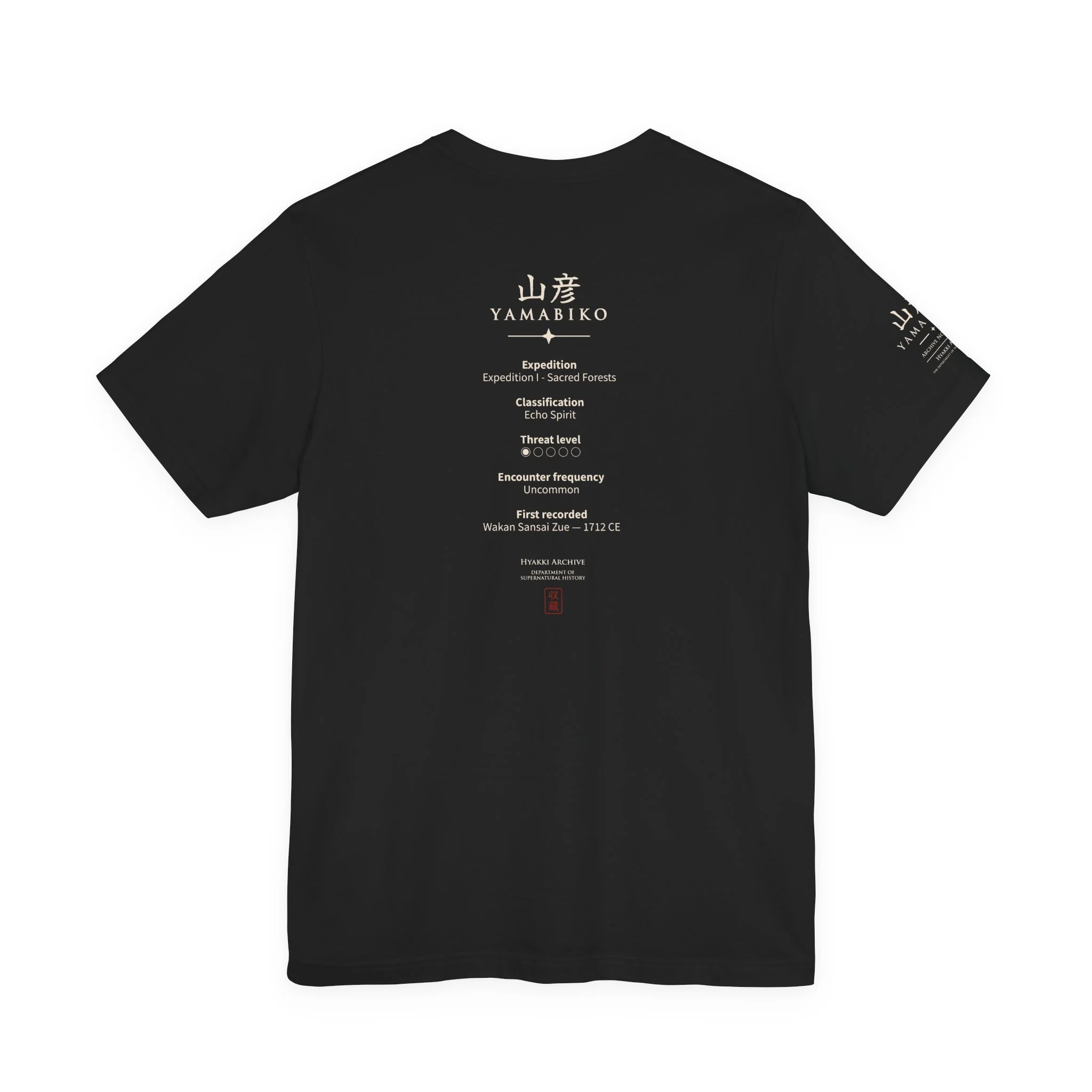
Archive File E01-005 continues Expedition I — Sacred Forests with one of the archive’s most elusive mountain presences.
Where Kodama asks whether a tree may hold a spirit, Yamabiko asks whether the mountain itself may be replying.
No ritual object is required.
No visible threat is necessary.
Only a voice, sent outward, and a voice returning.
This design captures that moment of uncertainty.
Something has heard the call.
Something has answered.
And for a second, the wilderness no longer feels empty.
収蔵
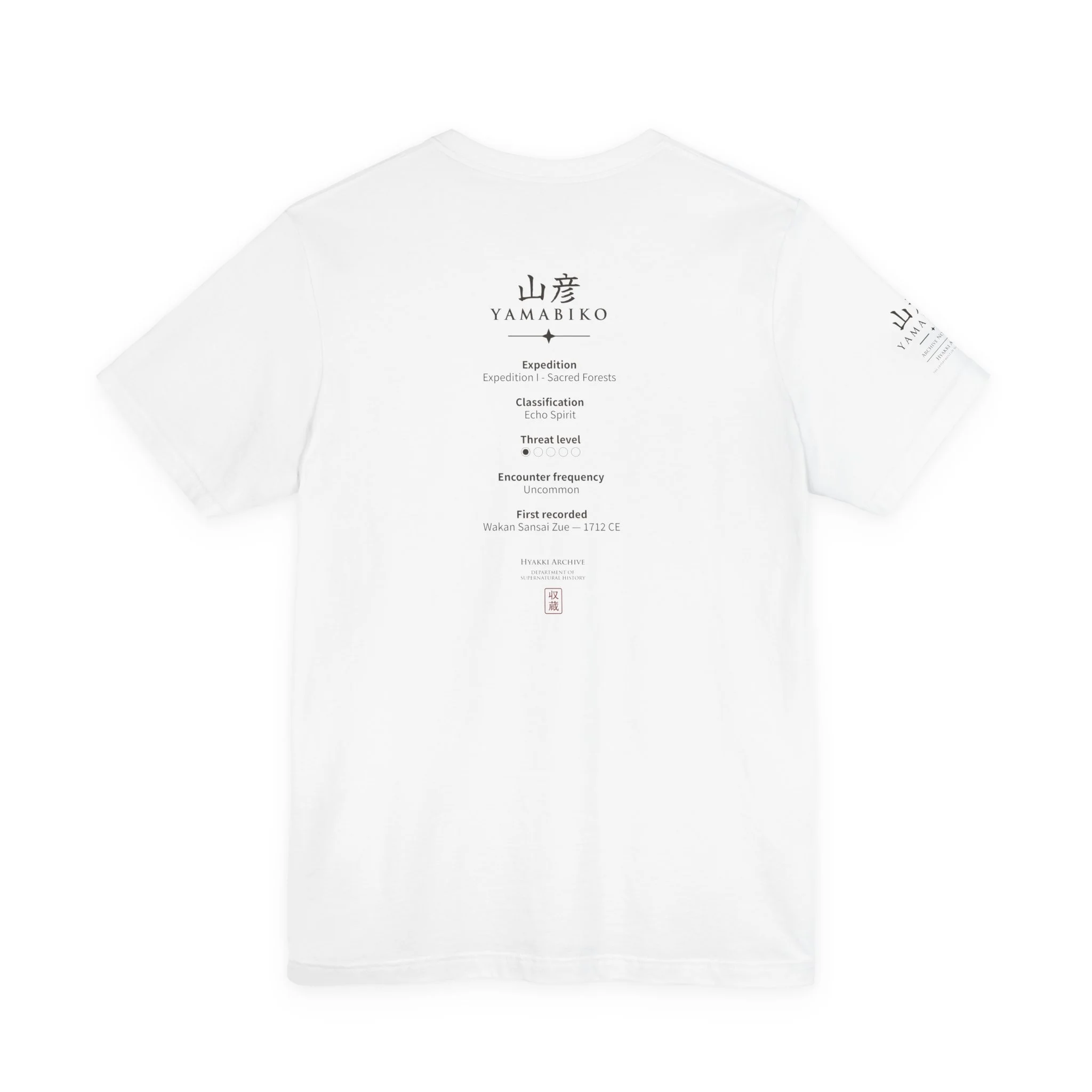
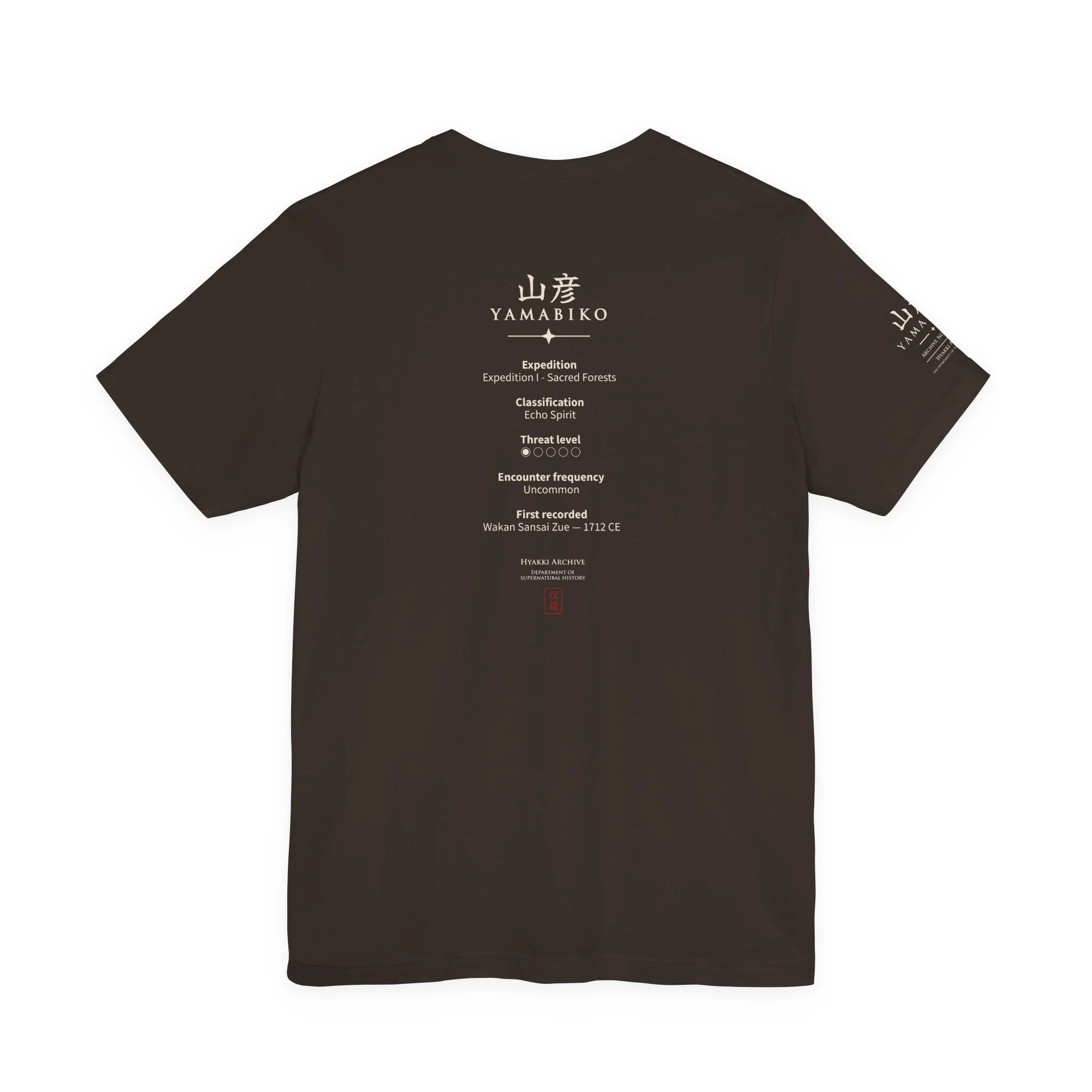
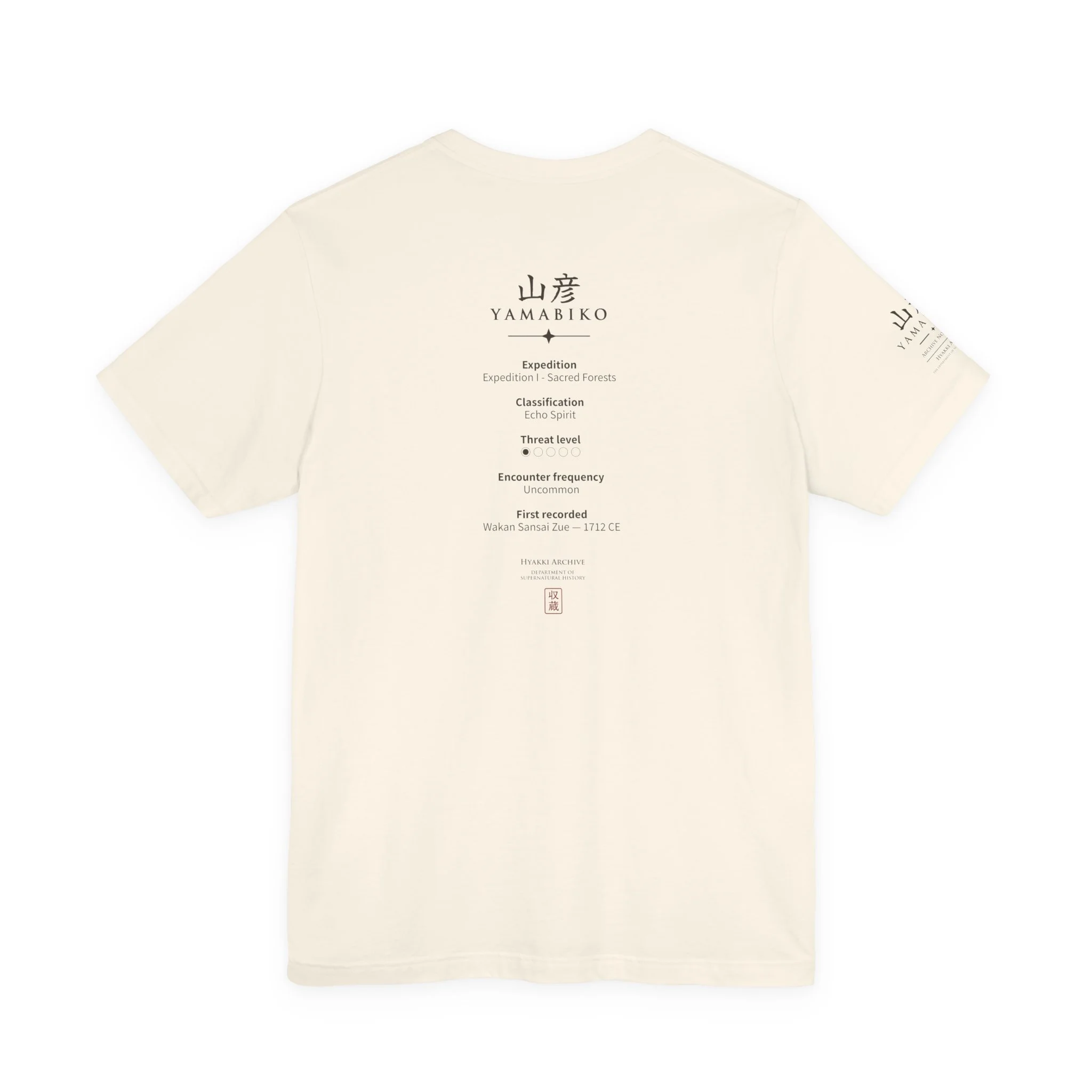
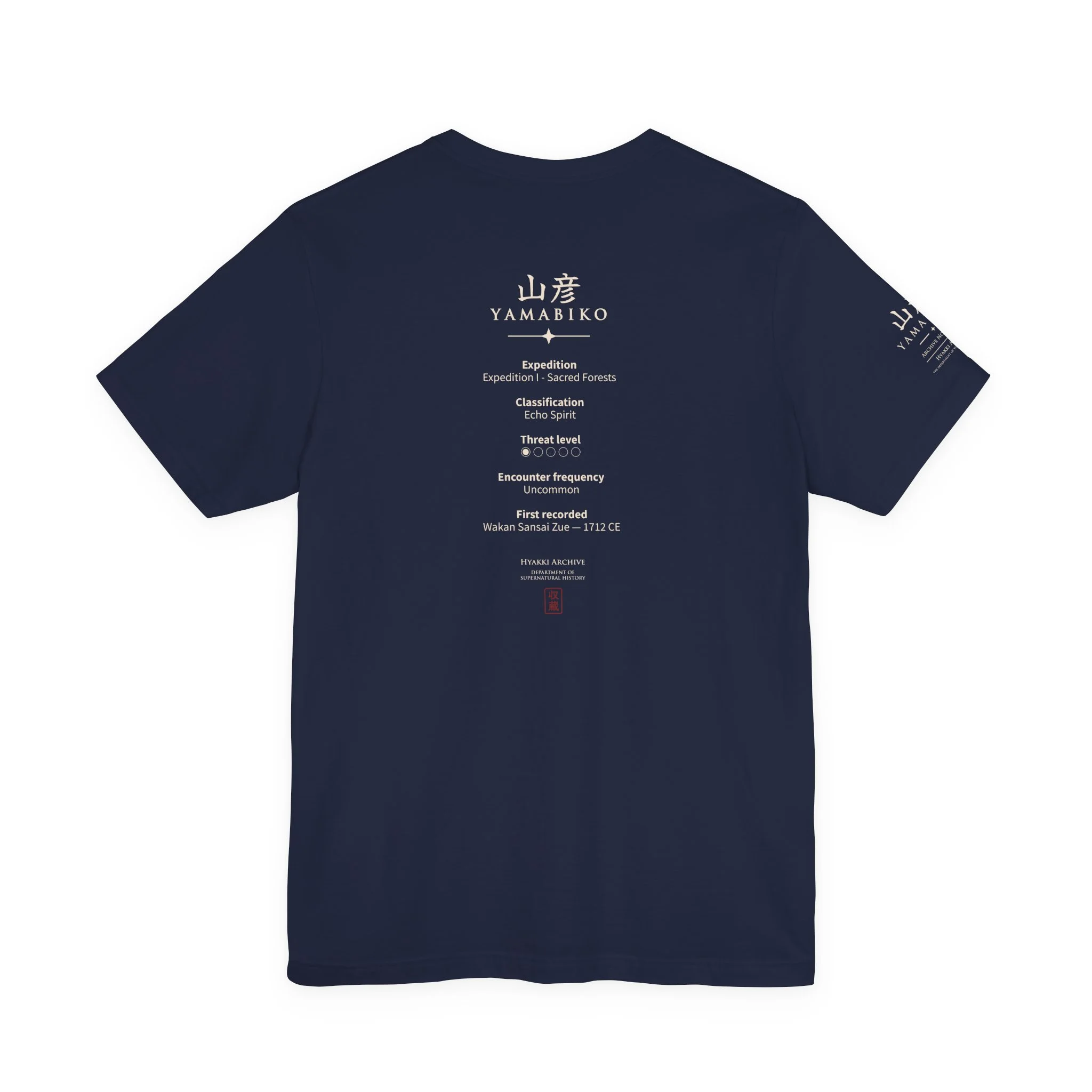
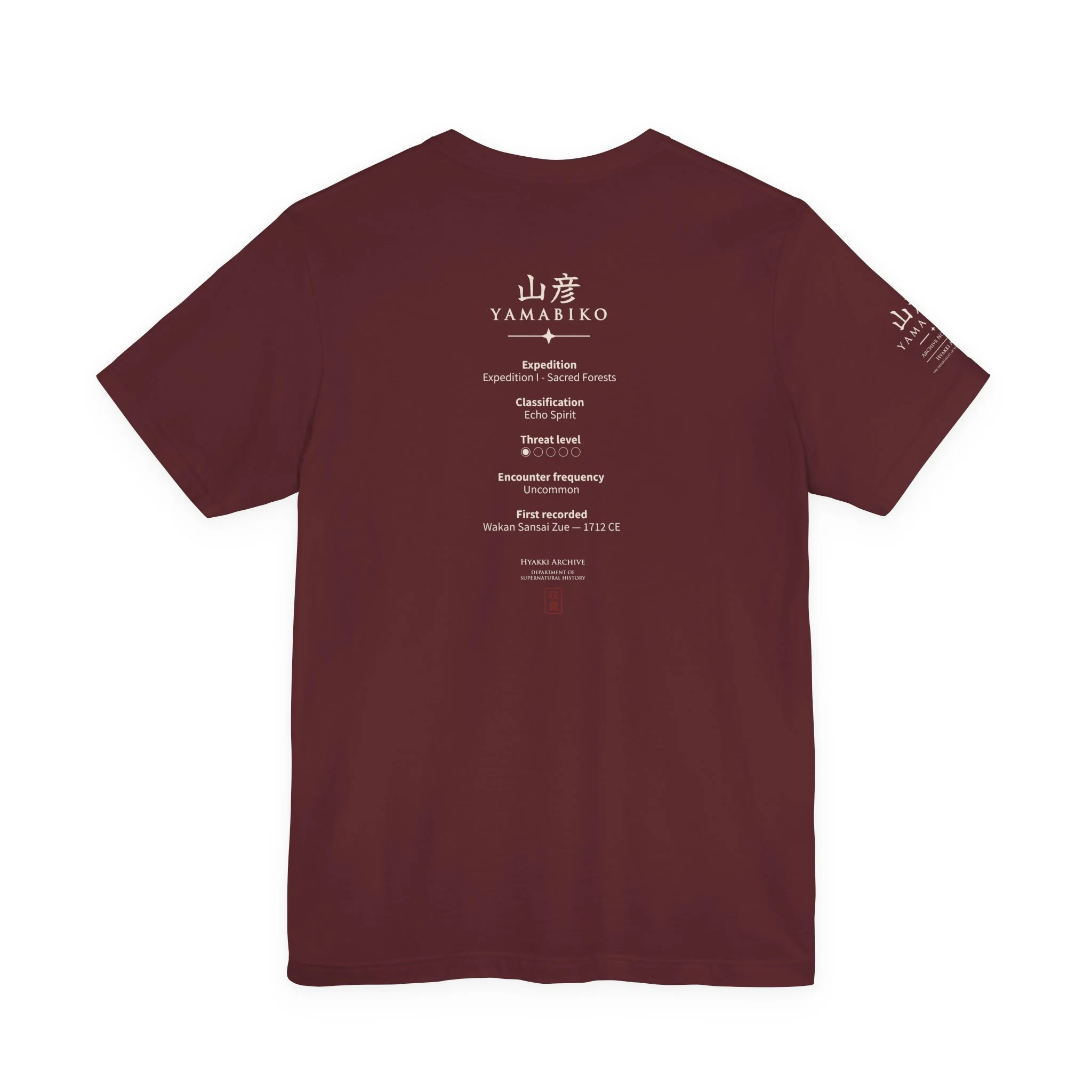
| Temperament |
Elusive • Reactive • Uncertain |
| Activity |
Triggered by Sound |
| Encounter Frequency |
Uncommon |
| Habitat |
Mountains • Deep Valleys • Forested Slopes |
| Known Variants |
Regional Echo-Spirit Traditions |
01 · What Is It?
Yamabiko is a supernatural explanation for the echo heard in mountainous terrain.
A person calls out, breaks a branch, or makes another sharp sound. A moment later, the same sound seems to return from somewhere across the valley or deeper within the forest. In folklore, that response could be understood not merely as acoustics, but as the voice of something inhabiting the mountain.
This makes Yamabiko unusual among supernatural beings because its sound is more important than its body.
Later artists gave the entity a visible form, but the underlying tradition does not require one. Yamabiko can exist almost entirely as an event: a human sound leaves the speaker, disappears into the mountain, and returns as though something unseen has answered.
02 · Historical Record
One of the clearest visual records of Yamabiko appears in Toriyama Sekien’s Gazu Hyakki Yagyō, first published in 1776. The National Diet Library identifies Sekien’s entry as 幽谷響(やまびこ), literally invoking the idea of a resonance or echo from a deep valley.
Sekien’s illustration helped give Yamabiko a recognizable body within Edo-period supernatural art. However, the phenomenon itself was not limited to illustrated yōkai collections.
A later folkloric record from Shimane Prefecture, published in 1914, describes Yamabiko as the voice of a supernatural being serving a mountain deity. In the account, a hunter breaks a branch and hears the same sound from the opposite woods. When he cries out, the voice repeats him again.
This later record is useful because it preserves Yamabiko primarily as an auditory encounter, rather than as a creature seen directly.
03 · Appearance
There is no secure universal appearance for Yamabiko.
Sekien’s eighteenth-century illustration gave the phenomenon a small animal-like or humanoid mountain form, and this image became influential in later yōkai culture. The National Diet Library includes Yamabiko among the supernatural beings illustrated by Sekien in his 1776 collection.
But an illustrated body should not be mistaken for evidence of a fixed folkloric species.
Regional accounts often describe only a returning voice or repeated sound. No body needs to appear at all.
For Hyakki, Yamabiko is therefore best treated as an entity whose manifestation is acoustic first and visual second. Any physical reconstruction should be understood as an interpretation of the presence behind the echo, not as definitive anatomy.
04 · Behaviour & Encounters
Yamabiko typically responds rather than initiates.
A person produces a sound in the mountains, and something answers with the same sound. This may involve shouting, conversation, cracking wood, or other noises that carry across valleys.
The 1914 Shimane account is especially revealing. A hunter breaks a dead branch and hears an answering crack from the opposite forest. When he shouts in surprise, the unseen being repeats that sound as well. Even his later spoken words are imitated.
The encounter contains no attack and no visible monster.
Its unease comes from imitation.
A completely ordinary sound suddenly seems intentional because it has been returned.
That makes Yamabiko less a predator than a challenge to perception: is the mountain merely reflecting sound, or is something within it listening?
05 · Belief, Ritual & Meaning
Yamabiko belongs to a broader way of interpreting mountains as inhabited and responsive landscapes.
In the Shimane tradition recorded in 1914, the returning voice is associated with a supernatural being connected to a mountain deity, showing that the echo could be incorporated into local religious and supernatural understandings of the landscape.
The significance of Yamabiko does not depend on an elaborate ritual system.
Its power lies instead in interpretation.
Mountains naturally distort distance and direction. A sound may return from a place the speaker cannot see. Before a purely acoustic explanation dominates the experience, that returning voice can feel remarkably personal.
Yamabiko gives that sensation an identity.
The mountain does not simply contain a spirit.
For a moment, it behaves as though it has heard you.
06 · Regional & Historical Variations
Yamabiko is not represented identically across every source.
Sekien gives it a visible illustrated form, helping transform an invisible phenomenon into a catalogued supernatural being.
Regional folklore can be much less concrete. The Shimane account describes Yamabiko as a voice associated with a supernatural mountain being, without requiring a visible creature at all.
Other Japanese mountain traditions also contain beings that imitate human activity, voices, or sounds, so not every unexplained noise in the mountains should automatically be classified as Yamabiko.
The most stable feature is therefore not anatomy or personality.
It is the phenomenon itself:
A sound enters the mountain and comes back.
Everything beyond that depends on how a particular period, storyteller, or community explains who answered.
07 · What We Actually Know
| Yamabiko is historically associated with mountain echoes |
DOCUMENTED |
| Toriyama Sekien illustrated Yamabiko in 1776 |
DOCUMENTED |
| Regional folklore records Yamabiko as an unseen answering voice |
DOCUMENTED |
| At least one recorded tradition links the voice with a mountain deity |
TRADITION |
| Yamabiko has one universal physical form |
UNSUPPORTED |
| Every mountain echo was historically believed to be Yamabiko |
INCORRECT |
| Sekien’s illustrated body should be treated as literal supernatural anatomy |
UNSUPPORTED |
| The returning sound is more historically stable than the entity’s visual form |
INTERPRETATION |







Reviews
There are no reviews yet.