The Design
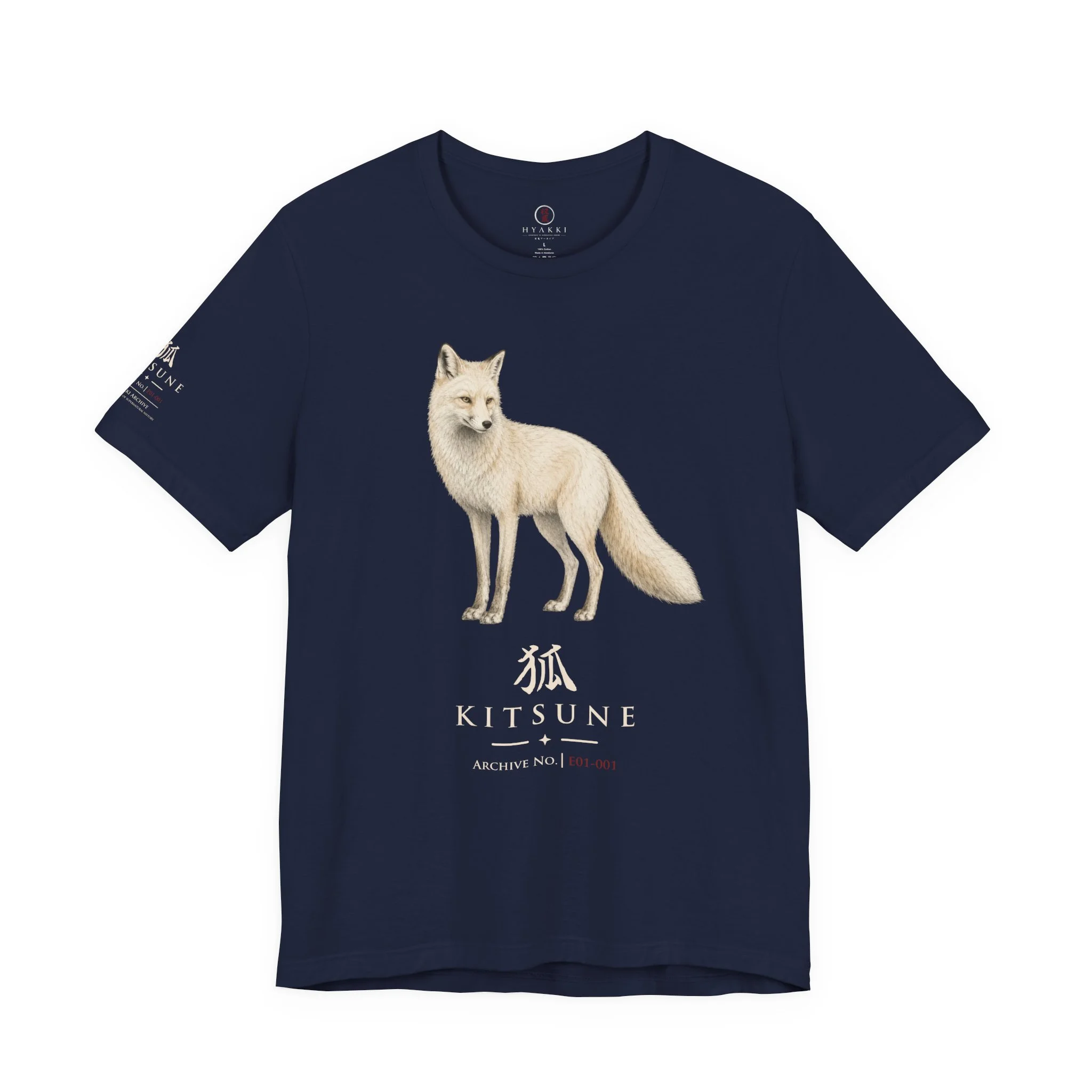
The E01-001 Kitsune design is built around restraint.
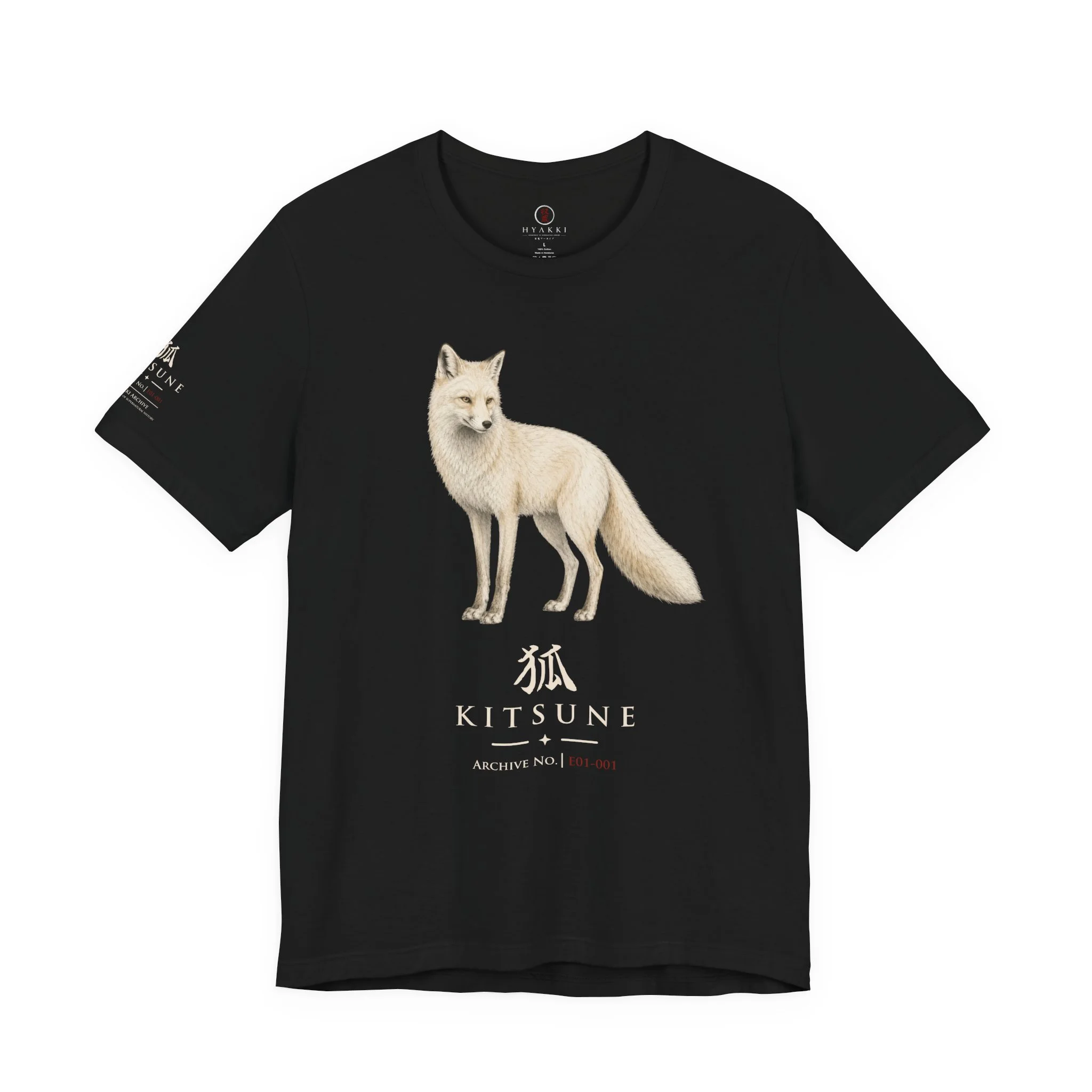
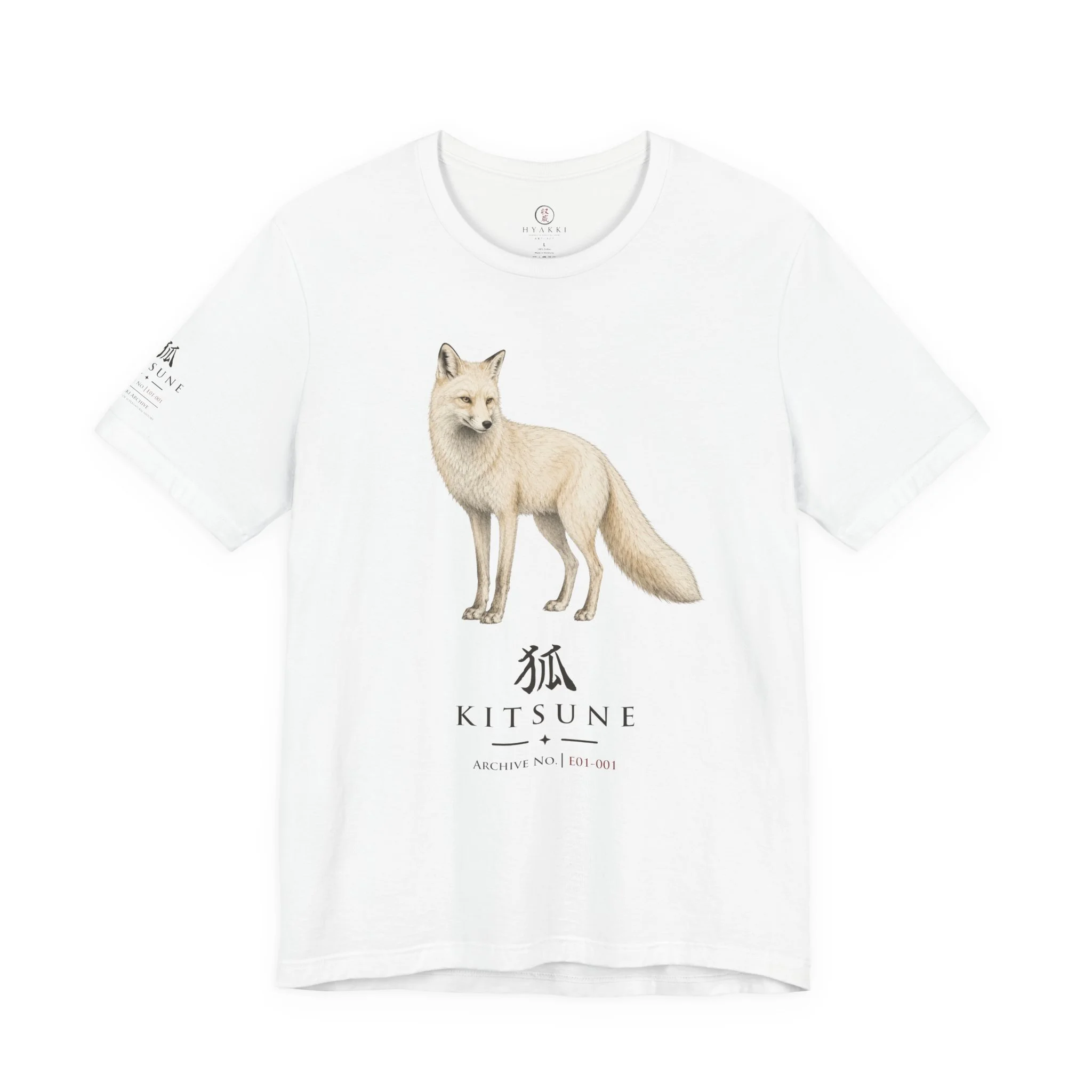
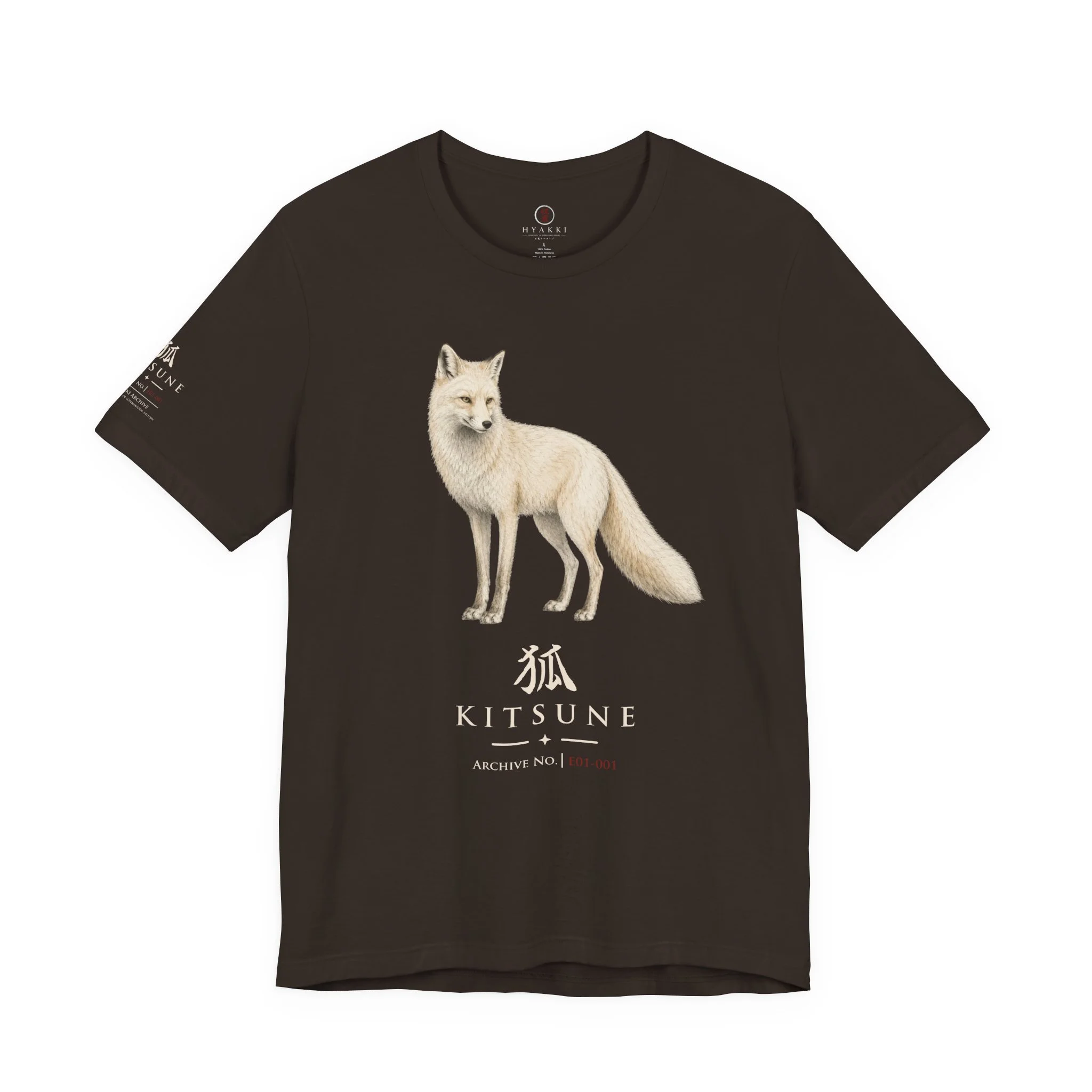
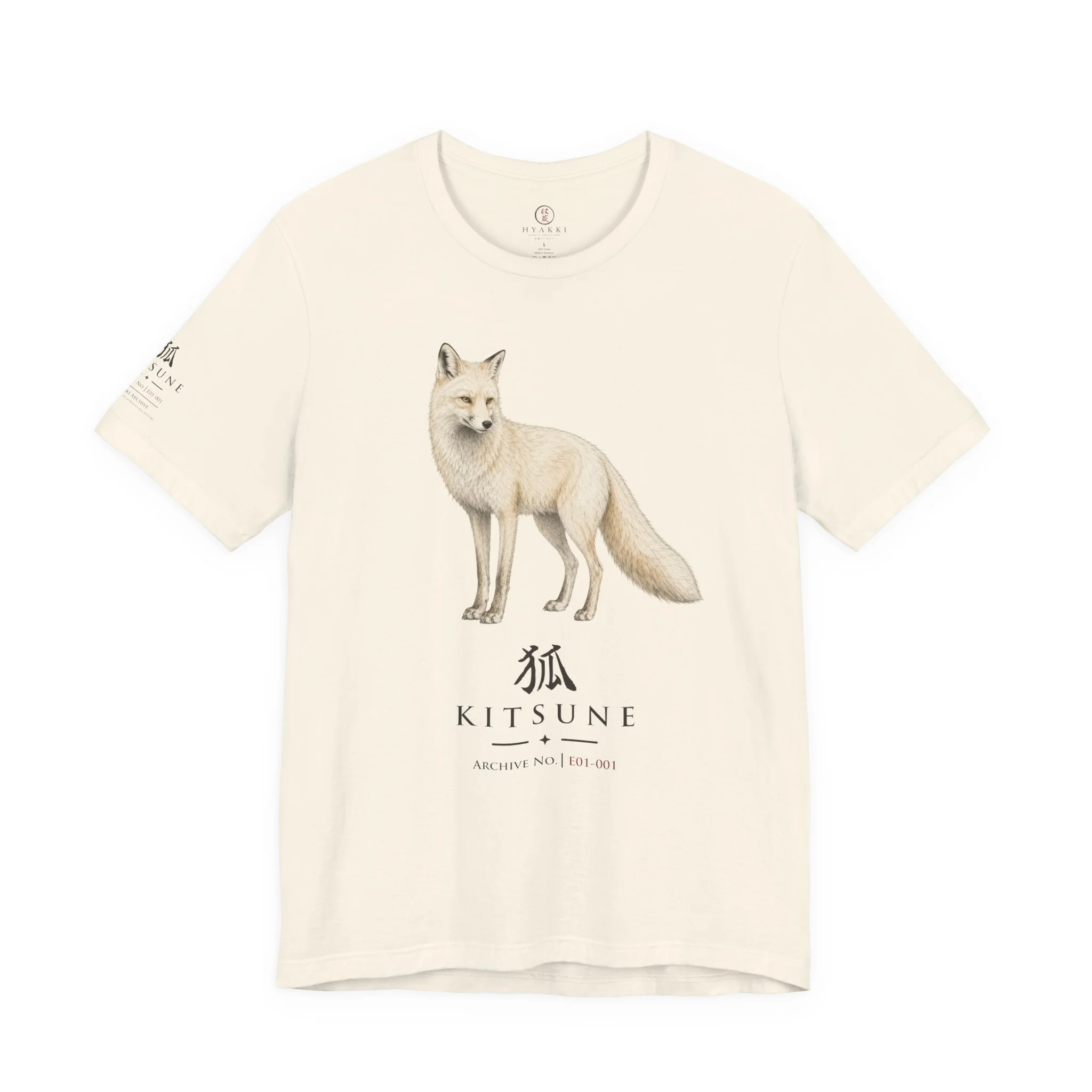
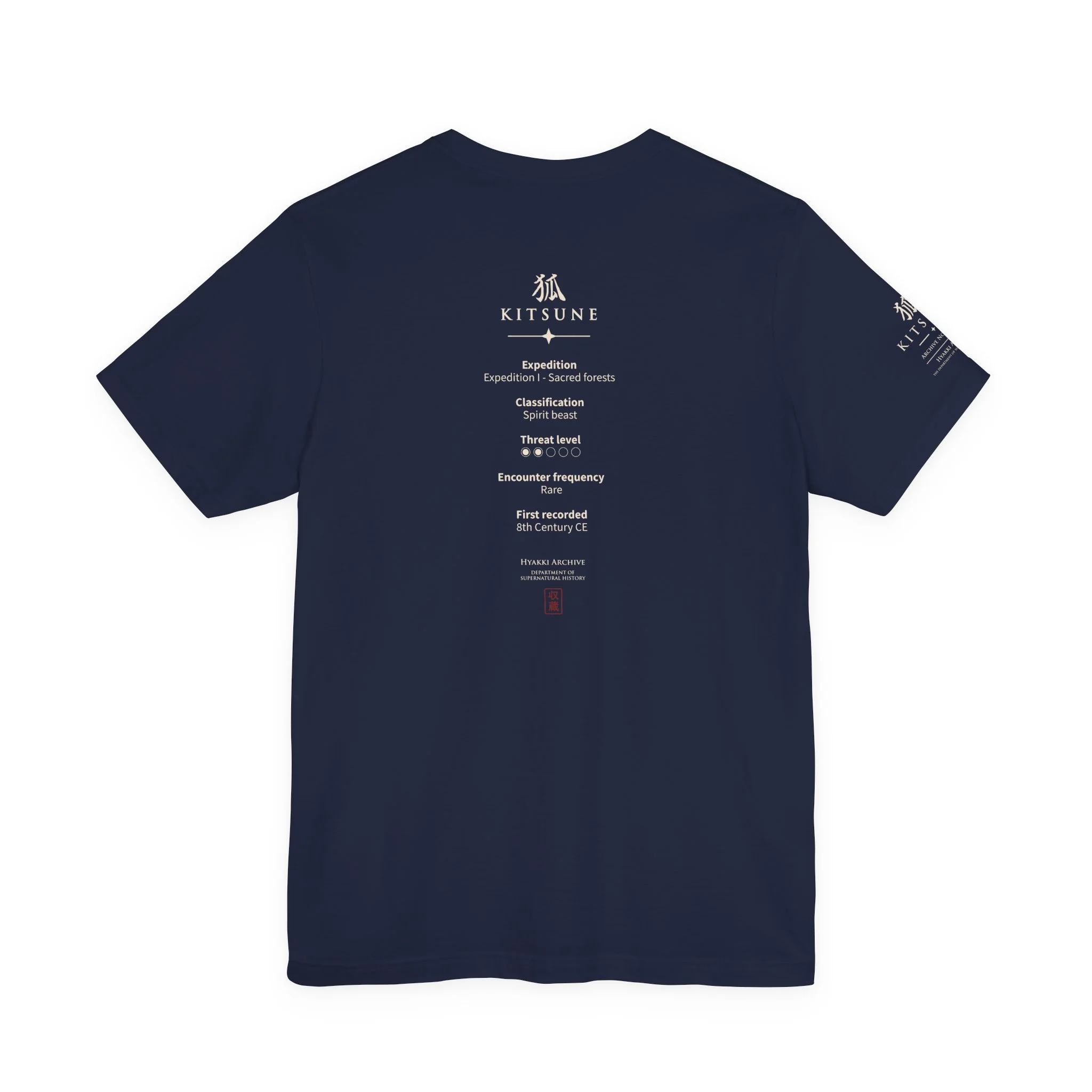
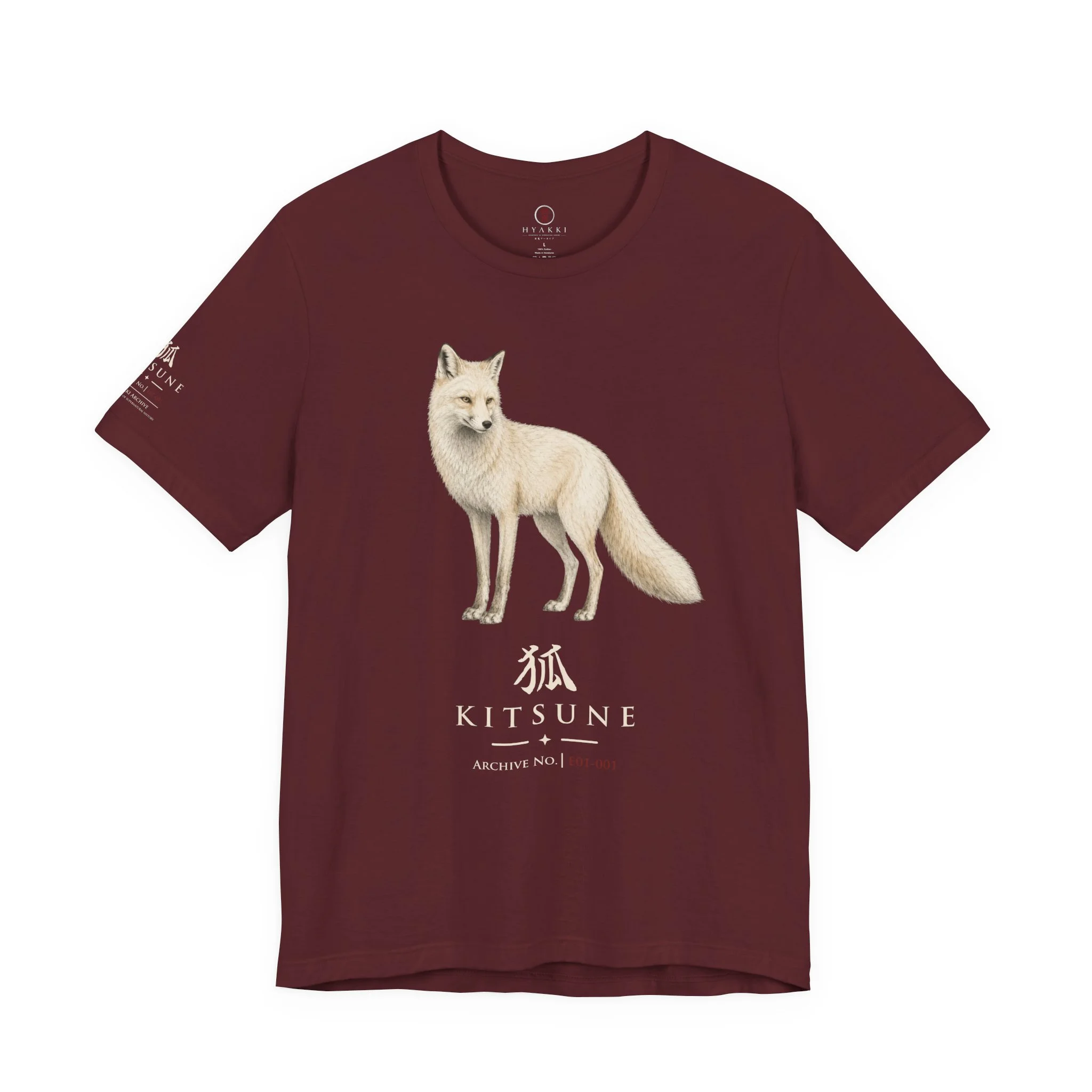
At the centre sits a pale, naturalistic fox shown in full profile, rendered with the feel of a museum or field-guide specimen rather than a fantasy character. Beneath it, the large 狐 and the word KITSUNE give the piece a strong archival identity, while Archive No. E01-001 anchors it directly to the Hyakki collection.
The composition is intentionally clean. There are no torii gates, masks, flames or multiple tails competing with the subject. That lets the fox itself do the work.
The result is quiet, balanced and slightly uncanny: at first glance, an animal study. On a second look, the fox’s pale coat and watchful expression suggest that the creature may not be quite as ordinary as it appears.
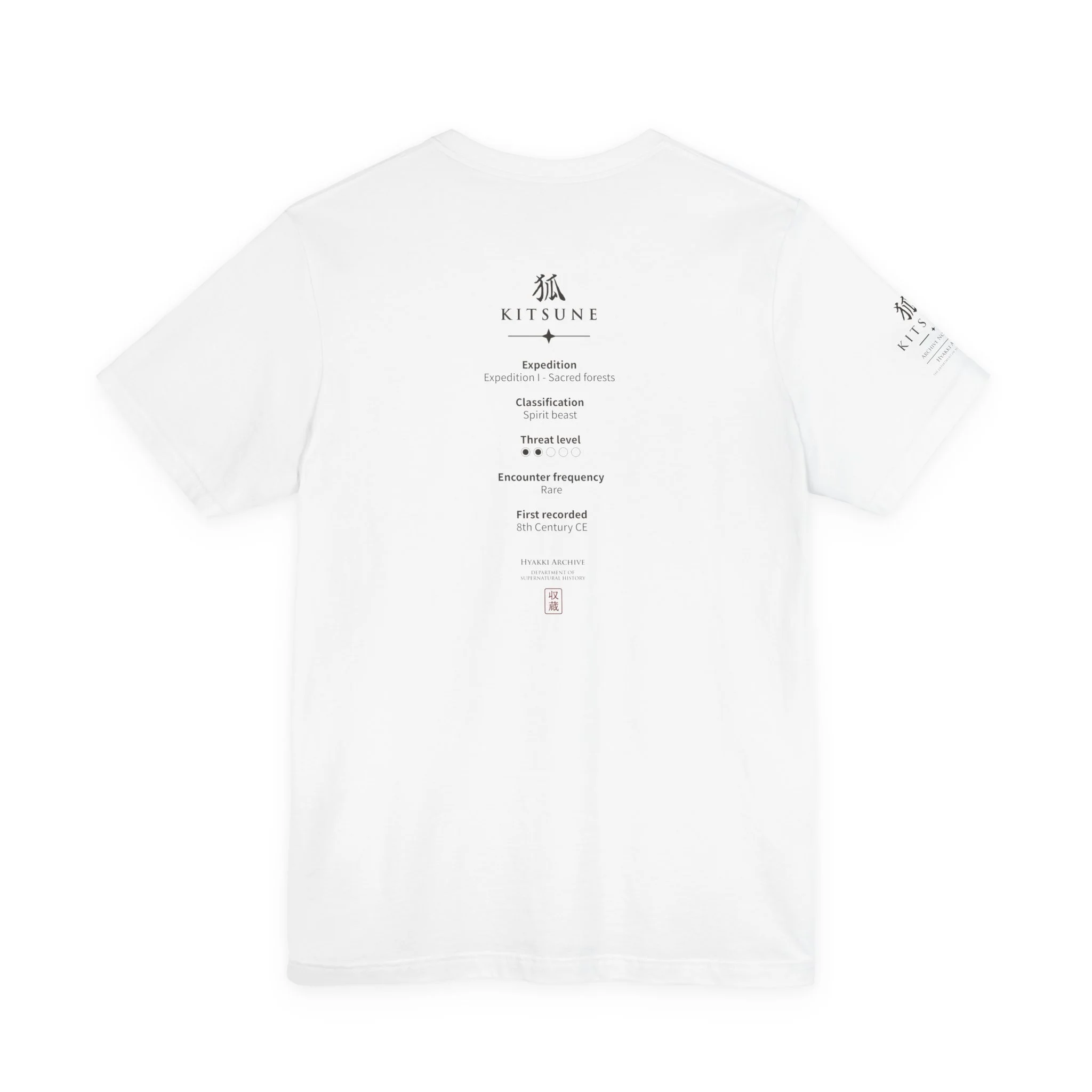
The design is available across a restrained palette of white, dark brown, black, warm cream, deep navy and muted burgundy, each giving the illustration a slightly different archival character.
The Entity Behind the Design
Kitsune is the Japanese word for fox, but Japanese folklore gives foxes an unusually broad supernatural identity.
Across centuries of stories, Kitsune may appear as shapeshifters, tricksters, spouses, lovers, possessors or supernatural messengers. Some mislead people, while others form lasting relationships with humans. One of the best-known historical motifs is the fox-wife, in which a fox takes human form, marries and becomes part of a human household before her true identity is discovered.
Kitsune is therefore less a single monster than a large family of fox traditions built around transformation and uncertainty.
That is what this design leans into. It does not show the fox in the middle of a magical transformation. It shows the moment before certainty, when the viewer still has to decide whether they are looking at an ordinary animal or something that has simply chosen not to reveal itself yet.
Known For
Kitsune is best known for shapeshifting, especially the ability to assume convincing human form. Historical stories frequently describe foxes becoming women, although male transformations also appear. In some tales, the disguise is used for deception. In others, the fox develops genuine affection for a human partner or family.
Foxes are also strongly associated with Inari worship. One common misconception is that Inari is itself a fox. Traditionally, foxes are better understood as messengers or beings closely associated with Inari, with white fox imagery becoming especially prominent around Inari shrines.
Other fox traditions involve possession, misleading travellers and supernatural trickery. Their behaviour varies so much that simple labels such as “good fox” or “evil fox” rarely hold up very well.
And despite how common it is in modern imagery, multiple tails are not required. The famous nine-tailed fox belongs to a particular branch of a much wider East Asian supernatural fox tradition.
From Folklore to Design
The most important decision in this design was to keep the fox recognizably a fox.
It has one tail, realistic proportions and no overt supernatural effects. The pale cream-white coat gives it an unusual presence and quietly echoes the historical importance of white fox imagery, especially around Inari traditions, without turning the design into shrine iconography.
Its pose is also deliberately composed rather than aggressive. The body stands still while the head turns slightly, giving the fox an alert, assessing quality. It feels less like something performing magic and more like something that has already noticed the viewer.
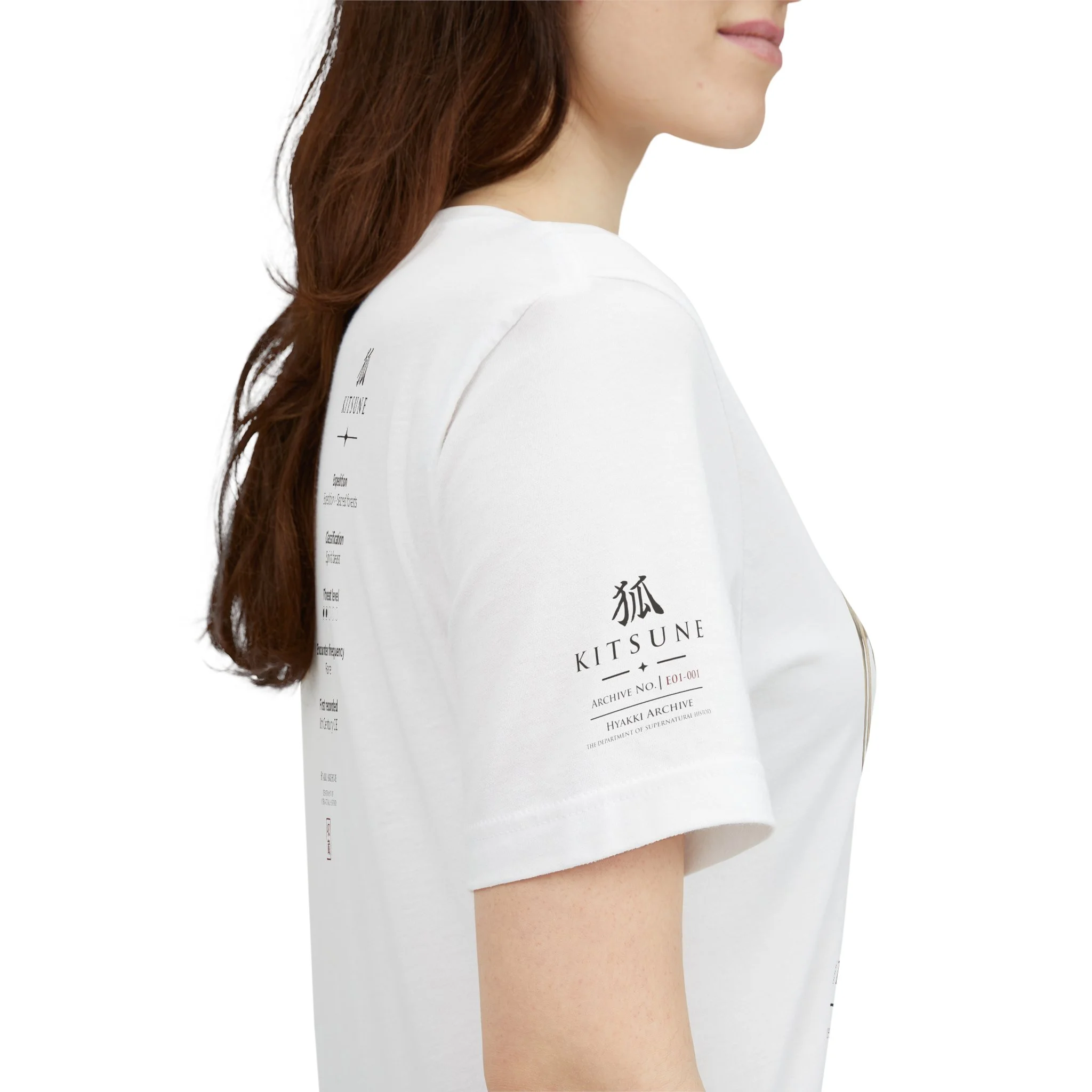
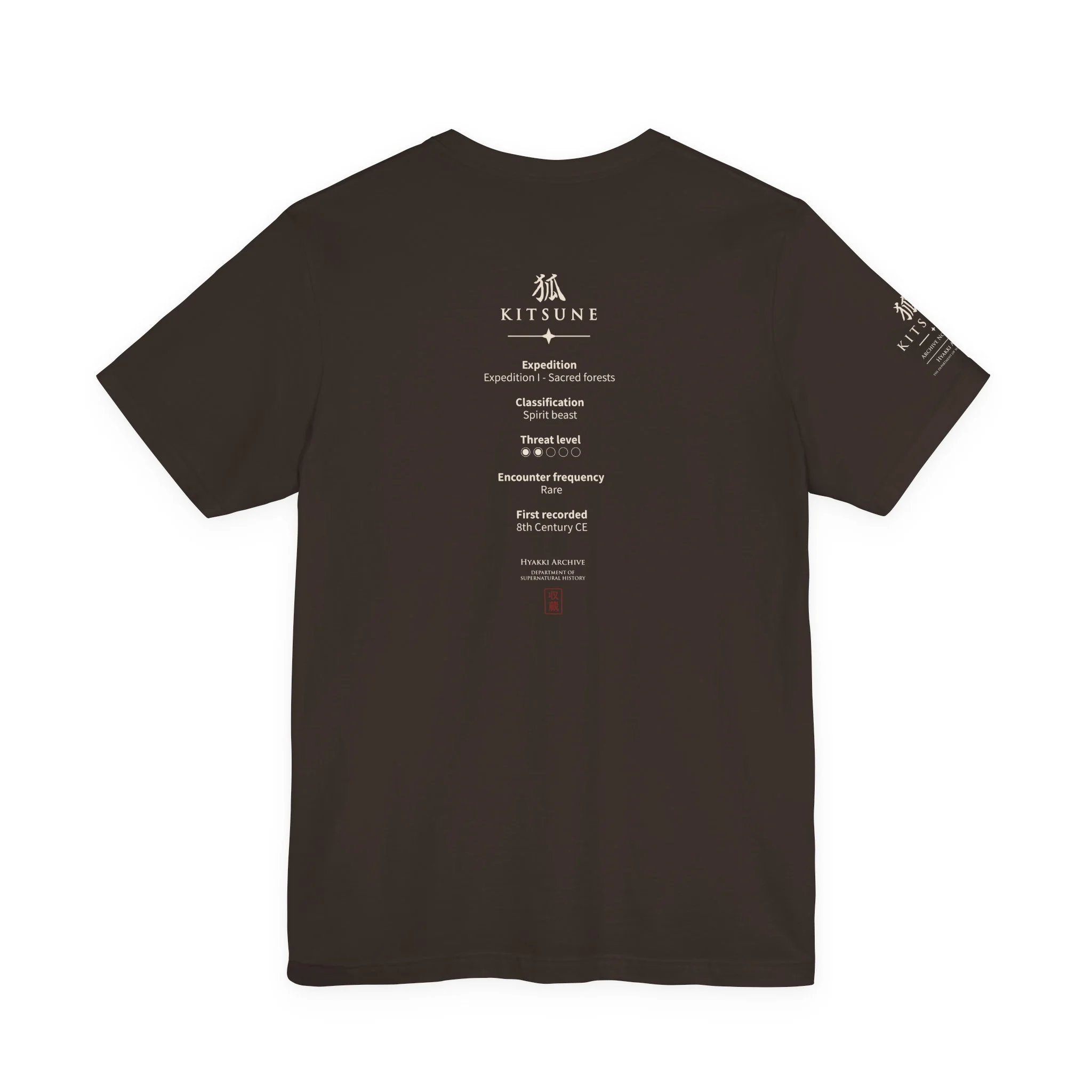
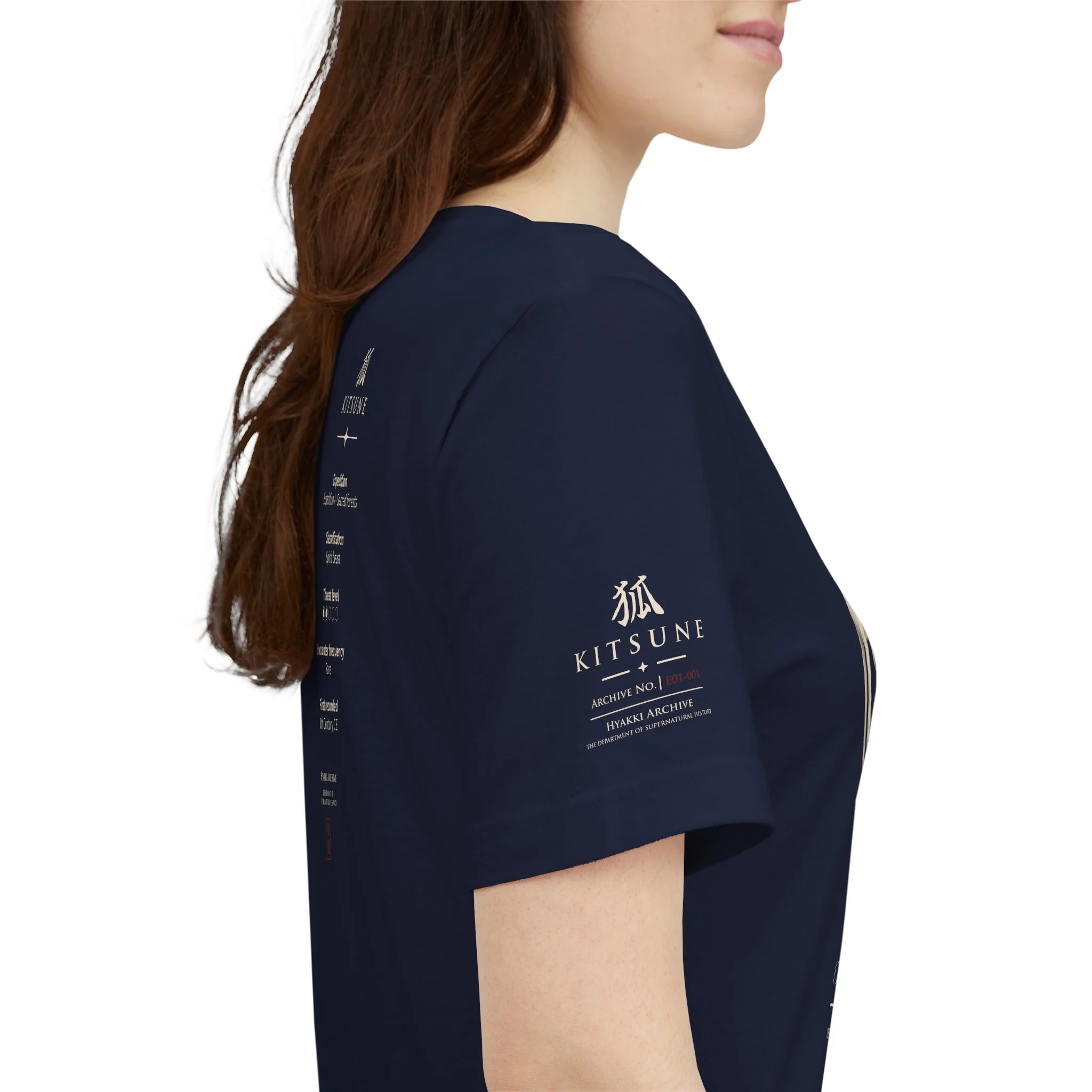
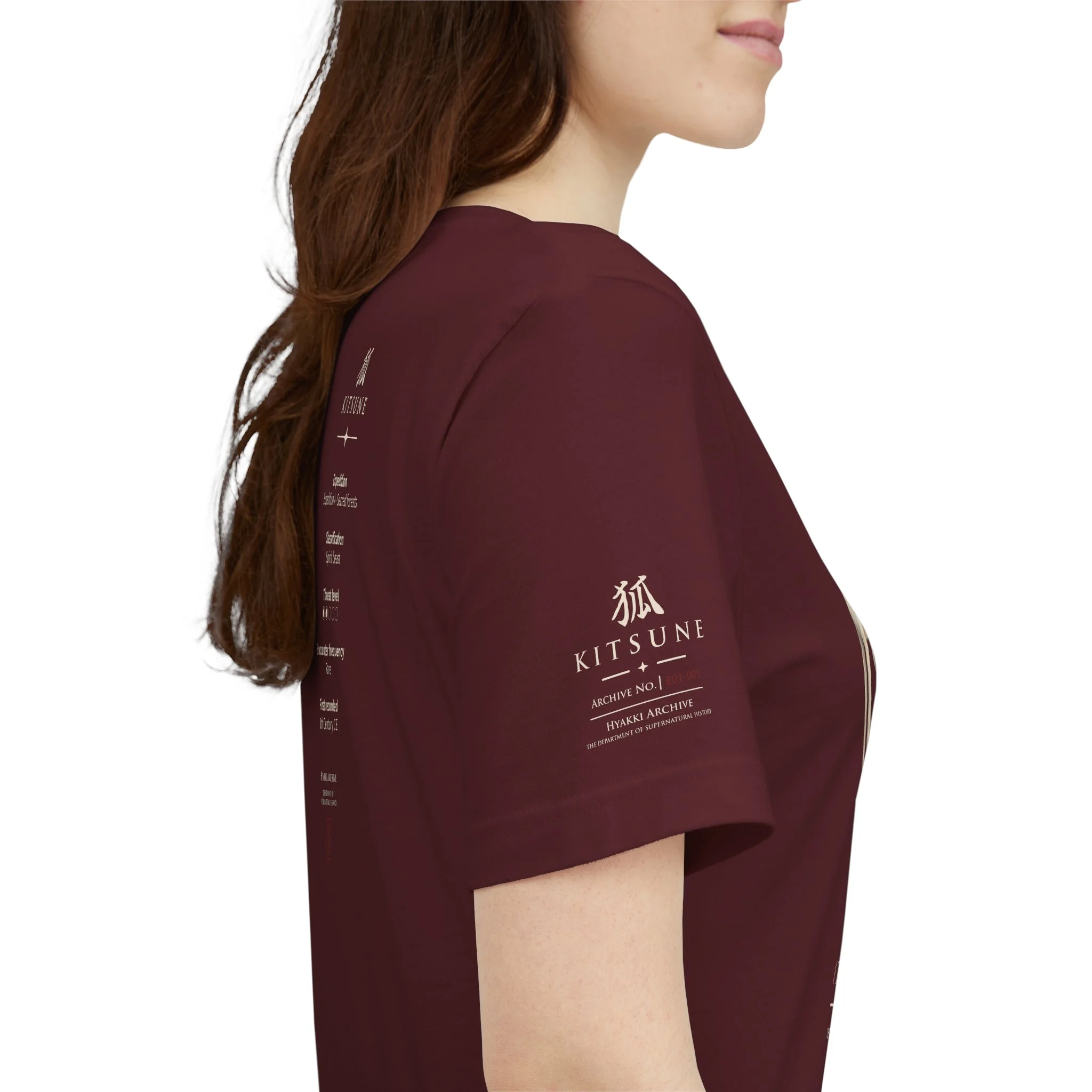
The typography continues the same idea. The large Japanese 狐, the spaced KITSUNE lettering and the small red archive number make the shirt read almost like a catalogued specimen plate.
That balance between natural history and supernatural suspicion is exactly what the design is meant to capture.
From the Hyakki Archive
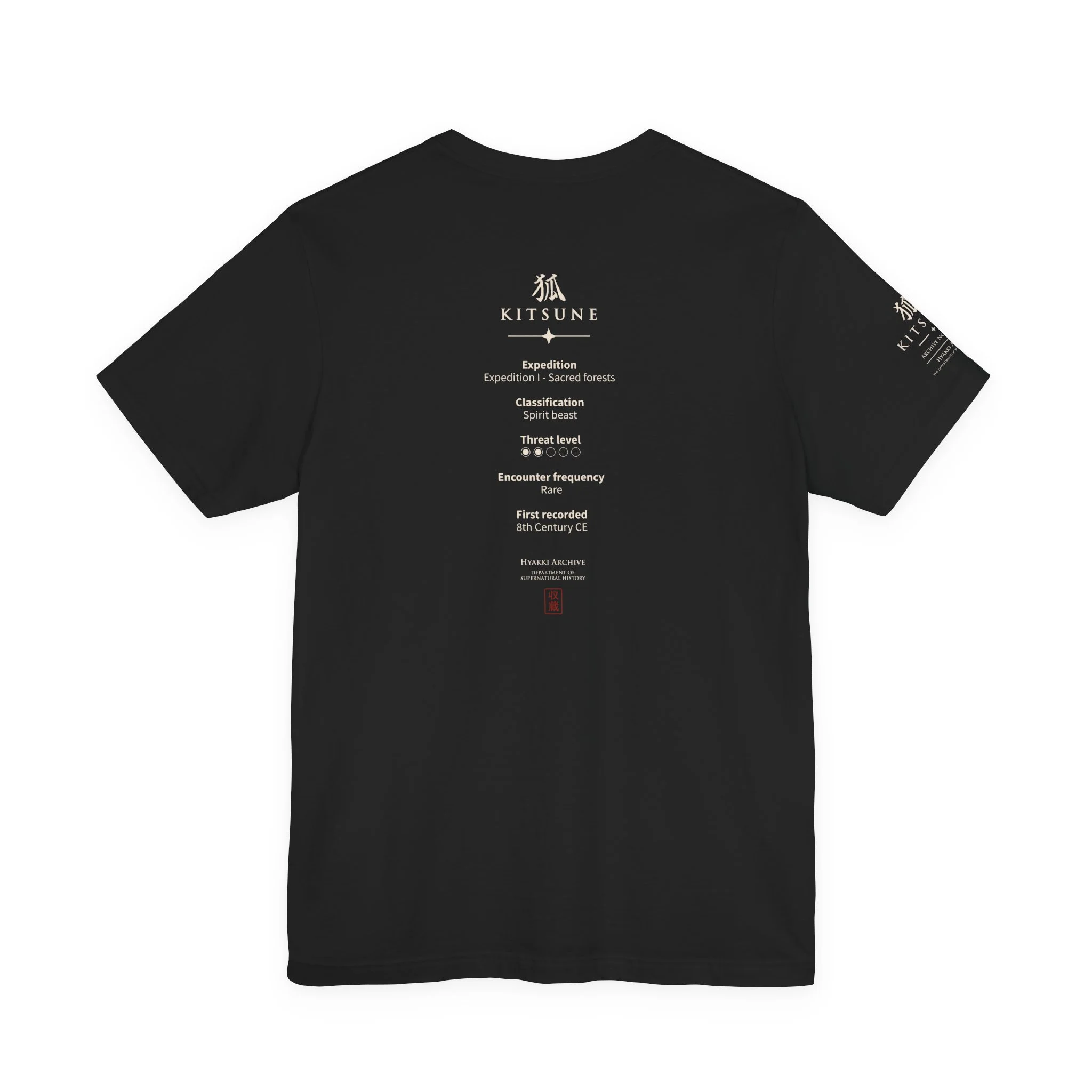
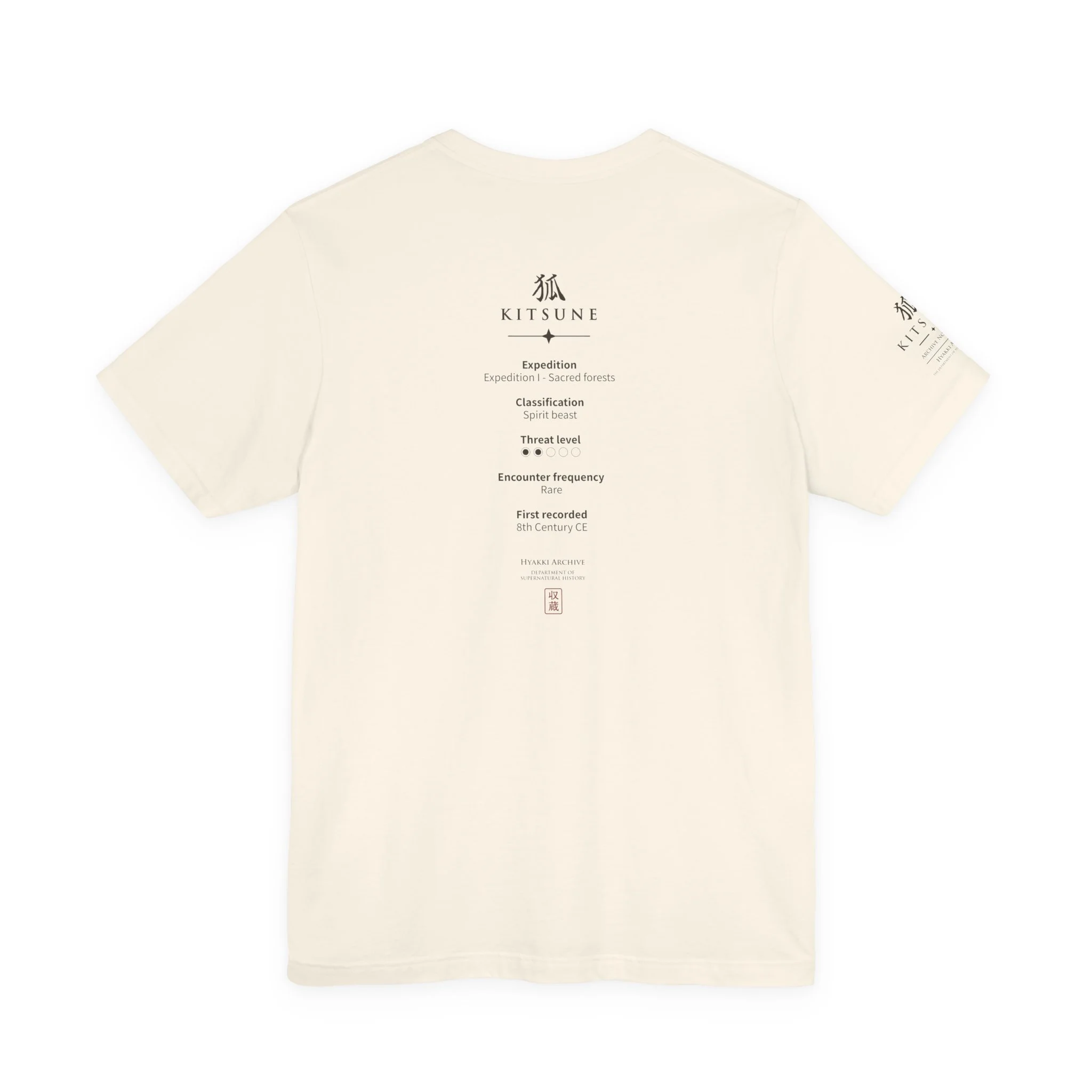
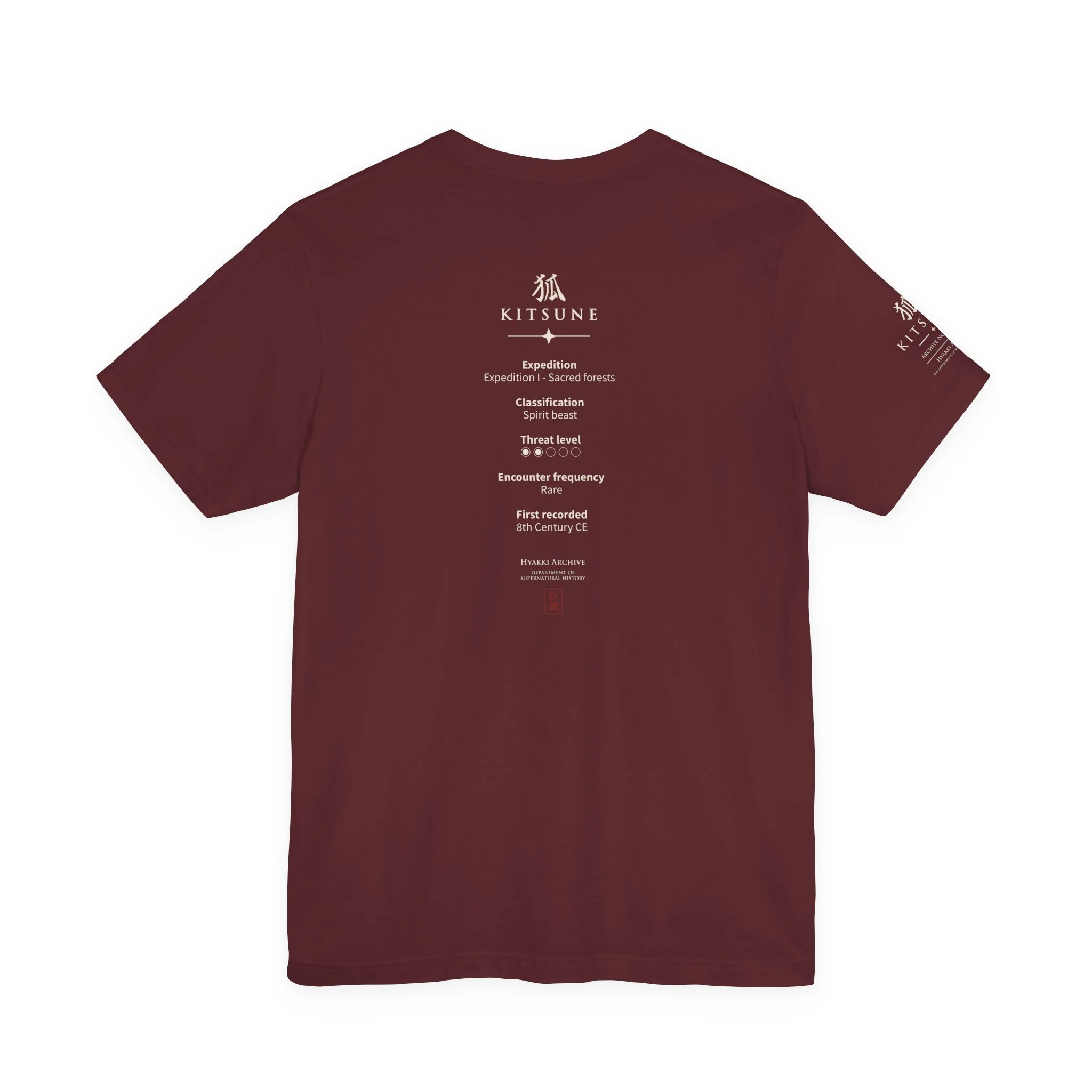
Archive File E01-001 opens Expedition I · Sacred Forests with one of Japan’s most enduring supernatural animals.
The Kitsune sits at the boundary between categories: animal and spirit, stranger and companion, deception and devotion. Rather than choosing one version and declaring it definitive, the Hyakki Archive preserves that uncertainty.
This design follows the same principle.
One fox.
One tail.
No visible transformation.
The fox has been identified.
Its intentions have not.
収蔵
| Field |
Research Record |
| Temperament |
Trickster |
| Activity |
Nocturnal |
| Encounter Frequency |
Common |
| Habitat |
Sacred Forests • Shrine Groves • Mountain Paths |
| Known Variants |
Nogitsune • Myōbu • Kuko • Tenko |
01 · What Is It?
Kitsune is the Japanese word for fox, but in folklore the animal may be far more than an ordinary fox. Across centuries of stories, kitsune appear as shapeshifters, tricksters, lovers, wives, messengers, possessors and supernatural beings capable of moving between the human and animal worlds.
There is no single Kitsune personality. Some deceive people for amusement or revenge, while others form genuine relationships with humans or become connected with religious traditions. This flexibility is one of the defining features of fox folklore in Japan. The same fox may appear familiar and animal-like in one story, then speak, transform or take human form in another.
Rather than one supernatural species, Kitsune is best understood as a broad and changing fox tradition.
02 · Historical Record
Fox stories have a long documentary history in Japan. One of the most important early examples appears in the Nihon Ryōiki, compiled in the early ninth century. Its famous fox-wife story concerns a man who marries a beautiful woman who is eventually revealed to be a fox. The relationship produces a child, and even after her identity is exposed, the emotional bond between human and fox remains central to the story. The fox-wife motif continued through later Japanese literature and became one of the most enduring forms of Kitsune narrative.
Over the medieval and early-modern periods, fox traditions expanded through religious belief, setsuwa tales, theatre, folklore and visual culture. By the Edo period, supernatural foxes were firmly established in popular storytelling. Later plays and artworks continued traditions such as Kuzunoha, the fox woman who marries a human, and foxes disguised as human retainers.
03 · Appearance
There is no canonical supernatural Kitsune body.
Many stories begin with an ordinary-looking fox. The supernatural quality appears through behaviour: speech, unusual intelligence, transformation or disappearance. In other traditions, the fox assumes human form, frequently that of a woman, although male transformations also occur.
Modern imagery often emphasizes white fur, multiple tails, glowing markings and elaborate supernatural features. Some of these elements have roots in wider East Asian fox traditions, but they should not be treated as universal characteristics of Japanese Kitsune folklore.
Historical art frequently focuses instead on the tension between fox and human identity. A figure may appear completely human until the story reveals the fox beneath the disguise. Nineteenth-century objects depicting Kuzunoha, for example, preserve precisely this transformation between wife, mother and fox.
04 · Behaviour & Encounters
Transformation is one of the strongest recurring Kitsune motifs. Foxes may take human form to deceive, test or interact with people, but these encounters are not always malicious.
Fox-wife stories can involve affection, marriage and children. Other tales describe tricks, false appearances or travellers being misled. Foxes also became associated with possession traditions in which unusual behaviour or illness was attributed to fox spirits. Beliefs concerning fox possession varied considerably by region and could have serious social consequences for the people accused of being possessed or of controlling fox spirits.
This range makes simple labels such as benevolent, evil or even trickster inadequate. A Kitsune story is often defined by the relationship involved. The fox may deceive one human, assist another, marry a third, or serve as a supernatural messenger in a completely different religious setting.
05 · Belief, Ritual & Meaning
Kitsune has an especially important relationship with Inari worship, but one major misconception needs correcting: Inari Ōkami is not a fox.
Fushimi Inari Taisha states directly that foxes are regarded as the messengers or kindreds of Inari Ōkami. These sacred messengers are traditionally conceived as invisible white foxes, or byakkosan, rather than ordinary wild foxes.
Kokugakuin's research on Inari belief shows that fox associations developed through agricultural religion, mountain and rice-field traditions, oracle practices and later religious interpretation. Foxes could become messengers, spiritually charged animals and eventually objects of devotion in their own right.
This religious connection exists alongside much less sacred fox folklore involving deception, possession and transformation. That tension is essential to Kitsune: the fox can stand close to the shrine without belonging entirely to it.
06 · Regional & Historical Variations
There has never been one universal classification system for supernatural foxes in Japan.
Different periods and regions developed terms for wild foxes, possessing foxes, white foxes, fox familiars and other specialized traditions. Beliefs concerning kitsunemochi, households said to possess fox spirits, became particularly influential in some regions and could affect marriage, property and community relationships.
Religious foxes associated with Inari should also be distinguished from ordinary mountain foxes and from the much broader category of supernatural Kitsune. Fushimi Inari itself makes this separation explicit.
Later literature and theatre further expanded individual fox traditions such as Kuzunoha and the fox retainer of Yoshitsune Senbon Zakura.
Because these traditions overlap without forming one consistent hierarchy, modern systems that divide every fox neatly into fixed “good” and “evil” classes should be treated with caution.
07 · What We Actually Know
| Claim |
Status |
| Supernatural fox traditions have existed in Japanese literature for more than a thousand years |
DOCUMENTED |
| Transformation into human form is a major Kitsune motif |
DOCUMENTED |
| Fox-wife stories form an important historical tradition |
DOCUMENTED |
| Foxes are associated with Inari worship |
DOCUMENTED |
| Inari Ōkami is itself a fox |
INCORRECT |
| Every Kitsune has multiple tails |
UNSUPPORTED |
| Kitsune are universally either benevolent or evil |
INCORRECT |
| Fox possession and fox-owning beliefs varied regionally and could affect real communities |
DOCUMENTED |
Sources:







Reviews
There are no reviews yet.