The Design
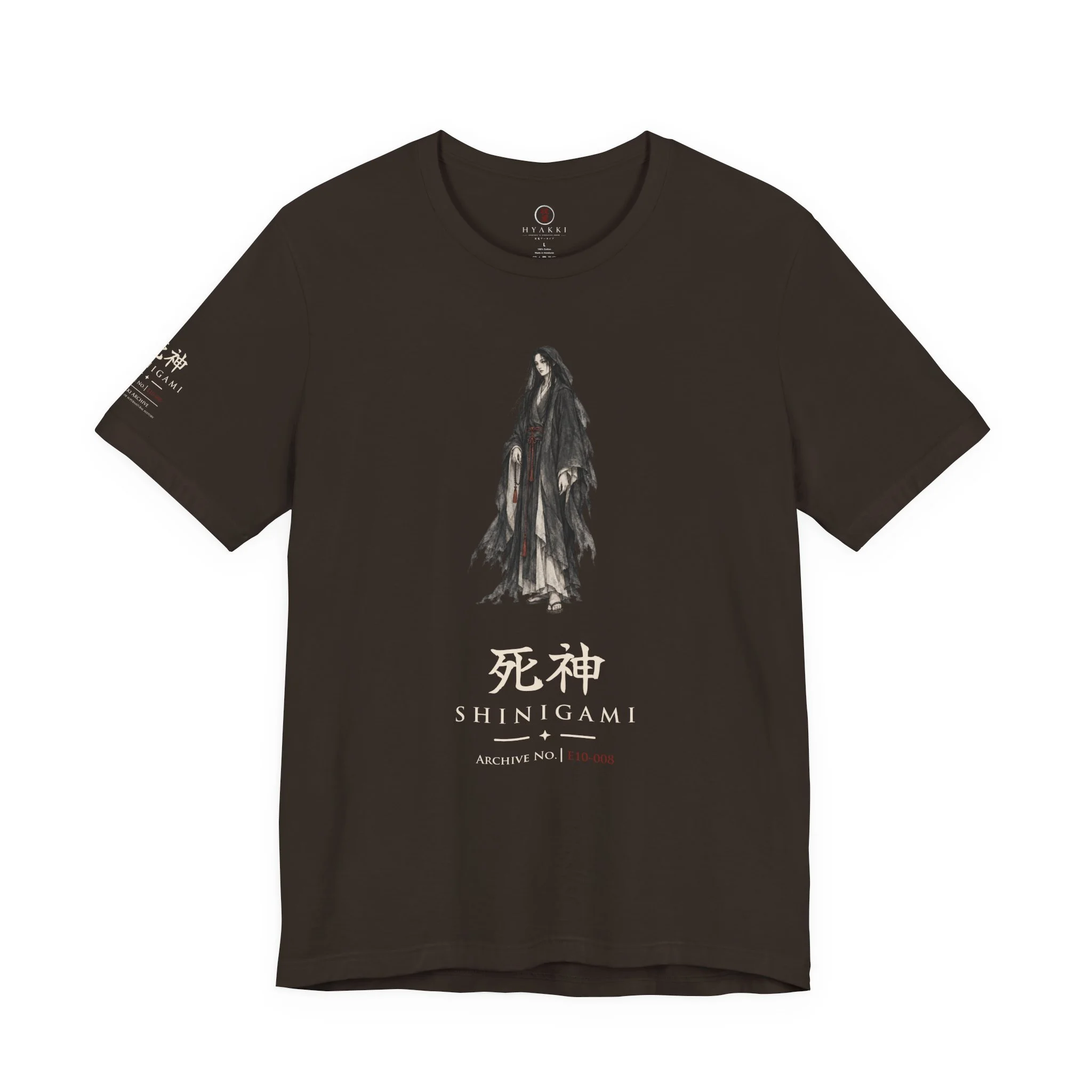
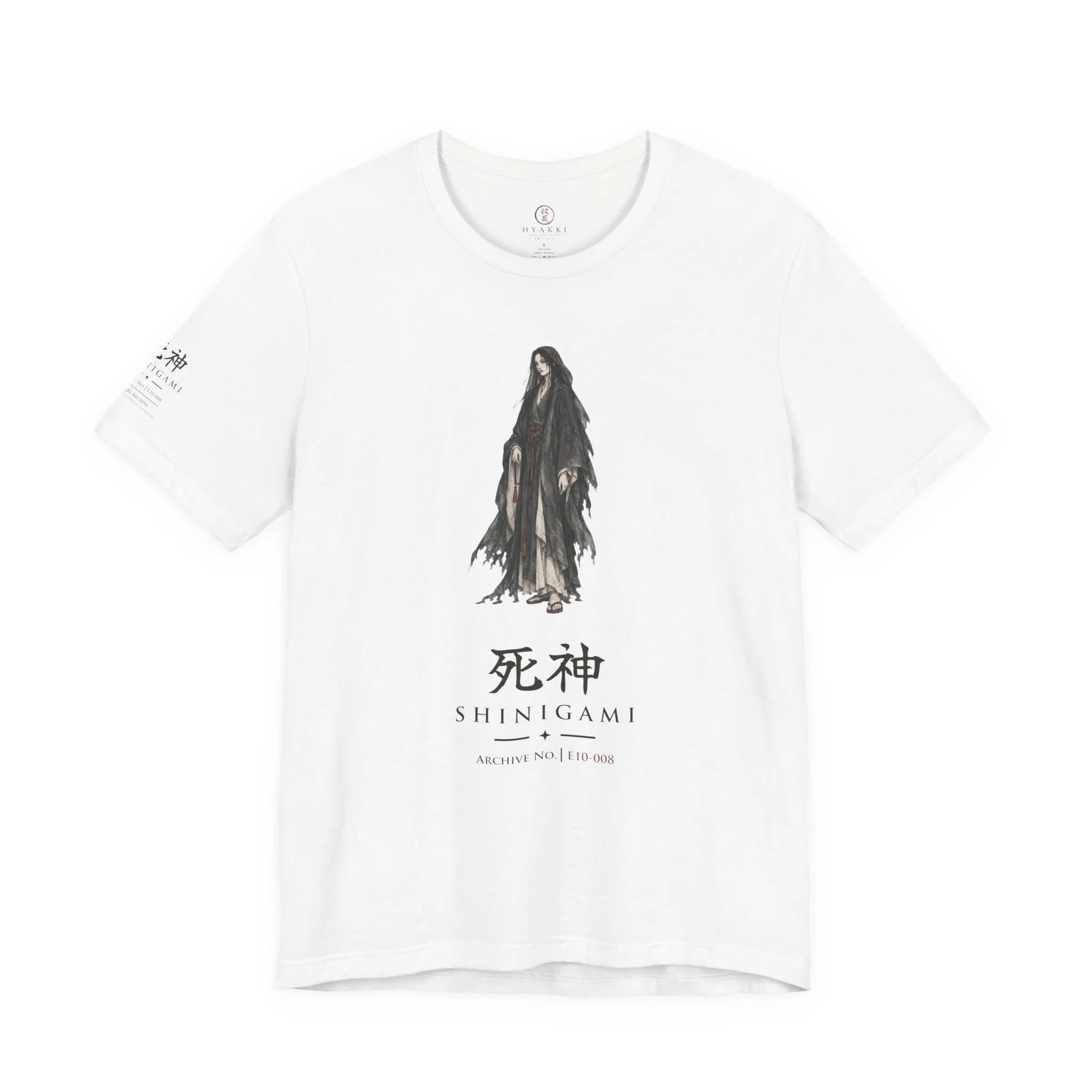
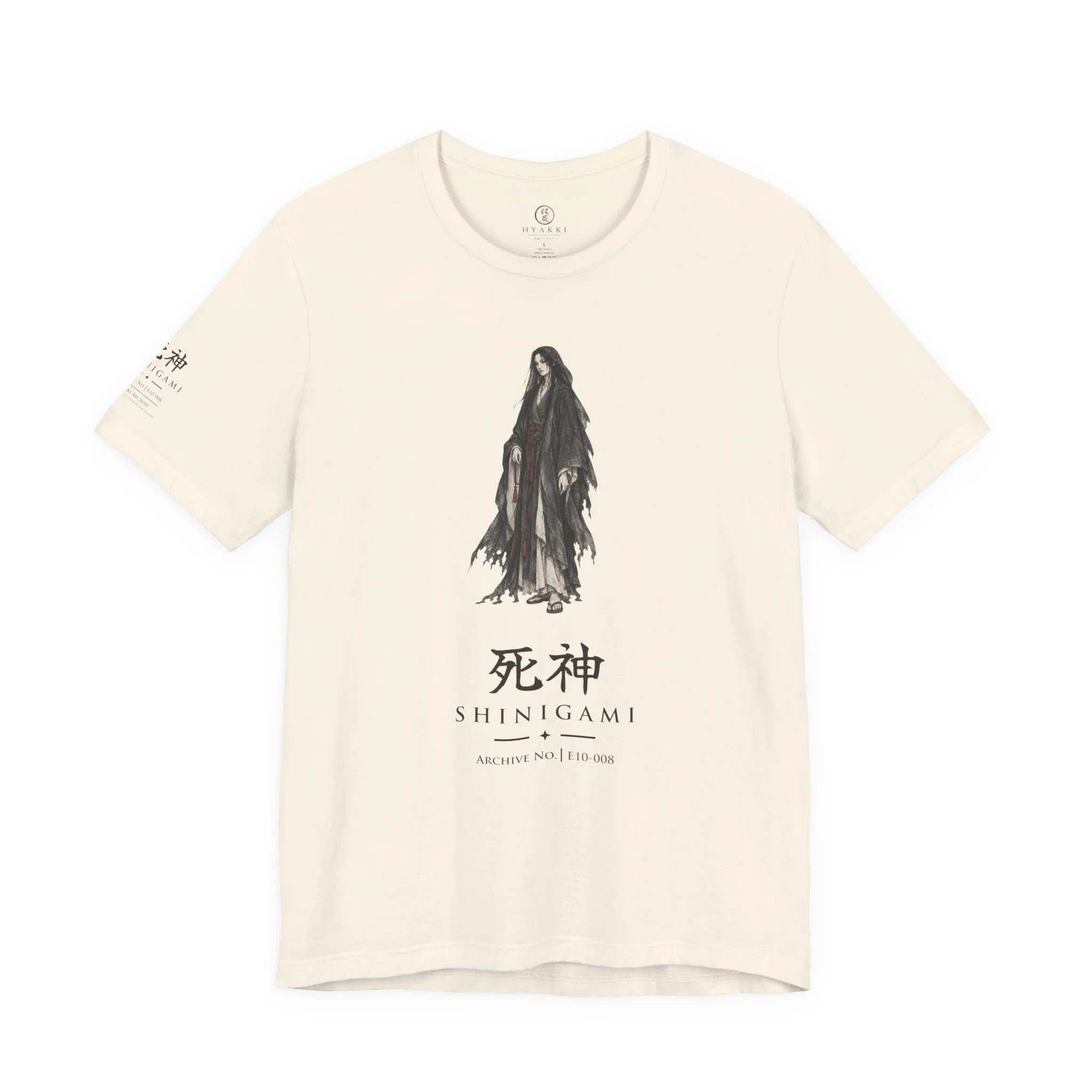
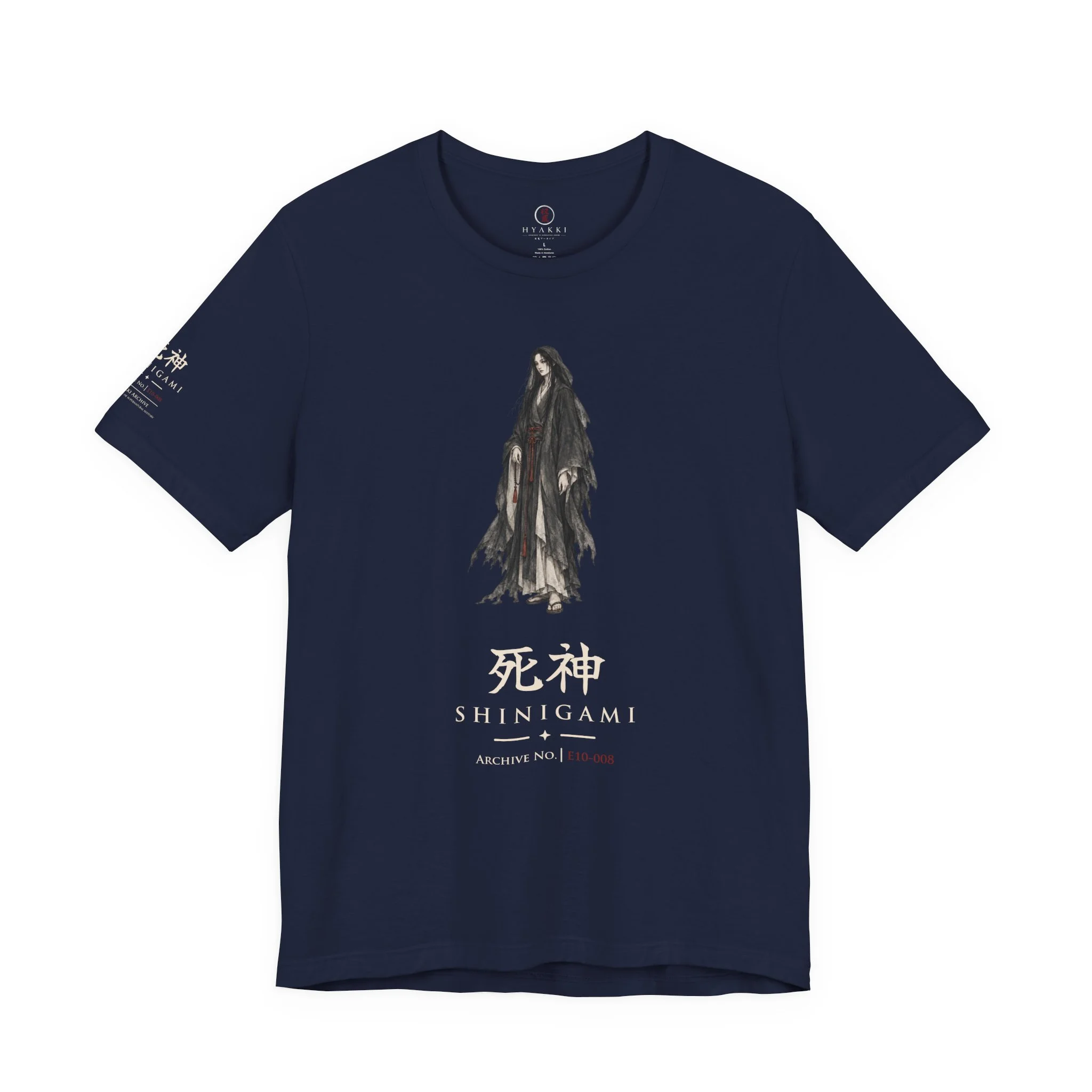
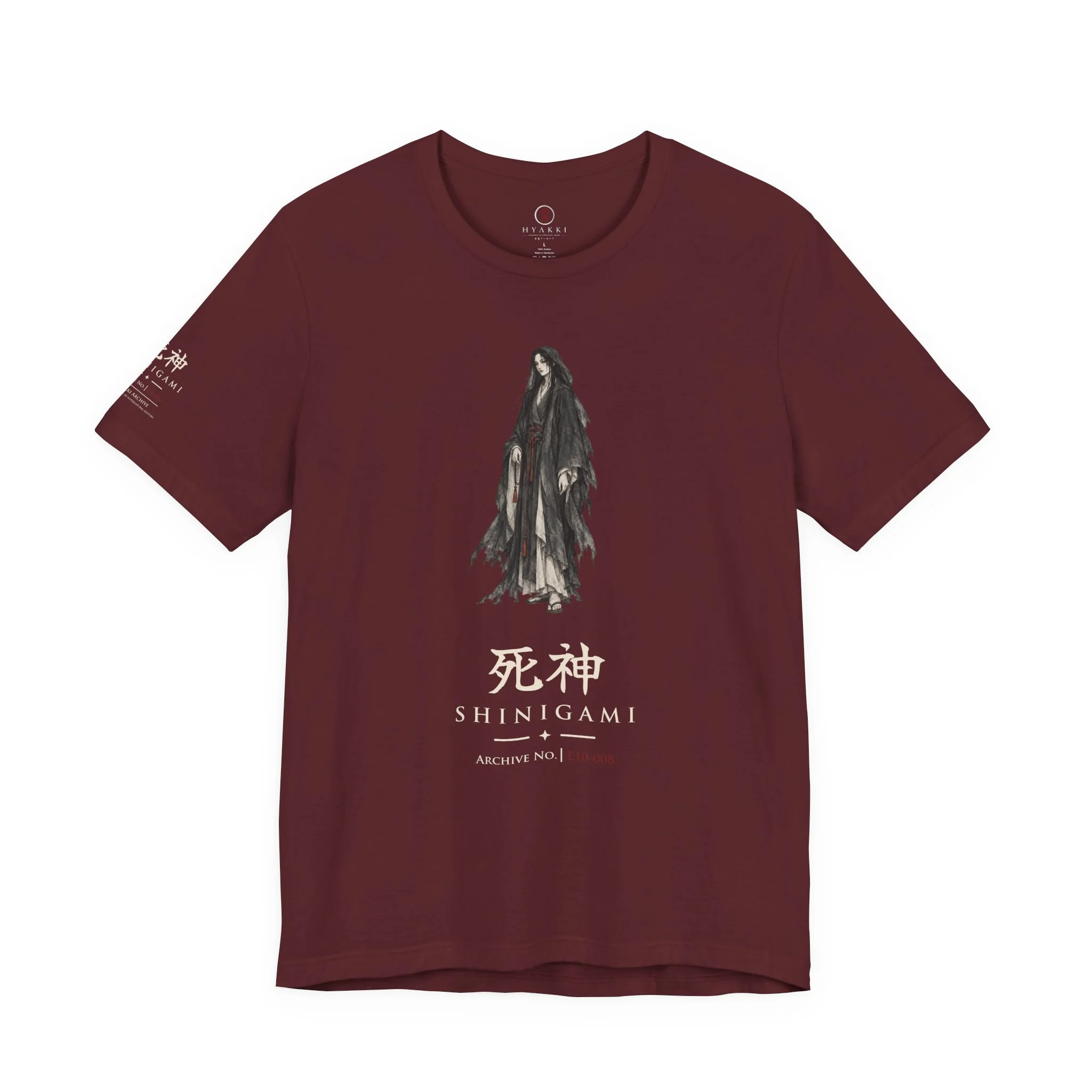
The E10-008 Shinigami design presents the entity as a solemn, humanlike figure rather than a skeletal reaper.
At the center stands a pale, slender woman in layered dark robes with a hooded outer garment, long black hair, and restrained red cord details at the waist. One hand holds a strand of prayer beads, adding a quiet ritual quality without turning the figure into a priest or formal religious icon. The expression is distant and unreadable rather than violent.
There is no scythe, skull face, armor, or theatrical display of death. The design instead leans into stillness.
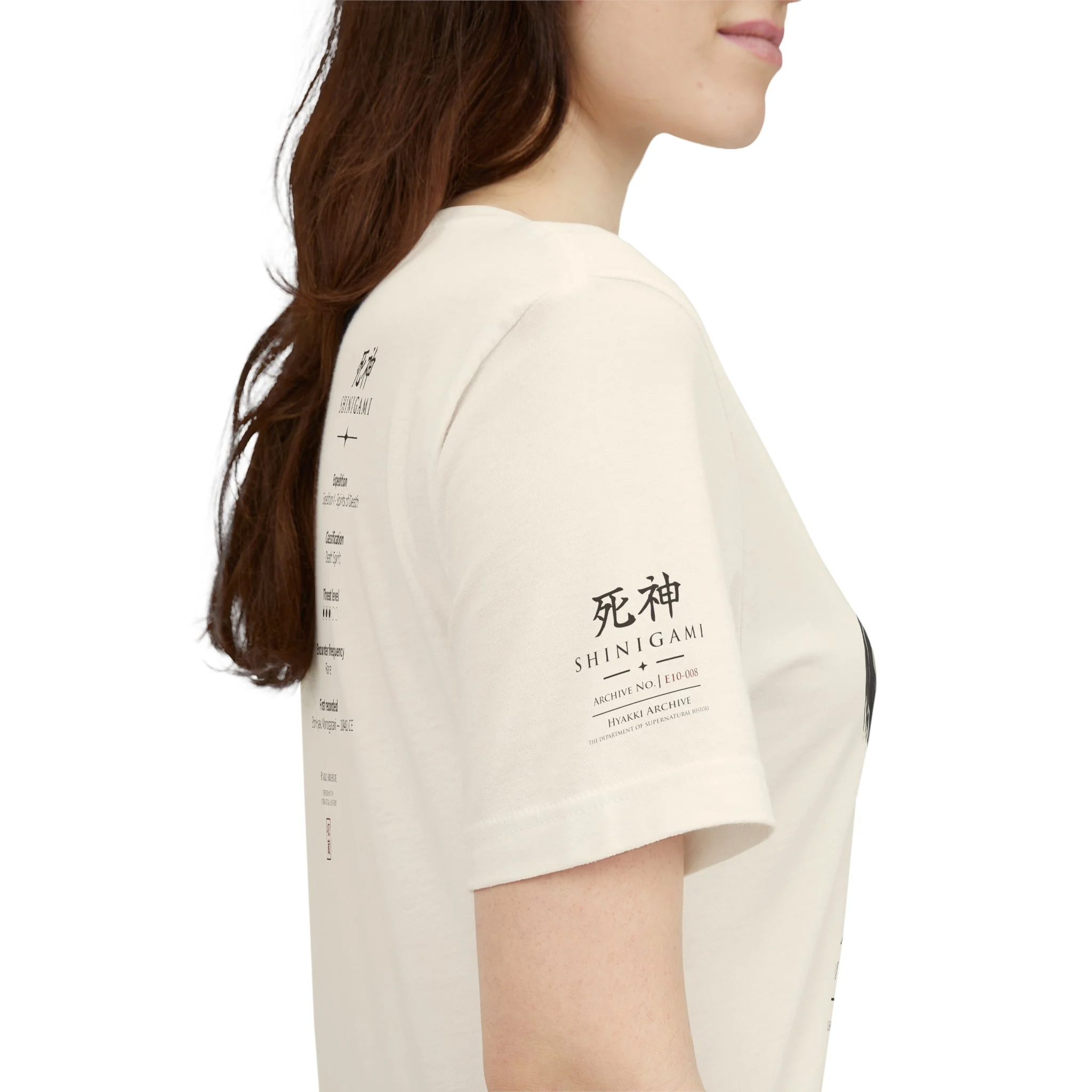
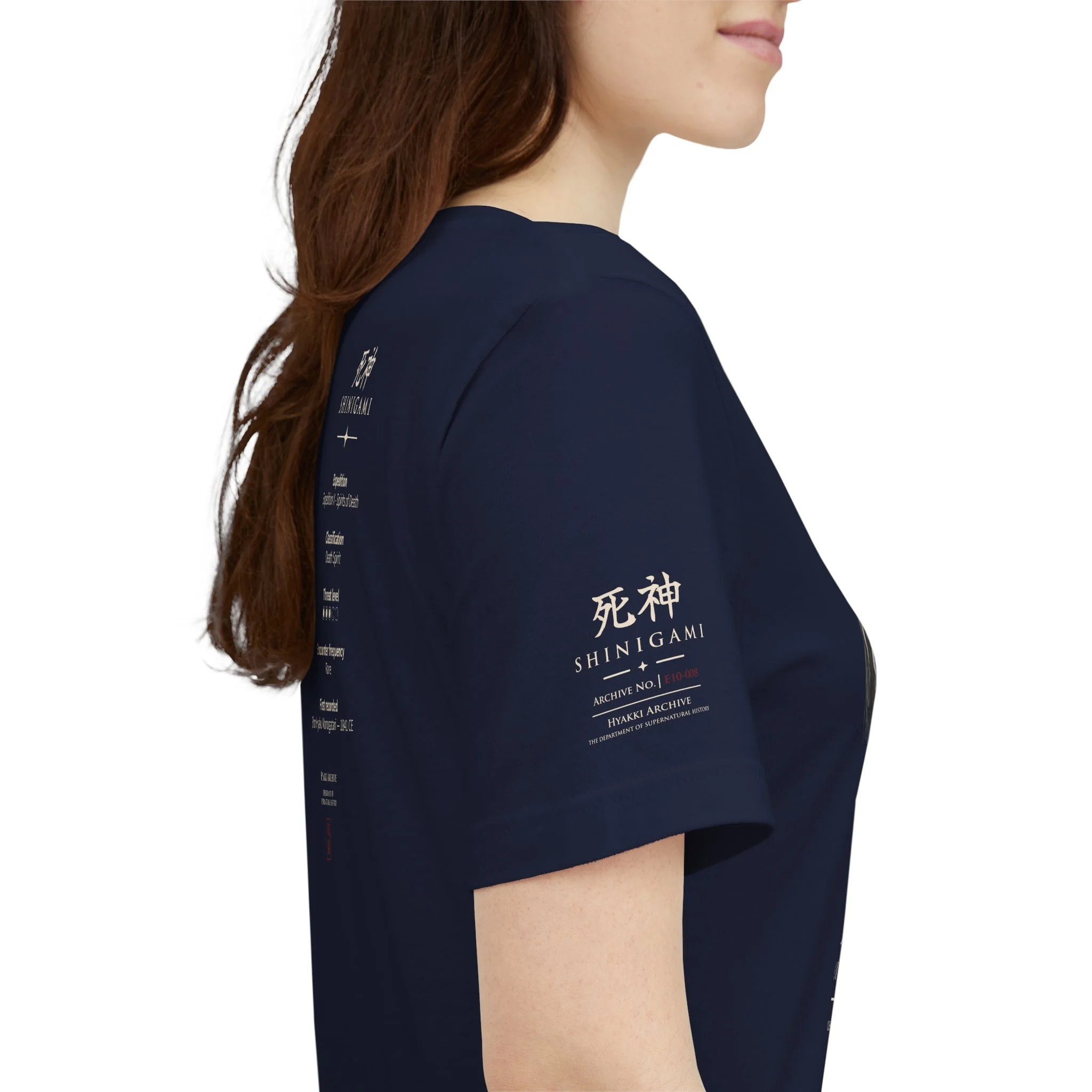
Beneath the illustration, 死神, SHINIGAMI, and Archive No. E10-008 maintain the Hyakki archive format and keep the focus on the figure itself.
The result feels less like an executioner and more like someone who has arrived because death is already near.
The Entity Behind the Design
Shinigami literally means “death god” or “death spirit,” but the historical idea is much less fixed than modern popular culture often suggests.
Early references from the Edo period use the term for something that draws, tempts, or leads a person toward death. In some texts, the Shinigami behaves almost like a supernatural influence or possession rather than a clearly visible being.
Later storytelling made the concept more concrete. Rakugo, ghost stories, theatre, and eventually modern fiction increasingly personified Shinigami as recognizable agents of death.
That means there is no single historical form to reconstruct.
The most accurate way to treat Shinigami is as an evolving personification of proximity to death, rather than as one ancient Japanese deity with a universal body and role.
Known For
Shinigami is especially known for leading people toward death.
In early dramatic usage, the concept appears around characters who continue toward fatal decisions even when others try to stop them. The Shinigami becomes a way to explain why death can feel irresistible or inevitable.
Later traditions make the being more independent. A Shinigami may possess someone, appear as a visible supernatural figure, or function as an intermediary who knows when death is approaching.
One of the most influential later forms comes from the rakugo story Shinigami, where Death appears as a distinct supernatural agent with its own rules. That version was shaped in part by European storytelling, which is a useful reminder that the modern idea was never culturally sealed or historically static.
The familiar hooded reaper with a scythe is therefore not the original Japanese model.
What is older is the idea that something unseen may already be drawing a person closer to death.
From Folklore to Design
This design chooses a humanlike, quiet Shinigami rather than a Western-style Grim Reaper.
The layered dark robes create a funerary atmosphere without relying on a black skeleton or oversized hood. The pale face and long hair keep the figure recognizably human, while the worn fabric and distant expression move it just far enough away from ordinary life.
The prayer beads are an interpretive addition. They give the figure a contemplative and ritual quality, but they should not be read as a fixed historical attribute of Shinigami.
The most important choice is the absence of a weapon.
This Shinigami does not look like something that comes to kill.
It looks like something that arrives when death has already entered the room.
That distinction fits the historical tradition much better than a straightforward executioner figure would.
From the Hyakki Archive
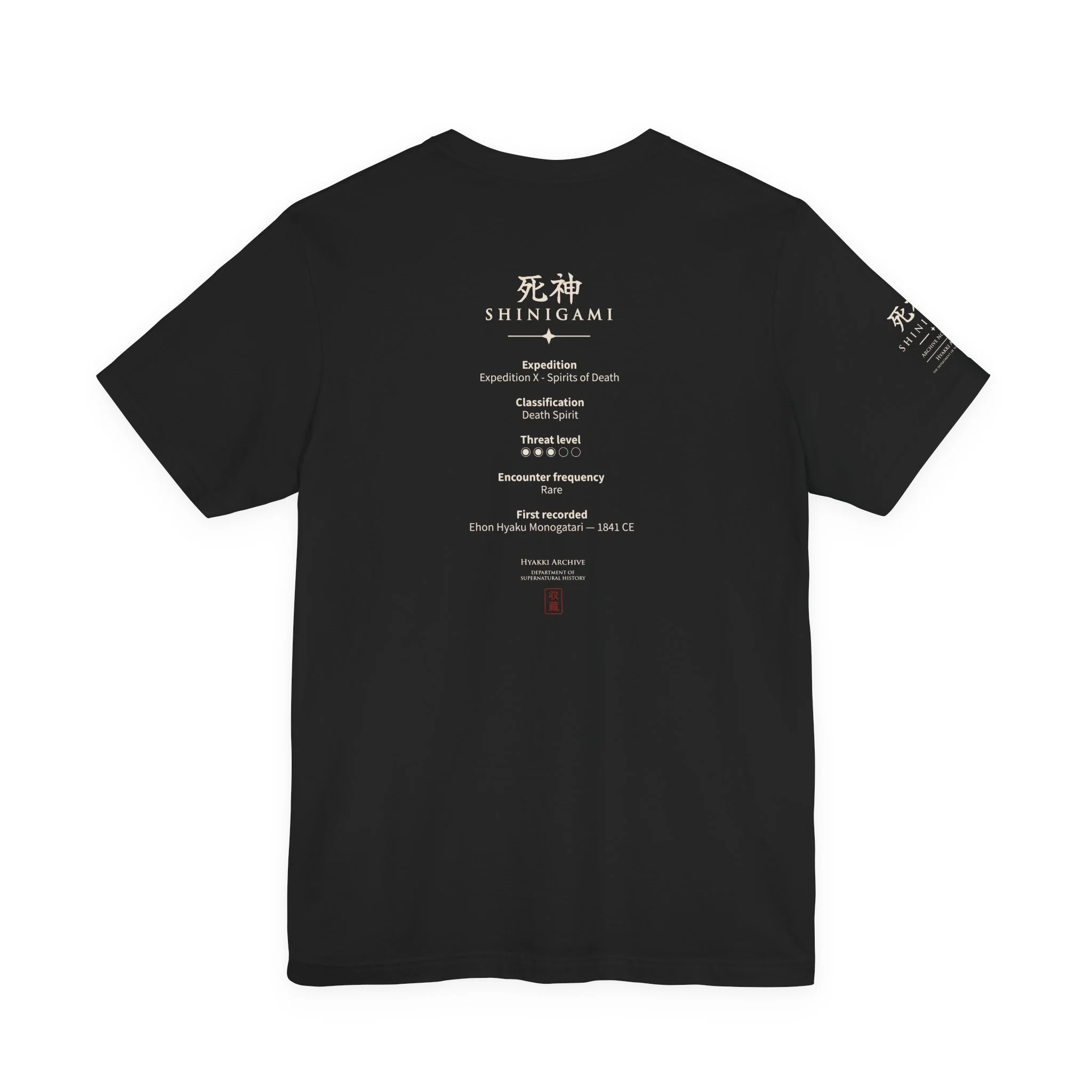
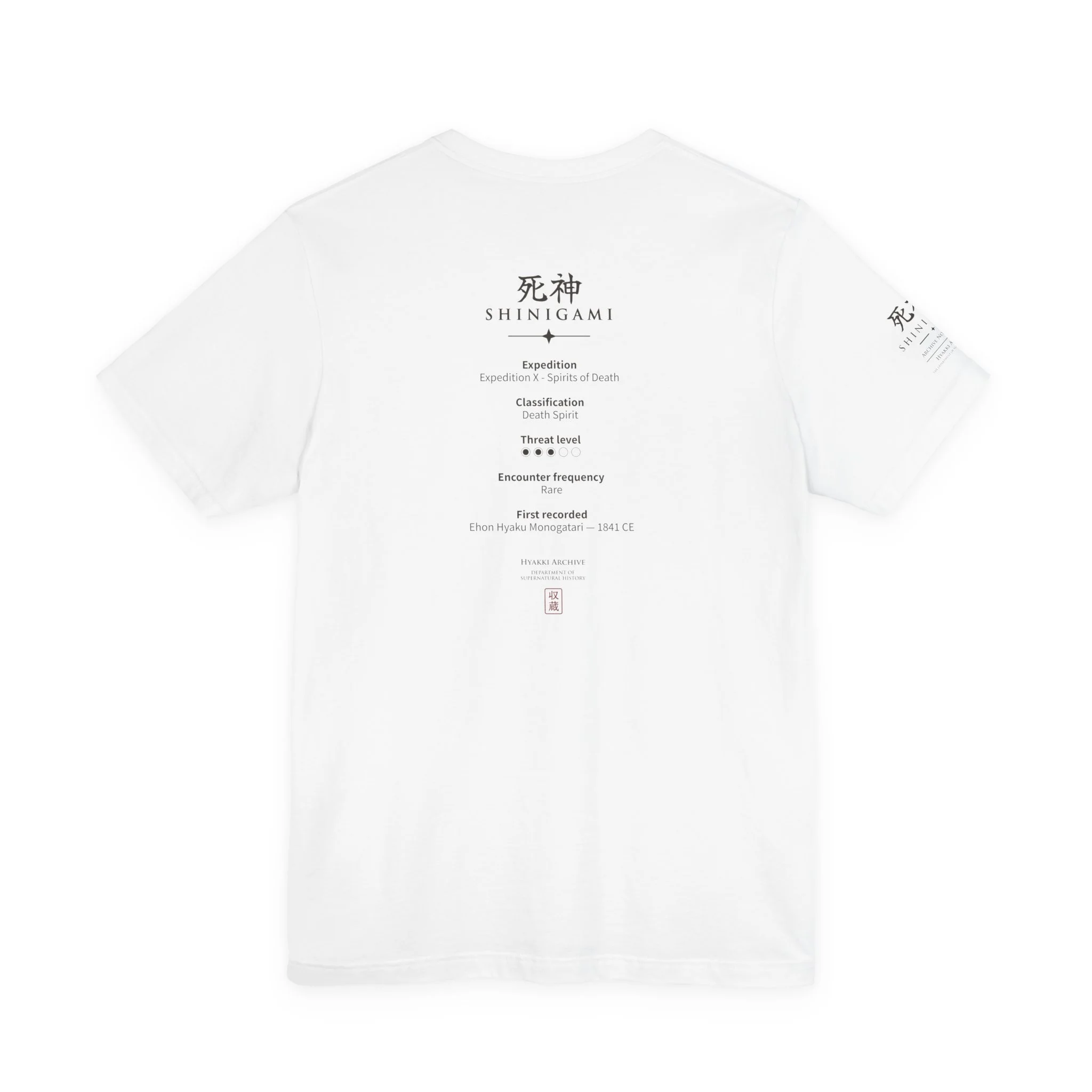
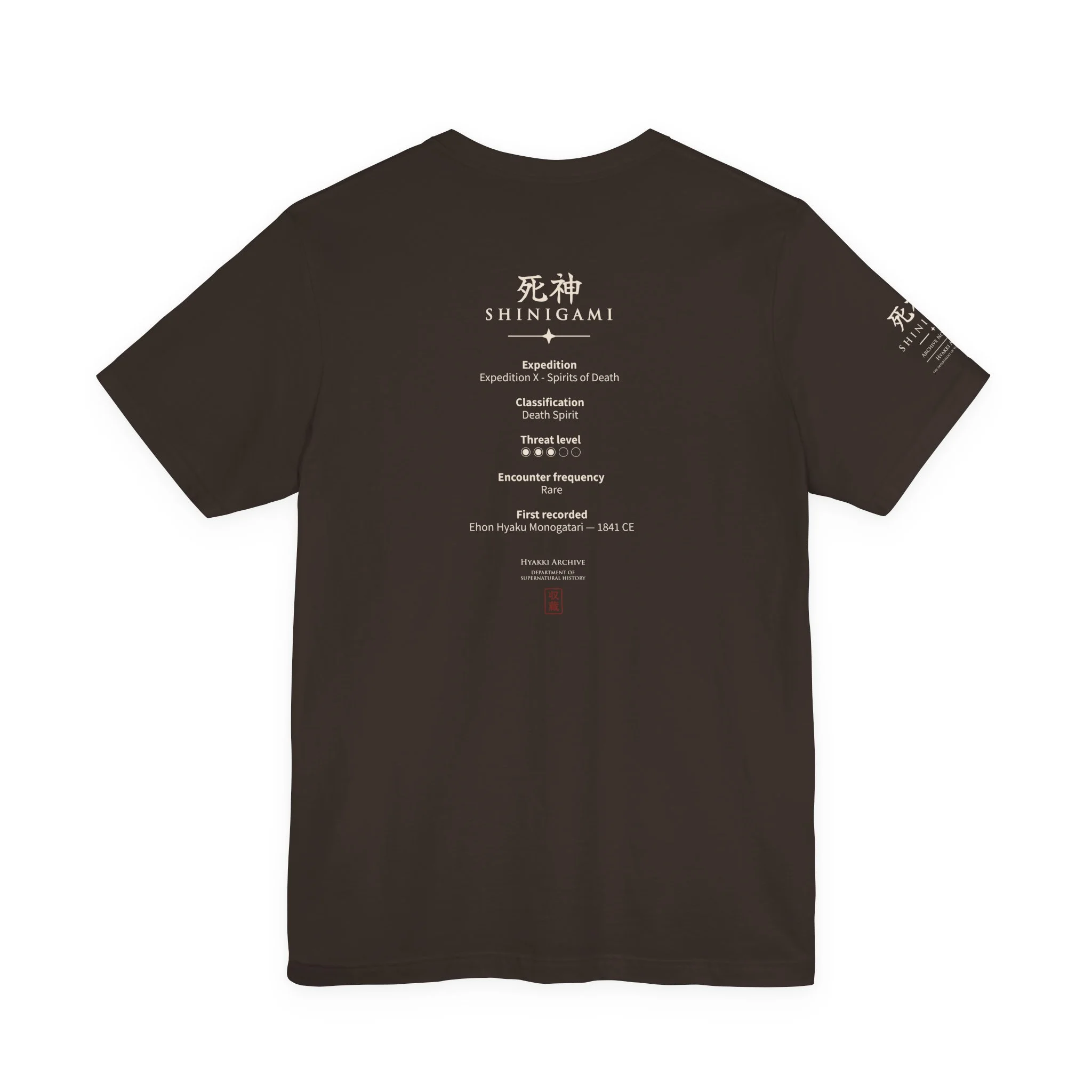
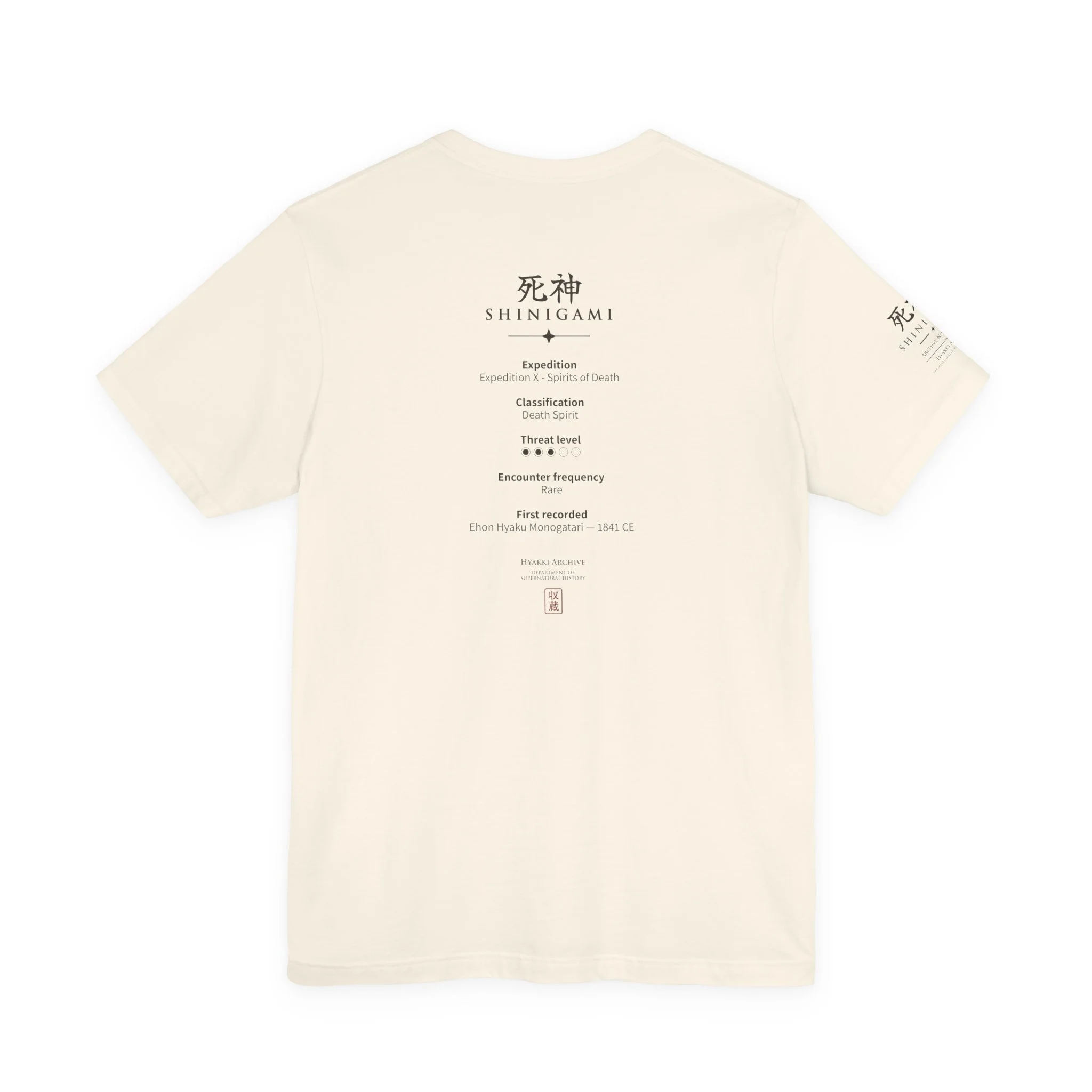
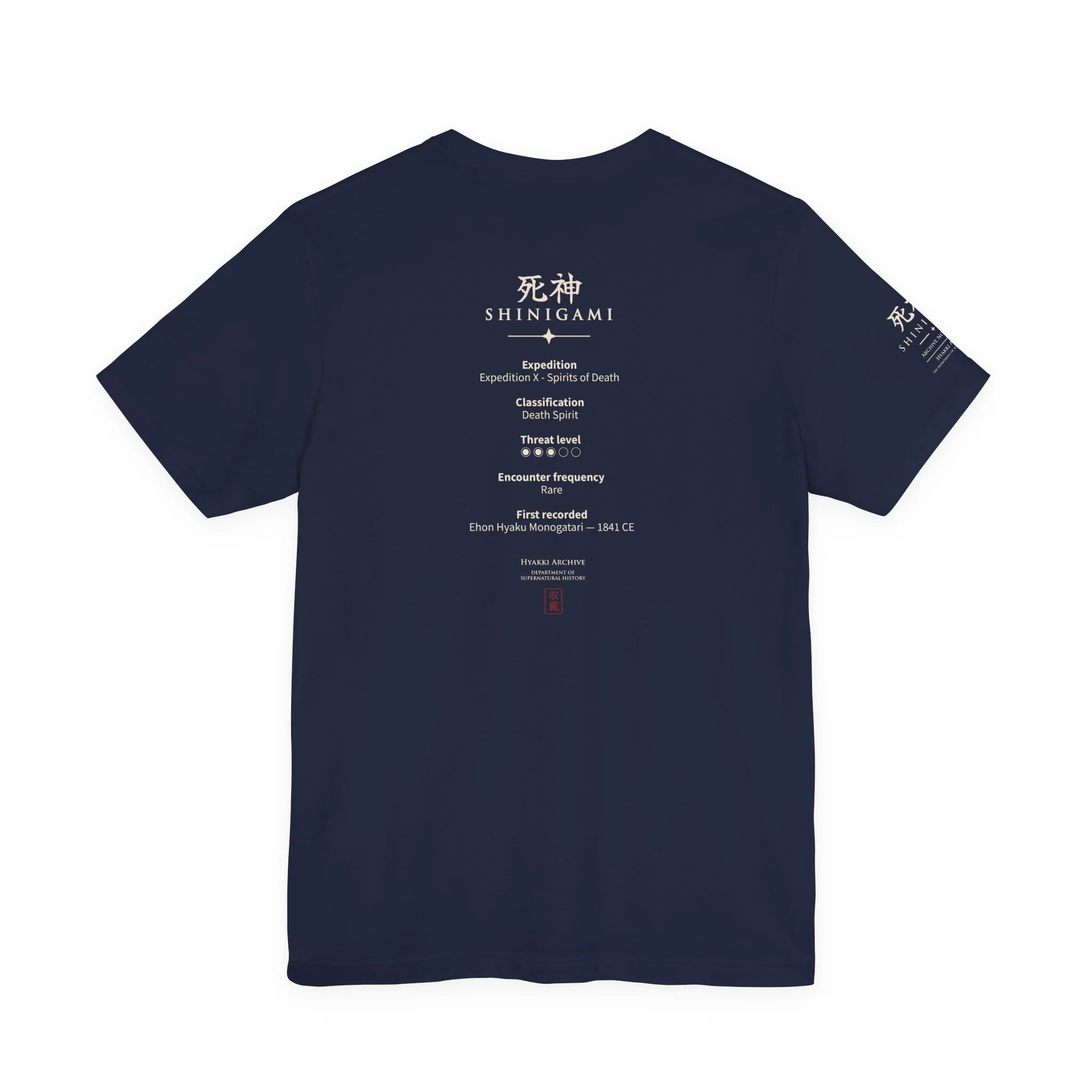
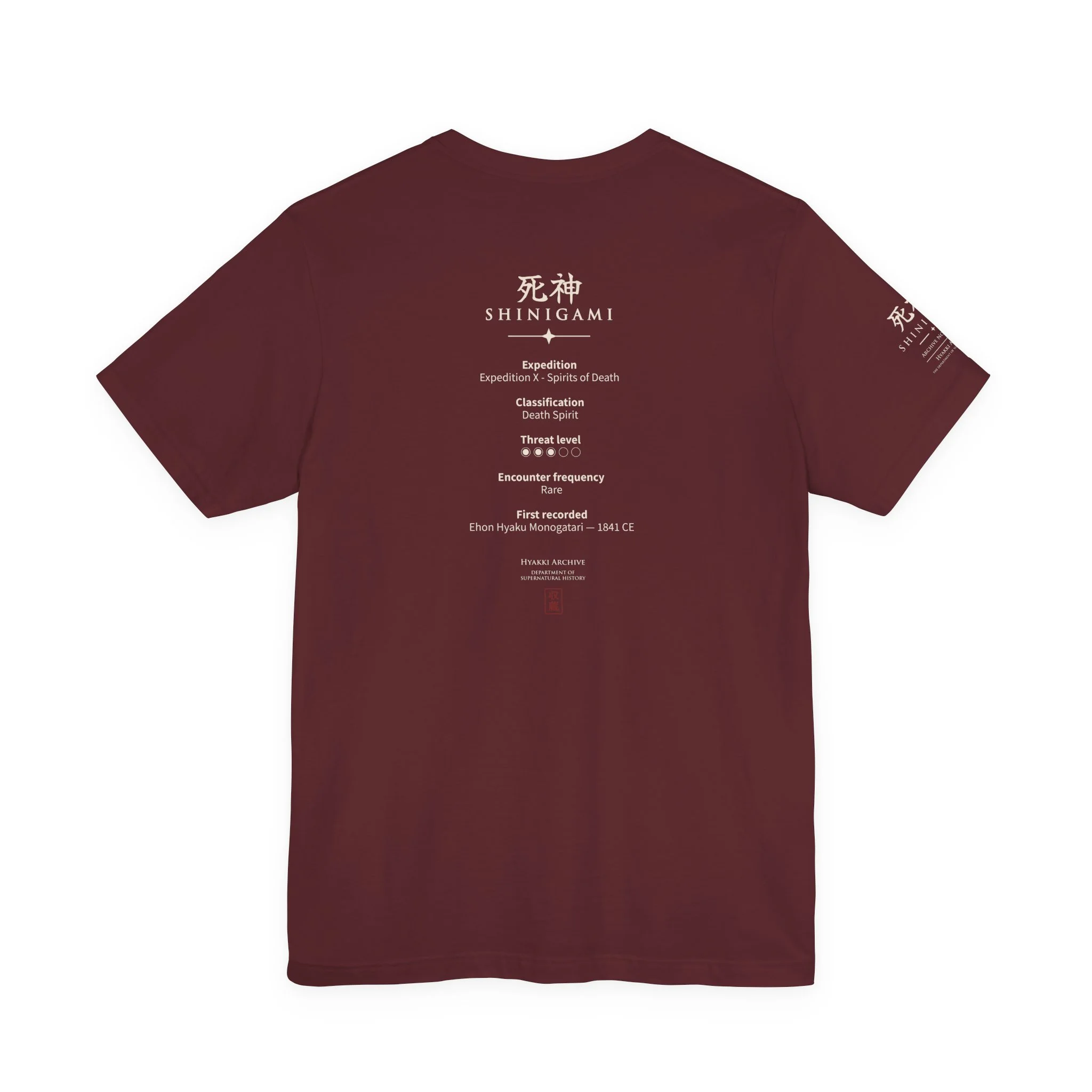
Archive File E10-008 continues Expedition X — Spirits of Death with a presence defined not by the dead, but by the moment before death becomes unavoidable.
Shiryō is what remains.
Goryō is what refuses to be forgotten.
Shinigami stands closer to the threshold itself.
No blow is struck.
No corpse is taken.
No grave is opened.
A figure simply appears.
And suddenly the path ahead feels much shorter.
Is death being caused, predicted, or merely accompanied?
収蔵
| Temperament |
Ominous • Enticing • Unreadable |
| Activity |
Associated with Approaching Death |
| Encounter Frequency |
Extremely Rare |
| Habitat |
Unfixed • Roads • Homes • Theatres • Liminal Spaces |
| Known Variants |
Death-Inducing Presence • Possessing Shinigami • Rakugo Shinigami • Modern Psychopomp Forms |
01 · What Is It?
Shinigami is a Japanese term for a supernatural presence associated with drawing people toward death.
Its meaning is broader and less stable than the modern idea of a Japanese Grim Reaper. Historical usage does not reveal one ancient deity responsible for collecting every dead person, nor one supernatural species with a standardized appearance.
The Nipponica encyclopedia defines Shinigami as a god or spirit believed to invite a person toward death or cause the desire to die. The term became especially visible in early-modern theatre and popular language.
That makes Shinigami different from many entities in the archive.
It is not primarily defined by a body.
It is defined by proximity to death and influence over the person approaching it.
Modern fiction has since expanded the word enormously, but those later interpretations should not be projected backward as ancient folklore.
02 · Historical Record
The earliest securely identified example currently cited by the Nihon Kokugo Daijiten appears in 1709, in Chikamatsu Monzaemon’s jōruri play Shinjū Yaiba wa Kōri no Tsuitachi. The play was first performed at Osaka’s Takemoto-za that year.
In the passage, Shinigami is invoked as something that entices or leads a person toward death.
Chikamatsu used the term again in Shinjū Ten no Amijima in 1720, where a person is described as though possessed by a Shinigami and therefore unreachable by ordinary advice or reason.
These examples are significant because they place Shinigami firmly in early-modern popular culture, especially stories involving fatal attachment and double suicide.
The documentary record therefore does not support the common claim that Shinigami was an ancient Shinto death god comparable to a classical European personification of Death.
03 · Appearance
Historical Shinigami has no fixed appearance.
The early theatrical references do not describe a hooded skeleton, scythe-bearing figure, black-winged spirit, or standardized psychopomp.
In many early usages, Shinigami behaves almost more like an influence, possession, or fatal attraction than a clearly visible being. A person may be spoken of as though a Shinigami has attached itself to them or is calling them toward death.
This leaves enormous room for later visual interpretation.
Modern literature, manga, anime, film, and games have created countless Shinigami forms, ranging from humanlike death gods to skeletal reapers and bureaucratic guides of the dead. Those images are culturally important, but they belong primarily to modern storytelling.
For Hyakki, any visible Shinigami should therefore be identified as a representative interpretation, not as reconstructed historical anatomy.
04 · Behaviour & Encounters
The earliest Shinigami tradition is most strongly associated with leading, tempting, or drawing someone toward death.
That does not necessarily mean physically killing the person.
In Chikamatsu’s plays, the word appears in contexts where death feels psychologically and socially inescapable. A Shinigami can function as the supernatural explanation for why someone continues toward a fatal decision despite intervention from others.
Later accounts make the idea more literal.
The nineteenth-century Sōzan Chomon Kishū includes a story discussing whether a woman involved in a double suicide may truly have been possessed by a Shinigami, showing that the term could be understood as an actual attaching supernatural presence rather than merely a figure of speech.
The encounter pattern therefore varies.
Sometimes Shinigami is an unseen pull.
Sometimes it possesses.
Sometimes later tradition gives it a visible body and personality.
The historical constant is not attack.
It is death becoming difficult to turn away from.
05 · Belief, Ritual & Meaning
Shinigami is not strongly associated with a standardized system of shrine worship, ritual appeasement, or formal religious doctrine.
Its historical strength lies instead in popular drama, urban belief, storytelling, and the language used to explain fatal compulsion.
That matters because it separates Shinigami from beings such as Goryō, which developed clear ritual responses, or Kasha, which became tied to funerary protection.
Shinigami expresses something more psychological and narrative.
Why does someone continue toward disaster even when others warn them?
Why can reason suddenly seem powerless?
Early-modern storytelling could answer: a Shinigami has taken hold.
This does not mean every use of the word described literal possession. The term could operate somewhere between supernatural belief, dramatic language, and metaphor.
That ambiguity is one of the most historically interesting parts of the concept.
06 · Variations & Later Development
Shinigami changed enormously after the Edo period.
One of the most influential later forms appears in the rakugo story Shinigami, associated with San'yūtei Enchō in the Meiji period. In that story, a man encounters a personified Death figure who reveals whether sick people can be saved depending on where the Shinigami stands. Japanese reference works note that the story was adapted from European material, with proposed sources including the Italian opera Crispino e la comare and the Grimm tale commonly known as Godfather Death.
This is a major turning point.
The Shinigami is no longer merely an influence drawing someone toward death. It becomes a recognizable supernatural agent with rules, knowledge, and personality.
Modern popular culture pushed that development much further, eventually making Shinigami into anything from psychopomps to judges, warriors, bureaucrats, or gods of death.
There is therefore no single “true” Shinigami form.
There is a historical word whose supernatural identity kept expanding.
07 · What We Actually Know
| The term Shinigami is securely attested in early eighteenth-century Japanese drama |
DOCUMENTED |
| A 1709 Chikamatsu play contains the earliest example cited by a major Japanese historical dictionary |
DOCUMENTED |
| Early Shinigami usage is associated with drawing or tempting people toward death |
DOCUMENTED |
| Possession-like interpretations appear in later early-modern accounts |
DOCUMENTED |
| Shinigami was an ancient Shinto god with one universal identity |
INCORRECT |
| Traditional Shinigami universally carried scythes or wore black robes |
UNSUPPORTED |
| The famous rakugo Shinigami was shaped partly by European storytelling |
DOCUMENTED |
| Modern Shinigami imagery is far more standardized and personified than the early historical tradition |
INTERPRETATION |








Reviews
There are no reviews yet.