


Yōkai: A Complete Guide to Japan’s Strange Spirits, Monsters, and Unexplained Things
What yōkai are, where they came from, what they are not, how dangerous they can be, and why these strange beings have remained part of Japanese culture for centuries.
Imagine walking home after dark and hearing footsteps behind you, but when you turn around, nobody is there.
Or passing a river that everyone in the village tells children to avoid.
Or finding an old household object in a story that has somehow grown a face, arms, legs, and a personality of its own.
Japanese folklore has countless ways of giving shape to strange experiences like these. Many of them are now gathered under one wonderfully difficult word:
Yōkai.
A yōkai might be frightening, funny, dangerous, ridiculous, beautiful, animal-like, human-like, completely shapeless, or even little more than an unexplained sound.
That is the first important thing to understand.
There is no single creature called “the yōkai,” and there is no simple checklist that makes something a yōkai.
The International Research Center for Japanese Studies describes yōkai broadly as mysterious or eerie creatures, presences, and phenomena. Scholar Kazuhiko Komatsu proposes thinking of them in three overlapping ways: as strange events, as supernatural beings or presences, and as the images or depictions created to represent them.
So if you came here expecting a Japanese equivalent of vampires, demons, or fairies, things are about to get considerably stranger.
What Is a Yōkai?
The word yōkai is written in Japanese as 妖怪.
It is difficult to translate into English with a single word. Depending on the particular story, translators might use terms such as monster, spirit, apparition, goblin, demon, phantom, supernatural creature, or mysterious phenomenon.
None of those translations covers everything.
That broadness is not an accident. Modern scholars repeatedly point out that yōkai resist strict classification. Folklorist Michael Dylan Foster describes the category as including supernatural creatures, monstrous beings, spirits, and even unexplained phenomena.
A useful working definition is:
A yōkai is a strange being, presence, transformation, or phenomenon associated with Japanese folklore and supernatural imagination.
But even that definition needs room around it.
Some yōkai have bodies.
Some transform between bodies.
Some are connected with animals.
Some appear as people.
Some inhabit rivers or mountains.
Some are ordinary objects that have become extraordinary.
Others may begin with something as simple as a mysterious noise, light, shadow, or unsettling event.
Yōkai Are an Umbrella Category
One reason newcomers get confused is that modern books and websites often present yōkai as though Japanese folklore contained a neatly organized supernatural zoology.
It does not.
There was never one ancient encyclopedia declaring exactly which creatures qualified as yōkai and which did not.
Folklore developed locally. Stories changed as people told them. A creature known in one village might have a different name, behavior, appearance, or explanation somewhere else.
Modern scholarship therefore treats yōkai as a broad and flexible category rather than a biological species or perfectly defined class of supernatural being.
That flexibility is part of what makes yōkai fascinating.
Where Do Yōkai Come From?
The simplest answer is Japan.
The more interesting answer is that they come from centuries of Japanese folklore, local legends, religious traditions, literature, art, storytelling, observations of nature, fears, humor, and attempts to make sense of strange experiences.
There was no single moment when somebody invented yōkai.
And there was certainly no single creator.
There Is No One “Origin Story” for Yōkai
It is tempting to ask when the first yōkai appeared.
Unfortunately, folklore does not work that neatly.
Japan’s early literature contains gods, unusual creatures, monsters, supernatural transformations, ghosts, and inexplicable events long before yōkai became the standard umbrella term used for them.
The Nihon Shoki, completed in 720, for example, records material stretching from mythic ages into early Japanese history.
But historians have to be careful here.
Calling every supernatural creature in an ancient Japanese text a “yōkai” applies a later category to earlier material. Many beings now discussed alongside yōkai were originally described using different words and understood in different religious or cultural contexts.
So rather than imagining yōkai beginning on one particular date, it is better to imagine a long river fed by many smaller streams.
Japanese myths contributed to it.
Local oral traditions contributed to it.
Buddhist ideas contributed to it.
Chinese and other continental Asian traditions influenced it.
Ghost stories contributed to it.
Village legends contributed to it.
Artists and writers contributed to it.
And eventually scholars, publishers, manga artists, filmmakers, game designers, and internet communities continued the process.

The Word “Yōkai” Is Older Than Its Modern Meaning
The word itself has Chinese-derived linguistic roots and existed before modern times. The International Research Center for Japanese Studies notes that historically it could refer to something strange or mysterious with unknowable powers.
However, yōkai did not become the dominant everyday umbrella term until comparatively recently.
Other words were often used historically, including terms such as bakemono, obake, mononoke, and kaii, depending on period and context.
That means an Edo-period person telling a story about what we now confidently call a yōkai might not necessarily have used the word yōkai themselves.
This distinction matters because folklore changes not only in its stories, but also in the language people use to describe those stories.
A Short History of Yōkai
Yōkai history is far too large to compress perfectly into a few dates, but several periods are especially important.
Ancient and Medieval Foundations
Strange beings, supernatural events, transformations, spirits, and monsters appear throughout early Japanese literature and religious traditions.
Over the centuries, local stories developed around dangerous mountains, rivers, forests, roads, abandoned places, homes, and other parts of everyday life.
Many stories probably circulated orally long before anyone wrote them down.
That makes exact dates of origin extremely difficult to establish.
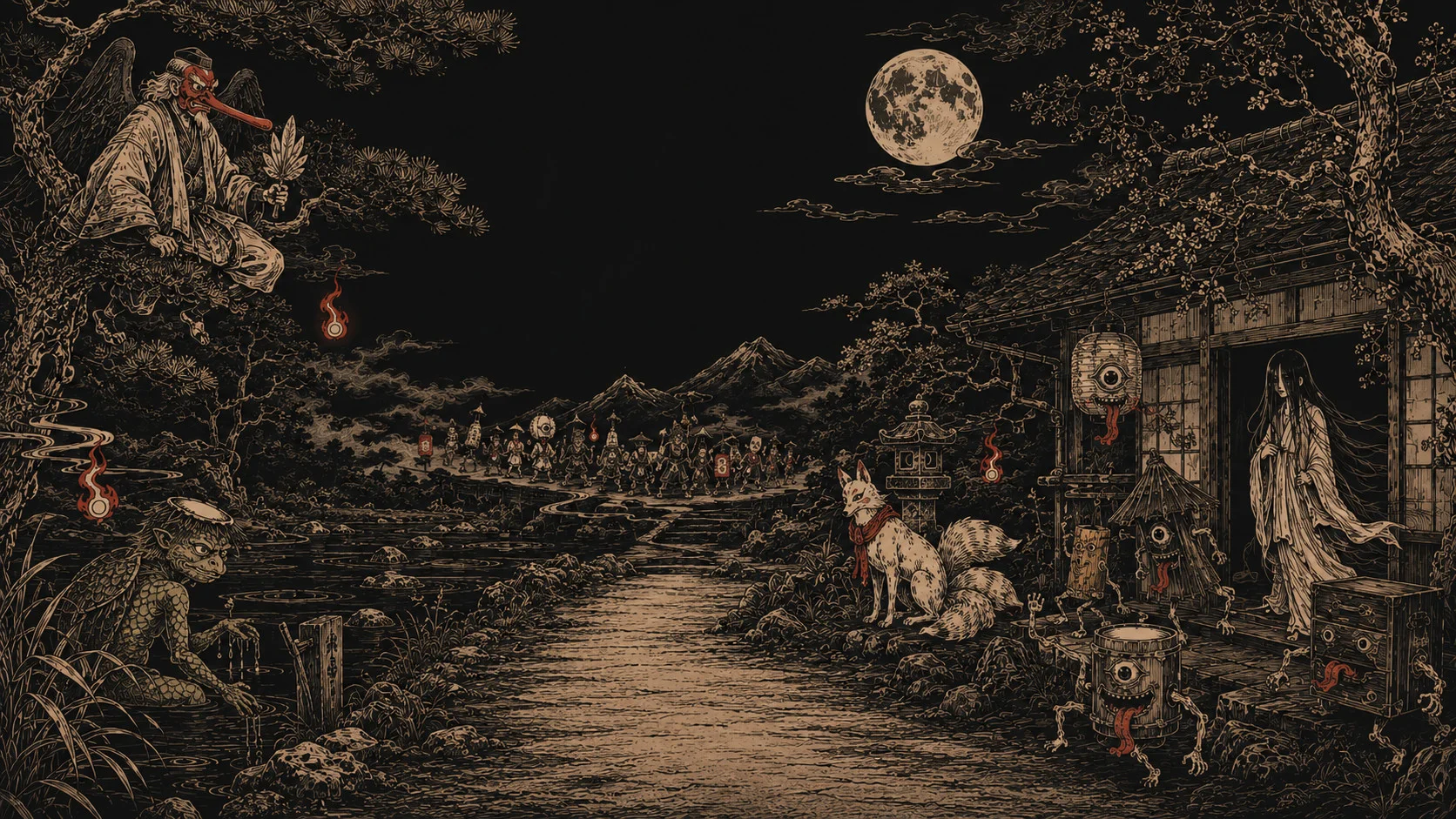
A famous medieval theme that eventually became closely associated with yōkai is the Hyakki Yagyō, usually translated as the Night Parade of One Hundred Demons or Night Parade of One Hundred Yōkai.
The Night Parade of One Hundred Demons
In these images and stories, strange beings form a supernatural procession.
Animals, monsters, humanoid figures, demons, and even household objects can appear together.
Surviving versions of the famous picture-scroll tradition can be traced to at least the sixteenth century, while later artists repeatedly recreated and transformed the theme.
The image of a crowd of bizarre beings marching through the night became one of the most recognizable visual ideas in yōkai culture.
And then the Edo period gave artists an opportunity to go wild with it.
The Edo Period: When Yōkai Became Entertainment
During the Edo period, from the early seventeenth century until 1868, yōkai became increasingly visible in popular entertainment.
They appeared in illustrated books, woodblock prints, games, storytelling, theater, and other forms of popular culture.
This was an important transformation.
A frightening supernatural being could still be frightening.
But it could also be fun.
People could collect images of monsters, read humorous stories about them, compare them, name them, and turn them into recognizable characters.
One artist became especially important.
Toriyama Sekien and the Illustrated Yōkai Catalog
Toriyama Sekien, who lived from 1712 to 1788, produced enormously influential illustrated collections of supernatural beings.
His major yōkai books appeared in 1776, 1779, 1781, and 1784.
Sekien did not invent yōkai as a concept, nor did he personally invent every creature he drew.
What his work did was help give many supernatural figures a recognizable name and visual form.
That matters enormously.
A strange local story can remain fluid for generations. Once an artist publishes a widely circulated illustration of the creature, people suddenly have an image to associate with its name.
Over time, that image can begin to feel “official,” even when the original folklore contained many different versions.
This process is still happening today.
The Meiji Period: Yōkai Become a Subject of Study
The Meiji period, beginning in 1868, brought rapid modernization to Japan.
One important figure during this period was philosopher Inoue Enryō (1858–1919).
Enryō investigated supernatural claims and attempted to analyze them rationally. His work on yōkaigaku, essentially “yōkai studies,” helped establish yōkai as a general category for strange and supernatural phenomena.
There is a lovely irony here.
Part of Enryō’s work was concerned with explaining supposedly supernatural events rationally.
Yet in helping classify and discuss them, he also helped strengthen the word yōkai itself.
The things he hoped to analyze did not disappear.
Instead, they acquired an increasingly convenient name.
The Twentieth Century and Mizuki Shigeru
Another huge transformation came through manga.
Artist Mizuki Shigeru (1922–2015) drew heavily on Japanese folklore and helped introduce yōkai to new generations through his work.
His GeGeGe no Kitarō became particularly influential. Its television anime adaptation began in 1968, contributing to renewed popular awareness of yōkai as recognizable characters.
By this point, yōkai were no longer simply creatures of old local legends.
They belonged to folklore and mass media.
That distinction remains important today.
What Is a Yōkai Not?
Understanding yōkai becomes much easier once we remove a few common misconceptions.
Yōkai Are Not Simply “Japanese Demons”
This is probably the most common misleading translation.
Some yōkai certainly look demonic.
Some are malicious.
Some attack people.
But many do not.
The word demon carries specific religious and moral associations in English that do not fit the entire yōkai category.
A mischievous transforming animal, an animated household object, a strange sound in an empty building, and a dangerous river creature might all fall somewhere inside discussions of yōkai.
Calling all of them demons tells us very little.
Yōkai Are Not All Ghosts
Japanese folklore has a more specific term commonly associated with ghosts of dead human beings:
yūrei (幽霊).
Yūrei and yōkai sometimes overlap in very broad classifications, and scholars do not always draw the boundary in exactly the same place.
But treating the words as synonyms is misleading.
The International Research Center for Japanese Studies describes yūrei specifically in terms such as wandering spirit, restless spirit, disembodied soul, specter, and apparition, while yōkai is the much wider category of mysterious beings and phenomena.
A useful beginner’s distinction is:
| Term | Basic idea |
|---|---|
| Yōkai | A broad category of strange beings, presences, transformations, and phenomena |
| Yūrei | Generally the spirit or ghost of a dead human |
| Oni | A distinct supernatural category often translated as demon or ogre, sometimes included under the broad yōkai umbrella |
| Kami | Divine or sacred presences associated with Japanese religious traditions; not simply the “good version” of yōkai |
The borders are not airtight.
That is normal.
Folklore rarely respects filing cabinets.
Yōkai Are Not the Opposite of Kami
Another tempting explanation goes like this:
Kami are good spirits. Yōkai are bad spirits.
That is much too simple.
Kami themselves can be powerful, frightening, destructive, protective, generous, or unpredictable.
Likewise, yōkai are not automatically evil.
The distinction involves cultural context, relationships, stories, worship, ritual, and historical interpretation rather than a simple good-versus-evil scale. The scholarly glossary maintained by Nichibunken describes both kami and oni as broad, varied categories and notes that their boundaries can be complex.
Yōkai Are Not All Ancient
This misconception is especially common online.
A strange Japanese creature presented alongside old woodblock artwork can quickly acquire the label:
“Ancient Japanese yōkai.”
But not every famous yōkai has an ancient documented history.
Some became recognizable during the Edo period.
Others developed or became widely known much later.
Modern urban legends can also be discussed as part of contemporary yōkai culture.
Folklore does not stop being created simply because smartphones exist.
Michael Dylan Foster points out that folklore continues today and can spread through texting, social media, and other modern forms of communication just as older legends once spread orally.
So whenever somebody claims that a particular yōkai is “thousands of years old,” it is worth asking for the earliest reliable source.

Are Yōkai Only From Japan?
In the strict cultural sense, yōkai are Japanese.
The word belongs to the Japanese language and the category developed through Japanese history, folklore, art, literature, and scholarship.
But Japan is obviously not the only culture with stories about supernatural creatures.
Ireland has fairies.
Scandinavia has trolls and other beings.
China has enormous traditions surrounding spirits, transformed animals, ghosts, demons, and anomalies.
Cultures throughout Africa, Asia, Europe, Oceania, and the Americas have their own supernatural traditions.
Those beings are not automatically “yōkai.”
Calling every supernatural creature in the world a yōkai would erase the cultural context that gives the word meaning.
Yōkai Culture Was Never Completely Isolated
At the same time, Japanese supernatural traditions did not develop in a vacuum.
Japanese culture interacted for centuries with ideas originating in China, Korea, India, and elsewhere, especially through Buddhism, literature, religious practice, art, and scholarship.
Even the term yōkai itself has Chinese-derived linguistic roots.
So the best answer is:
Yōkai are Japanese, but yōkai culture developed through centuries of cultural exchange and exists within a much larger human tradition of telling stories about the strange and supernatural.
Today the movement goes both ways.
Japanese yōkai appear in games, films, books, comics, art, and animation around the world. Foster notes that modern Japanese popular culture has carried yōkai to international audiences far beyond Japan.
What Do Yōkai Do?
Almost anything.
That is not a joke.
Because yōkai are not a single species, they do not share one purpose or behavior.
A yōkai might:
- frighten travelers,
- trick people,
- disguise itself,
- transform,
- imitate humans,
- make mysterious noises,
- cause people to become lost,
- guard or inhabit a particular place,
- attack humans or animals,
- appear as an omen,
- warn people,
- behave mischievously,
- interact with people without harming them,
- or simply appear and do something inexplicable.
Some stories are horrifying.
Others are basically supernatural practical jokes.
And some are so bizarre that trying to decide whether they are supposed to be scary or funny becomes half the fun.
Yōkai and the Dangerous Places Around Us
Many famous yōkai traditions are deeply connected with particular environments.
Rivers.
Mountains.
Forests.
Roads.
The sea.
Old houses.
Dark rooms.
Village boundaries.
These locations mattered.
Before modern infrastructure, a river could kill.
Mountains could swallow travelers in bad weather.
The sea could suddenly become deadly.
People could disappear on isolated roads.
An unfamiliar sound in the darkness could signal an animal, another person, a storm, or something less easily identified.
Yōkai stories could give those dangers a personality.
A warning becomes much easier to remember when the river does not merely contain dangerous currents.
It contains something that grabs children who get too close.
Foster gives precisely this kind of example with local kappa traditions, in which children were warned against swimming in dangerous areas because a kappa lived there.
The supernatural story and the practical warning can exist at the same time.
Are All Yōkai Dangerous?
No.
Some are very dangerous.
Others are troublesome.
Some are merely strange.
Some may be beneficial.
And the same yōkai may behave differently depending on which regional story you read.
Dangerous Yōkai
Certain traditions involve yōkai that attack, drown, deceive, abduct, possess, or kill people.
Kappa stories, for example, frequently associate the creature with dangerous water and drowning.
Tengu traditions can also be frightening. Historical accounts and representations connect tengu with mountains, supernatural power, abduction, possession, attacks, and disruption, although other traditions give them more protective roles.
Mischievous Yōkai
Other yōkai prefer confusion over murder.
Shape-shifting animals such as foxes and tanuki are famous for stories involving transformation, disguise, deception, and tricks.
A person might encounter something terrifying only to discover that the entire experience was a supernatural prank.
At least, if they were lucky.
Harmless or Ambiguous Yōkai
Some yōkai essentially exist to create an uncanny experience.
Something appears.
Something makes a sound.
Something follows you.
Something blocks the road.
Then it disappears.
The person survives with a strange story to tell.
That story gets retold.
Details change.
A name becomes attached to it.
And eventually, perhaps, somebody draws the creature.
This is one of the ways folklore grows.
The Main Kinds of Yōkai
There is no universal official taxonomy, but grouping yōkai by the forms they take can help newcomers understand their variety.
Animal-Associated Yōkai
Animals occupy an enormous place in Japanese supernatural folklore.
Foxes, tanuki, cats, snakes, spiders, otters, and other animals have all been associated with strange powers in different traditions.
Kitsune
Kitsune simply means fox in Japanese, so an ordinary fox is not automatically a yōkai.
But supernatural foxes feature prominently in Japanese folklore.
They may transform, deceive humans, take human form, or become involved in relationships with people.
Foxes also have religious associations, particularly as messengers connected with Inari worship.
That is another reminder that Japanese supernatural categories overlap in complicated ways.
Tanuki
The tanuki, or Japanese raccoon dog, is a real animal.
In folklore, however, supernatural tanuki became famous as shape-shifters and tricksters.
Like fox stories, tanuki tales demonstrate how something completely ordinary in the natural world can acquire an extraordinary second life in folklore.
Water Yōkai
Water produces some of Japan’s best-known supernatural creatures.
Kappa
The kappa is probably among the most internationally recognizable yōkai.
Kappa traditions are associated particularly with rivers and other bodies of water.
Descriptions vary considerably by region, which is important because there is no single original kappa blueprint.
Stories often portray them as dangerous to swimmers, especially children and animals. Other traditions emphasize strange behavior, tricks, challenges, or interactions with humans.
Modern popular culture has helped turn the kappa into a standardized national character, while older local folklore contains significantly more variation. Foster uses the kappa as a good example of how locally specific folklore becomes generalized through mass media.
Mountain Yōkai
Mountains have long been places of physical danger, religious practice, isolation, and supernatural imagination.
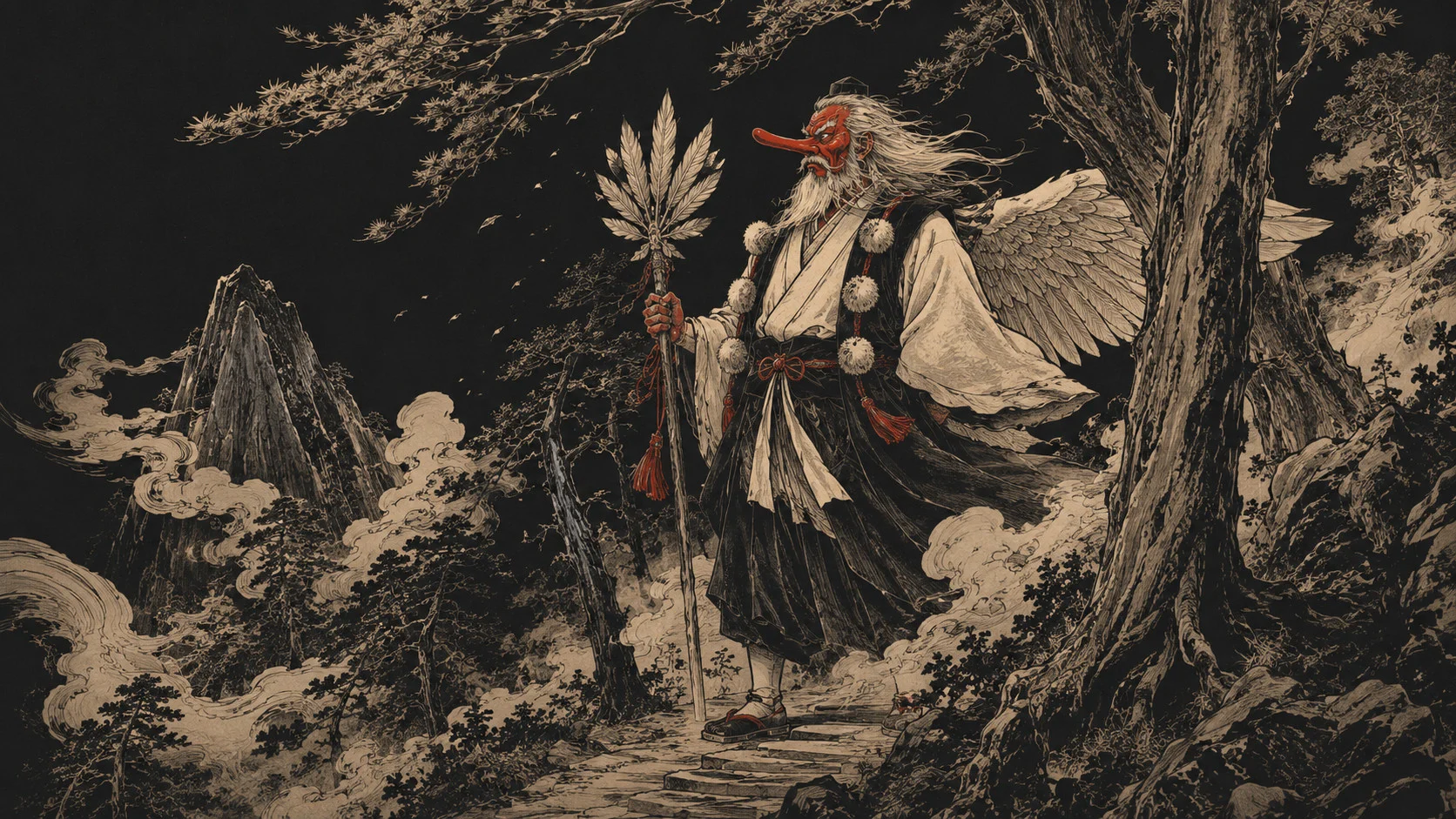
Tengu
The tengu has one of the most complicated histories of any famous Japanese supernatural being.
Early tengu could have strongly birdlike features.
Later artistic traditions produced the famous human-like tengu with an extraordinarily long nose.
They became associated with mountains, supernatural abilities, flight, transformation, religious figures, warriors, and numerous legends.
Their meaning also changed considerably over time.
The Metropolitan Museum of Art notes that tengu have a long and evolving history and could be portrayed as malicious in some contexts and benevolent or protective in others.
Trying to label the tengu simply “good” or “evil” misses most of what makes it interesting.

Human-Like Yōkai
Many yōkai look almost human.
That “almost” is often the frightening part.
A stranger may look completely ordinary until something impossible happens.
The face disappears.
The neck changes.
The body transforms.
The person turns out not to be a person at all.
Rokurokubi
Rokurokubi are usually depicted as human-like figures associated with an unnaturally extending or otherwise supernatural neck.
Different versions of the tradition describe their condition and behavior differently.
Toriyama Sekien included the rokurokubi in his famous eighteenth-century illustrated yōkai collections, helping establish the visual image that later audiences inherited.
Object Yōkai and Tsukumogami
Few ideas capture the imagination quite like the supernatural household object.
Umbrellas.
Musical instruments.
Containers.
Tools.
Old belongings.
In illustrated Night Parade scenes, such objects sprout faces, limbs, and personalities and join the supernatural procession.
These are often associated with the idea of tsukumogami.
Do Objects Really Become Yōkai After 100 Years?
You will often encounter the claim:
“In Japanese folklore, any object that survives for 100 years becomes a yōkai.”
There is some genuine historical basis behind the famous hundred-year idea, but the internet version is too universal.
The medieval Tsukumogami-ki describes old tools and containers receiving spirits after one hundred years and becoming supernatural beings. The text is associated with the Muromachi period, and traditions surrounding animated tools became especially visible in medieval and Edo-period material.
But this should not be treated like a universal supernatural law applying to every object in every Japanese tradition.
Folklore does not run on game mechanics.
Why Are There So Many Yōkai?
Because folklore multiplies.
One village tells a story.
Another village tells something similar but changes the creature.
A traveler repeats the story elsewhere.
A writer publishes it.
An artist draws it.
Another artist changes the picture.
A scholar records the local name.
A manga creator discovers the old story decades later.
Then millions of people see the new version.
At each stage, something can change.
This is why asking for the official version of many yōkai leads to trouble.
There may not be one.
Local Yōkai Versus Famous Yōkai
Foster distinguishes between highly local “hometown yōkai” and the nationally recognizable yōkai produced through popular culture.
A local community might preserve a creature almost nobody elsewhere knows.
A famous yōkai such as the kappa, meanwhile, becomes standardized enough that people across Japan and eventually around the world recognize it.
This difference also explains why counting yōkai is nearly impossible.
The Nichibunken database contained 35,257 records as of November 2023, drawn from folklore reports and accounts across Japan. That does not mean there are exactly 35,257 different species of yōkai. Multiple records may concern similar beings, local names, repeated traditions, or mysterious phenomena.
There is no final Pokédex of Japanese folklore.
And there probably never will be.
Yōkai, Folklore, and the Unexplained
It is common to say that yōkai were invented to “explain things people did not understand.”
There is some truth in that idea, but it needs nuance.
Not every yōkai story was a primitive scientific theory.
Folklore can do many things simultaneously.
A story can explain.
It can entertain.
It can frighten children.
It can preserve a local memory.
It can warn someone about a dangerous place.
It can express anxiety.
It can turn an ordinary landscape into a meaningful landscape.
It can simply be a good story.
Sometimes the important question is therefore not:
“Did people actually believe this creature existed?”
A better question can be:
“Why did people keep telling this story?”
Did Japanese People Really Believe in Yōkai?
There is no single answer.
Japan contains centuries of history and millions of people with different religious beliefs, levels of skepticism, local customs, and personal experiences.
Even during the Edo period, yōkai could exist simultaneously as frightening folklore and obvious entertainment.
An urban reader could enjoy an absurd illustrated monster without necessarily believing that the creature was hiding outside.
Nippon.com’s history of yōkai describes Edo-period audiences increasingly enjoying supernatural beings as fantasies and entertainment, particularly as illustrated popular culture expanded.
That mix of fear, humor, belief, disbelief, and play is not unusual.
People today happily watch ghost films without agreeing about whether ghosts exist.
Folklore does not require universal literal belief to survive.
Yōkai in Art
Visual art changed yōkai profoundly.
Before a supernatural being receives a widely circulated image, descriptions can remain flexible.
One storyteller imagines feathers.
Another imagines fur.
Another barely describes the creature at all.
Then someone draws it.
And suddenly the story has a face.
The Night Parade
The Hyakki Yagyō, or Night Parade of One Hundred Demons, became one of the great visual traditions of Japanese supernatural art.
A surviving sixteenth-century scroll tradition depicts crowds of bizarre creatures moving through the night, and later artists repeatedly produced their own versions.
The creatures can be grotesque.
They can also be hilarious.
Some have animal characteristics.
Others look demonic.
Others are ordinary household belongings that seem to have decided they have had enough of being furniture.
That mixture of horror and humor remains central to the visual appeal of yōkai.
Yōkai in Modern Popular Culture
Yōkai never vanished.
They changed media.
Woodblock prints became manga.
Picture books were joined by animation.
Oral legends found their way onto television.
Local stories entered video games.
Old monsters acquired plush toys.
New creators borrowed features from old folklore and created completely new characters.
Modern franchises including Pokémon and Yo-Kai Watch contain creatures inspired by yōkai, although their fictional characters should not automatically be confused with the traditional folklore that inspired them.
This distinction matters.
A game designer may take a traditional kappa and give the resulting character completely new powers, personality traits, weaknesses, and visual features.
Those additions belong to the modern fictional character.
They do not automatically become ancient kappa folklore.
Why Yōkai Still Matter
Yōkai survive because they are unusually adaptable.
A yōkai can be frightening enough for horror.
Strange enough for fantasy.
Funny enough for children’s entertainment.
Beautiful enough for fine art.
Flexible enough for games.
Local enough to become regional heritage.
Mysterious enough to fascinate researchers.
And old enough to connect modern audiences with centuries of stories without remaining trapped in the past.
They also preserve something deeply human.
We notice strange things.
We give them names.
We tell someone what happened.
The next person tells the story differently.
Eventually the darkness has a face.

Common Questions About Yōkai
Questions About Meaning and Language
What Does “Yōkai” Mean in English?
There is no perfect English equivalent.
Depending on context, words such as monster, spirit, apparition, supernatural creature, goblin, demon, phantom, or strange phenomenon may work.
However, translating every yōkai as the same thing removes much of the meaning.
For that reason, many English-language writers simply use yōkai.
Is It Spelled Yōkai, Yokai, or Youkai?
Yōkai is a common scholarly romanization.
The line over the “o” indicates a long vowel.
Yokai is widely used when macrons are inconvenient.
Youkai is another way of representing the long Japanese vowel in roman letters.
All three may appear online, although yōkai is the most precise form used throughout this article.
What Is the Plural of Yōkai?
Japanese nouns do not normally change form for singular and plural in the way English nouns do.
So you can write:
one yōkai
and
many yōkai.
You will sometimes see “yokais” in English, but yōkai works perfectly well as both singular and plural.
“Yokai’s” with an apostrophe would normally indicate possession in English, not a plural.
Questions About What Counts as a Yōkai
Are Oni Yōkai?
Sometimes.
Oni are their own major category in Japanese folklore, often translated as demons or ogres.
In very broad modern usage, oni may be discussed under the umbrella of yōkai.
In more precise discussions, the terms can be kept separate.
The important point is that oni and yōkai are not exact synonyms. Nichibunken’s terminology guide treats oni separately and notes that oni traditions themselves are extremely diverse.
Are Yūrei Yōkai?
Again, it depends on how broadly the word is being used.
Yūrei are specifically associated with the spirits of dead humans.
A broad discussion of yōkai culture may include ghosts, but Japanese folklore also has a strong reason to distinguish yūrei as their own category.
So:
All yūrei should not automatically be called yōkai, and all yōkai certainly are not yūrei.
Are Kami Yōkai?
Not normally.
Kami belong to a different religious and cultural category.
However, the boundaries between sacred beings, feared beings, local spirits, and supernatural figures can become complicated when examining different historical periods and regional traditions.
The safest rule is not to classify something based only on appearance.
A frightening face does not automatically mean yōkai.
A beautiful face does not automatically mean kami.
Context matters.
Questions About Their Nature
Are Yōkai Good or Evil?
Neither category works universally.
Some yōkai are murderous.
Some are malicious.
Some are tricksters.
Some are neutral.
Some can be helpful.
Some simply appear.
And individual traditions concerning the same type of yōkai may disagree.
Yōkai are therefore better understood individually rather than placed on a universal morality scale.
Do All Yōkai Have Supernatural Powers?
Not in the superhero sense.
Many stories involve supernatural abilities such as transformation, flight, possession, invisibility, unusual strength, or deception.
But other yōkai are essentially unexplained phenomena.
Asking for every yōkai’s “power set” applies modern fantasy logic to folklore that was never organized that way.
Can Yōkai Shape-Shift?
Some can.
Supernatural foxes and tanuki are particularly famous for transformation stories.
Other yōkai have relatively fixed forms.
So shape-shifting is a common yōkai theme, not a requirement.
Can Animals Become Yōkai?
Japanese folklore contains many traditions in which animals acquire supernatural characteristics or transform.
Foxes, tanuki, cats, snakes, and other animals appear repeatedly.
But there is no universal rule stating that every animal automatically becomes a yōkai after reaching a certain age.
Different traditions have different explanations.
Can Objects Become Yōkai?
Yes, traditions concerning animated or supernatural objects exist, particularly those associated with tsukumogami.
The famous idea that old objects acquire spirits after one hundred years has medieval textual precedent, but it should not be turned into a universal rule governing every Japanese folk belief.
Questions About Danger
Can a Yōkai Kill You?
In folklore, some absolutely can.
Stories about dangerous water beings, monsters, supernatural predators, and hostile spirits can be extremely violent.
Other yōkai seem interested only in frightening or confusing people.
There is no universal danger level.
Can Yōkai Be Defeated?
Many stories feature supernatural beings being tricked, fought, driven away, pacified, sealed, or otherwise overcome.
But again, there is no universal weakness shared by all yōkai.
If a modern game tells you every yōkai is vulnerable to one particular substance or weapon, that is a rule of that fictional universe, not Japanese folklore as a whole.
Questions About History and Culture
How Old Are Yōkai?
There is no single age.
Japanese supernatural traditions reach back into the country’s earliest surviving literature, while individual yōkai developed during different periods.
Some famous forms became recognizable in medieval art.
Others were popularized in the Edo period.
Some are much more recent.
So “How old are yōkai?” is less useful than:
“How old is the earliest reliable record of this particular yōkai?”
That question can often produce a much better answer.
Who Invented Yōkai?
Nobody.
Yōkai developed collectively through folklore.
Specific artists and writers shaped particular representations, but the larger tradition has no single creator.
Toriyama Sekien was enormously important in visualizing and cataloging yōkai during the eighteenth century, while Inoue Enryō helped establish the word as a modern analytical category during the Meiji period. Mizuki Shigeru later played an enormous role in their twentieth-century popular revival.
How Many Yōkai Are There?
Nobody knows.
There is no official list.
Local names, regional variants, historical changes, unusual phenomena, and newly recorded legends make a final number impossible.
Nichibunken’s research database alone contained more than 35,000 folklore records by late 2023, but those are records of traditions and phenomena, not 35,000 neatly separated “species.”
What Is Hyakki Yagyō?
Hyakki Yagyō, commonly translated as the Night Parade of One Hundred Demons, describes a supernatural nighttime procession filled with strange beings.
It became an important artistic theme, particularly in illustrated handscrolls.
Creatures in these processions can include monsters, animals, demons, human-like beings, and household objects brought to life.
The word “hundred” should not be understood as requiring an exact census of one hundred creatures. It functions more naturally as an image of a vast supernatural multitude.
Do People in Japan Still Believe in Yōkai?
Some people may hold supernatural beliefs, others do not, and it would be misleading to describe an entire country’s beliefs with one answer.
What can be said confidently is that yōkai remain culturally alive.
They continue to appear in local folklore, festivals and regional identity, research, museums, books, art, manga, anime, television, film, and games.
Modern folklore also continues to develop.
Are Yōkai Part of Shinto?
Not simply.
Yōkai traditions interact with Japanese religious history, including Shinto traditions, Buddhism, folk religion, and other systems of belief and practice.
But yōkai are not a collection of official Shinto creatures.
Their history is much broader and messier than that.
Are Yōkai Mythology or Folklore?
Usually folklore is the more useful term.
“Mythology” often suggests narratives concerning gods, cosmic origins, and foundational sacred stories.
Yōkai traditions frequently come instead from local legends, folktales, rumors, ghost stories, art, and popular entertainment.
However, the worlds of mythology, religion, legend, and folklore overlap, so you will see yōkai discussed under several of these labels.
The Most Important Thing to Remember About Yōkai
The biggest mistake you can make when learning about yōkai is expecting them to behave like creatures from a modern fantasy encyclopedia.
There is no master rulebook.
No official list.
No universal origin.
No universal morality.
No universal set of powers.
No final version of what every creature looks like.
That uncertainty is not a problem with yōkai folklore.
It is the point.
Yōkai live in the space between a strange experience and the story we tell about it.
They turn rivers into places with personalities.
They turn old objects into characters.
They make mountains feel inhabited.
They give a mysterious sound a name.
And once something has a name, someone can tell a story about it.
Someone else can draw it.
Another person can change it.
Centuries later, someone on the other side of the world can still recognize it.
That is how a creature from a local Japanese legend can travel from a whispered warning beside a river to an Edo-period woodblock print, from a woodblock print to a manga page, and from a manga page to screens around the world.
Yōkai have survived not because they remained unchanged.
They survived because changing is one of the things folklore does best.
Sources and Further Reading
This guide draws primarily on scholarship and collections from the International Research Center for Japanese Studies (Nichibunken), including its database of yōkai and mysterious phenomena; the work of folklorists Kazuhiko Komatsu and Michael Dylan Foster; the Smithsonian Institution and National Museum of Asian Art collections; the Metropolitan Museum of Art; research concerning Inoue Enryō; and historical material surrounding Toriyama Sekien’s illustrated yōkai collections.
When researching an individual yōkai, it is worth checking several sources. Local folklore frequently differs from later popular versions, and many confident-sounding “ancient facts” repeated online turn out to be modern additions.