

The Sound Across the Valley
At 07:12, a researcher called once across the valley.
The answer returned from the opposite slope.
A second response followed more faintly from somewhere farther north.
Both were expected.
Neither sounded quite as expected.
The survey was conducted to investigate one of the more difficult elements of the Kodama record: its connection not only with spiritually significant trees, but with sound returned from mountains and wooded places.
For this investigation, the Archive did not attempt to locate a spirit.
We attempted to locate an echo.
The Survey
The observation site was selected for its simple terrain.
A narrow mountain valley separates two heavily wooded slopes. Cedar and other trees cover much of the lower ground, while exposed rock appears intermittently higher on the opposite side.
A shallow stream runs along the valley floor.
Conditions were cool and dry.
Wind was minimal during the first observation period.
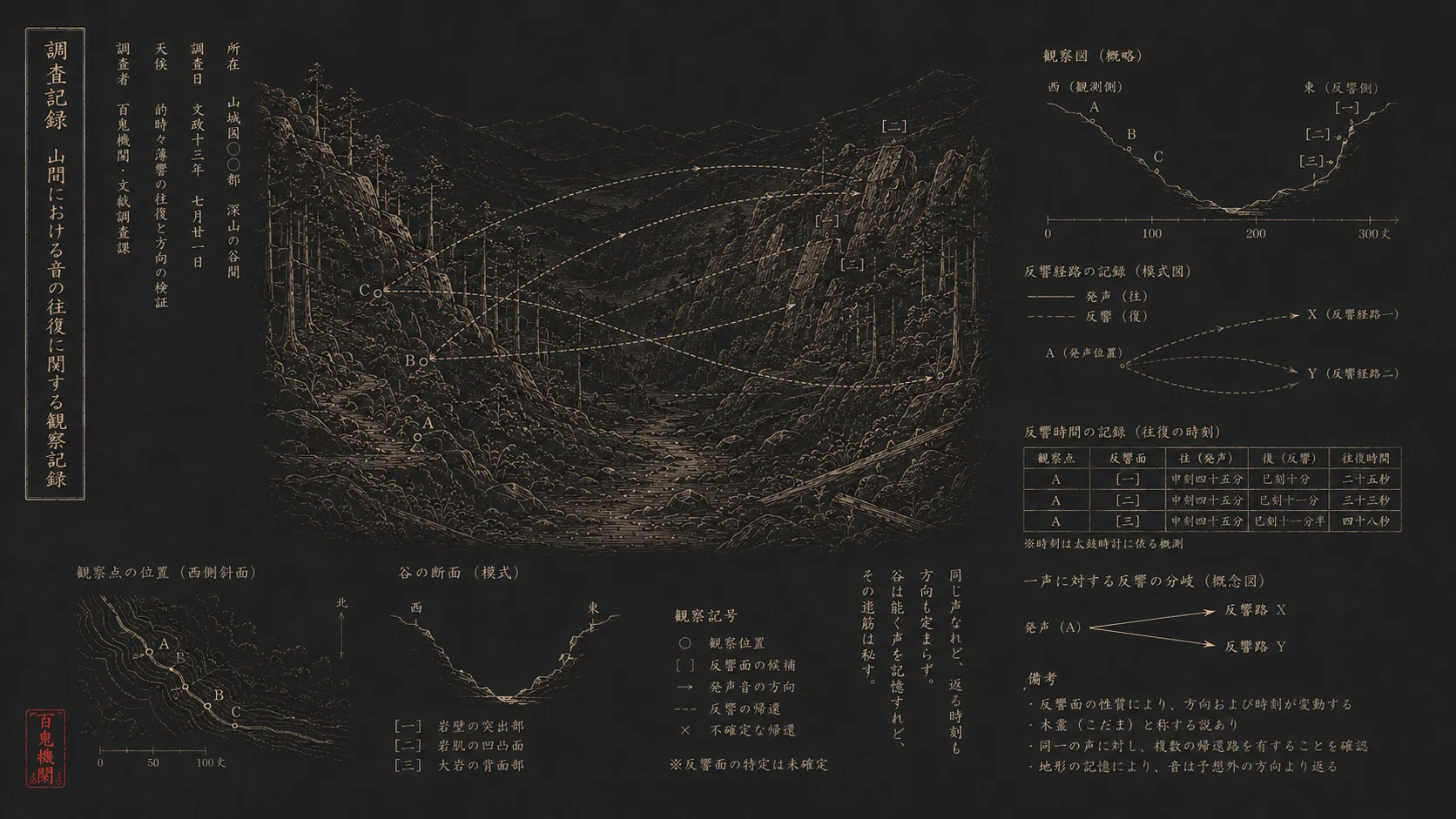
Three researchers occupied separate positions along the western slope.
Known sounds were produced from Position A while researchers at B and C independently recorded what they heard.
The First Call
A single human call was directed toward the eastern slope.
Observer A heard one strong return followed by a weaker second response.
Observer B recorded two.
Observer C recorded only one.
The first return was easily recognized as an echo.
The second was less straightforward.
It arrived from a noticeably different direction and at lower volume, giving the impression that another call had originated farther along the mountain.
Repeated trials produced similar results, although the second return was not audible from every position.
Striking Wood
The test was repeated using two dry pieces of fallen wood struck together.
The effect was more pronounced.
The initial strike returned sharply from across the valley.
A quieter sound followed.
From Position B, it appeared to originate behind the observer rather than ahead.
No source existed there.
Moving approximately twenty meters along the path changed the apparent direction again.
The sound had not moved.
The listener had.
Following the Answer
A simple acoustic survey identified several surfaces capable of returning sound.
The opposite slope contained exposed rock partly concealed by woodland.
A second ridge lay beyond it at an angle to the primary observation position.
The shape of the valley allowed sound to reach the observers along more than one path.
Trees and uneven terrain further complicated the apparent direction of the return.
This provided an ordinary explanation for the secondary responses.
It also demonstrated something important.
Knowing that a sound is an echo does not necessarily make it sound like one.
At several positions, the returning call appeared separated enough from the original that an observer unfamiliar with the source could reasonably perceive it as a new sound coming from elsewhere in the landscape.
What the Record Says
Kodama is associated not only with spiritual presence in trees but also with echoes.
Historically, a sound returned from a mountain or valley did not need to be understood through modern acoustics. The mountain could be perceived as returning the sound, and supernatural explanations became associated with that response.
The Archive should be careful here.
It would be easy to tell a convenient story in which people once heard echoes, misunderstood them, and therefore invented Kodama.
The evidence does not justify that conclusion.
Folklore is rarely reducible to a single misunderstood natural phenomenon.
What the survey demonstrates is narrower.
The acoustic experience described by the tradition is real.
Mountains do answer.
The disagreement concerns what, historically, was believed to be doing the answering.
One Unscheduled Sound
At 08:03, testing was temporarily suspended while researchers changed positions.
During the interval, Observer C recorded a single short sound from the eastern slope.
It resembled the wooden strike used earlier in the survey.
No researcher produced it.
The sound did not repeat.
The area contained woodland, moving branches, falling material, birds, and other potential natural sources.
No corresponding event was visually identified.
The observation has been retained because it occurred during the survey.
It has not been classified as anomalous evidence.
A sound without an identified source is not evidence of a Kodama.
It is a sound without an identified source.
Archive Assessment
The survey demonstrates that wooded mountain terrain can produce returning sounds whose direction and number are difficult for a listener to judge.
Multiple echoes can make a single call appear to receive several responses.
This provides useful environmental context for historical associations between Kodama and answering sounds.
It does not explain the broader tradition of spiritual presence within trees, nor does it establish that acoustic phenomena were the origin of Kodama belief.
The results change one part of the Archive File:
An apparently answering voice in mountainous woodland should not, by itself, be treated as evidence of an entity.
The next question is more difficult.
If Kodama can be explained visually neither as a consistent creature nor acoustically as anything beyond an echo, where did the familiar image of the forest spirit come from?
That question requires returning to the Archive.
Unresolved
When a mountain returns your voice from somewhere you did not expect, at what point does an echo begin to feel like an answer?