

FIELD JOURNAL — KITSUNE
Entry: Kitsunebi Visibility Test
Classification: Observation / Comparative Test
Cross Reference: Kitsune — Kitsunebi / Fox-Fire
Confidence: Moderate regarding observed discrepancy; cause unresolved
Survey
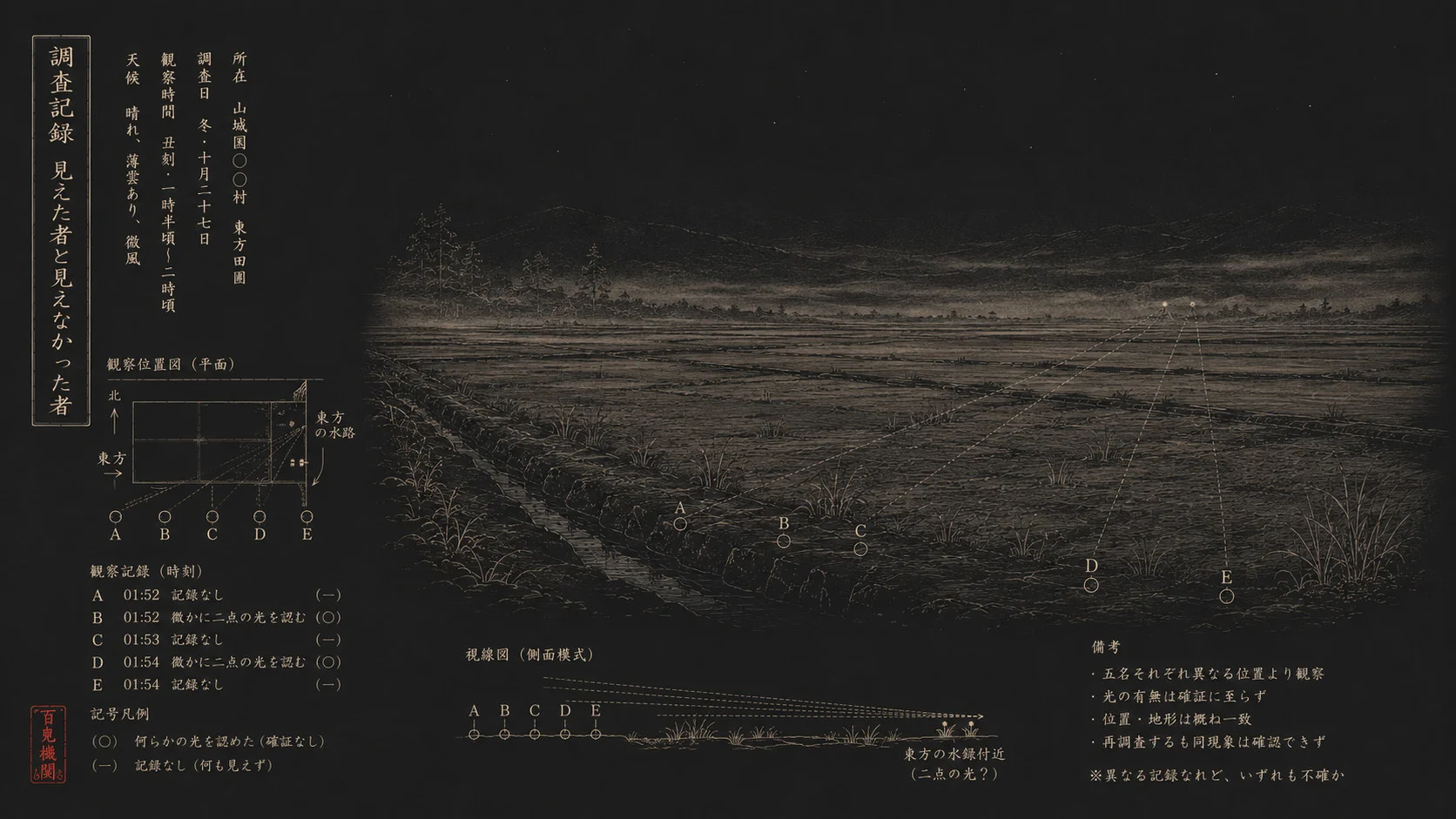
A comparative night observation was conducted at the eastern agricultural boundary following earlier reports of lights identified locally with kitsunebi.
The purpose was not to determine whether the lights were supernatural.
Previous Archive surveys had established a more immediate problem.
Descriptions of distant lights differed considerably between witnesses even when accounts appeared to concern the same location.
Five observers were therefore positioned separately along the western field boundary.
Each was instructed to record visible lights independently.
Communication between observers was prohibited during the active survey.
Grid
Observation positions were designated A through E.
Spacing between positions ranged from approximately thirty to fifty meters.
All five observers possessed overlapping views of the eastern fields.
Positions B, C, and D shared the greatest overlap.
Vegetation differed slightly between locations.
Position A was partially bordered by reeds.
Position E stood approximately two meters higher than the central observation points.
Weather was dry.
The moon was not visible.
Low mist formed above several drainage channels after midnight.
Visibility across the fields remained otherwise adequate.
Observation
At 01:52, Observer B recorded a small pale light east of the central drainage channel.
The light was described as stationary for several seconds before moving slowly north.
At 01:54, a second light was recorded.
Observer D independently noted two distant lights at approximately the same time and bearing.
Observers A, C, and E recorded nothing.
No communication occurred between stations.
At 01:57, Observer B recorded a third brief light.
Observer D did not.
No further unusual illumination was reported during the survey.
Comparison
Written records were collected before observers were permitted to discuss the event.
The first two lights reported by B and D correspond sufficiently in time and approximate location to justify treating them as observations of the same phenomenon.
Their descriptions were not identical.
Observer B described the first light as pale yellow.
Observer D recorded no color.
B reported movement.
D was uncertain whether the light moved or whether mist crossing the field created that impression.
The discrepancy involving Observer C is more difficult.
Position C lay between B and D.
Its sight line toward the reported location was unobstructed during reconstruction the following morning.
Observer C recorded:
No light observed.
Environmental Test
The observation positions were revisited after dark on the following evening.
A shielded lantern was placed at several points corresponding approximately to the reported location.
This was intended only to compare sight lines, not reproduce kitsunebi.
All five observers could detect the test light at sufficient brightness.
When the lantern was lowered toward the drainage channel, reeds and slight changes in ground elevation produced significant differences in visibility.
At several positions, a light could disappear after movement of less than one meter.
Mist was absent during the reconstruction.
The test therefore demonstrated that small differences in location can affect visibility.
It did not explain why observers B and D reported lights while C did not.
Cross Reference
Kitsunebi, or fox-fire, is well established within Japanese folklore, though descriptions vary across sources and regions.
Accounts may describe isolated lights, multiple lights, or larger sequences associated with fox activity and, in some traditions, fox processions.
The present survey provides no basis for determining whether the observed lights belong to that folkloric category.
The relevant finding concerns observer agreement.
Archive records have previously treated multiple witnesses at one location as mutually reinforcing evidence.
This survey demonstrates that the relationship may be more complicated.
Several observers can occupy overlapping sight lines without reporting the same event.
Field Note
After the survey, Observer C was informed that B and D had recorded lights.
C remained confident that nothing unusual had been visible.
No attempt was made to persuade the observer otherwise.
This is important.
A failed observation should not be corrected after the fact simply because another witness reports success.
Nor should the two positive observations automatically be dismissed because three observers recorded nothing.
The Archive therefore retains all five records equally.
Two observers saw lights.
Three did not.
That is the observation.
Any explanation added beyond it belongs to interpretation.
Archive Assessment
Two independent observers recorded distant lights at corresponding times and bearings.
Three observers positioned within the same survey area recorded no such lights.
Differences in terrain, mist, viewing angle, brightness threshold, and attention remain plausible explanations.
No evidence presently supports the conclusion that kitsunebi are selectively visible to particular individuals.
No evidence presently explains the discrepancy completely.
Future multi-observer surveys should preserve independent records before discussion between witnesses is permitted.
Unresolved Question: Were the observers looking at different conditions within the same landscape, or did the same landscape present something different to each observer?

The Wise Trickster of the Sacred Forests
| Japanese Name | 狐 |
| Romanization | Kitsune |
| Classification | Shapeshifting Animal Spirit |
| Expedition | Expedition I — Sacred Forests |
| Threat Level | ■■□□□ (Level II – Caution) |
| First Recorded | 8th Century CE |