


Local accounts repeatedly claim that dogs react unusually to suspected kitsune in human form. The Archive compares several such stories and finds a familiar folkloric pattern, but little agreement about what the animals actually perceive.
Author Archives: Van Infenstein
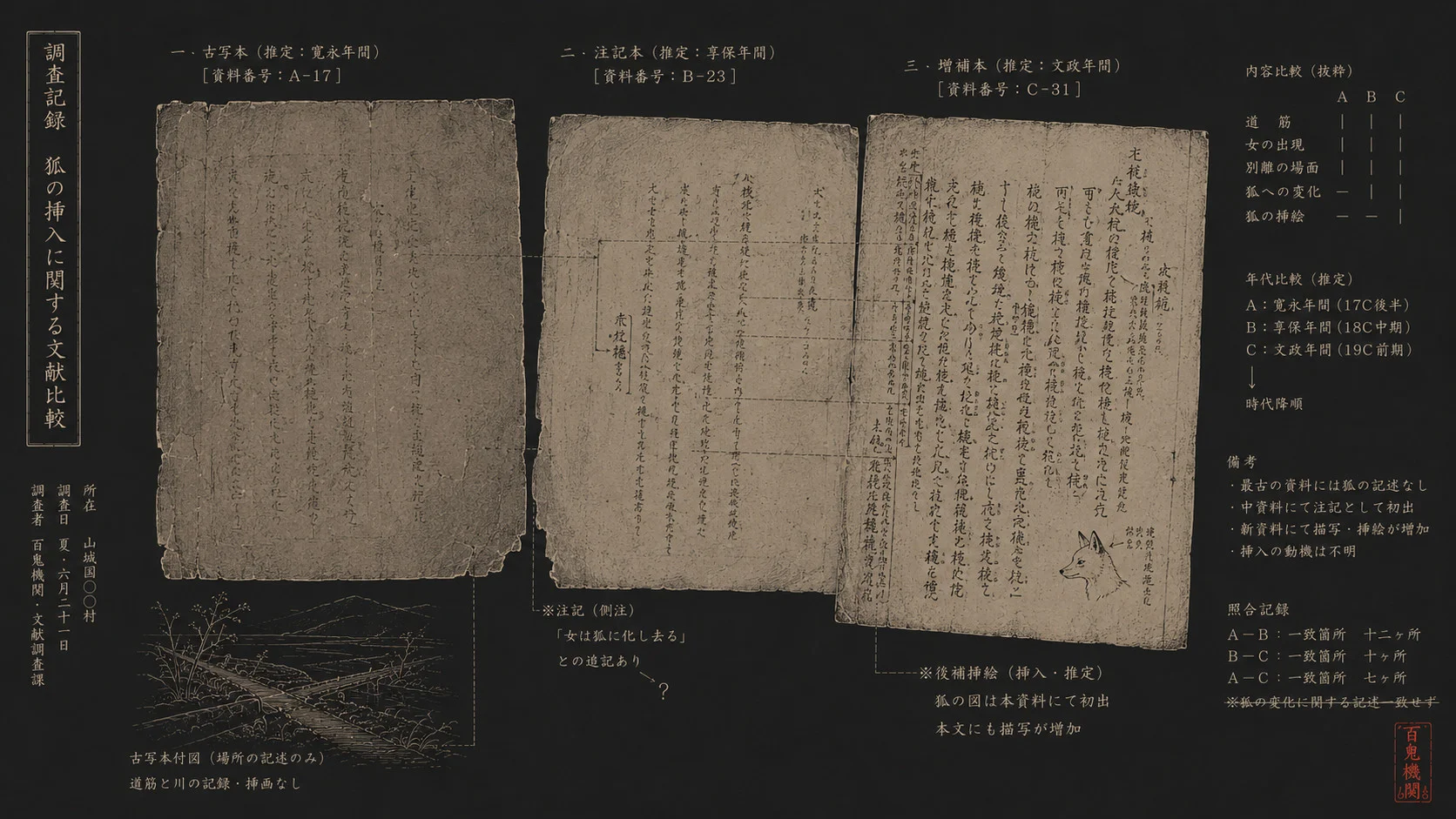
A local tale long catalogued as a kitsune legend is traced through several surviving versions. The earliest record contains no fox at all, raising a different question for the Archive: when does a later interpretation become part of the folklore it was meant to explain?
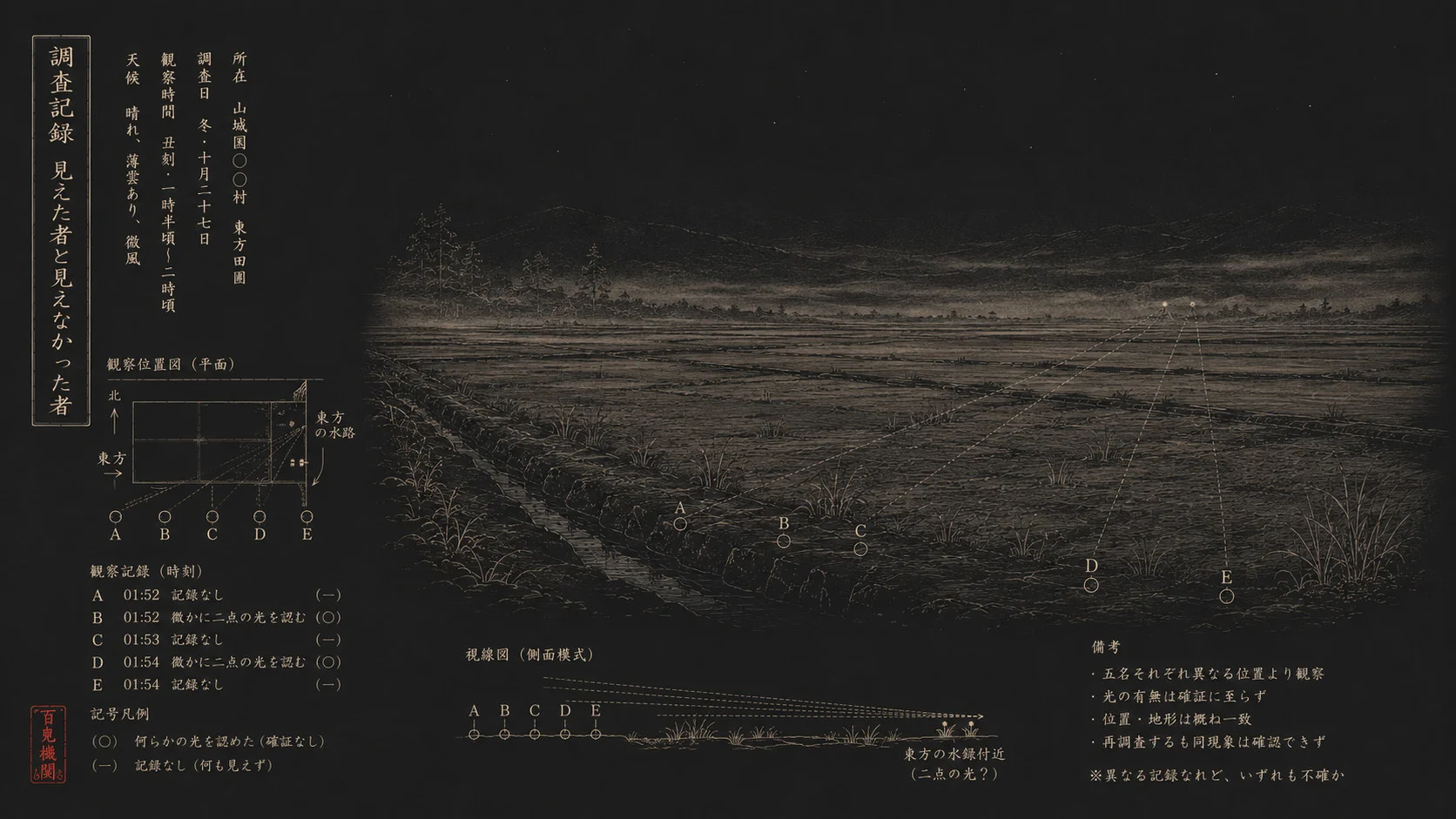
Five Archive observers watch the same field from overlapping positions during a reported occurrence of fox-fire. Two record distant lights while three see nothing, leaving the Archive unable to determine whether the discrepancy lies in the landscape, the observers, or the phenomenon itself.

Repeated surveys conducted during sunshowers produce no unusual lights, fox activity, or other observable phenomenon. The investigation instead preserves a fading local association between strange weather and the traditional expression kitsune no yomeiri.

Several travelers report encountering an unfamiliar woman along the same mountain road at dusk. Their descriptions broadly agree, but only one identifies the stranger as a kitsune, prompting the Archive to examine how an unexplained encounter becomes a supernatural one.

Following fresh snowfall, an Archive team maps the movements of ordinary foxes around a woodland shrine to establish a behavioral baseline. Nearly every trail follows expected terrain, except one that ends across an open patch of otherwise undisturbed snow.

A family prohibition against disturbing the earth beneath an old storehouse leads the Archive to examine inherited beliefs concerning household foxes. No animal or unusual object is found, but testimony suggests the taboo once carried consequences beyond the boundaries of the property.

A comparison of transformation accounts reveals an easily overlooked inconsistency: witnesses describe clothing, ornaments, and carried objects differently when a fox assumes human form. Rather than resolve the contradiction, the Archive records where folklore stops providing a consistent answer.

An Archive researcher revisits a decades-old account attributed locally to fox possession. Surviving family testimony and written records agree that something happened, but disagree considerably on what it was, revealing as much about the transmission of kitsunetsuki belief as the original incident.
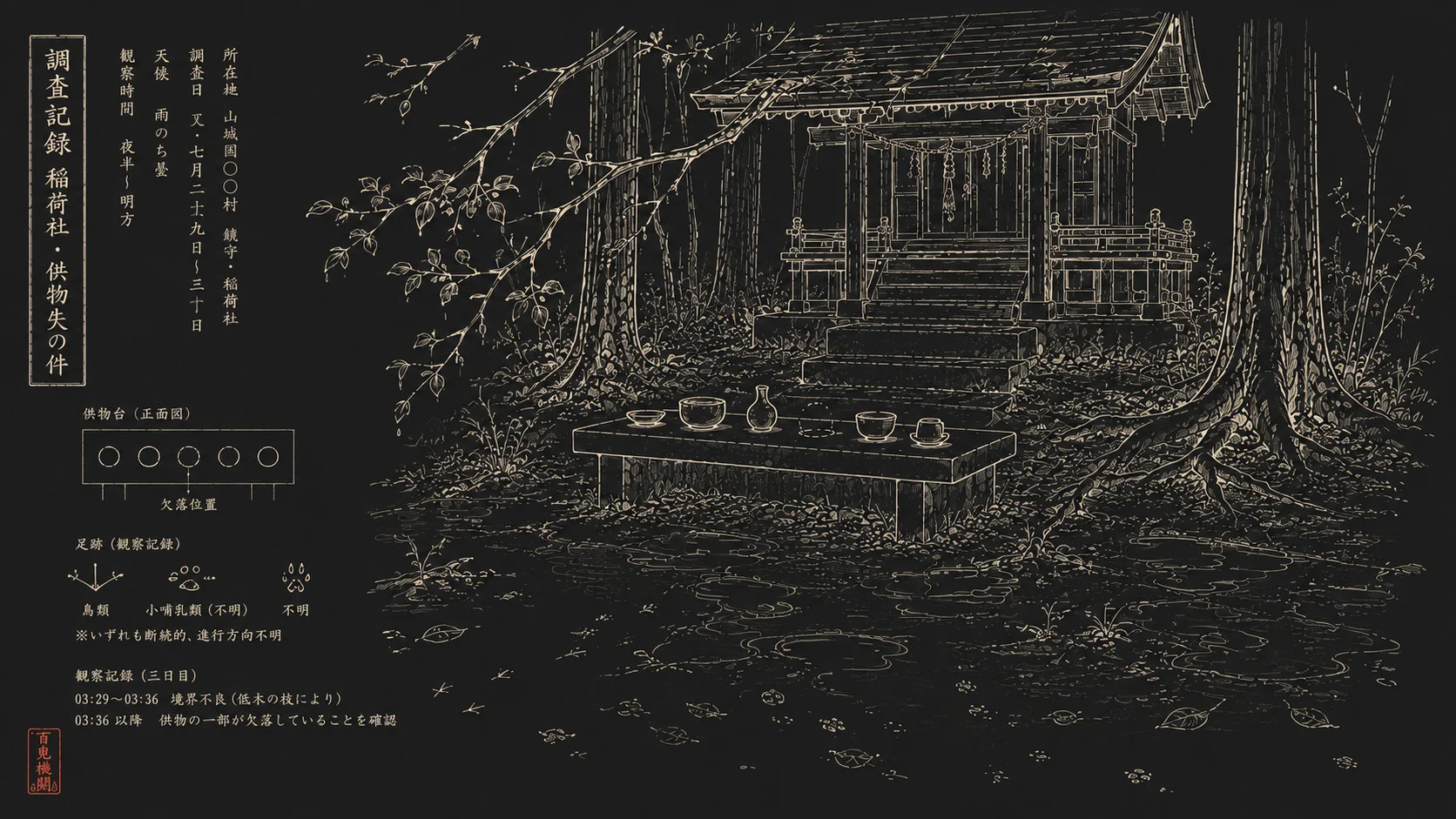
After offerings repeatedly disappear from a small woodland shrine overnight, the Archive conducts a controlled observation survey. Most disturbances are readily attributed to ordinary wildlife, while one unexplained absence leaves the record incomplete.