

What Lives in the Tree?
The expedition began with a creature.
The Archive File described Kodama as a spirit inhabiting old trees. It assigned the entity a habitat, appearance, temperament, and several expected characteristics.
Seven investigations later, some of those fields are considerably harder to complete.
We have documented protected trees.
We have recorded inherited prohibitions.
We have reproduced echoes in mountain valleys.
We have demonstrated how difficult it can be to locate the source of sound in woodland.
We have found historical precedent for giving Kodama humanlike form.
What we have not found is a consistent specimen.
The final review therefore returned to the question that should perhaps have been asked first:
What exactly is the Archive trying to classify?
What We Can Establish
There is a genuine historical relationship between Kodama and trees.
Japanese religious and folkloric traditions include the idea that particular trees may possess spiritual significance or be associated with spiritual presence.
This broader context matters.
Within Shinto practice, certain trees may be regarded as sacred and associated with kami. Such trees may be called shinboku or goshinboku, and some are visibly distinguished with shimenawa.
Kodama should not simply be treated as another name for these concepts.
Neither should it be separated from the religious and cultural landscape in which spiritually significant trees make sense.
Our earlier classification did exactly that.
It extracted the spirit from the tree and turned it into a creature.
The Tree Is Not Just Habitat
The original Archive File listed:
Habitat: Ancient Forests
That description has been withdrawn.
A forest is where trees grow.
That does not make every forest a Kodama site.
More importantly, describing a tree as the spirit’s habitat implies that the tree and the entity can be understood independently.
The collected traditions do not always support that separation.
In some accounts, the significance lies precisely in the idea that the tree is inhabited or spiritually alive in a way an ordinary piece of timber is not.
The relationship is therefore more intimate than:
creature + location.
The tree may be central to what Kodama means.
Sacred Does Not Mean Kodama
The reverse mistake must also be avoided.
Not every sacred tree is a Kodama tree.
A tree associated with a kami should not automatically be reclassified as Kodama.
A tree marked with shimenawa is evidence that the tree possesses religious significance.
It is not evidence that Archive researchers have located a Kodama.
This distinction has now been added to field guidance.
The Problem of the Echo
The acoustic investigations complicated the classification further.
Kodama can also refer to an echo.
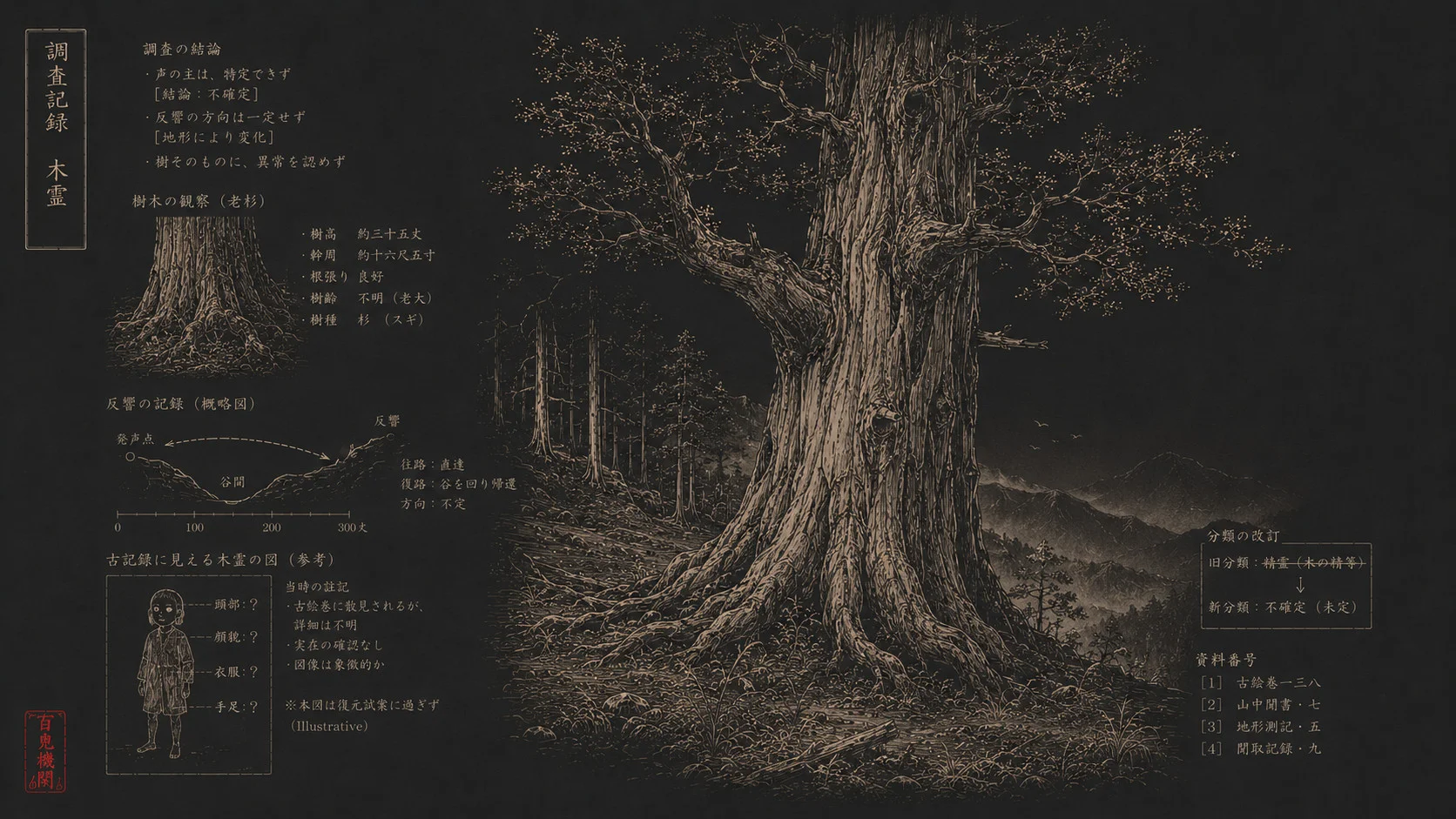
Our surveys demonstrated that wooded mountain terrain can produce returning sounds whose direction and apparent origin are surprisingly difficult to determine.
This gives us an environmental phenomenon corresponding closely to one aspect of the tradition.
It does not explain Kodama away.
Nor does it prove that a spirit produces the sound.
What it demonstrates is that the word exists at an intersection between landscape, sound, and spiritual interpretation.
Trying to remove one element may leave us with something easier to classify but less faithful to the tradition.
The Specimen We Could Not Find
The visual review produced a similar result.
Kodama has historical precedent for anthropomorphic representation.
Toriyama Sekien’s Edo-period depiction is important evidence of that.
It is not evidence of standardized anatomy.
The Archive therefore no longer assigns Kodama a confirmed height, facial structure, number of limbs, or consistent visible form.
The current specimen illustration remains in the collection under:
Interpretive Reconstruction.
It should not be presented as an observed organism.
This is not a minor correction.
It changes how future expeditions should approach the entity.
Researchers should not enter forests searching primarily for a small humanoid figure.
Doing so risks finding only the image they brought with them.
A Revised Classification
The Archive considered removing Kodama from the entity catalogue.
That recommendation was rejected.
The tradition is sufficiently distinct and historically significant to warrant its own record.
The classification has instead been revised.
Previous Classification:
Tree Spirit / Forest Entity
Revised Classification:
Spiritual Presence Associated with Trees and Answering Sound
The revised description is deliberately less precise.
That is an improvement.
Confidence
Association with trees: High
Association with echoes / answering sound: High
Fixed physical appearance: Unsupported
Universal association with old trees: Unsupported
Relationship to broader sacred-tree traditions: Strong, but not interchangeable
Observable supernatural mechanism: Unestablished
These distinctions will remain attached to the primary Archive File.
What the Investigation Changed
The Archive began with an illustration.
It ends with a tree.
That may be the most important result of the expedition.
Marked Against the Axe demonstrated that a prohibition can survive even when its explanation becomes uncertain.
The Cedar No One Cuts showed that this inherited behavior can leave a physical mark on the landscape: one tree remaining while those around it disappear.
The acoustic surveys showed that an answering mountain requires no supernatural mechanism to produce a genuinely strange experience.
The historical review showed that artists have long attempted to give form to something the surviving tradition does not describe consistently.
None of these investigations proves that Kodama exists as an independently observable being.
None requires the tradition to be dismissed.
Together, they suggest that our original question was too narrow.
We asked:
What lives inside the tree?
The surviving tradition may not permit the tree and what inhabits it to be separated so cleanly.
Archive Assessment
Kodama will remain an active Hyakki Archive classification.
Future records should prioritize historically documented relationships between particular trees, spiritual presence, local taboo, and answering sound rather than assumed physical characteristics.
Sacred trees should not automatically be classified as Kodama.
Echoes should not automatically be classified as supernatural.
Anthropomorphic depictions should not automatically be treated as descriptions of observed morphology.
And the absence of a visible creature should not be considered a failed Kodama investigation.
The Archive has not determined what lives in the tree.
It has determined that the question itself contains an assumption the evidence does not require.
Unresolved
If the tree, the presence, and the answering voice were never meant to be separate things, what exactly would finding a Kodama look like?